Out on a Whim. And Special Recipe!!!! 21 November, 2025

For any of you who know me, you know that although usually organized and scheduled, when the opportunity presents itself, I’m up for an adventure.

I signed up to take Hebrew lessons again. This time from Citizen Cafe Tel Aviv. Totally different approach, this time it’s just conversation. No books. No conjugations and inflections. Just street talk on Zoom classes with unlimited cafe time (chat room in Hebrew). And fun. Bimonthly they offer interesting talks in English on random subjects like cooking (fermentation anyone?), music, recent film reviews, livestream urban tours, technological developments in Israel, agricultural innovations and geology.

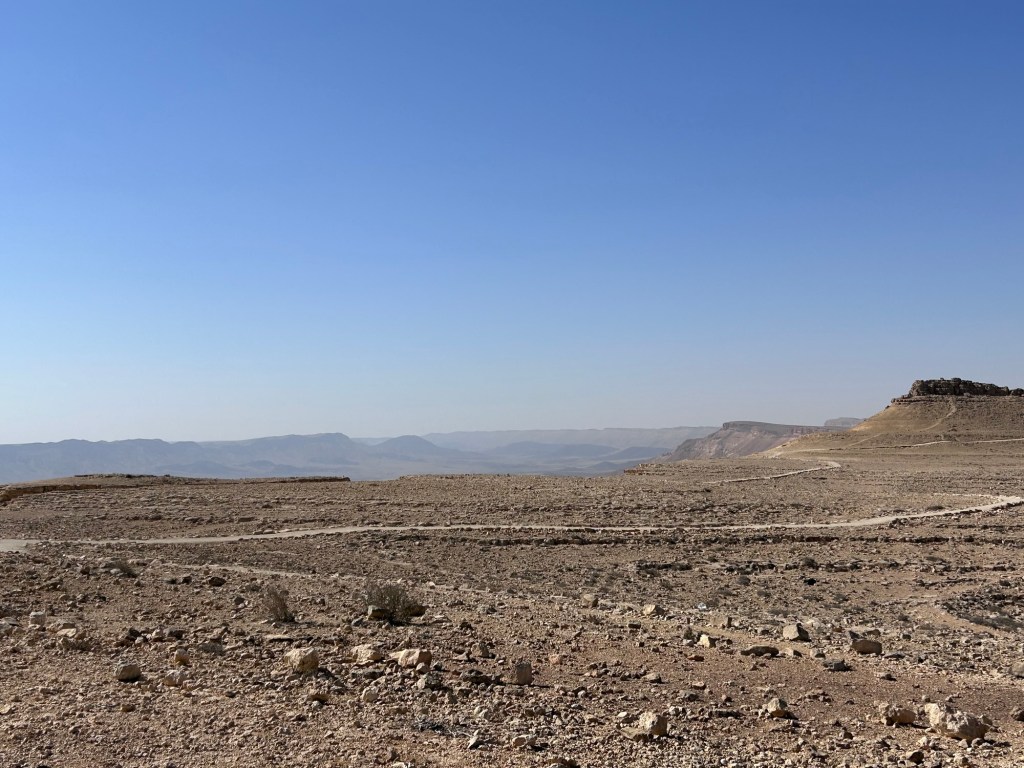
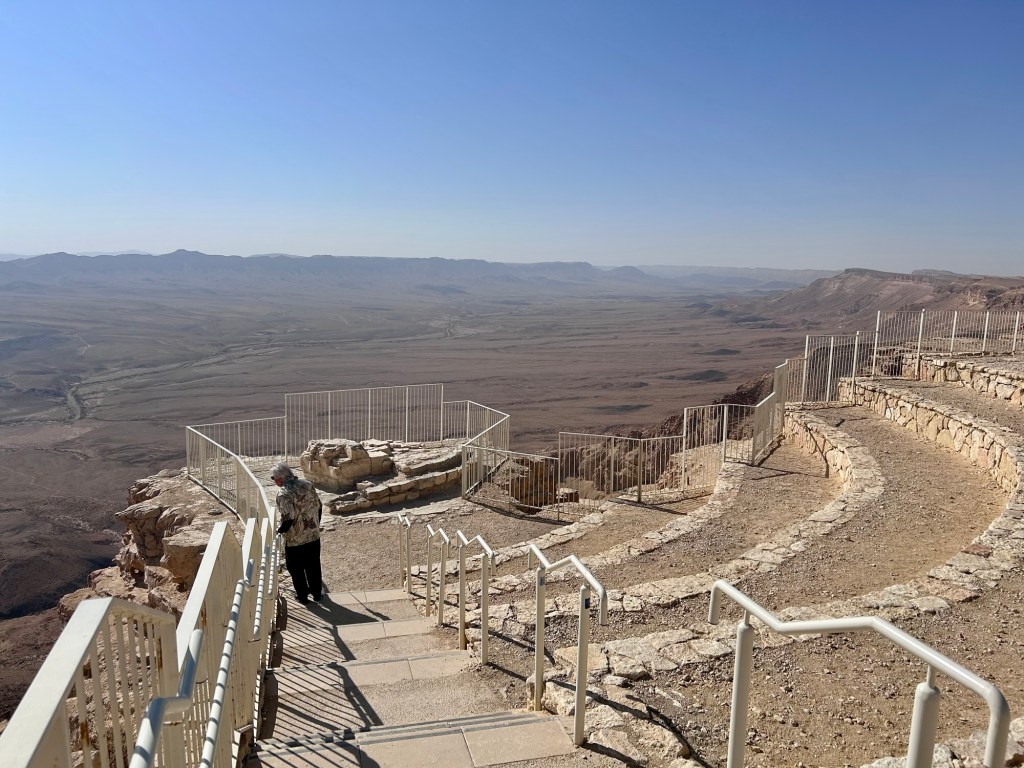
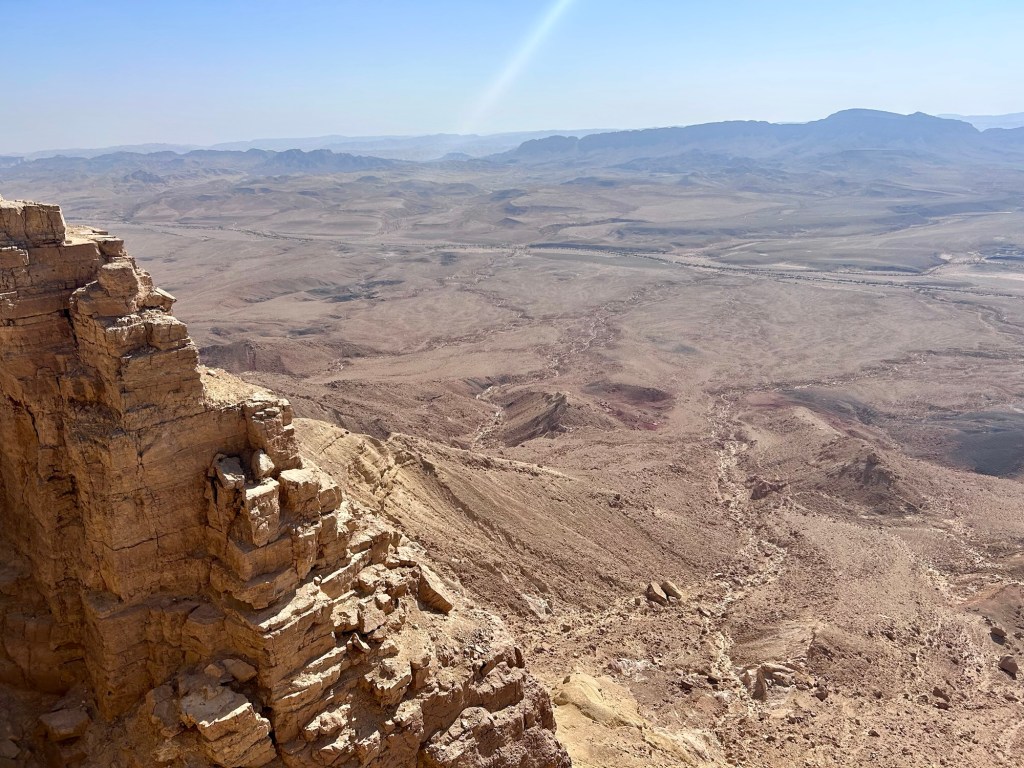
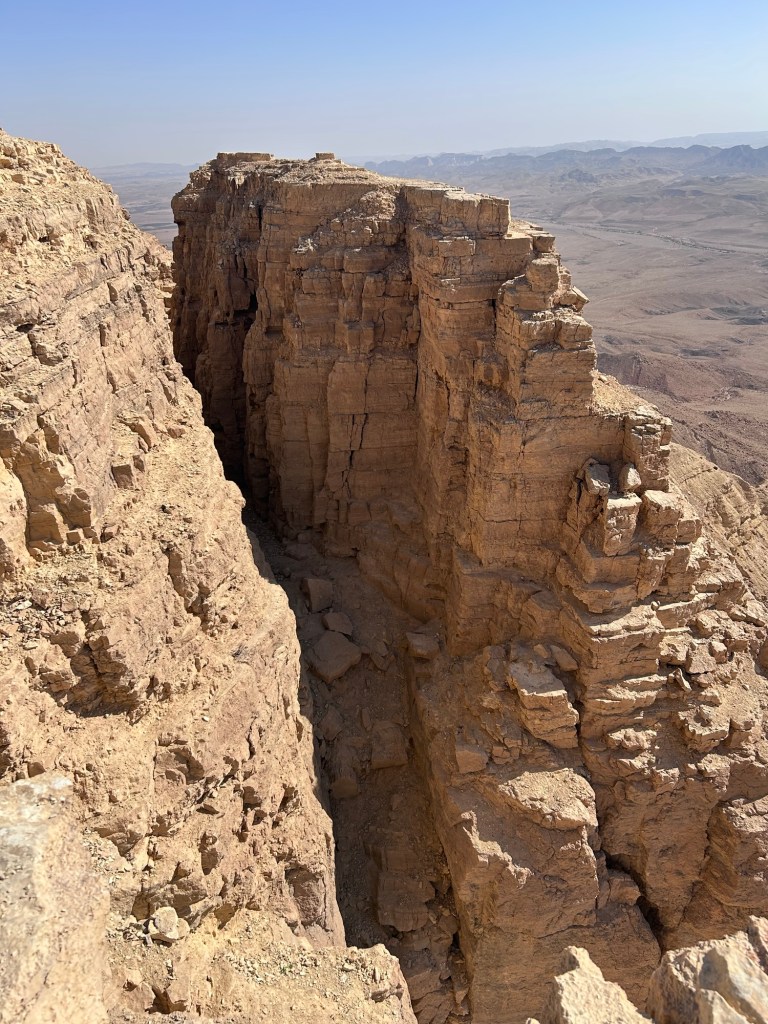
I took a class last Thursday night on the Ramon Makhtesh, a hugely expansive erosion crater out in the middle of the Negev Desert. So so interesting. Only 8 in the world, all in Israel, they are not impact craters (from meteors), but erosion craters.

Along the Syrio-African rift that runs along the length of Israel are tectonic plates. Millennia ago, they shifted. The present desert was flooded with water, grinding down the rock. Eventually leaving behind various strata of sandstone, limestone, marine fossils. There are tar mountains of basalt, deep red iron ore and yellow sulfur deposits as well as white chalk. In other words: gorgeousness!

I got this wild hair…. I turned and yelled at John in the next room,”Honey, can you Google when the Leonides Meteor Shower is?” They usually come around Thanksgiving. “They peak Monday night,” was the response. Mitzpe Ramon, the town at the very edge of the crater is a world-designated dark spot for astronomical observation.

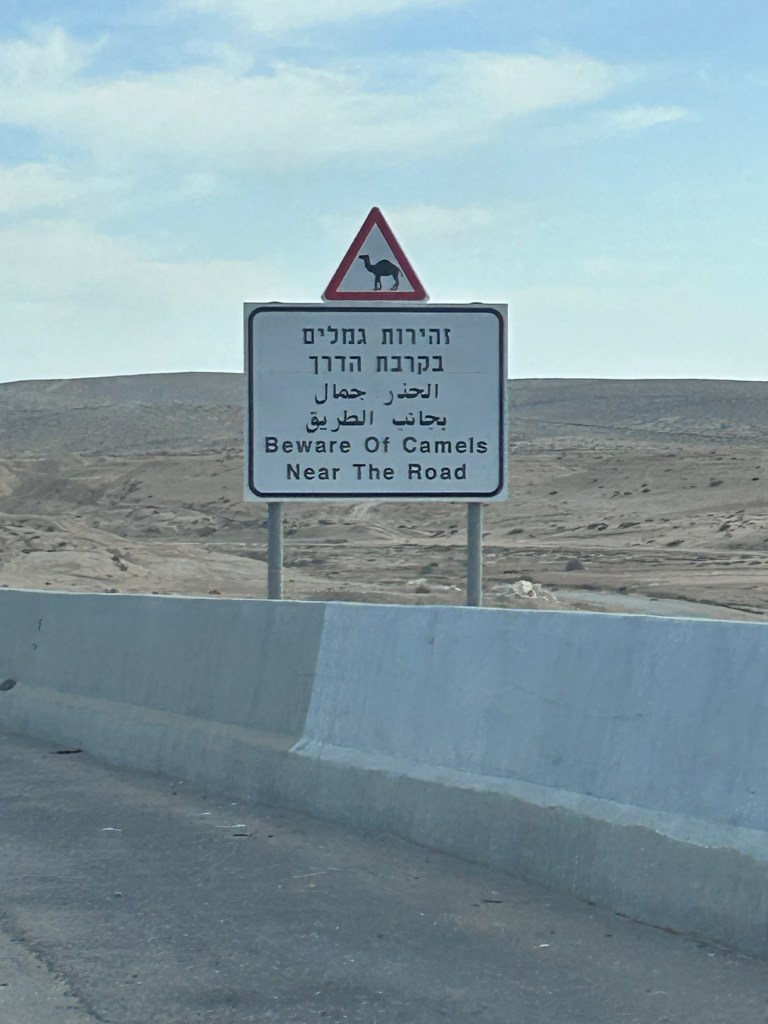
Monday morning we packed our blankets and lawn chairs, thermos, and dog into the car and we were off on an adventure! BeerSheva, where our patriarchs Abraham, Isaac and Jacob sojourned. I wonder what they’d think of the place now?

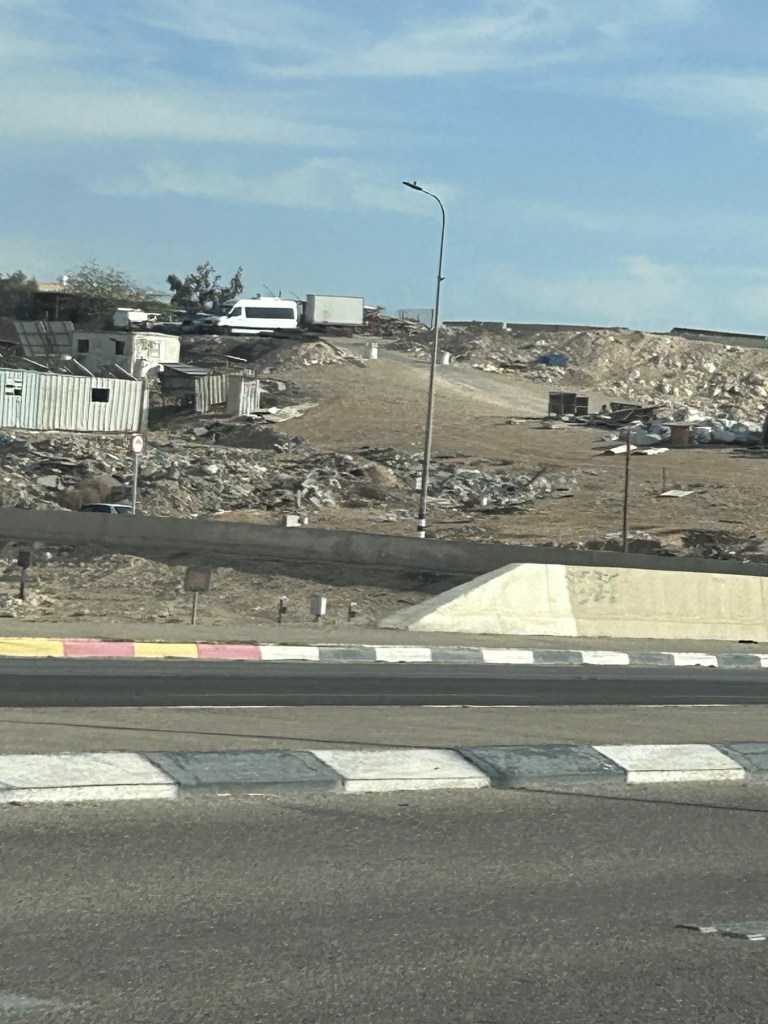
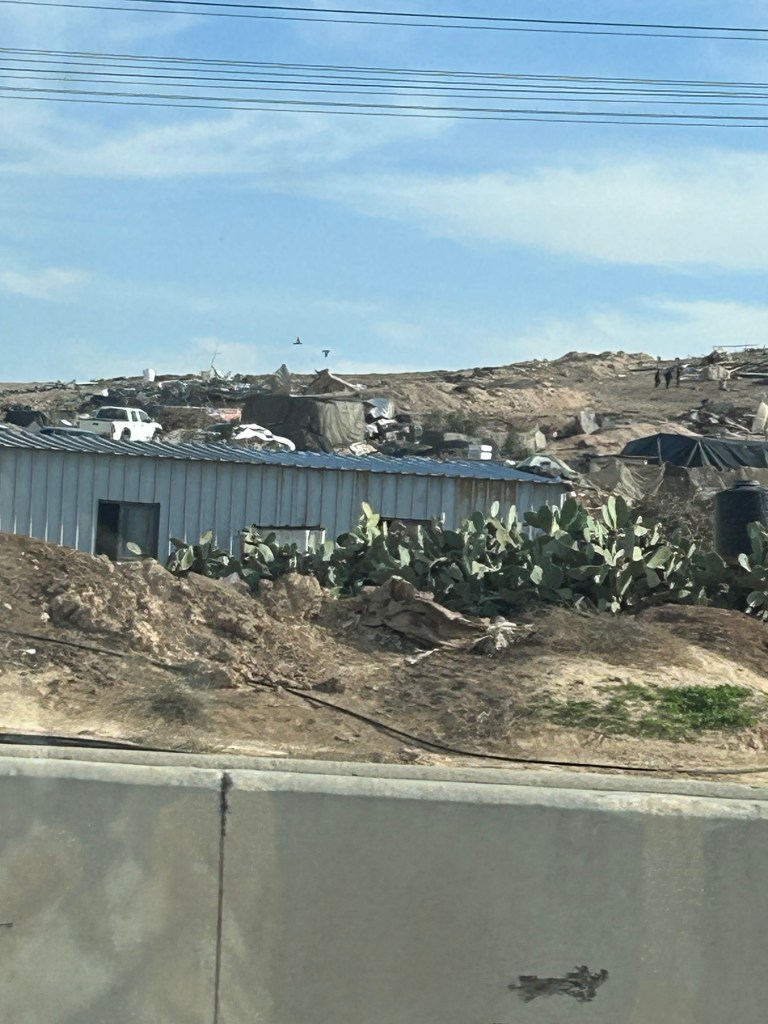
Past the Bedouin encampments:
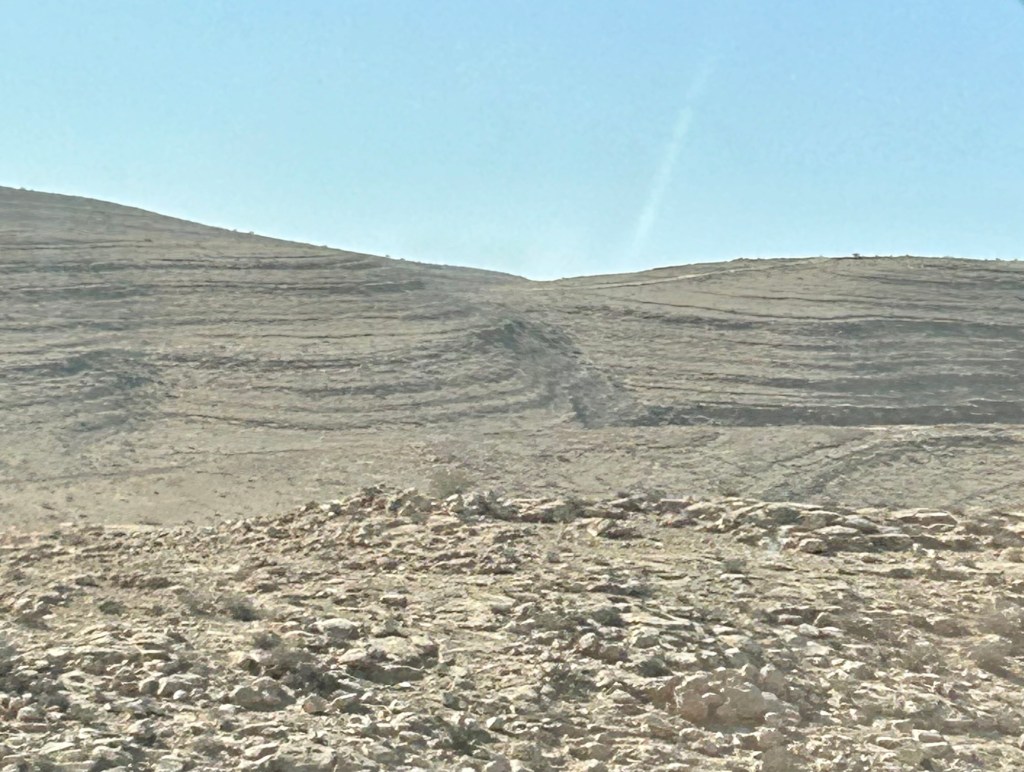
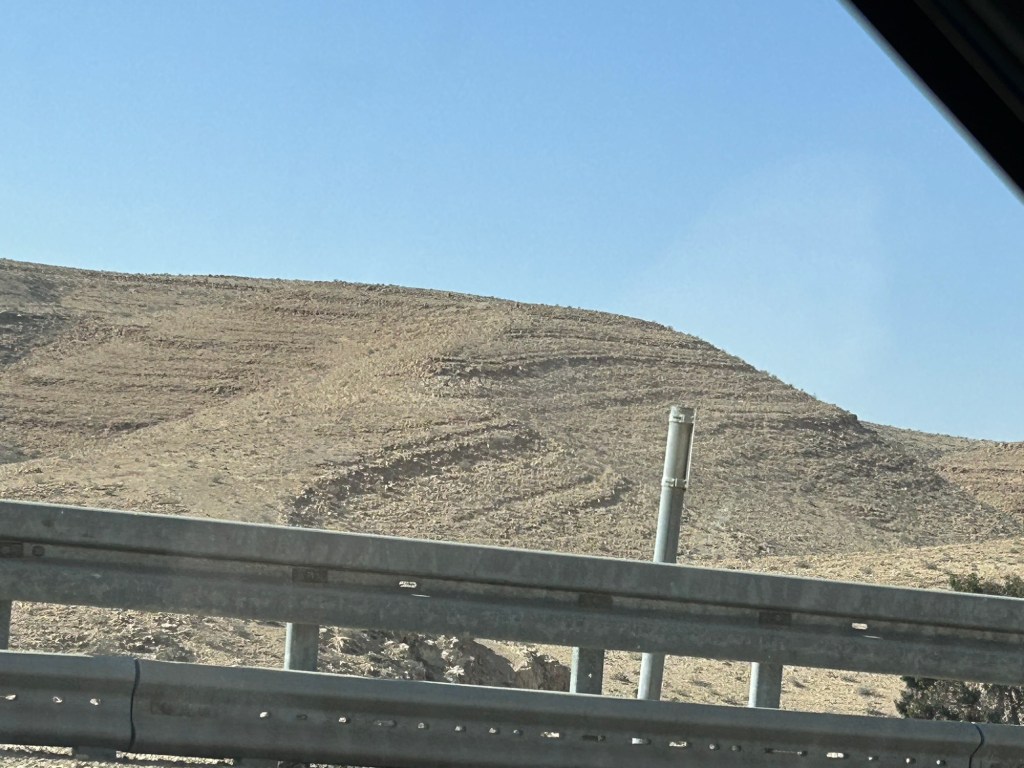
And into the heart of the barren, windswept desert!

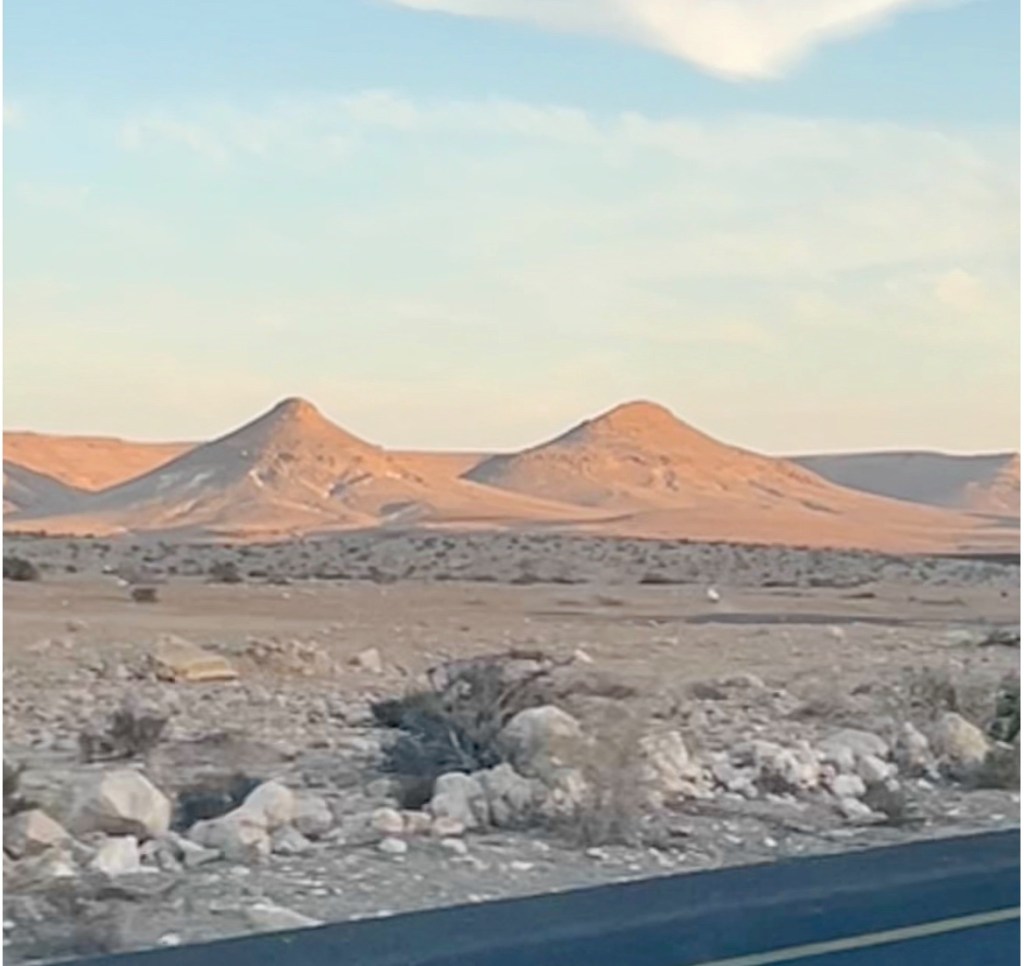
The Desert of Zin! Tsin! Sin!!! In the Bible

We had to get there by sunset… it’s all of 3 1/2 hours, but we kept stopping along the way-
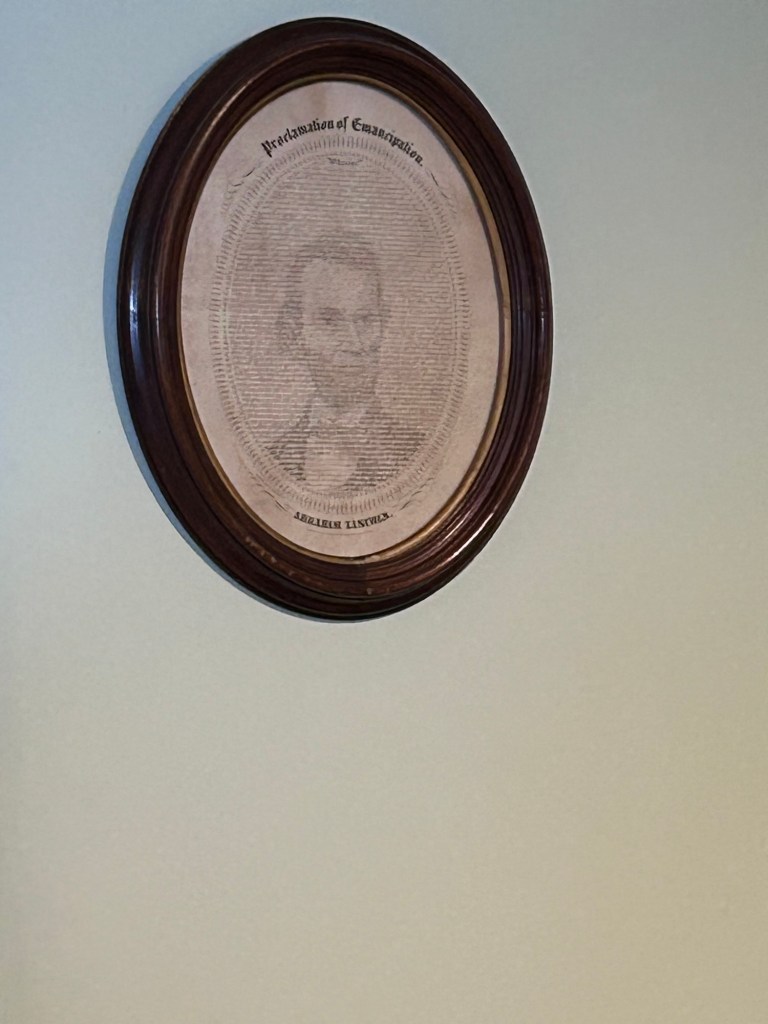
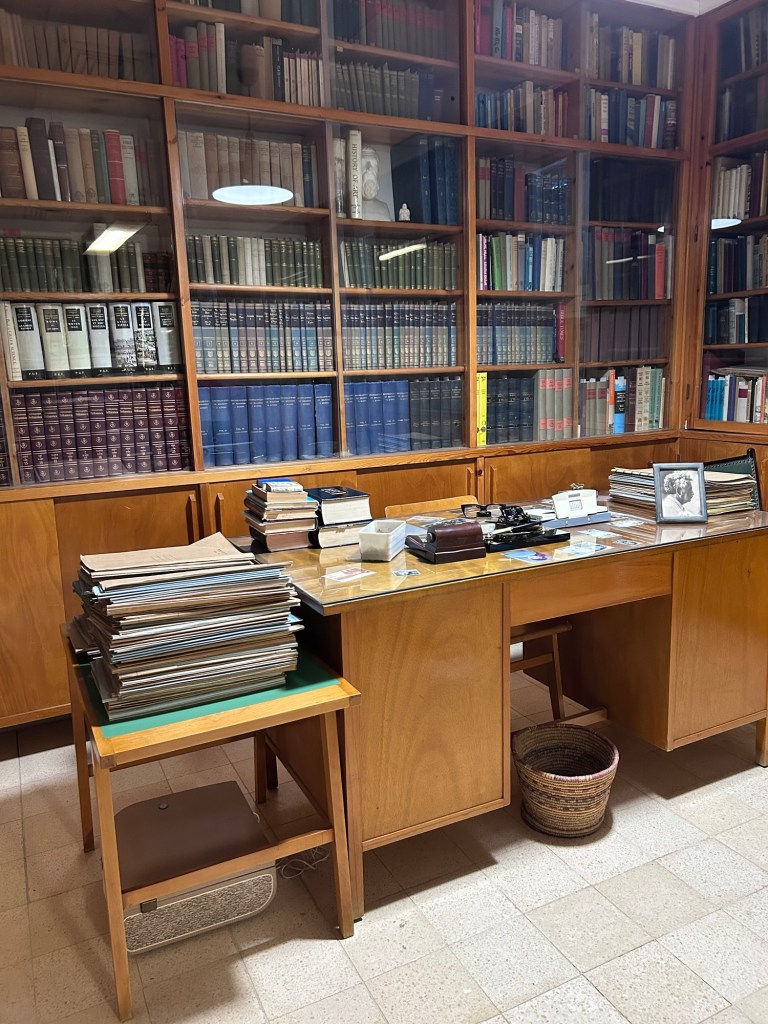
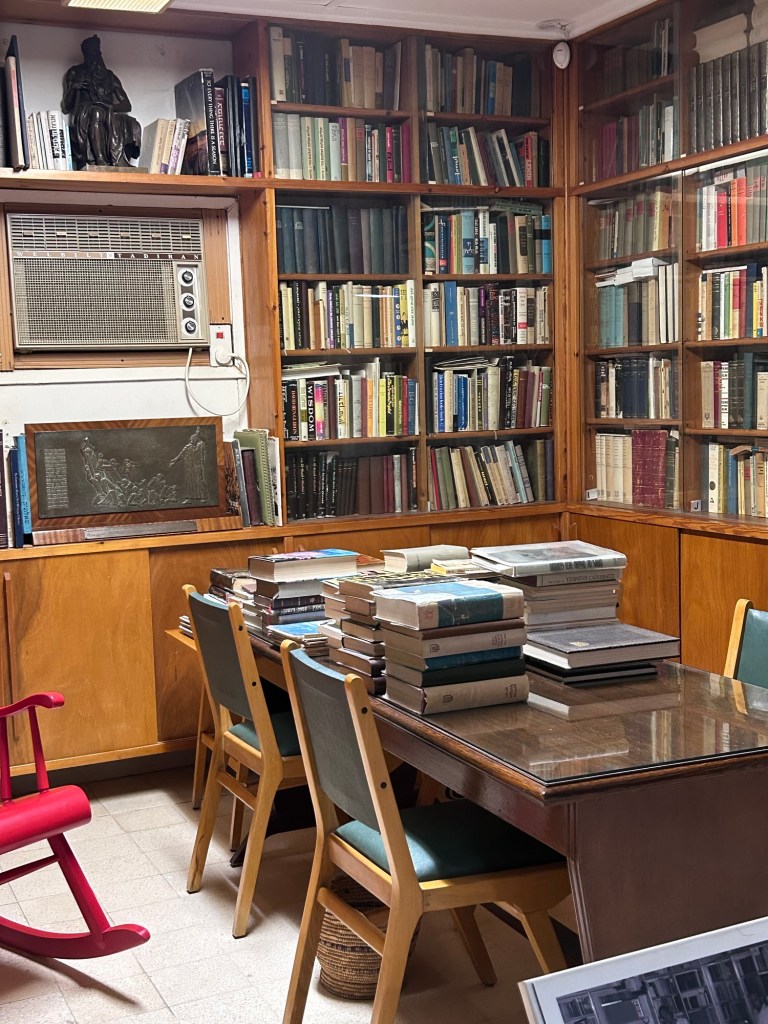
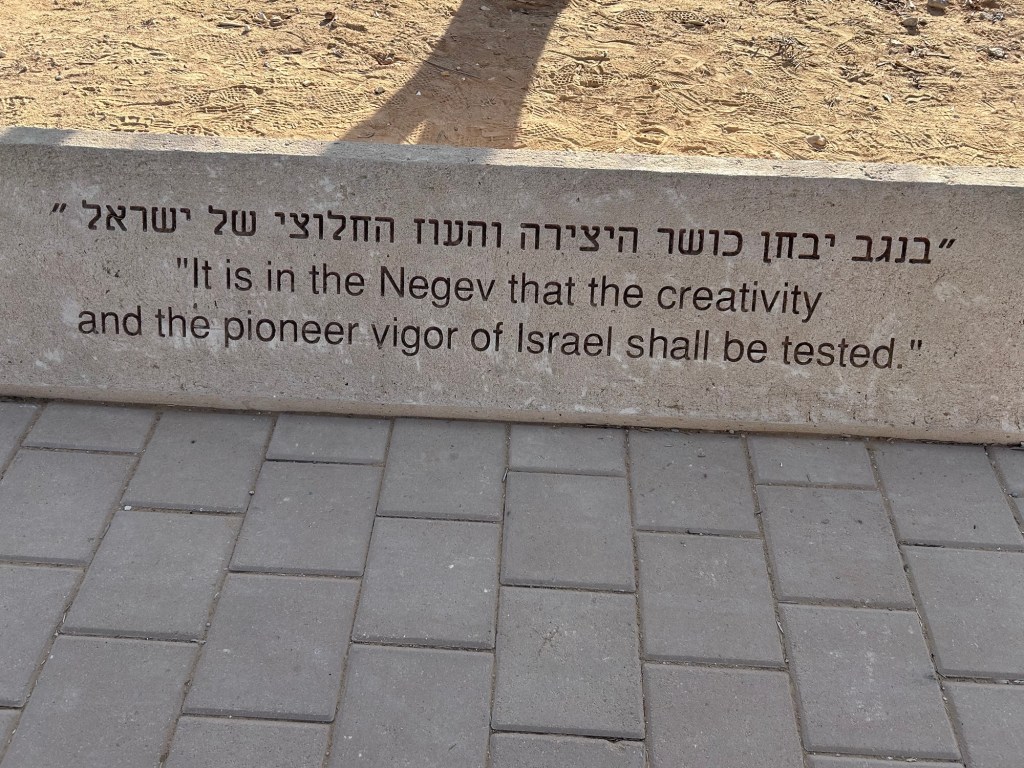
We made a big stop at Sde Boker, the kibbutz founded by first Israeli president, David Ben Gurion. Ben Gurion and his wife, Paula, lived the desert and thought it was the safe spot and key to future Israeli development. He foresaw the day when the Jewish people would learn to irrigate and farm the desert and make it bloom. He wasn’t wrong.

Today his home is a national landmark, open to the public. When we visited, there were only about a million school kids on tour. I was surprised that his home was so modest!!!! And tiny!!!! Like a summer camp bunkhouse. it had a living/reception room, his personal study, teeny tiny rudimentary kitchen and two sparse and small bedrooms- one for BG and one for Paula. He only slept 2-4 hours a night: was always up working, listening to radio news, studying – so Paula had her own quarters so she could get some shut eye. When there was a visiting dignitary, she’d go to a friend’s cabin and the important guest would take her room.

Hurry!!! We need to check in to our hostel!

We found a really remote spot on the edge of the crater. It was much darker than anywhere else (when we first moved to Israel the sky above our home was pitch black and filled with stars. Now, with all the new construction and light pollution, we see very little). John and I – and Haggis, our yappy little long-haired dachshund, sat and waited. We looked up for over 4 hours. The sky was beautiful and the stars many. We named the constellations. We waited. It grew colder. John saw 2 shooting stars. Another hour. I saw 1. So much for the Leonides, although it was a fun adventure.

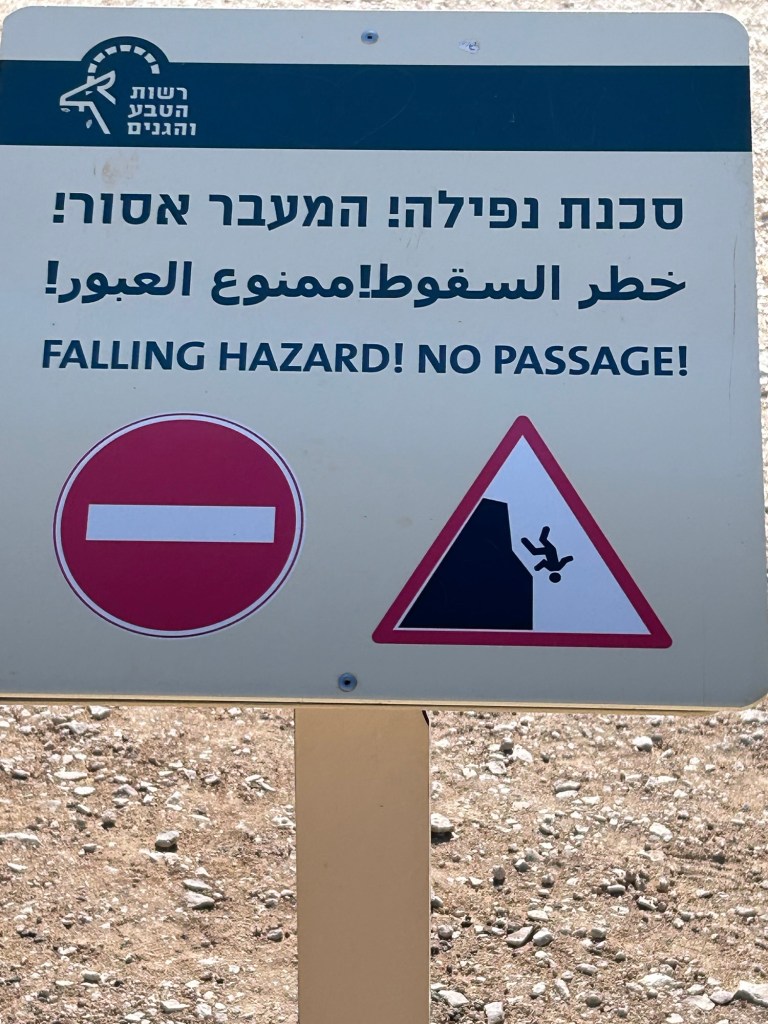
The next morning we got up early to actually see the Makhtesh. Spectacular!!!!

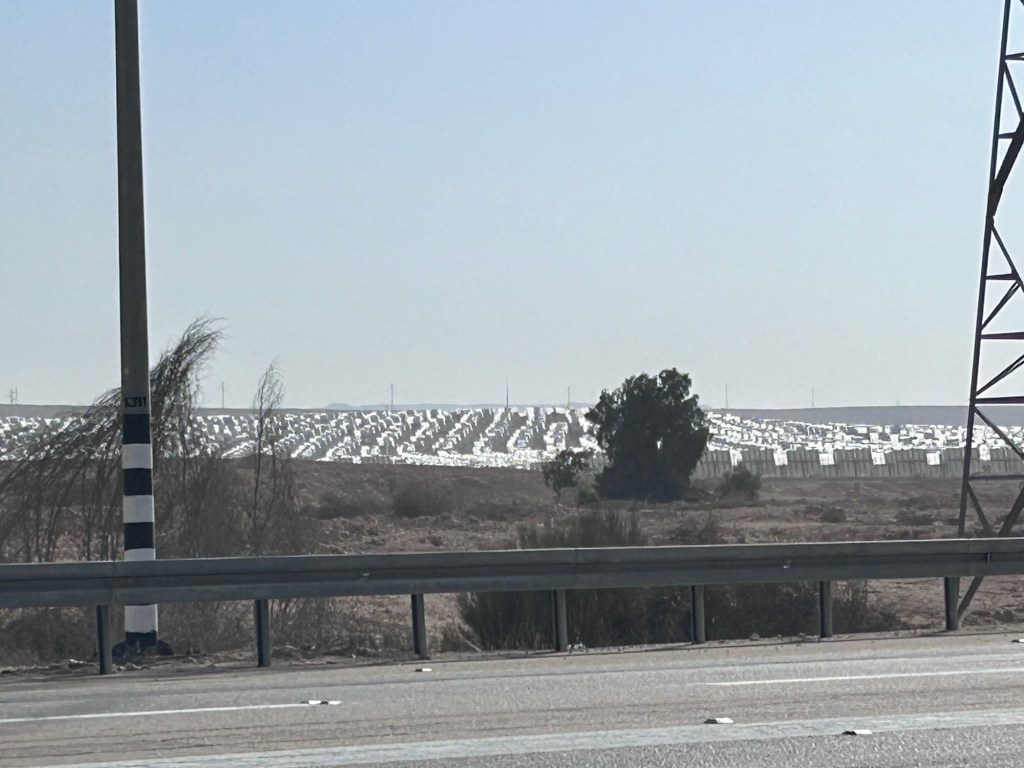
From Mitzpe Ramon, we made our way back to Beersheva. We kept seeing this bright flaming tower/beam in the distance – both coming and going. So we decided to check it out-

What IS that thing miles away?

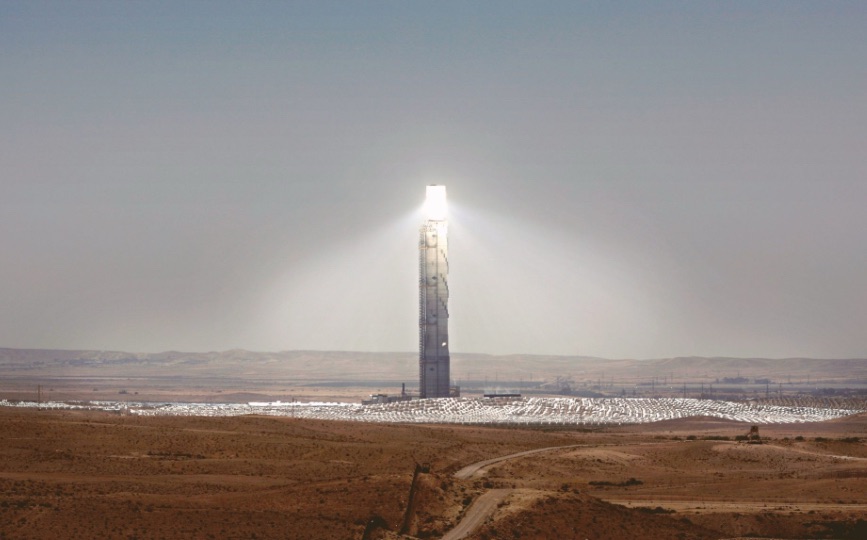
How cool!!! The Eye of Sauron overlooking the wasteland of Mordor from Lord of the Rings!!!! We found it!!!!! In Israel!!! Actually it turned out to be the Ashalim Power Station. Decades ago, Elon Musk that you could take 10 square kilometers in the desert, put in solar plates and generate most of the electricity in Israel.

Ranking as one of the world’s premiere and few thermal solar stations, Ashalim is composed of 55,000 heliostats or solar panels that reflect the sun onto a huge mirror-like “Eye of Sauron” at the top of the tower which absorbs the heat and turns it into electric power.
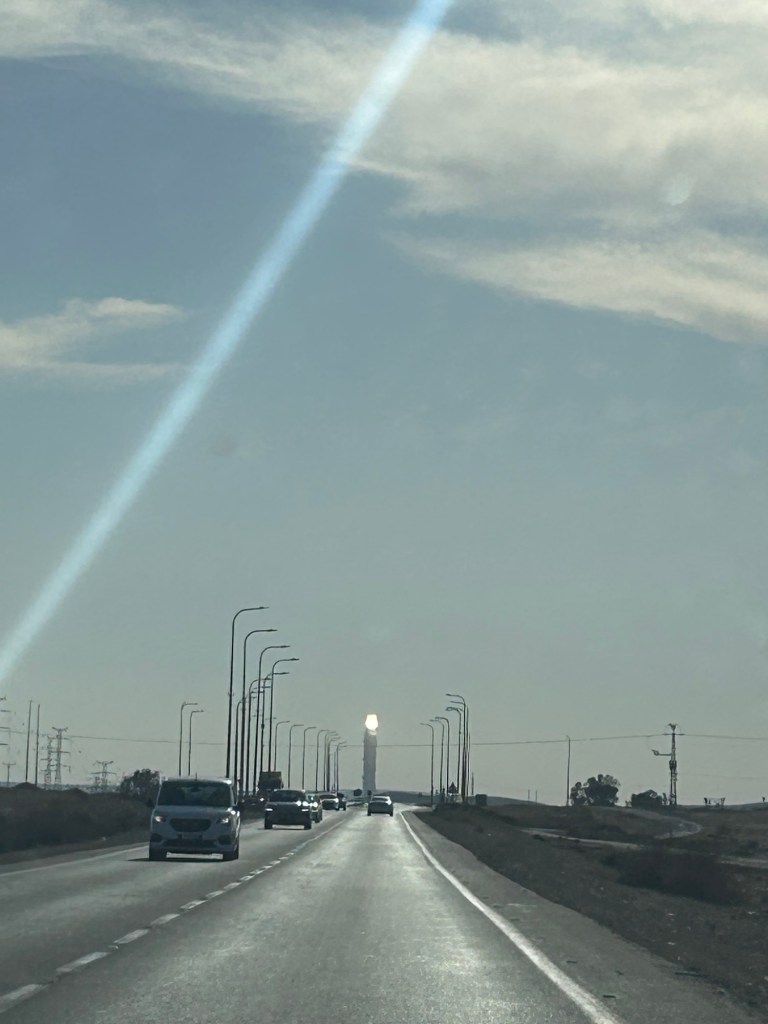
The Ashalim Power Station used to be the tallest solar plant in the world standing at 240 meters (about 790 feet), the size of a skyscraper. However, it was surpassed by Dubai’s Noor Energy 1, with a height of 260 meters (circa 850 ft). There is another (Israeli built) solar power farm in the California Mojave Desert. The reflector on the tower generates concentrated heat which reaches up to 1000 degrees Fahrenheit (over 500 °C) to spin turbines and generate electricity in high quantity. It generates enough power to keep 120,000 homes (5% of all Israeli homes) for a year fully lit. It’s green, renewable and sustainable. I hope to do a more detailed post on this and other amazing Israeli innovations shortly. All in all, it was an illuminating trip!

Now onto a completely different subject!!! Each year, when the Jewish people read the Torah story of Jacob and Esau, I get creative. Esau, a big burly, hairy, red-headed hunter and the favorite son of his father, Isaac, sells his entire inheritance to his younger brother. Jacob has cooked this amazingly tasty and great smelling lentil stew. Esau comes into the desert tent, after a long day of hunting (ibex???). He tells his brother “I’m dying. Just pour some of that red stuff down my throat!!!” Seriously. It’s what he said. I love it!!!!! Anyhoo- Esau winds up giving away the birthright to Jacob for a bowl full. It must have been delicious!!!

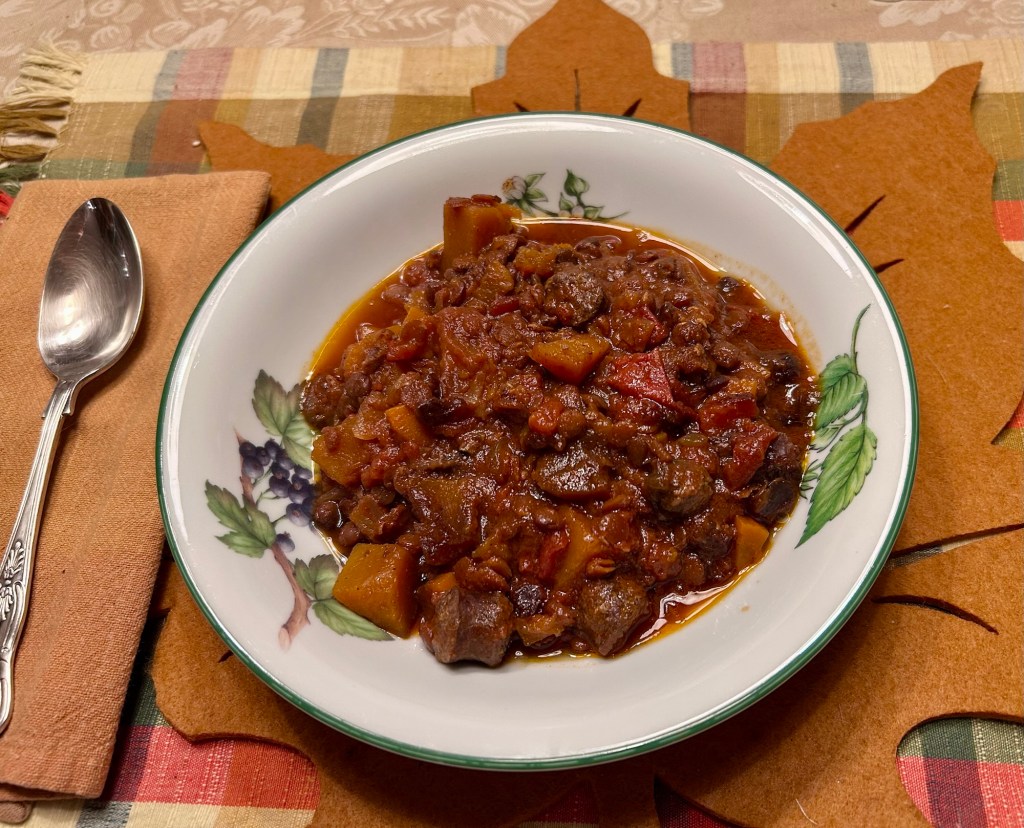
So, last week I worked out my own version: I wanted it MiddleEastern in flavor. With Israeli products. It had to have lentils. It had to be red. And it had to be prepared in a crockpot so I could keep it warm/hot through Shabbat. It turned out AMAZING!!!!!!! So here’s this year’s Red Stuff-

Jacob’s Lentil Stew

Ingredients:

  • 2 large carrots
  • 2 large onions
  • 6 long, thin Merguez beef sausages
  • 1 butternut squash
  • 2 1/2 cups green or brown lentils
  • 10 Medjool dates
  • 1 red bell pepper
  • 1 yellow bell pepper
  • 2 large orange sweet potatoes
  • 6 cups vegetable stock
  • 1 can large chopped tomatoes and juice
  • 1 small packet tomato paste (2-3 TBSP)
  • 2 tsp cumin
  • 2 TBSP baharat spice (cinnamon, cloves, allspice, cumin, black pepper, cardamom)
  • 1 tsp smoked paprika
  • 1 1/2 tsp sweet paprika
  • Pinch cayenne (to taste)
  • 1/3 cup Silan (date syrup) OR 1/4 cup honey
  • Fresh dill
  • 2 tsp salt

In a large skillet cook the sausages, removing outer casing if necessary. Reserve to plate to cool. In same pan, sauté the cubes of onions and peeled carrots – cubed to bite sized chunks. Chop the sausage into 1” thick coins. Add to crock pot. Chop bell peppers into small cubes. Put into crockpot. Peel and remove seeds from squash. Cut into bite sized cubes. Place in crockpot. Peel and cube sweet potatoes. Into the crockpot. Rinse the lentils well, removing any stones or “dry stalks” and dump in crockpot. Pour in the veg stock (can use all natural bullion cubes) and dump in can to tomatoes with juice. Stir well with a big spoon. Remove the pits from the dates and chop coarsely. Scatter around crockpot. Add the spices and tomato paste. Add the Silan or honey. Stir well. Chop about 1/2 cup fresh fennel and add to crockpot last. Mix well and cover. Set the power to low and let cook for hours (overnight). Can add more water if needed. Freezes beautifully.

Trash to Treasure:an environmental transformation

Israel has always stood at the forefront of environmentalism and sustainability. Upon visiting Park Ariel Sharon, it’s hard to believe that this, the largest park in the Middle East (larger in acreage than New York City’s Central Park), was once a trash dump and environmental disaster. Today it stands as the largest eco-rehabilitation and success story the world has ever seen. Situated just to the east of Tel Aviv, since 1952, Hirya was the trash dump for the city and the whole of the Gush Dan region. As the population grew, so did the refuse until it became a towering mountain of garbage. In the heat of summer, the smell wafting into Tel Aviv and surrounding cities was almost unbearable. In 1998, the site was shut down due to toxic waste and environmental concerns. What to do??? A meeting was called with urban planners, scientists, landscape architects, environmental researchers, mayors, artists, social welfare experts, philanthropists and others to brainstorm. Out of these conferences, Park Ariel Sharon was born.

It’s hard to imagine that exactly a week ago, people here were running to bomb shelters as the Palestinian Islamic Jihad lobbed over 1250 missiles into Israel. When we visited yesterday, it was completely serene. John and I got there very early afternoon and had the place almost to ourselves. At the foot of the ‘mountain range’ standing over 200 feet tall, are various buildings:a recycling center is at one end; museums and classrooms where groups can come and learn about recycling and the environment at the other.
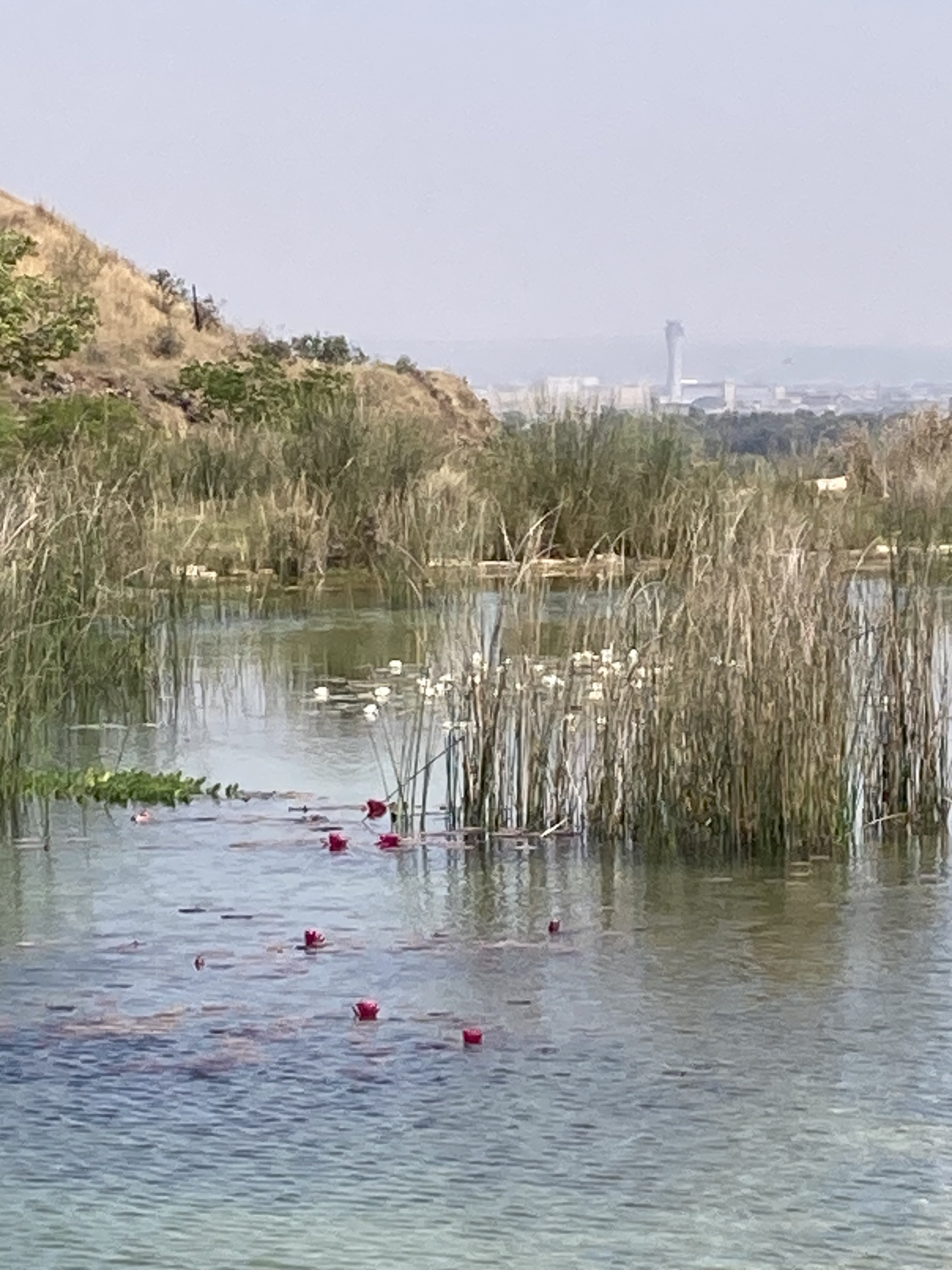
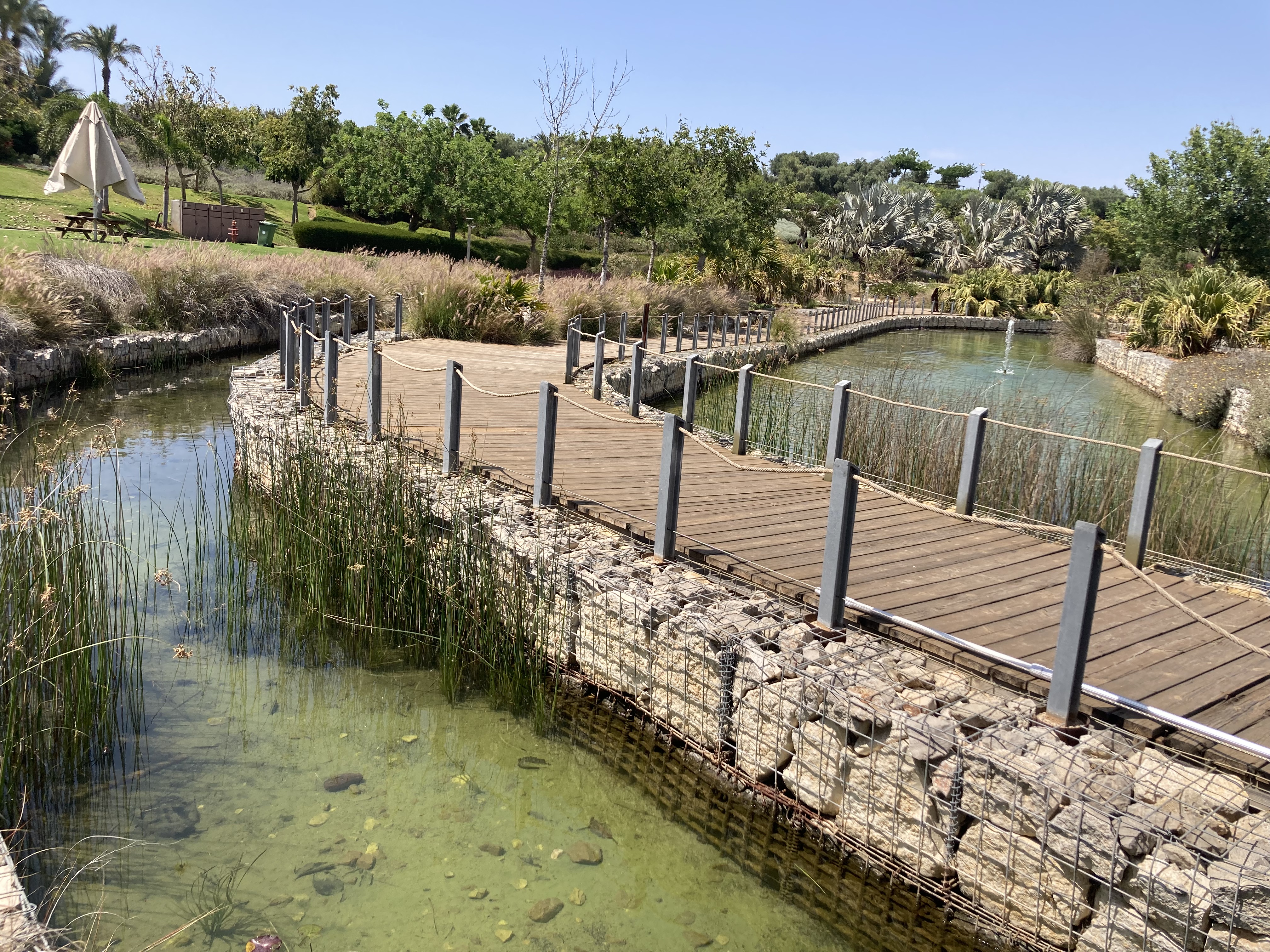
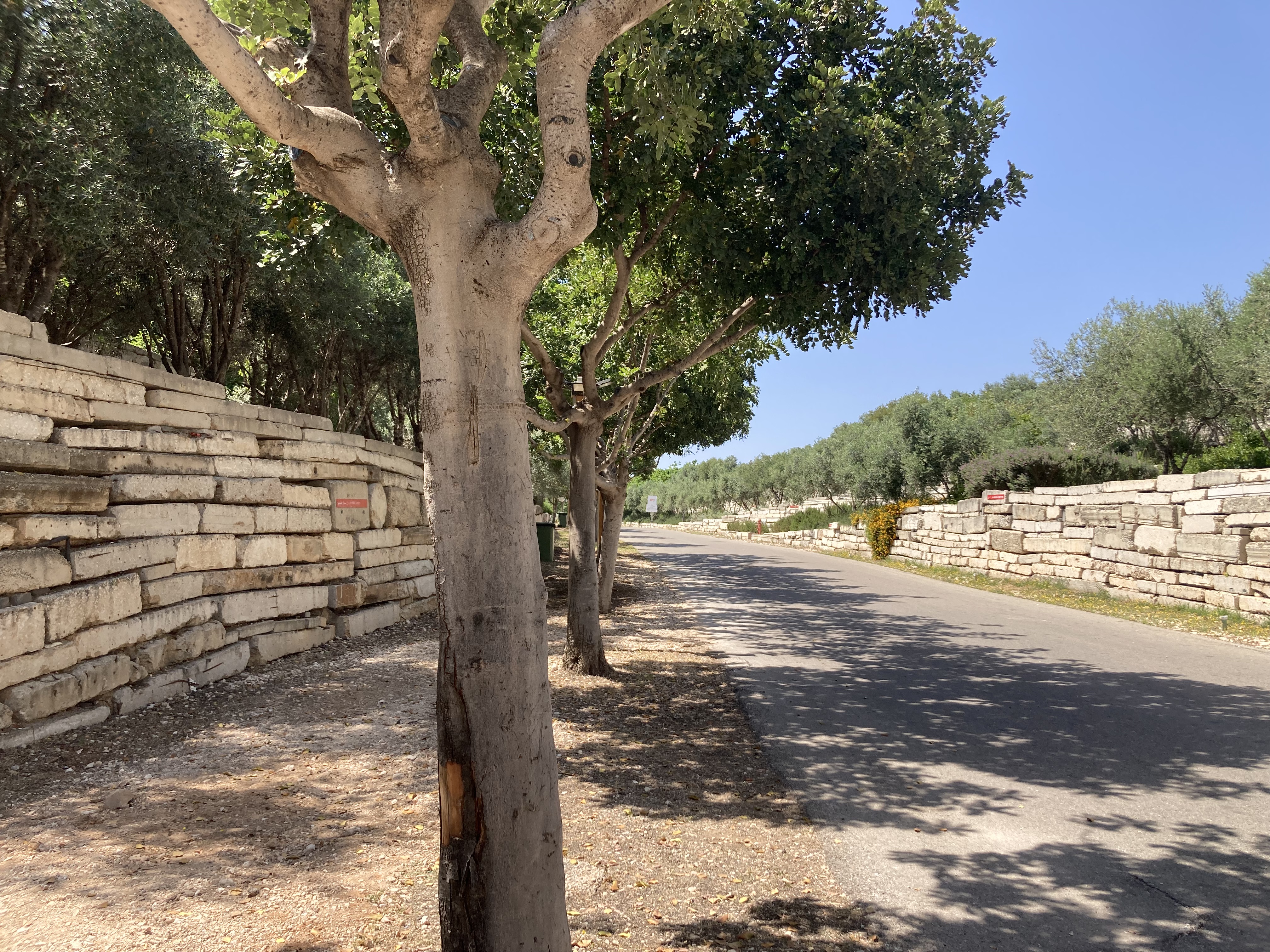
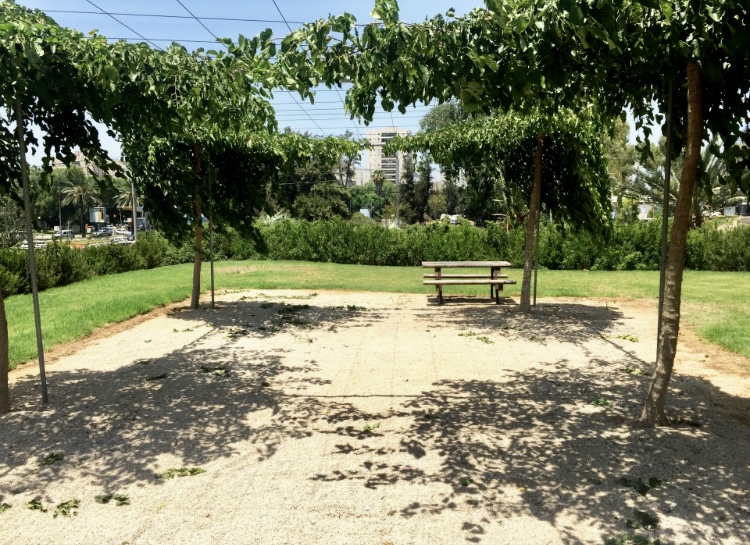
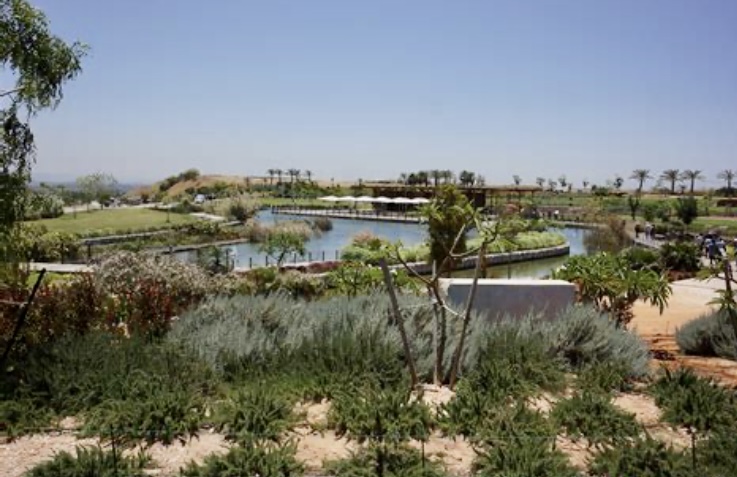
The drive up the mountain is beautifully lined with Eucalyptus trees. What was once dubbed ‘Trash Mountain’ is now an absolutely gorgeous multipurpose park. Expansive swaths of green fields, hiking and biking trails lead to a large green picnic area shaded by trees. The grass is watered using desalinated and gray water, all recycled. A visitor center, natural food cafe and large terrace with ample seating area invites one to sit and relax. The terraces have been landscaped into islands connected by pathways surrounded by natural ponds and watercourses filled with fish. Papyrus, lilies, lotus, and water lettuces float gently. Each pond is bordered by repurposed concrete salvaged from the old dump. These newly formed blocks act as barrier reefs for the fish to take shade and to spawn.

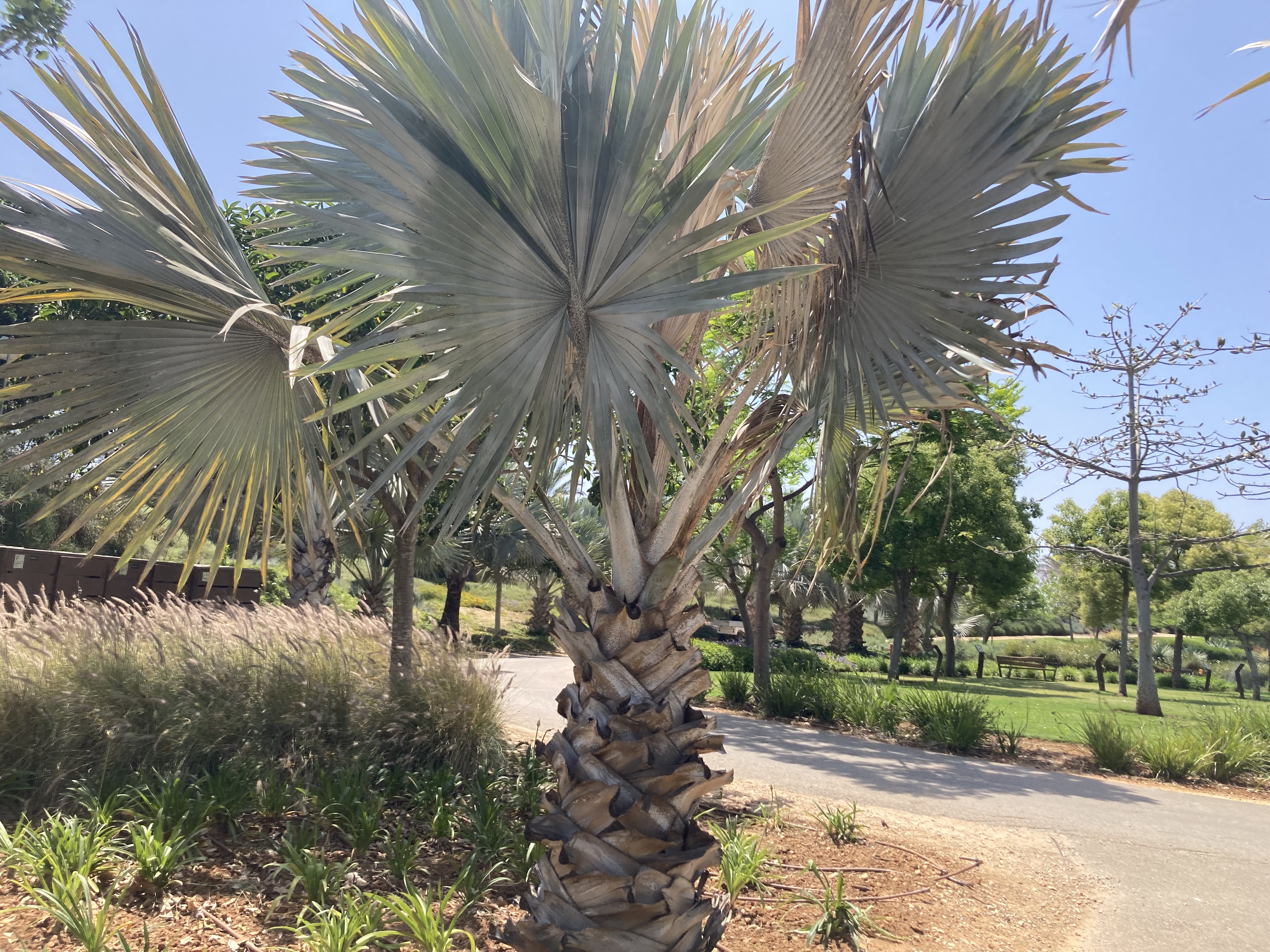
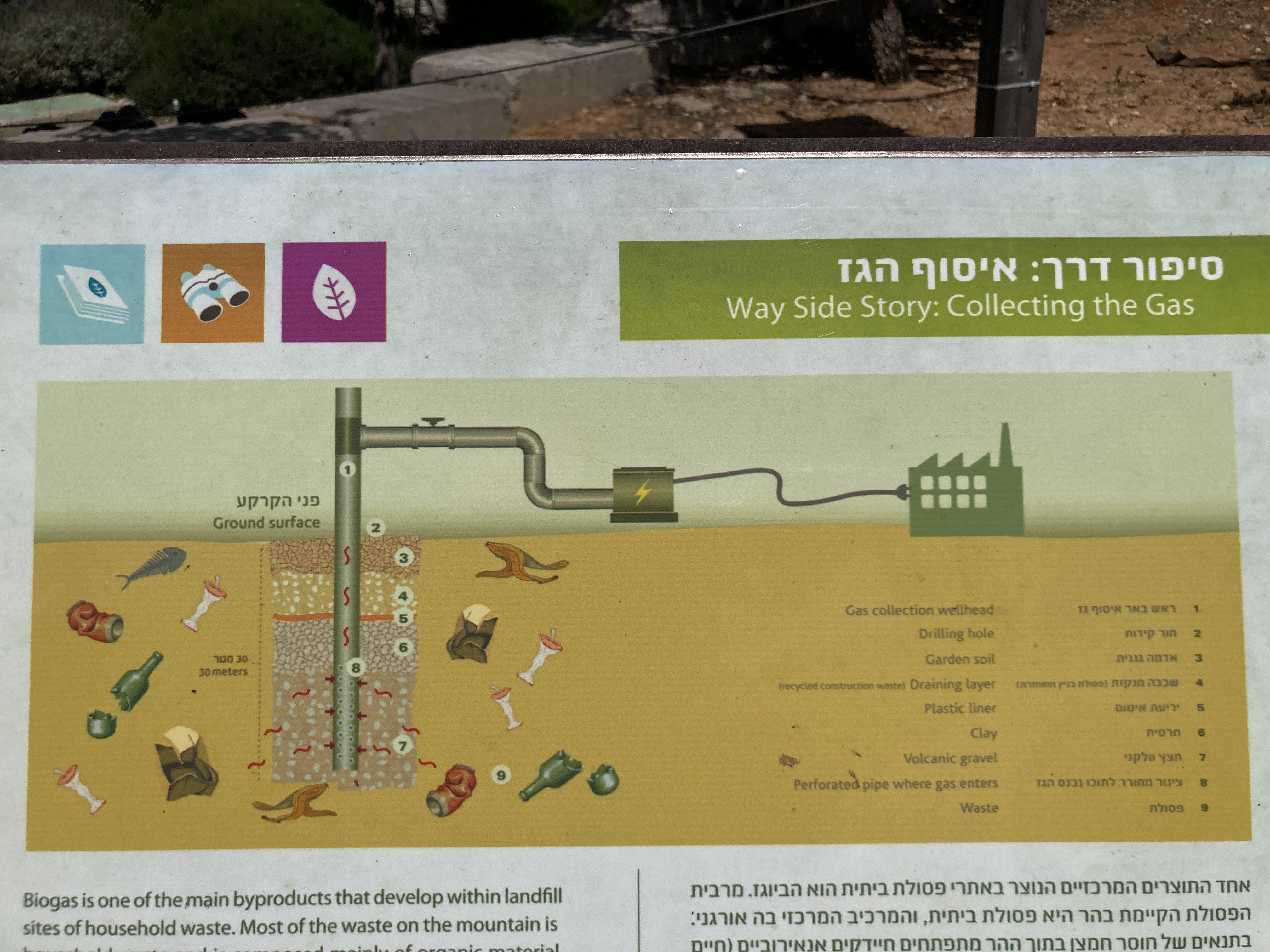
Rubbers tires were repurposed as mulch. Concrete construction barriers were sorted out to create retaining walls lining pathways and actually forming the mountain. It is actually quite beautiful. All the materials here were pulled from the dump and transformed to new purposes. Native trees- carob, olive, date palm, eucalyptus, cedar- have been planted. Metal was sorted out, recycled, reused and some turned into lamp posts, benches, and sculpture. The entire park has a been built over the old dumping grounds. Dangerous biogases are one of the main products that develop within landfills (mostly organic household waste). Their decomposition create polluting greenhouse gases and methane. To combat this, dozens of wells were drilled inside the mountain. The gas is collected and pumped into pipes which flows to nearby industry in the form of steam energy. The gases are constantly monitored to ensure that none escapes into the atmosphere. The amount will decrease over the years, but as more additions are made to the area of landfill surrounding, safe, cheap and efficient energy will be piped to companies into the next several decades.
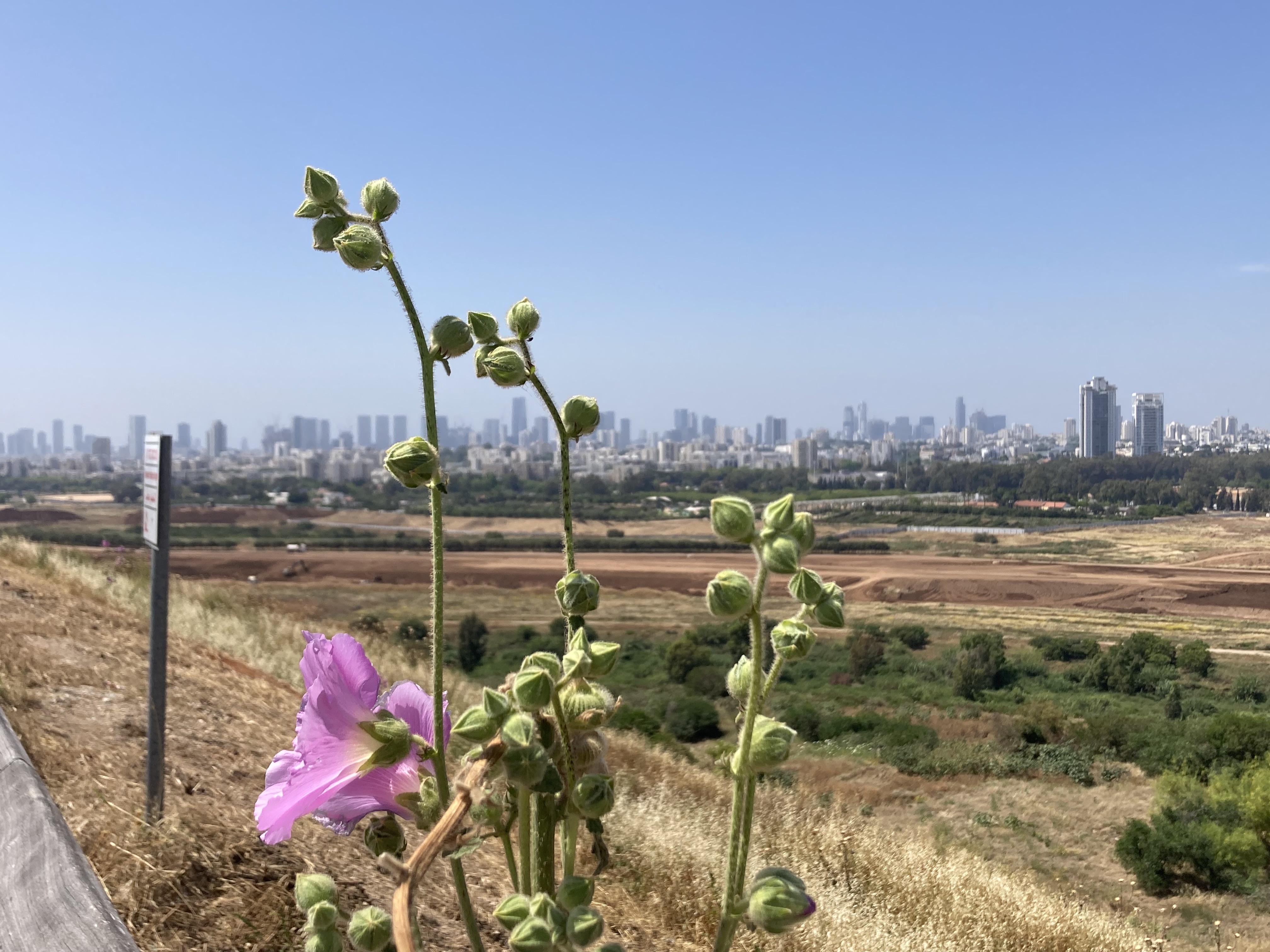
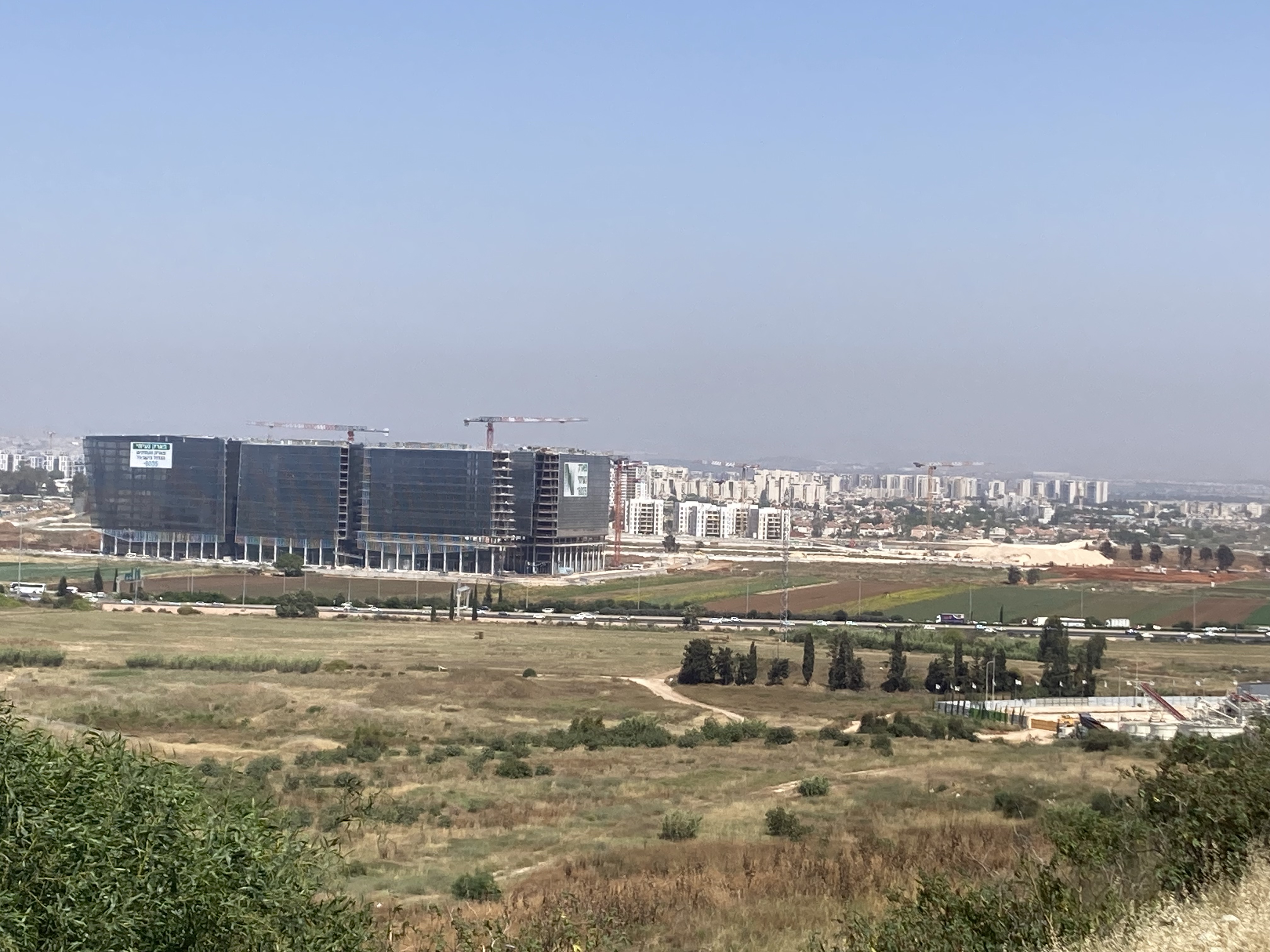
Everything has been so carefully thought out to the very last detail. Grassy small ‘amphitheaters’ have been placed in strategic areas for school groups, tour groups, outdoor meeting areas and Shakespeare in the Park in the summer months. At the far end of one ridge is a 50,000 seat concert venue. Spectacular covered terraces and outlooks offer sweeping panoramas of Tel Aviv, the Mediterranean, the Shefela Valley below and the Judaean hills in the distance. The trash heaps have been covered with volcanic gravel and concrete, layers of thick clay, straw, more clay and garden soil. Flowering vines clamber over wooden trellises and gardens from around the world are featured in each area. There are natural playgrounds for children with rope courses; things to climb over and on; musical instrument sculptures from recycled materials; brain games and interactive play areas. Disability compliant and equipped with many bathrooms and mothering stations, nothing has been left to chance.


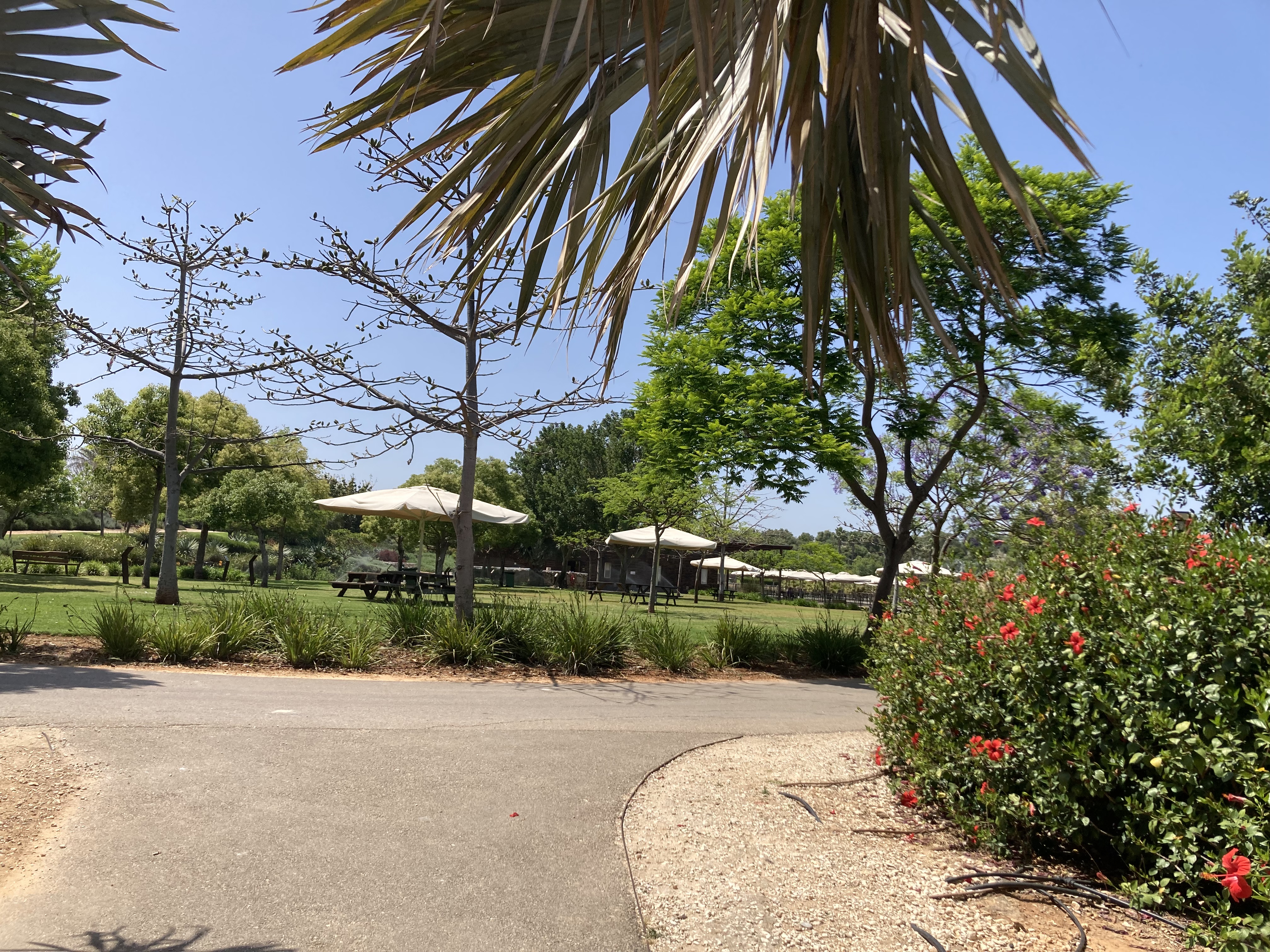
There is a native herb garden with sages and lavenders and scented geraniums where the air is perfumed and heady. We strolled through desert gardens of sand, succulents and cacti. In each section are benches, pathways, and picnic areas. Park Ariel Sharon is definitely now a green lung in the country’s most densely populated urban area. It is a place that is open to all, free of charge (except for concerts and special events). It is a great place for wedding photography – we saw two wedding parties there. This once polluted, neglected dump is now a flourishing metropolitan park. Guided tours can be arranged in advance. At the bottom is the Mikva Yisrael agricultural school where classes are held on sustainability and organic farming. Israel is an amazing country in its innovation and is a leader in environmental issues.

Lavender Fields Forever

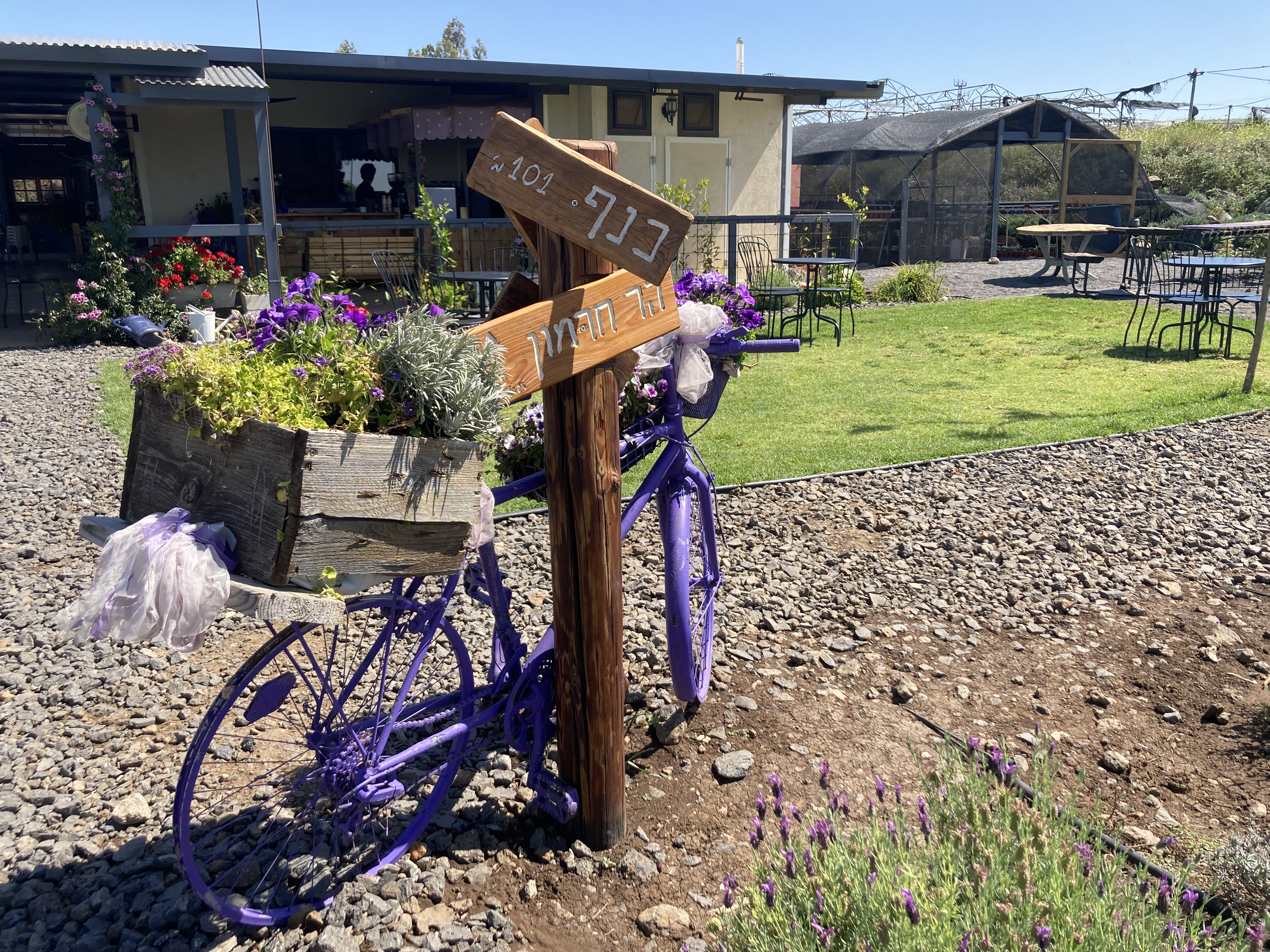
The rains and winds and chilly days are hopefully behind us here in Israel. It’s tiyuulim weather! In Hebrew a tiyuul is best described as a day-trip, and Israelis are crazy about them. I’d heard about Azizo Lavender from a friend who brought us the most heavenly lavender liqueur, so we decided to drive way up in the highest parts of the southern Golan Heights. The mountains were still spring green and the wildflowers were in full bloom making splashes of pinks and purples over the ridges and wadis. On a high plateau overlooking the Kinneret (Sea of Galilee), we finally pulled into Azizo Farms just outside the tiny moshav of Kanaf.


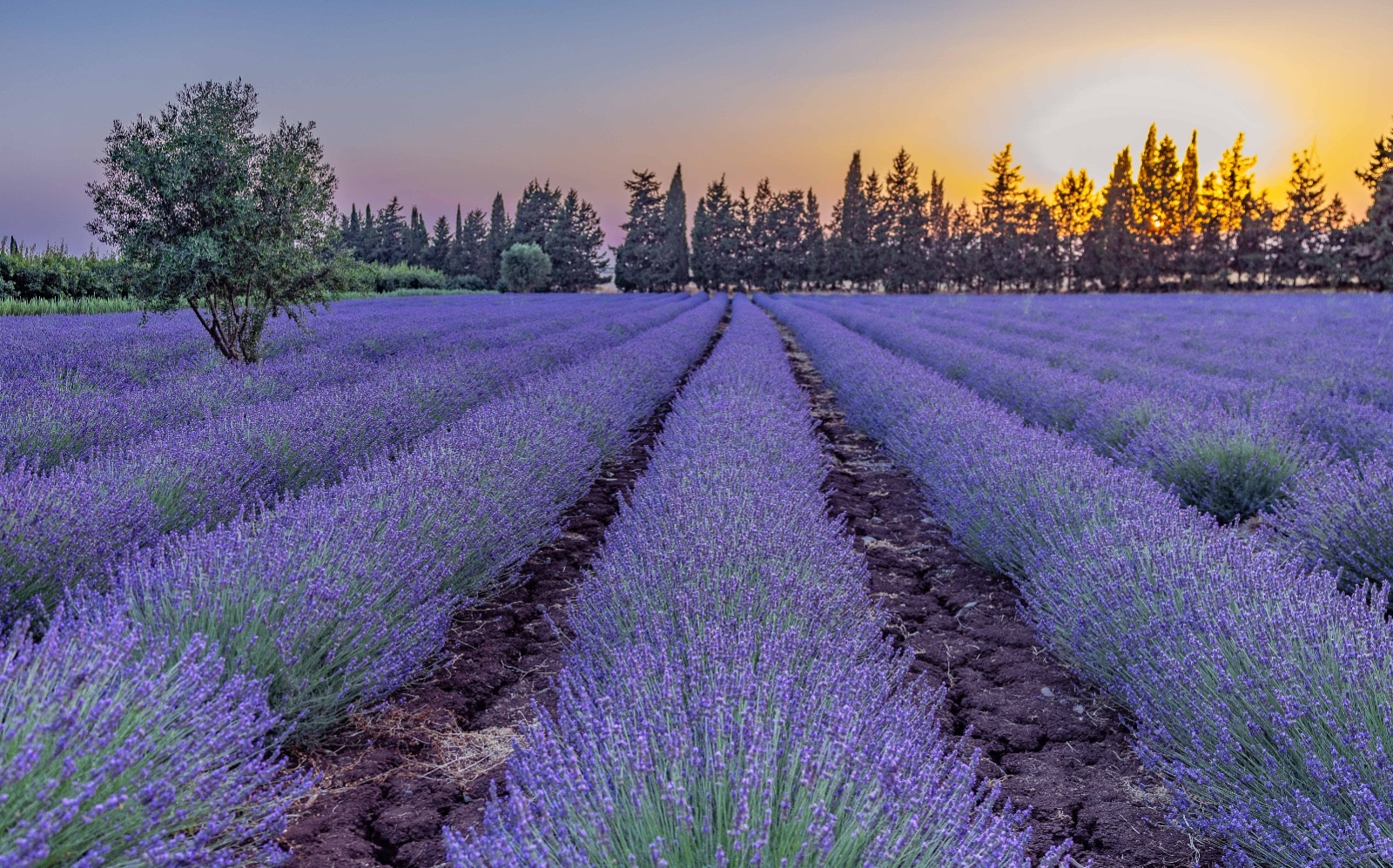
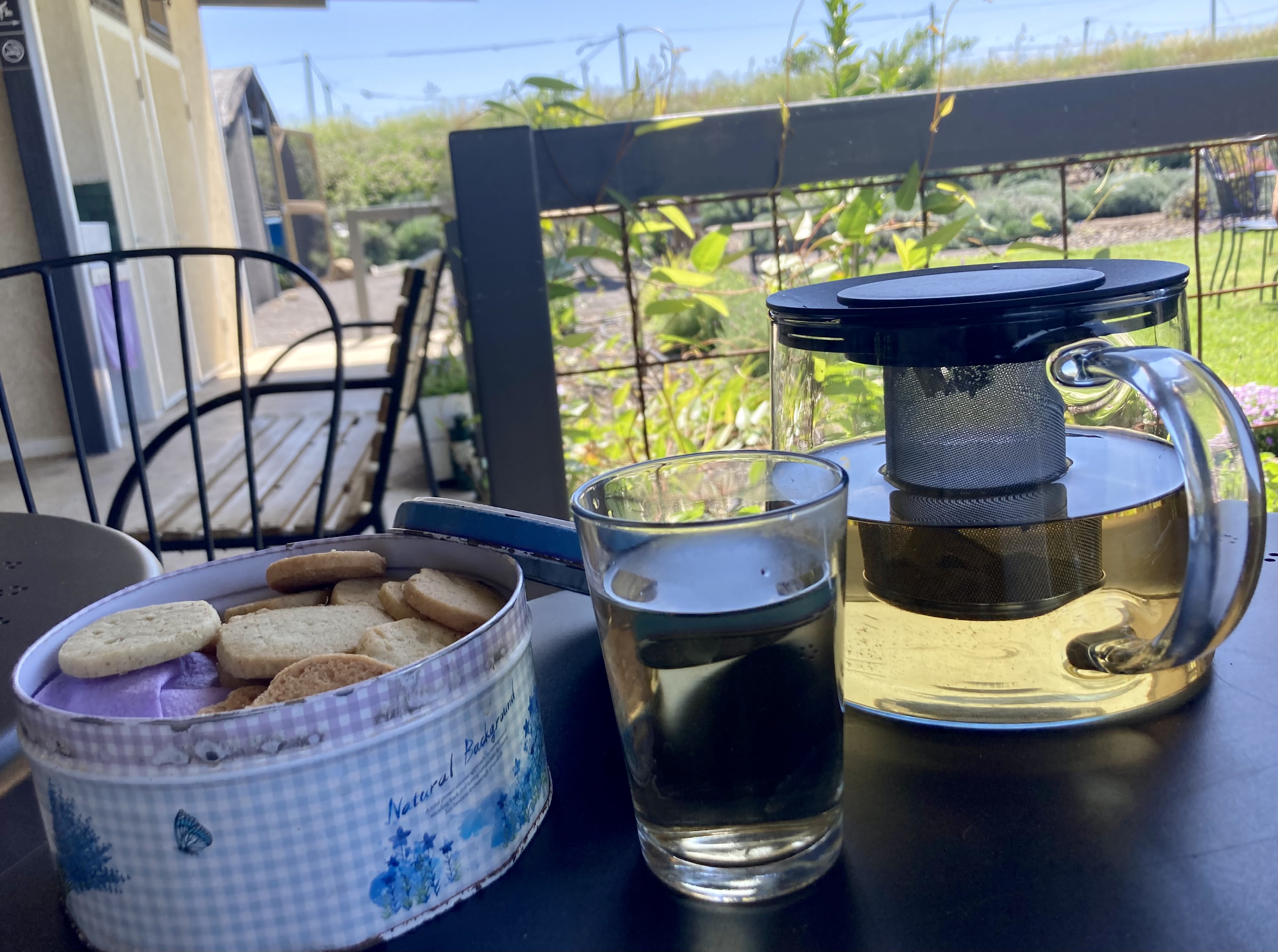
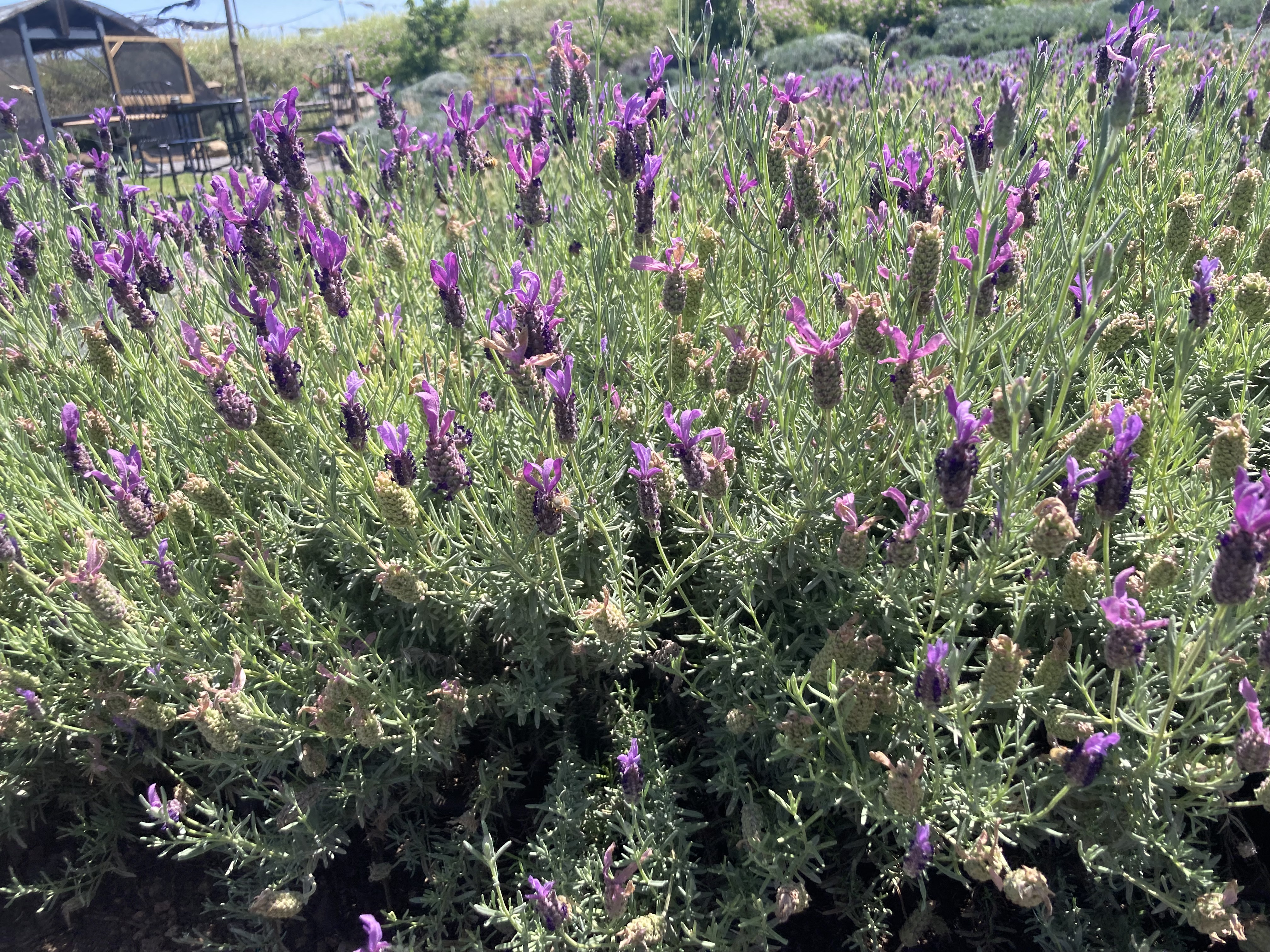
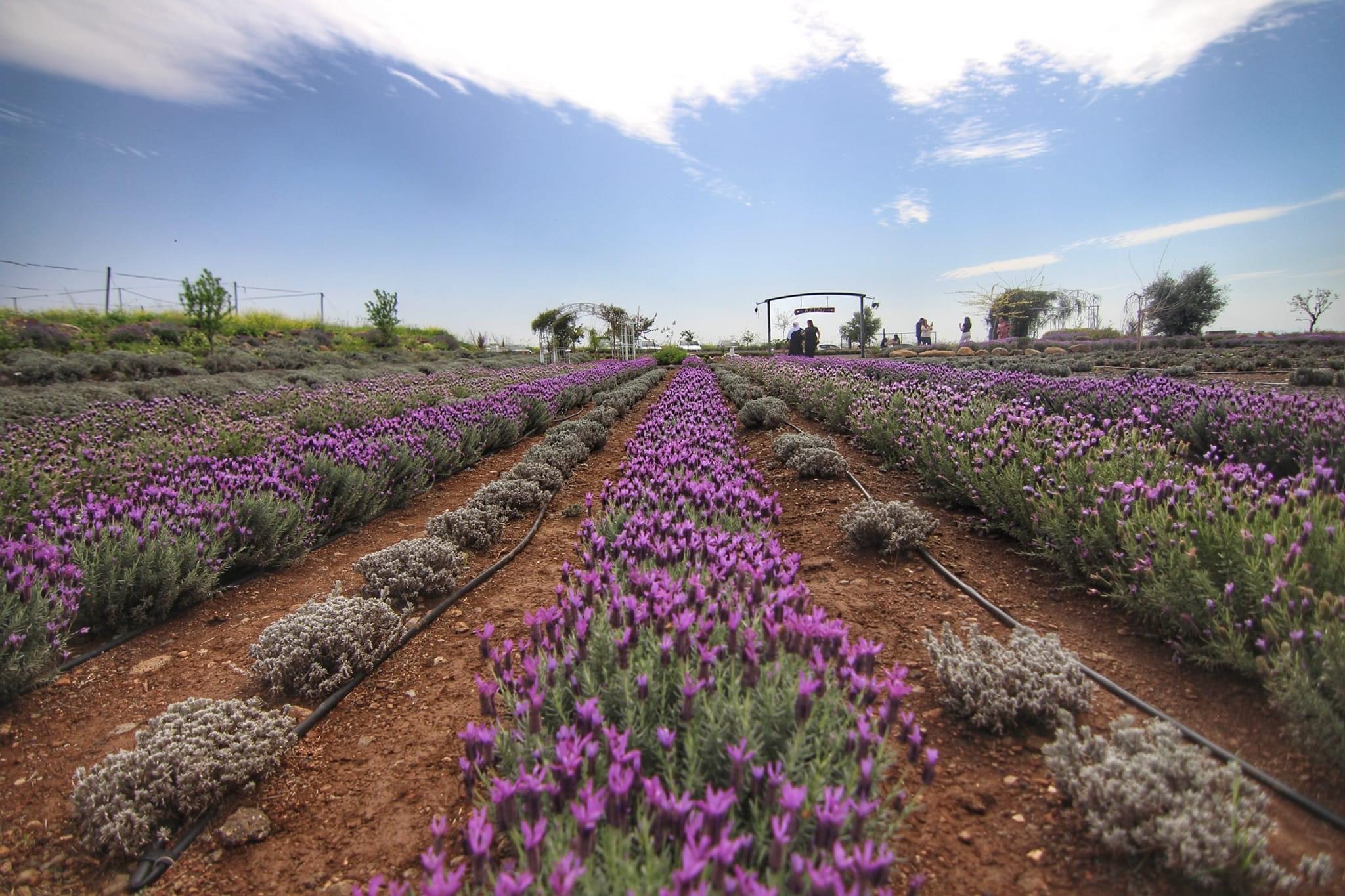
In the center of a field of row upon row of different varieties of blooming lavender is the Azizo visitor center. We were met by the owner, Lilach Assraf, who welcomed us with cups of lavender lemongrass tea and lavender shortbread. Can you say heaven???? John and I sat on the expansive terrace cafe and listened to Lilach tell the history of the farm and business. It started in 1985 with 11 men, all friends who had served in the IDF together. They were going to start a new agricultural community on the wild plateaus of the Golan. Lilach and her husband, Dan, lived on a nearby moshav (village) while they built their homes and plowed the fields around what was to be Kanaf. They started with orchards of plums, pears and grapefruit. One day, another of their army buddies, a lone soldier from France, came to them with a proposal. Norn had just returned from working on a lavender farm in Provence. He was looking for a few daring, open-minded farmers willing to set out on a new course: lavender.

In 1987, 15 acres, about 60 dunams, of French lavender were planted along the Syrian border. The volcanic soil would be perfect as well as the hot days and cool nights. The plants needed little water and drip irrigation was put in. The amount of flowers produced was surprisingly enormous and the quality of the essential oils was the highest on the spectrum. They made and sold the oil and sachets filled with the dried seeds. The venture grew and grew to include the purchase of more dunams and marketing of more products sold within Israel. The original farmers still worked in other fields, holding onto “day jobs” with the lavender being a side business. Then in 1992, everything was “gone with the wind. It was the end of the world, complete heartbreak for us,” recounts Lilach. After severe rains and flooding followed by the most intense heatwave and drought, all the lavender dried up. What to do? Lilach and Dan made the decision to persevere.

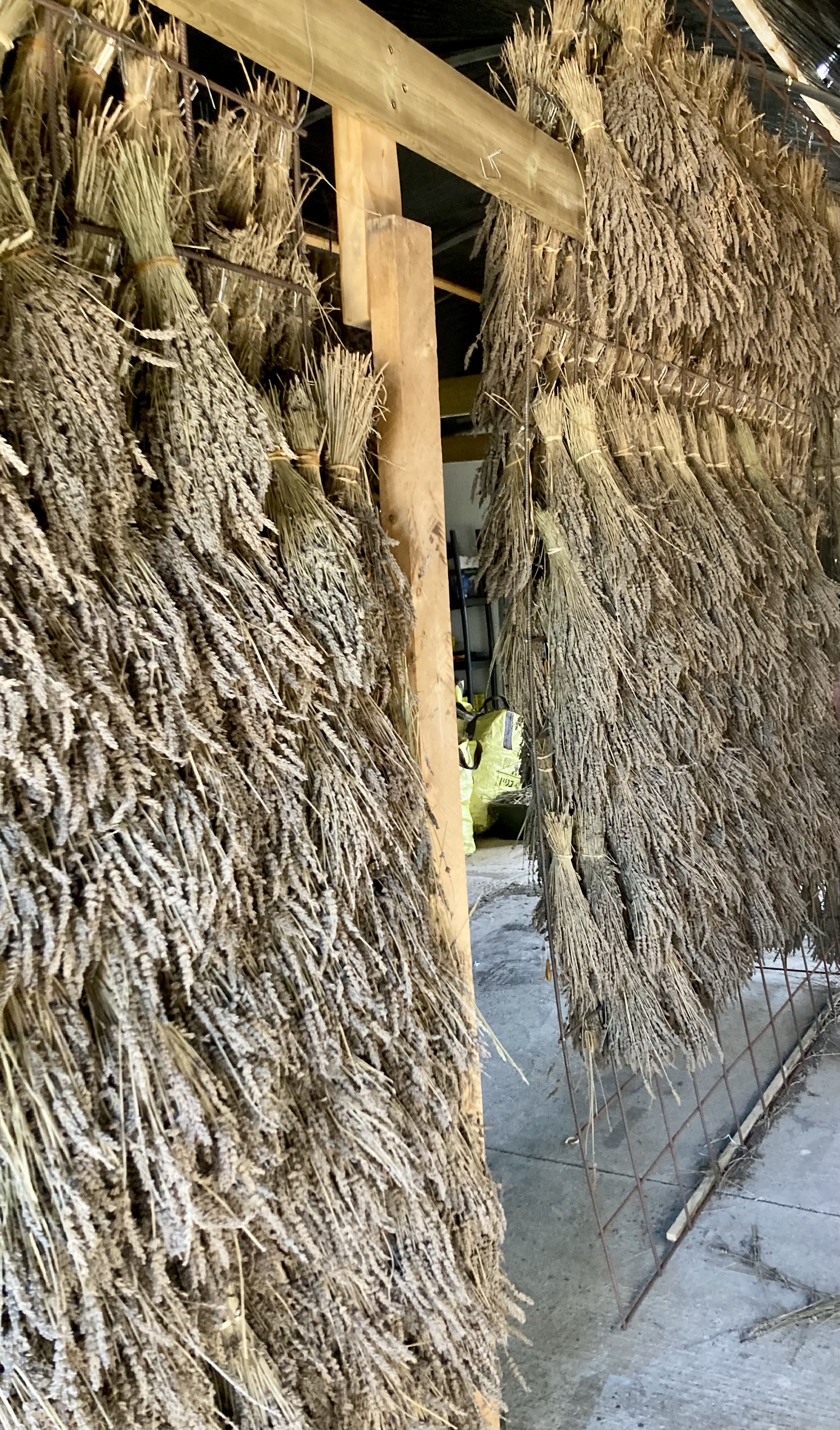
They traveled the world – to France, Hungary, Bulgaria, the United States, to visit other lavender growers. The Israeli Volcanic Research Institute was called in to examine the Golan soil. More irrigation was installed and more dunams were planted with heat tolerant, high yield varieties. Now six different types are grown and new cultivars are being tested. The Assrafs used to pay the teenagers on the moshav to harvest the crops, but now they have a special lavender harvester. Lilach took us and two other couples on a guided tour of the farm and explained the process and manufacturing. We went into the drying room. The smell!!!!! The lavender stalks hang for weeks in a special atmospheric controlled room as they dry, preserving the oil content. Dan and Lilach re-engineered a chicken plucking machine into a device that separates the dried seeds from the stalks. All the distillation is done on site, the oil separated from the hydrosols (water), and both used for different products. The distilling machinery was purchased in Bulgaria, famous for the distillation of its famous roses in the manufacture of perfume. The Assrafs called in Professor Nativ Dubai of the Neve Yaar Agricultural Research Center to confer on varieties of lavender suitable for the climate that would produce highest yield of flowers per plant and the highest concentration of essential oil.

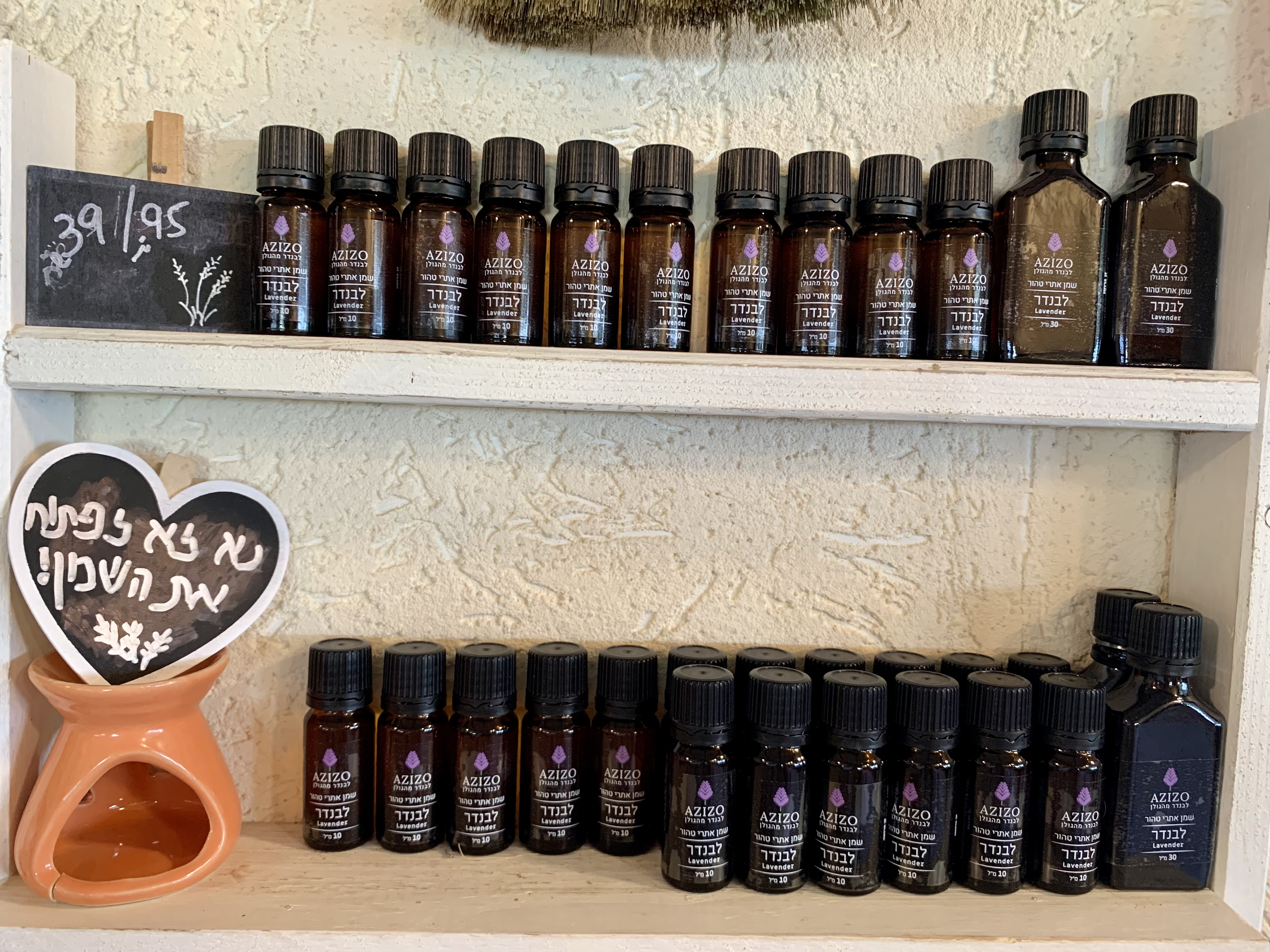
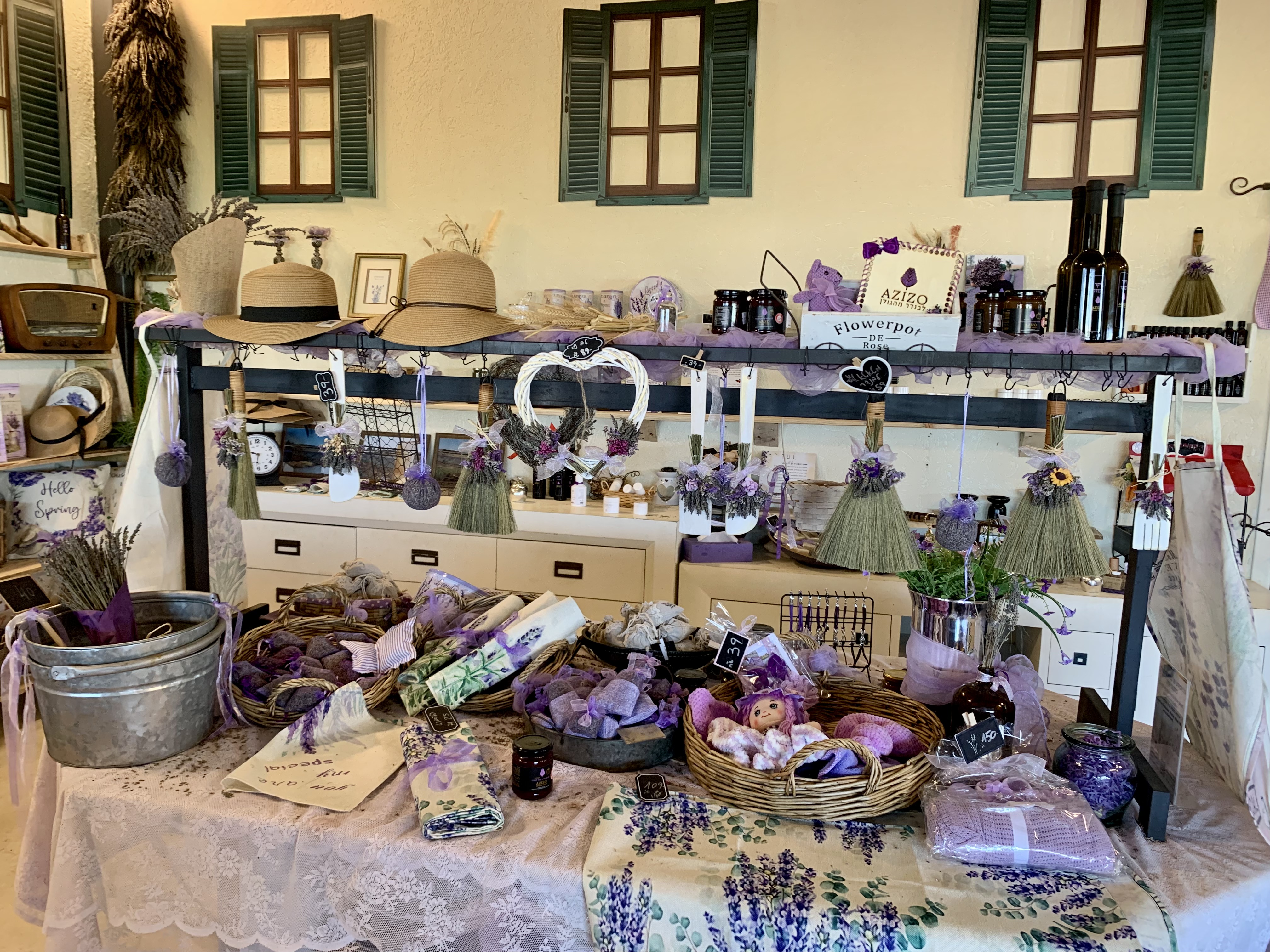
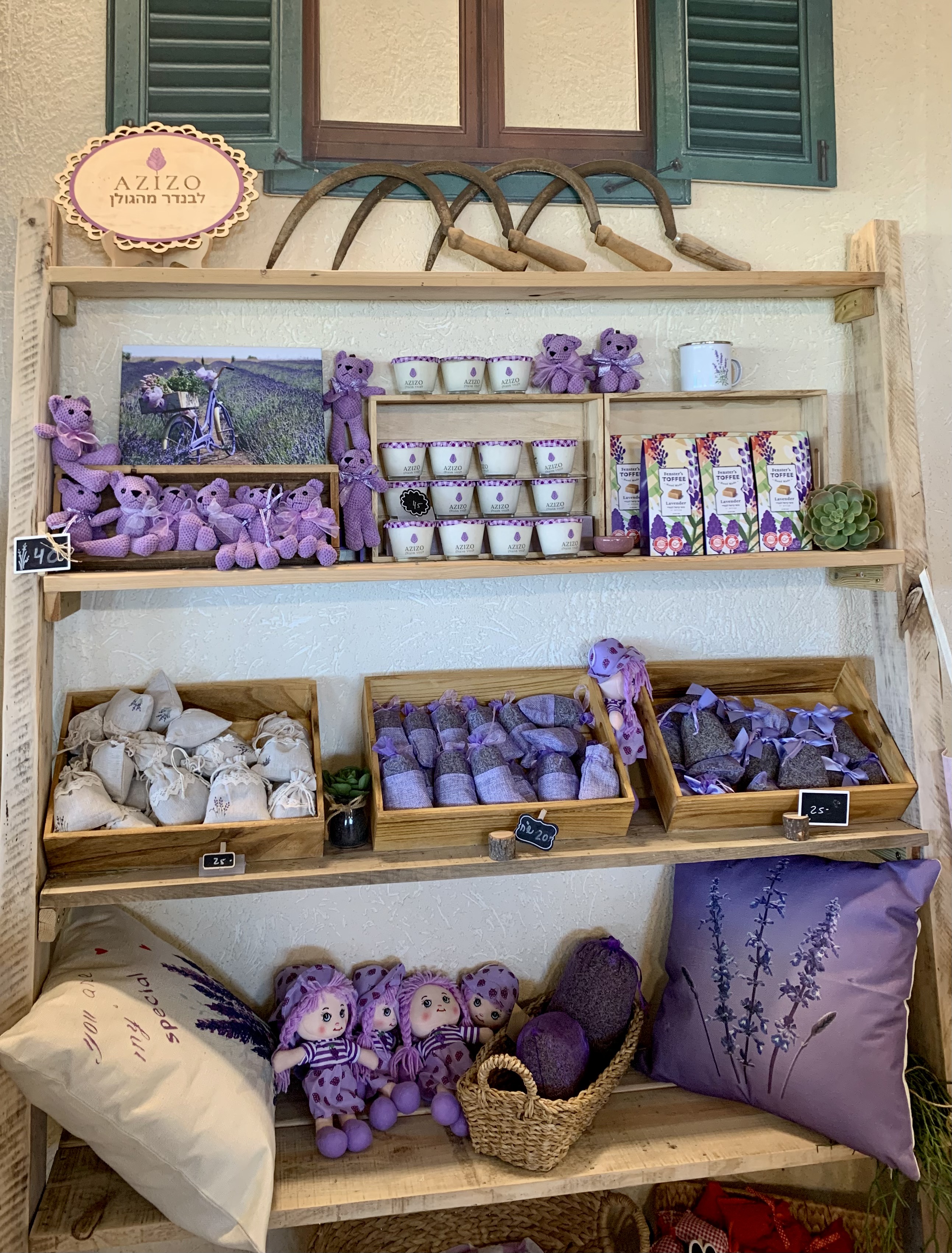
There is a classroom on site at Azizo Lavender for demonstrations, experimentation and projects for different ages. Throughout the year schoolchildren visit the farm to learn about the distillation process. They learn about all the different uses of this herby flower from medicinal to cosmetic to culinary. The ‘King of Essential Oils,’ lavender is antiseptic and anti inflammatory, so can aid in burns, headaches, digestive issues, skin problems, insomnia and is an anti-anxiety remedy. Azizo produces the finest soaps, candles, lotions, balms, oils, diffusers and sachets. The list is quite lengthy. Beehives have been placed adjacent to the fields, and now lavender honey is also part of their venture. Lavender fruit jams, lavender liqueur, lavender syrup, lavender chocolate! Azizo Farms has teamed up with DeKarina Chocolates to produce the chocolate and the liqueur. Powdered lavender is jarred for culinary uses. Herbes de Provence, their secret blend of Israeli herbs with lavender, mint, thyme, oregano and other dried spice is also available in the shop, which has been open daily for six years now.

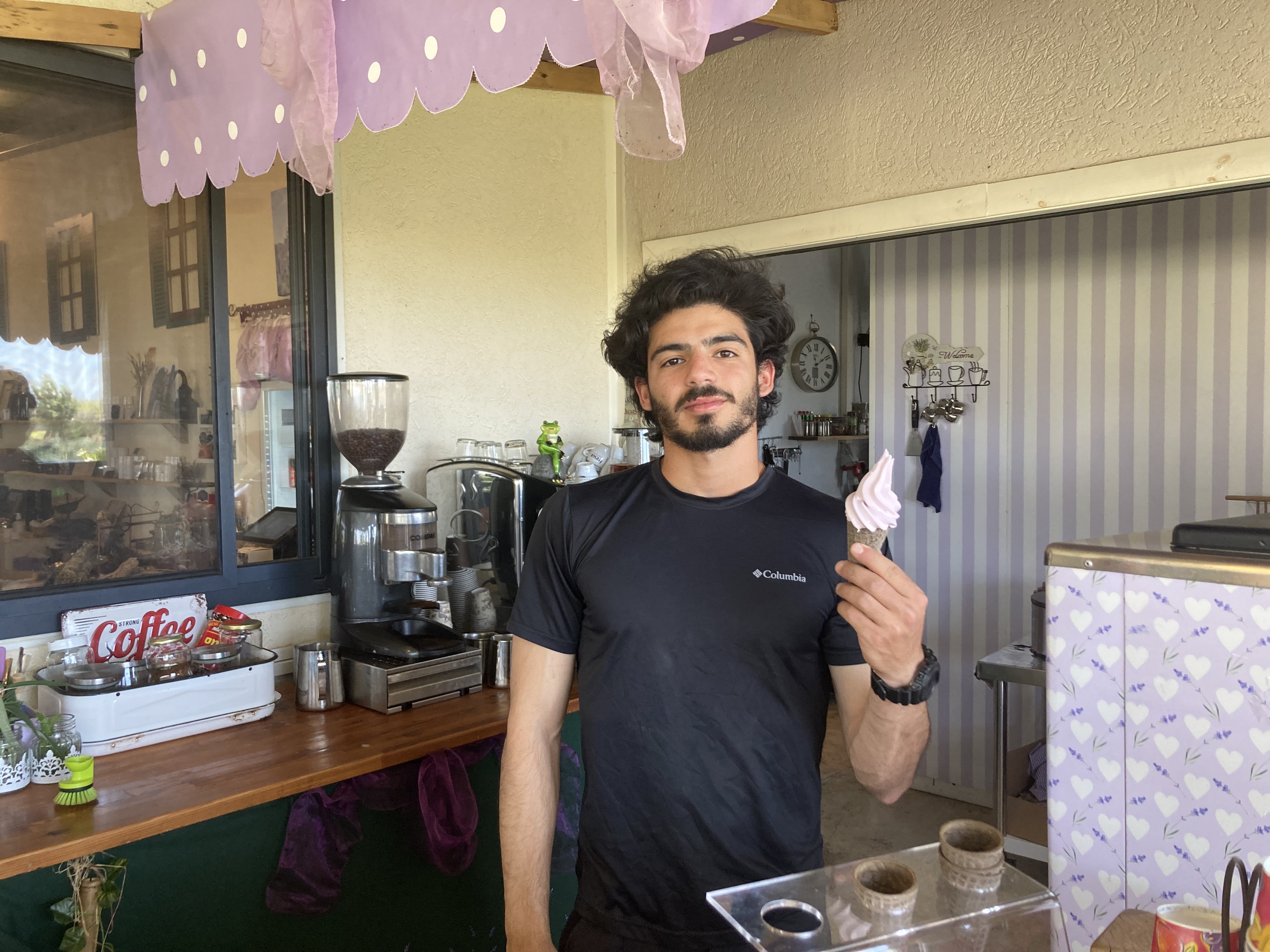
After over 40 years farming lavender, Dan and Lilach have finally given up their secondary jobs. All of their time is now devoted to Azizo Lavender, which has also become part of the eco-tourism industry in the Golan. Everything they do is sustainable and environmentally friendly. No pesticides are used in the growing and no chemicals are added in the production process. All of the labor from fieldworkers to cafe and gift shop employees live on Moshav Kanaf or the surrounding area. The gift shop is, of course, loaded with all things lavender. I bought a case of the liqueur. Now that summer is almost here, it’s amazingly delicious on vanilla ice cream, melon, or in a drink made with a tablespoon of the nectar with a spritz of soda water. I bought some sachets, a candle, and the ground dried seeds to use in cooking. John got a pot of bug balm for insect bites and a little vial of the essential oil for our diffuser. We ended our tour by splitting a small pizza with dried lavender sprinkled on top… it was very different, and very good. And we had the lavender ice cream for dessert. It’s definitely a place we will return to with guests. The views are spectacular and the hospitality “welcoming Israeli.” Admission is free.

Lilach’s Lavender Shortbread

Lilach served her cookies with a pot of lavender lemongrass tea. So easy to make, you just put a teaspoon of lavender and some dried lemongrass in a teapot, pour hot water over and let steep 5 minutes. The result is quite soothing and can be served both hot or over ice on a summer day. The tea stands on its own and needs no sweetener. The cookies were crisp and buttery—

INGREDIENTS:

  • 11/2 cups butter at room temperature
  • 2/3 cup white sugar
  • 1/4 cup sifted powdered sugar
  • 2 Tbsp chopped fresh lavender or 1 Tbsp dried lavender (organic)
  • 1 Tbsp finely chopped lavender leaves
  • 2 1/2 cups all-purpose flour
  • 1/2 cup cornflour (cornstarch in the US)

Cream together the butter and sugars in a large bowl. Mix in the lavender. In another bowl, stir together the two flours. Add to the ‘wet’ ingredients. Mix together well until all ingredients are combined. On two sheets of waxed paper, form the dough into two logs. Roll up and place in refrigerator at least one hour until quite firm. Preheat oven to 325*F/160*C. Remove dough logs from fridge and slice into coins. Place on parchment lined cookie sheet and bake for 16-18 minutes until just turning slightly golden. Remove from oven. Let cool. Keep in covered tin for about 2 weeks. These also freeze well.

Lavender Honey Glazed Grilled Chicken

We had friends over for the holiday of Lag b’Omer, when it’s traditional to make bonfires and eat grilled food (it’s often the food that goes with these holidays). We celebrate the creation of Light and the Divine Light that entered the world. It also commemorates the death (Feast Day) of the great Rahsbi, Rabbi Shimon bar Yochai, the 2nd century Talmudist. Anyway, we had a barbecue with friends and I served grilled green beans from my garden and butternut squash and chicken glazed with lavender honey. Rather than buy the honey at Azizo, I made my own. It’s really easy and I use it on/in tea, cooking, over yogurt or ice cream and as a glaze. It imparts a lovely fragrance and flavor.

To make the honey, I steeped whole fresh lavender leaves and flowers in 2 cups of honey. I put it in a saucepan and heated it on medium heat on the stove and just let it gently simmer for about 20 minutes. The kitchen smelled so good!!!After the honey cooled, I strained the liquid back into the jar. No need to refrigerate.

INGREDIENTS:

  • 2 kg (4 lbs) chicken..I used breasts, each one halved (thighs/pargiot) work well too
  • 1/2 cup lavender honey (see instructions above)
  • 1/4 cup good quality balsamic vinegar
  • 1 TBSP fresh rosemary, chopped fine
  • salt & pepper

This is so easy to make. Rinse and pat dry your chicken pieces. Salt and pepper. In a small bowl, combine the honey, vinegar and rosemary. Pour over chicken, reserving a bit for the glaze. Refrigerate the chicken and let marinate about an hour before grilling. Grill each piece over a high flame to sear, then lower to medium high heat. Grill chicken about 6 minutes each side. In least minute of grilling, brush with the honey glaze. You can sprinkle dried lavender or some of the chopped rosemary over the top to serve.

Some of the lavender drinks I’ve been “playing around” with are Lavender Lemonade: freshly squeezed lemon juice, some water and the lavender honey to taste. Last night before bed I made a Lavender MoonMilk: I heated a can of coconut milk and added the lavender honey to flavor. It was a nice end to the day, and I think I’ll try using that same recipe to make an ice cream by putting it in the ice cream maker and then freezing. When I was in England, I discovered their London Fog Tea, which became my go-to drink. It soothed try soul – between the cold, wet weather and everyone driving “on the wrong side,” it kept my nerves in check just to sip and smell.The London Fog was Earl Grey tea, a spot of milk, and lavender simple syrup.