"When G-d will return the captivity of Zion, we will be like dreamers. Then our mouths will be filled with laughter and our tongues with glad song." Psalm 126
A friend recently reminded me of the goodness of the L-rd. Living here in Israel, John and I are a believing and praying people. We have seen so many prayers answered from large to small almost on a daily basis (We are still waiting for some to be answered. For some of you Special Ones who read this blog, know that your prayers are being lifted up by us on a daily basis.)
It’s really hard for us to be in a state of unbelief or disbelief as we encounter archaeological sites that absolutely prove beyond the shadow of a doubt that the words in the Scriptures are at the very least historically accurate. We have visited the oldest city gate in the world that has been uncovered. It’s from pre-Canaanite times and is the place where Abraham met with the kings to discuss the ransom of his nephew, Lot, who was taken captive. You can read the exciting story in Genesis 13. It’s in Dan, on the Lebanese Border. We׳ve visited so many places that attest to the veracity of the Bible, so…..
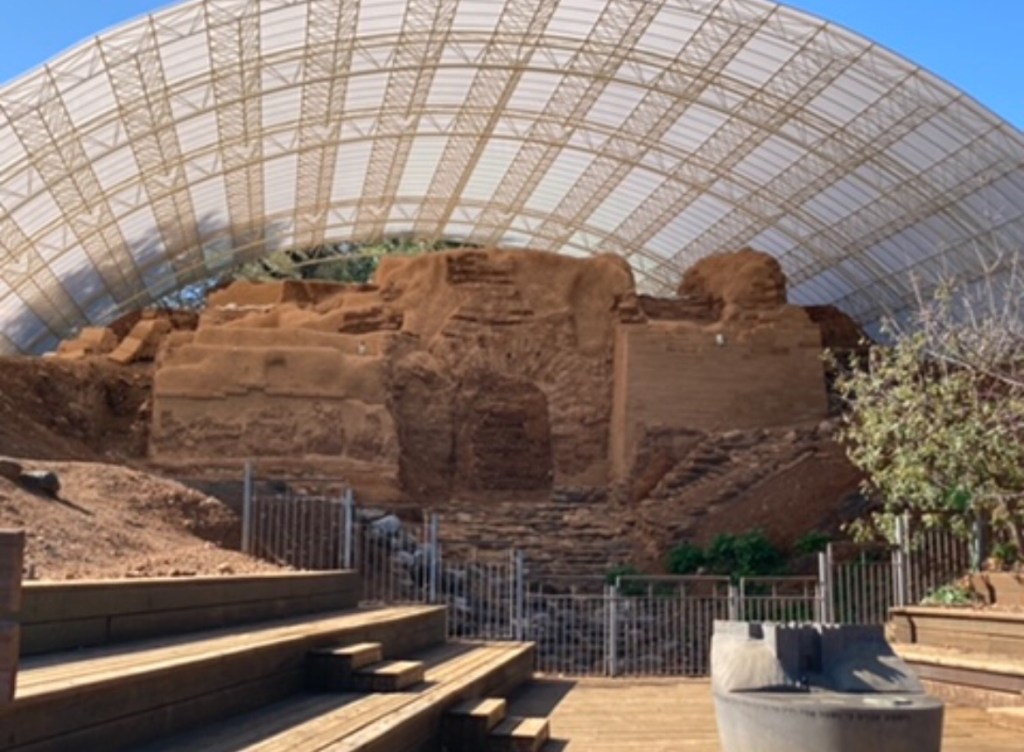
The ancient city has been closed off. Its sandstone walls were so delicate they began to crumble after excavation.This is the oldest fortified city ever found. It dates to around 1900 BCE !!The city gate where Abraham met with the 5 kings in Genesis 13. The gate has been sealed due to rapid erosion.
Anyway, one of our daily prayers is for the protection of all the IDF soldiers, wherever they are stationed. We pray this in the morning and at dinner. But we have added: protect them from every booby trap and every kidnapping attempt. We have received multiple answers to prayer on this one…
In yesterday’s news –
Yesterday in Khan Younis, Gaza, more than 20 Hamas terror operatives emerged from a tunnel in an ambush attempt on an IDF encampment.They approached firing machine guns and RPGs. Some terrorists actually breached the encampment, engaging in close combat with the Kfir Brigade troops. The IDF radioed for backup and airstrikes killed 15 operatives while 8 escaped back into the tunnel. A kidnapping attempt of 4 soldiers was narrowly averted. The IDF is actively pursuing the remaining operatives. An extensive investigation is underway to draw all necessary conclusions. Hamas has continuously tried to kidnap soldiers throughout the conflict. So far, all their attempts have proved unsuccessful. 3 Israeli soldiers were wounded and medivac’ed to local hospitals in Israel. – Hamal News
In other news, we all keep hearing about “settler violence.” It’s big news. “Settler violence” is the grossly over exaggerated stories of the Jewish families living in Judaea and Samaria (West Bank). Many are farmers and shepherds. The farmers have extensive vineyards and orchards. They grow dates, pomegranates, grapes, olives, and herbs and spices among other things. Many are artisans, making food, wine, ales, cosmetic products, candles, crafts and spice blends. Many are shepherds, grazing their herds of sheep and goats…and cows…across the fields to graze.
I’ve spoken with residents in Tekoa, Itamar, and Efrat. I have read police reports and incidents reports from the Binyamin and Yesha Regional Counsels. There are thousands of incidents of Arab gangs who pull up the plantings of the Israelis, who lie in wait for them in ambush. There are videos of gangs ambushing settlers, throwing large rocks at them and the livestock. There are videos of these marauding gangs setting fire to the grazing pastures of the Israelis. Yet all you hear about is settler violence.
These gangs are not ignorant. They stage attacks and wait for the shepherds to defend themselves, filming everything so that it looks like the settlers are the instigators, not the defenders. And it makes international news.
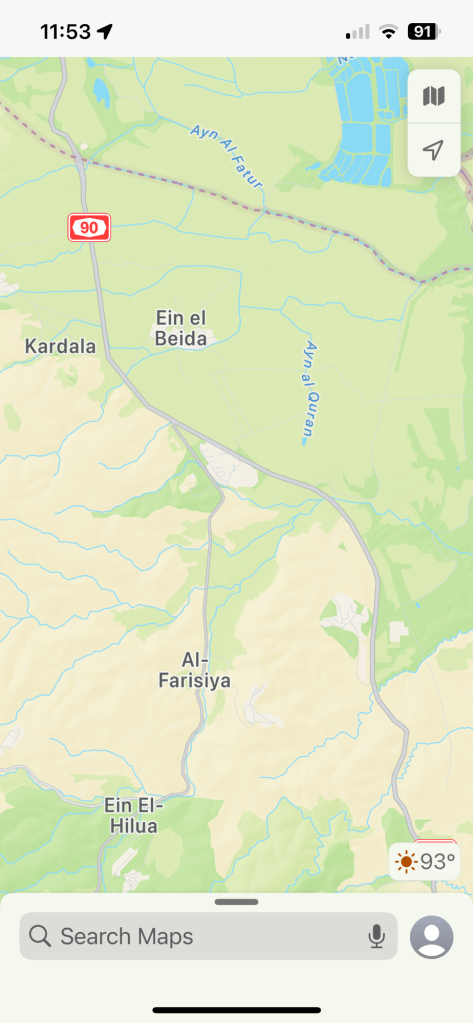
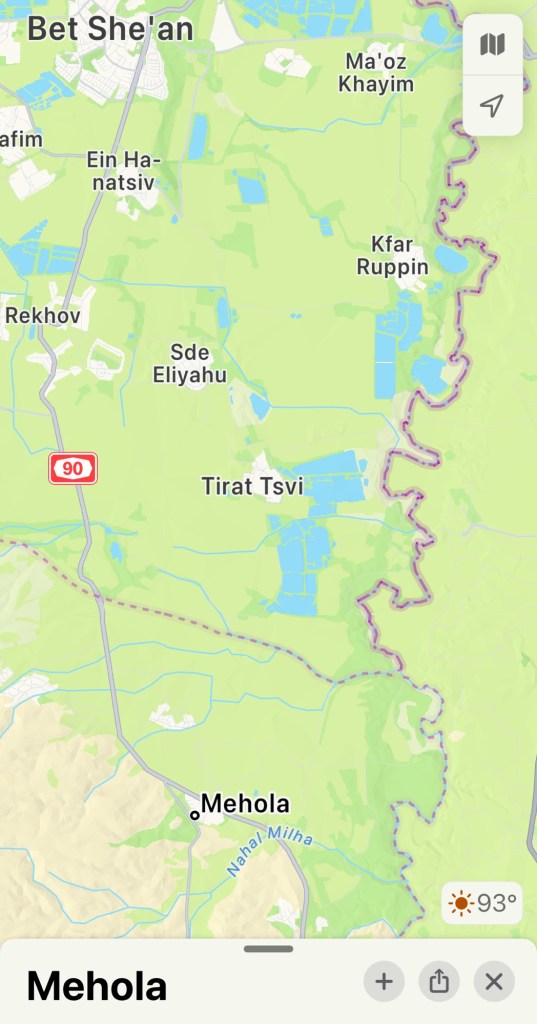
Today marks theone year yarzeit (memorial of a death) of the murder of Yonatan Deutch, a Maglan Unit soldier who was on his way to Ofra (community in Samaria) to see his fiancée, Emunah. At Mehola Junction on Route 90, just south of the West Bank border line, his car was ambushed and shot at by West Bank terrorists. His car veered off the road and he was shot multiple times.
In the exact spot where his life was cut short, his family and friends chose to respond not with despair, but with hope and strength. They opened a pop-up coffee shop, ‘Cafe Jonni.’ Here travelers can stop for refreshment and remembrance. It is a sign of Israeli resilience. It is a statement to the Arabs and to all the world that “Am Yisrael chai,” the People of Israel live.
Jonni and Emunah, above, Cafe Jonni belowMehola is a tiny Jewish village surrounded by Arab villagesYou can see Mehola, where the killing occurred is just past the border line
As of this morning, the Magen David Adom paramedics were called to the scene of another Arab attack on Israeli shepherds (settlers). One was injured very lightly by a bullet that strafed his head. The other shepherd was shot and is in fair condition in a regional hospital. They were driving in a semi protected ATV, called a Ranger, which overturned while herding their cattle. The pair were ambushed. This is the story from i24 News:
Because i was informed that my blogposts are just way too long, i shall end it here on a positive note.
In other news, just in time for the new school season and the fall holidays, a Nefesh b’Nefesh sponsored plane load of 225 new olim (immigrants) landed at Ben Gurion Airport yesterday morning. These families from the United States have decided to make the exciting journey to live in Israel. The youngest is 9 months old and the oldest is 82. There were also several Lone Soldiers, coming by themselves to enlist in the army. May their absorption and Aliyah experience be easy, joyful and smooth as they transition to their new lives as full Israeli citizens.
They were met at the airport with bands, balloons and crowds of well wishers
To all those readers and old friends who have emailed and called us since Thursday out of concern for the plight of Christians in the Holy Land and for those who want further clarification, thank you for reaching out.
I know the news that does eventually make its way to your parts of the world comes piecemeal at best, and at worst, with twisted narratives. In the past two weeks there have been several different slanders, accusations and confusing stories from Judaea and Samaria (West Bank) and from Gaza. Of course, the international community seems to get involved before having all the facts, so once again….here we go.
First, leading newspapers around the world have headlined with dramatic photos of starving babies…the humanitarian aid crisis and mass starvation of the Gazan people. The above photograph appeared on the front pages of the NYT, the UK’s DailyExpress, and was picked up by Sky News, BBC, CNN and other media outlets. The young boy, Mohammad alMatouq suffers from a rare genetic condition and muscle disorders unrelated to starvation according to independent investigative journalist, David Collier. Mohammad’s mother as well as his younger brothers, who was photoshopped out of the picture is healthy. This is not to diminish the immense tragedy, but to give context. There is an undeniable humanitarian crisis unfolding in Gaza.
But not for the reasons you’ve been told. This is a story that goes way back. I have covered it numerous times. No one wants to see people in a famine – especially innocent children. They deserve dignity as human beings, not suffering for political gain. Since the beginning of the war, there have been continual attempts made to get food, medicine and supplies into Gaza.
Unfortunately, the situation is a complete balagan or crazed mess. Hamas still rules Gaza. Despite Israeli attempts to get desperately needed supplies to the people, Hamas operatives dressed as civilians storm the trucks, kill the drivers and commandeer the goods. They pirate it for themselves and then sell it off at inflated prices to those willing to pay. It’s basic extortion. What was meant to be given away as free assistance is being sold on the black market at exorbitant rates. Also, Hamas operatives have been using the food as incentives for people to join up with them. Basically, you help us, and we’ll let you have food. Tragically, death and suffering are part of the terror group’s modus operendi. Victimizing the innocent civilians helps the cause of Hamas by provoking the outrage of the world. The truth, however, is essential.
The United States has subcontracted with the GHF (Gaza Humanitarian Fund) to set up heavily guarded independent aid centers at different marked locations throughout the Strip. Although it was reported falsely that IDF soldiers were firing on people waiting in line to receive their donations, it was actually Hamas operatives. So far 13 American contractors have been killed while attempting to distribute goods. Still, the endeavor is ongoing and seems to be helping many people who are in distress.
The UN is also involved. There are currently 1046 trucks piled high with assistance (food, hygiene products, baby formula and bottles, water, tents, medicine, sunscreen, diapers) millions of tons of supplies all waiting inside Gaza. Not outside. Inside the border of Gaza. It’s owned by the United Nations (UNICEF, UNaid, UNHumanitarian Relief) But they will not allow it to pass through to the people. Why?
The UN is following the orders of Hamas. They are using starvation as a negotiating tool with Israel. Israel has allowed the trucks in after inspection for weapons and contraband. The US has implored the United Nations to let it pass through to the people, but the UN has flatly refused. Hamas has insisted the UN escort the aid. Even Egypt has told the Washington Post that Hamas is stealing the cargo.
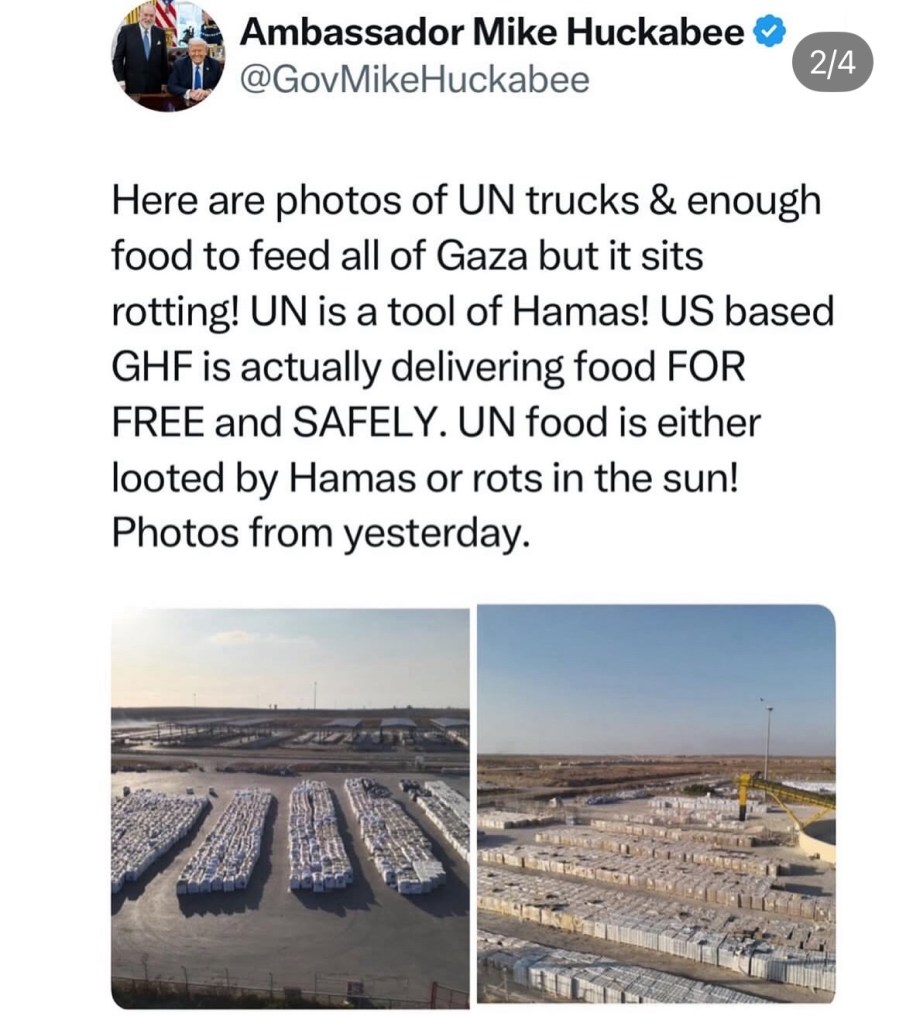
Ambassador Mike Huckabee traveled to Gaza last Friday to assess the situation for himself. He surveyed the area, saw the drone footage of the pallets and trucks in the parking lots and saw for himself the rotting produce.
Over 2 million TONS of aid sits rotting in the sun in Gaza
Israel has started parachuting aid packages directly into the tent cities and neighborhoods in which civilians are known to be residing. Whether that will fall into nefarious hands or not remains to be seen, but Israel and the U.S. are doing the absolute best they can to mitigate the dire circumstances. The global communities are imploring Israel (not Hamas) to sign a ceasefire agreement.
There is no ceasefire because Hamas will not acquiesce. They refuse to let the remaining 51 hostages go. They refuse to lay down their weapons. They have rejected ALL negotiations, deals or opportunities to end this. The onus lies on them.They refuse to give up power. Even if it means starving their own people. This is not about peace. It is about power. Despite all this, Israel has agreed to a pause in all military operations from 10am to 8pm “every day until further notice” in order to allow aid corridors to be established for safe passage of trucks to reach the civilians. Today, over 100 semis have been allowed free passage defended by the IDF, who seeks not only to protect its own people, but to protect those who are in opposition. Jordan and the UAE have air dropped 25 tons of aid into Gaza.
Backed by UN funding and Qatari billions, this entire war has been needlessly prolonged and the plight of the innocent civilians is turned inside out into victimhood for the sake of world sympathy. The IDF, the Israeli government and the Jews are the villains in this distorted propaganda war.
In other news, the so-called “visa crisis” addressed by Ambassador Huckabee has been completely resolved. The person who was holding up entry visas for Christian tour groups to come to Israel has been fired. It was discovered, upon investigation that a far right religious Jewish government worker was denying entrance visas to what he believed to be missionary groups. He’s gone. Paperwork expedited. Case closed.
Mike Huckabee has been one busy man lately. He was present at the scene of the “church burning” in the (West Bank) Christian town of Tayibe last week. His words were completely mangled once it reached the press to make it sound as if he was condemning Jewish setttler terrorist acts. He did not say this, only that the case should be completely investigated and anyone who causes damage to a religious or heritage site as an act of terror should come under full force of the law.
For complete clarification and visual proof -with some absolutely damning evidence – I refer you to Josh Waller and Luke Hilton:Please watch this short explanatory video and pass on the information.
In addition, a bit of a more lengthy video that fully explains the entire situation and the settler violence. It is fully researched and well presented.
No, Israeli citizens are not targeting Christians. And neither is the IDF. From everything I have witnessed since we have been in Israel over the past decade, is that Israelis (for the most part) treasure antiquities and historical sites. They preserve and not tear down. There is a respect for other religions (for the most part), as long as a person is behaving in a law abiding orderly manner. There will always be those outliers and extremists who cause trouble, however.
There are the ultra observant from all religions who look down upon and cause trouble for others. From the Haredim Orthodox Jews who shout out, harass and abuse Christian tourists to Catholic priests throwing rocks at Jewish settlers. From Muslim violence against Christians and Jews they consider infidels and occupiers to the extremely secular who dislike all super religious. It is evil. I in no way condone bad behavior. It needs to be examined, rebuked and prosecuted. But it is far and beyond the exception to normal life here.
Jews do not “target” Christians or their holy sites. Synagogues, churches and mosques, unless proof is given that they are being used for purposes of terror or criminal intent, are holy and to be respected. There is freedom of worship here. It is a sacred and basic human right. Any reports to the opposite are verifiably false and libelous.
Tourism is a huge source of revenue for Israel, so anything that would endanger it is discouraged. Besides Jewish people from around the world, Christians of all denominations have been our biggest supporters in our fight for truth and freedom. We share common ancestry and a common morality as dictated by the Scriptures.
From some of the calls we received, quite a few people had heard that the Jews were persecuting and killing Christians and the IDF was routinely demolishing churches as some sort of sick and twisted hate crime. Not true. This is propaganda. Please seek out the truth for yourself from reliable sources. These include Pulse of Israel; The Israel Guys; Israel Video Network the Philos Project, Shadi Khalloul and United With Israel.
In his article, Is Gaza Starving? Searching for Truth in an Information War, Matti Friedman writes, “ In a blizzard of ideological fiction, how are sane citizens in Israel, or anywhere else, supposed to know what’s true and to do the right thing? It’s not an exaggeration to say, as we’re seeing right now, that the answer to this question is a matter of life and death”
When I started this blog, I had decided to stay away from anything political, contentious and anything that would possibly offend or be misconstrued. I shied away from all the elephants in the room, not wanting to ignite a firestorm. I have received beautiful letters of solidarity and friendship from many of my readers along with personal texts and emails. On the other hand, I have chosen to delete several messages from “trolls” who are either antithetical to Zionism (the belief that Jewish have the right to return to their ancient and ancestral homeland), to the Jewish faith and to Israel’s position to fight against evil and terrorism militarily.
The Israeli Defense Forces are not just fighting an existential war against terror and evil to protect the Jewish nation, but they realize they fight to protect other ethnicities, innocent civilians, both within Israel and abroad. So in the next article or two, I hope to address the elephant in the room. The Christians in Israel and Syria who are being heavily persecuted by the radical Islamists.
Christians in Israel make up about 5% of the population. They are divided mostly into Eastern/GreekOrthodox (Melkite); Latin/Roman Catholics and Maronites; Arameans; with a smattering of Anglican, Baptist and other believing sects. The majority are Arabic speakers. Many are indigenous to this land, the original Christians; others are refugees from persecution in Lebanon, Egypt, Jordan and other Middle Eastern countries.
Bethlehem in Judaea is the birthplace of Jesus, the second holiest site in Christianity. The city was 98% Christian just two decades ago. It lies in the mostly Palestinian part of what is called the West Bank, just about 8 miles from Jerusalem as the crow flies. Jewish people holding Israeli passports are not allowed entrance to this territory without a special tourist permit. Today the Christians total less than 2% of the total population, most of them being clerics.
The Muslims who live in this once Christian area have what we call their own “mafia.” They impose large taxes –jizzia or protektzia – upon small the Christians – mostly multi-generational, family owned business, artisans and sellers of religious objects, restaurants, cafes and hotels in return for having no harm come to their places of livelihood, homes or family members. It is extortion followed by violence.
Unfortunately, this all too often has gone unseen or has been couched under “Arab on Arab violence” and has not been curtailed by Israel or the Palestinian Authority. In addition, as Christian families flee for safer cities within Israel or abroad, the Muslims move in. Because of the newer, Muslim majority, Palestinians who are unfavorable towards Israel, more radical Muslim mayors have been elected. The Israeli Jews seem to be too busy fighting other wars to address this serious problem.
The radical Islamists even seem to have sway over the different Bethlehem churches. At Christmas celebrations, since the tourism has sharply declined from the time of the pandemic to today, Christmas celebrations have been curtailed or cancelled by the local authorities. Lights displays are no more. Christmas trees in the town square have been replaced by martyrs trees (decorations are the faces of Palestinian terrorists eliminated by the IDF while committing an attack). Traditional nativity scenes have been replaced by displays of “Christ in the Rubble,” a political statement. Negative propaganda put out against ‘the occupation’ by the Churches are part of the protektzia. Look it up. See for yourself. Martyrs tree, Bethlehem. Christ in the rubble.
We live in the Northern part of Israel, the gorgeous and mostly peaceful Galilee region. Small Jewish kibbutzim and moshavim and medium sized towns are being surrounded by an ever-growing Muslim presence. Our city is less than a half and hour drive from Nazareth. This city, most famously known as the place where Mary was visited by an angel and where Mary, Joseph and Jesus lived and worked as an observant Jewish family of carpenters, is another one of the holiest sites for Christians worldwide. The largest Catholic Basilica Cathedral in the Middle East, the Church of the Annunciation, is located in the heart of Nazareth. In Israel. The city also has a large Orthodox presence, centered around Mary’s well. In 2010, Nazareth was 99% Christian.
Nazareth received most of its income from Christian tourism. There are more convents and monasteries in Nazareth than any other Israeli cities outside Jerusalem. They used to be beautiful, welcoming places. Now, most are hidden behind tall, barb-wire topped walls for protection. In Nazareth, too, the Islamists have taken over. Threats against Christian businesses have become commonplace. Targeted killings have occurred since 7 October. Unfortunately, Israel expects the local governing bodies to police their own towns, but the mayor of Nazareth is now Muslim. For the past several years, the Christmas celebrations have either been curtailed or cancelled altogether. (Nazareth also boasted the largest Christmas tree in the MidEast with Christmas markets and parades.)
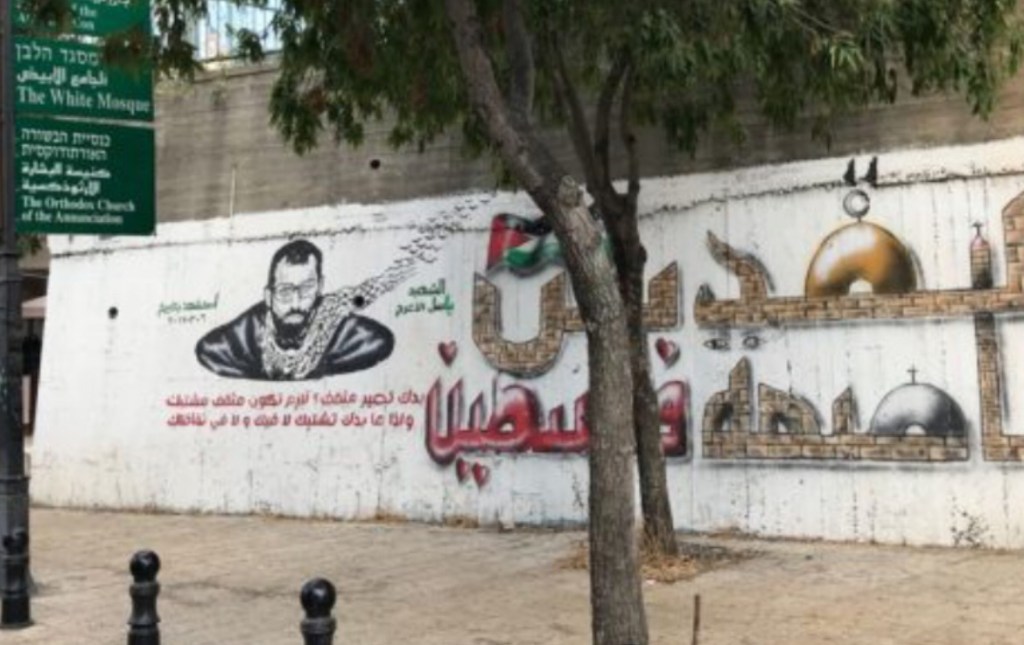
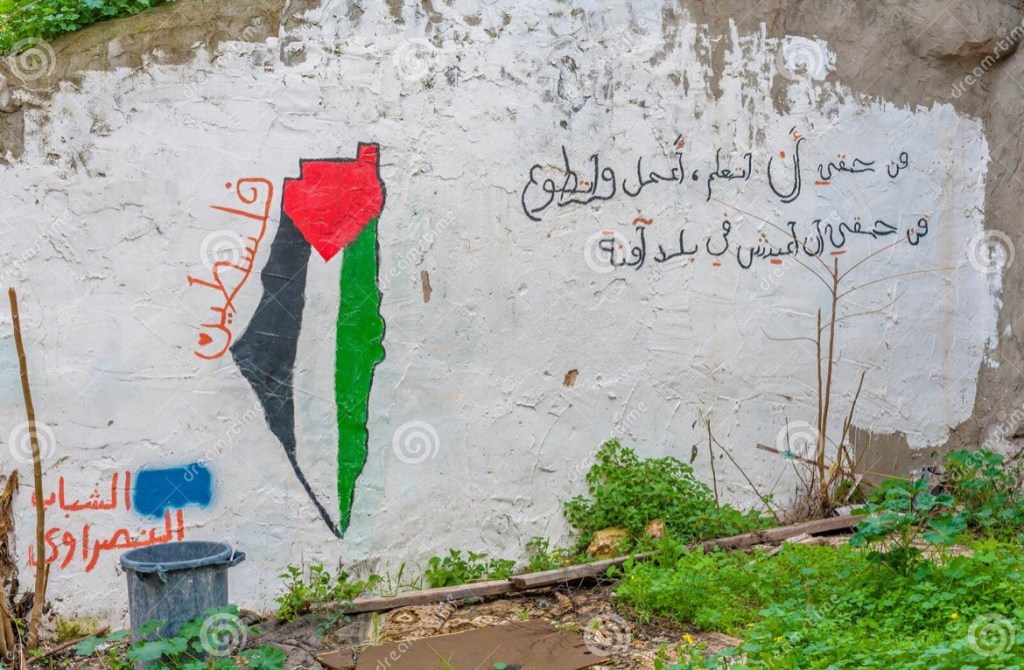
Large concrete walls throughout the city have been painted with Palestinian flags, swastikas, slogans against the “occupation,” and pictures of the martyrs, aka eliminated terrorists. They are often whitewashed, only to reappear, making the city a most unwelcoming place for non-Muslims. John and I personally know families from Nazareth who have left for our pluralistic, safer-feeling cities like Haifa, Karmi’el and the Kryot and for immigration to Canada and the United States. One family who we know, left without a word one weekend, after receiving numerous death threats. We still have no idea where they went.
Until the last five years, there were Christian majority Northern Israeli towns: Shefaram, Deir Hanna, Deir Al Assad, and Ibillin. Here, too, these towns are facing the same predicament. The “Arab mafia” has moved in. As an interesting aside, the word Deir, is Aramaic, for monastery. These towns from the 4th century once centered around ancient Byzantine Churches supported by the indigenous Christian population. Deir Hanna is the Monastery of St. John. Deir Al Assad, is the monastery of the lion, or St. Mark’s Monastery. The Muslim Arab population who moved in did not bother to change the original Christian name of the town. There is the clue, the reminder.
The problem of Islamic persecution of Christians is not just a phenomenon in Israel. It has happened throughout the Middle East. Entire countries have persecuted and killed and expelled almost their entire Jewish and Christian populations: Egypt, Libya, Yemen, Just this past week the Egyptian government took over all property rights to St. Catherine’s Monastery in the Sinai.
Located at the foot of Mt Sinai , it is the oldest, continually inhabited Christian monastery in the world. Founded in the 6th century by the Emperor Justinian, St. Catherine’s is home to some of the most ancient icons, relics and manuscripts. The Greek Orthodox monks have preserved the spiritual integrity of the site for over 1500 years. The monastery is said to be built around the burning bush of Moses/Exodus fame. It is now part of Egypt’s public domain. They have also appropriated 73 smaller Christian sites surrounding.
Because it has been a site for pilgrims from throughout the world, the government is considering turning this into a resort tourist area. Since 1980, the monastery has submitted documents of ownership for the 74 places including receipts, land rights and tax documents. The state has refused to recognize any of this. The monks are now being ordered to pay rent for use of the properties. The monks yesterday, Pentecost Sunday (the birthday of the Church) closed their doors to any and all outsiders. See Acimena.com for more information.
In Syria, the new rebel government that ousted Assad are now seen to be the ‘good guys.’ Formerly one of the heads of alQaeda, the new Syrian president has labeled himself a moderate and recently has had a seat at the world’s negotiating tables. This past week has seen Syrian Islamic terrorists going from village to village murdering Christians and Druze. Local sources confirm massacres in minority communities. Young women are being raped and taken against their will. Entire villages are being emptied and burned in areas of southern Syria near the Israeli border.
In response, Israel has launched targeted airstrikes aimed at stopping the attackers and preventing further atrocities. The international community has said nothing about this Syrian Islamic extremist violence against vulnerable religious minorities. We ALL must demand coverage by the press, truth from the international arena and accountability from the Syrians.
Nigeria has been hard hit as Islamist radicals are wiping out entire villages of Christians. These are actual genocides as complete and targeted minority populations are being massacred. Women and children beheaded. Congregants bolted into their churches as they gathered for Mass. Last week, Fr. Alphonse’s Alina, Nigerian pastor of Catholic Church in Fairbanks, Alaska returned home for a visit. His Mass was attended by over 200 people. While traveling to another village in the northern part of the country, Fr Alphonse’s was kidnapped by the jihadists group, Boko Haram. They desire to see Nigeria turned into an Islamic state, and the current government is doing nothing. Bishop Steven Maekawa has asked for continued prayer for the father’s safe release.
This Islamist jihadi madness is not localized in Israel (think from the River to the Sea chanters). Paris was overtaken on Saturday once again by thousands of Muslims at prayer around the Eiffel Tower. Tourists had no access. This occurred after riotous jihadists burned tired and cars and broke windows throughout the city just nights prior. Innocent women passengers were pulled out of cars and raped. Stores were broken into and looted and buildings and monuments grafittied. All this to further the freeing of Palestine.
London is a nightmare. Marchers, demonstrators, a literal infiltration into the highest of government offices are part and parcel of the agenda. Today, on the streets of Brussels, Belgium a dramatic reenactment was held of the 7 October massacre in Israel. Blood and bodies on the ground and people staging the kidnappings. All to the background of French music and keffiyeh covered “actors.” There are similar weekly demonstrations throughout Europe. Truly the Intifada (aka wipe out Israel and the Jews) is being globalized. Los Angeles riots throughout the weekend show not only a protest against ICE and deportation of illegals but a stand of solidarity with Gaza. It’s time to wake up, people….
As an aside, I’ve spent the last hour scouring YouTube for footage of these events. Footage I saw just this morning. As soon as a video showing pro-Palestinian rioting or violence is posted, it is taken down. Apologies for this. I shall continue my search-
This is an unusual year here in Israel. For the first time in many years, Passover, the Roman Catholic, Orthodox, Coptic, and general Christian population celebrate concurrently their Holy Week. It is an exciting and special time to visit the Holy Land. This year, convents and hostels are filled with Christian pilgrims – many of them have traveled from Poland, the Philippines, Mexico and South Korea. Jewish people from the United States and Canada have come to celebrate Pesach with family living here. Still, the recent war has kept the multitudes away for the most part.
For the Jews, last Shabbat led right into the Pesach/Passover Seder. Families gathered together. Army units had their Passover Seders in dining halls and in the fields. Everyone celebrated the story of the liberation from Egypt under Pharaoh, the crossing of the Red Sea by Moses and the Children of Israel in Exodus, and ate the festive meal. During the seven days of Chag ha Matzot (the Matzah holiday) or Khol ha Moed, the intermediate days, Israelis head to to the hills and mountains hiking and to the shores of Lake Kinneret (Sea of Galilee) camping. For those that stay in the cities, museums are all free.
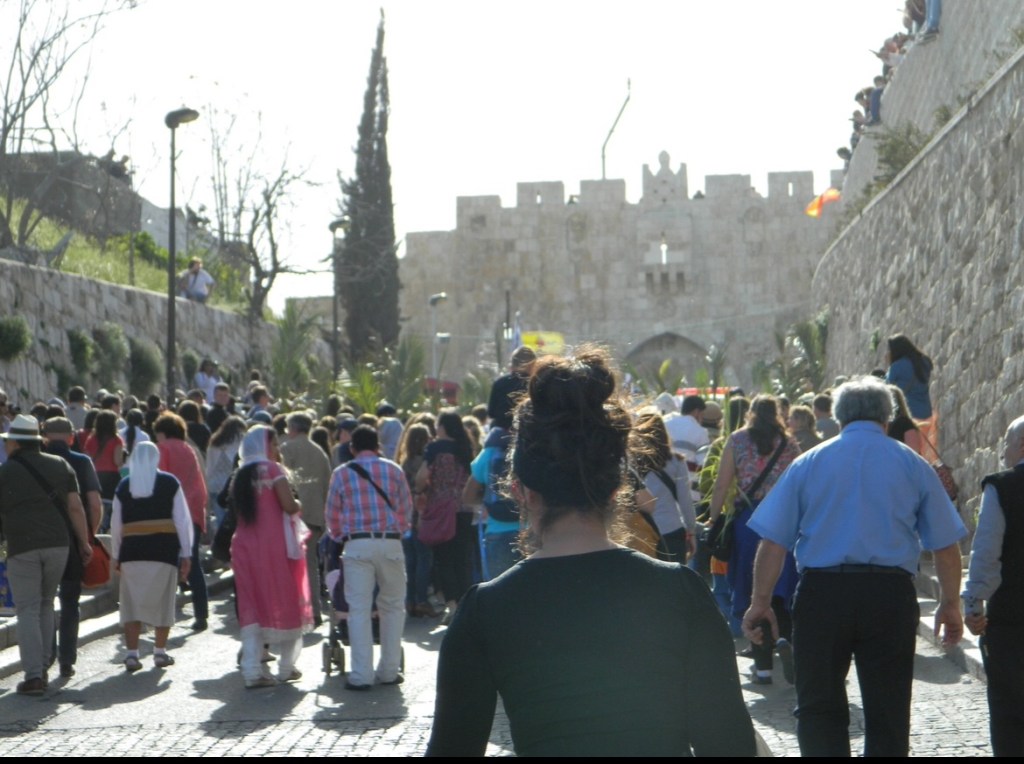
As the Seder feasts wound down in the wee hours of last Sunday morning, Holy Week started for the Christians. Thousands gathered with palms for the traditional Palm Sunday walk. Tens of thousands of pilgrims came from all over the world. The crowds were still not as large as in most years, but the festivities started at BethPage at the top of the Mount of Olives, Har Zeitim. The Latin Patriarch and the Franciscan Custos of the Holy Land blessed the palms and the participants in the walk. The Arab Israeli Scouts from Jerusalem, Nazareth and Ibillin led the procession.
Arab Israeli Scouts lead the procession with drums and bagpipes
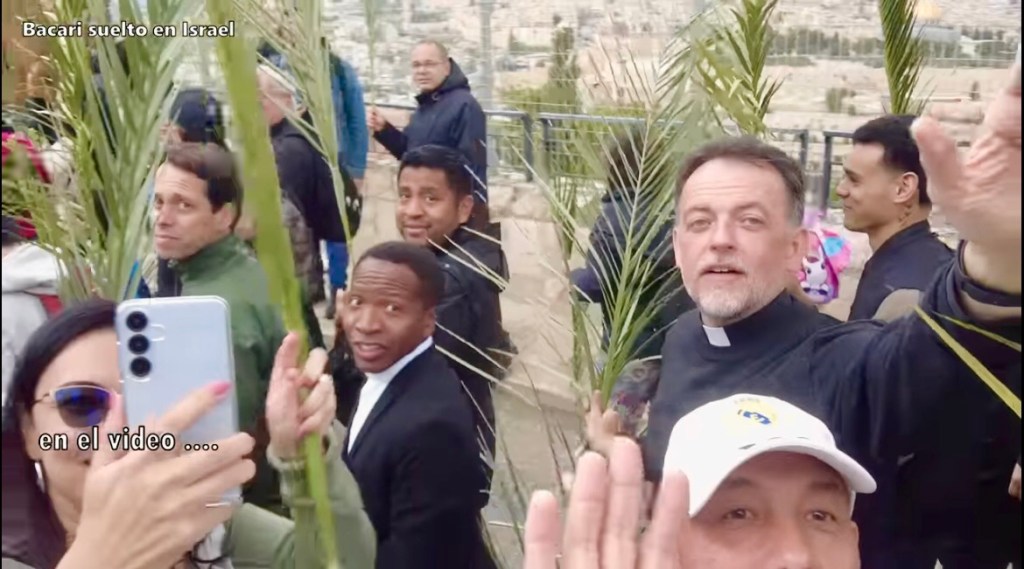
The walk starts at the top of Mt. Olives and winds its way down through East Jerusalem. Spectacular views of the Temple Mount, Old City and all of Jerusalem are one of the high points of the walk which traces the path of Jesus from the starting point to its finish within the Holy City. The entire walk is about 3 miles. As in the Gospel accounts, people wave palm and olive branches and sing Hosannas and great Hallels. Security is tight with armed soldiers ready against any act of terror. Helicopters circle overhead for added protection for the walkers.
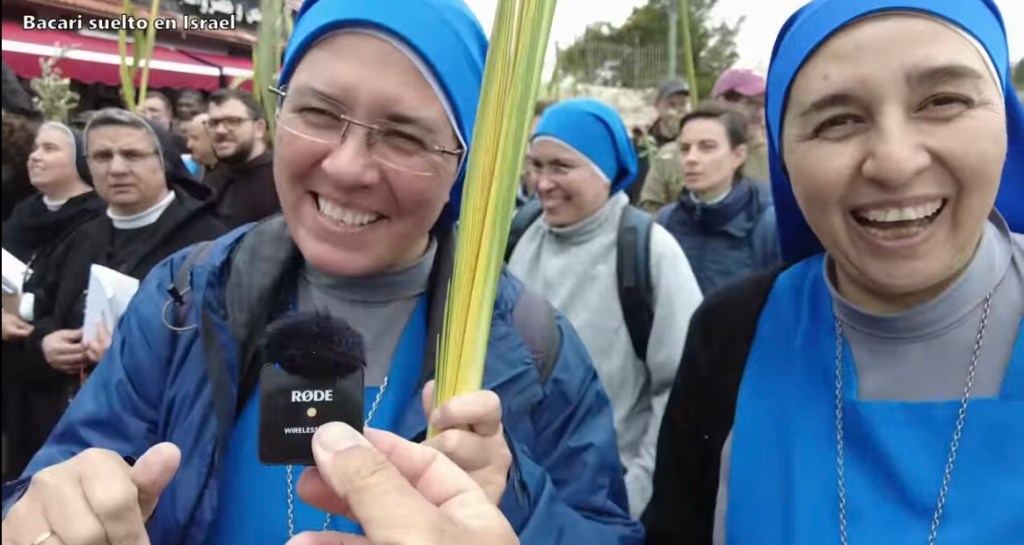
Mexican pilgrimsInternational throng with palmsThe Franciscans A group of nunsFr. Francesco Voltaggio with the NeocatechumensThe Hebrew CatholicsSweeping views of JerusalemKoinonia John the Baptist from ItalyA procession of Hebrew Speaking CatholicsThe pilgrims enter the Lion Gate into the Old City
And even Jesus showed up for photo ops…
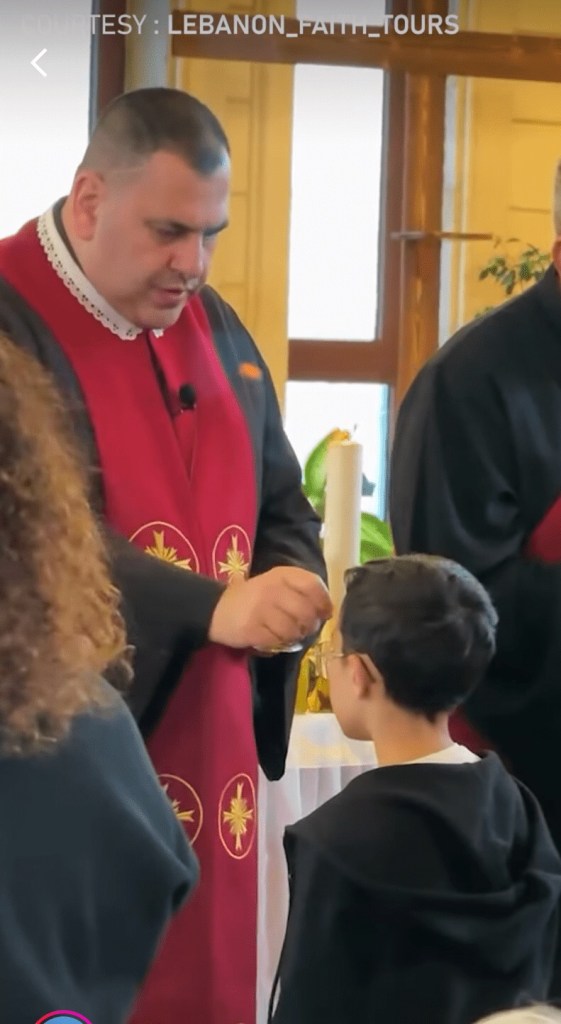
On Wednesday, Maronite Catholics, indigenous Arameans and Lebanese and Syrian Catholics living in the Holy Land, celebrated the blessing of the Holy Oils and the lighting of the Blessed Candles. Their congregations are mostly to be found throughout the North, where the majority of the Christian population is either Maronite of Orthodox Christian. Their population centers are Nazareth, Fassuta, Jish, Me’ilya, Tarshicha, Ibillin and Sh’faram.
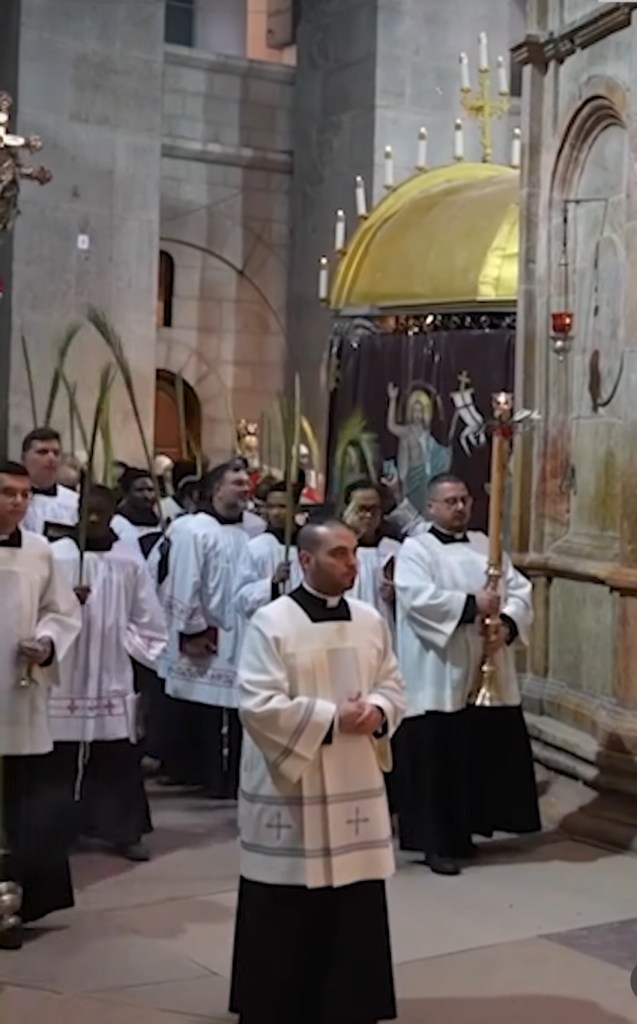
Yesterday, the Orthodox Christians (Greek, Russian, Eastern) and the Roman Catholics celebrated Holy Thursday, the beginning of the Triduum, or three-day holy period, concurrently. Eastern rite/Orthodox priests and patriarchs led the procession through their churches with the carrying of the cross for their congregation to venerate.
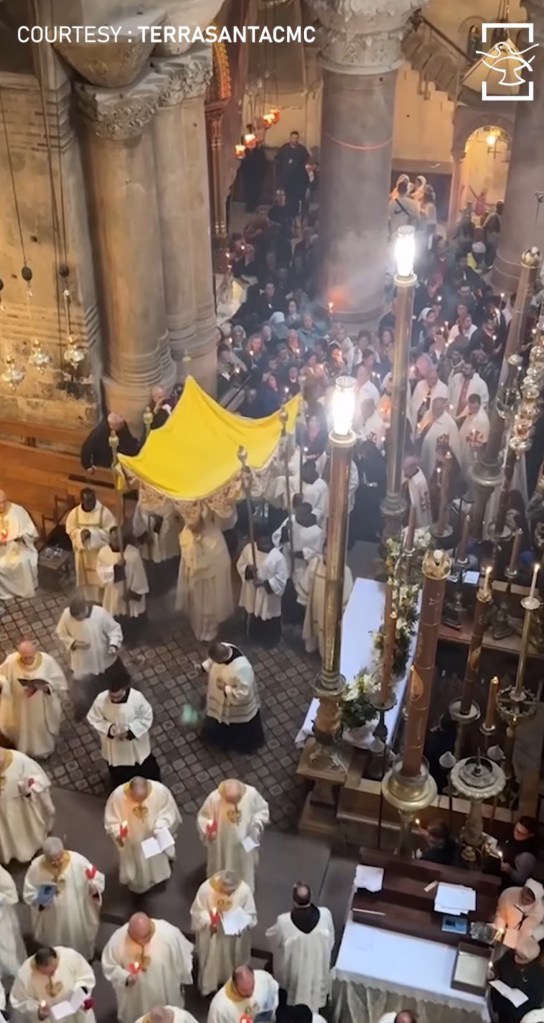
Cardinal Pierbatista Pizzaballa, the Latin Patriarch, commenced the Catholic liturgies at the Church of the Holy Sepulchre. There was a solemn procession from the place of the crucifixion to the stone where Jesus was wrapped and then throughout the church to the tomb where Jesus was interred. The faithful gathered to reverence, kiss and touch objects to the holy stone slab.
As soon as the Roman Catholic rite was finished, the church was cleared so the Orthodox worshippers could celebrate their liturgy. This is scheduled to happen throughout the weekend.
For the first time, in order to to accommodate all branches of the faith, the Roman Catholics will hold their Easter Vigil at the Holy Sepulchre very early in the morning – 06:30 am on Saturday morning. “Catholics must enter the New Gate between 05:30 and 06:00 am. After 06:00 am, the gate will be closed for entry to the Vigil Mass. Entry into the Basilica will be difficult due to extensive security apparatus in place on this day for the Orthodox Holy Fire ceremony. All those participating in the Latin Mass, will be obliged to leave the church after he Mass. No one will be permitted to remain, as the entire church will be cleared for the Orthodox worshippers.”
The Orthodox Holy Fire is the oldest recorded continual miracle. It has occurred in the Holy Sepulchre…the tomb where Jesus’ body laid… for 2000 years. The Orthodox priest enters the sepulchre at midnight with the Paschal candle and waits in darkness as the worshippers congregate throughout the basilica with their candles. A blue fire comes down and miraculously lights the candles. The flames burn cold for about 10 minutes afterward. This will be the eternal flame from the pascal candle that burns throughout the year in Jerusalem. You can view the entire spectacle onYouTube. It is quite fascinating!
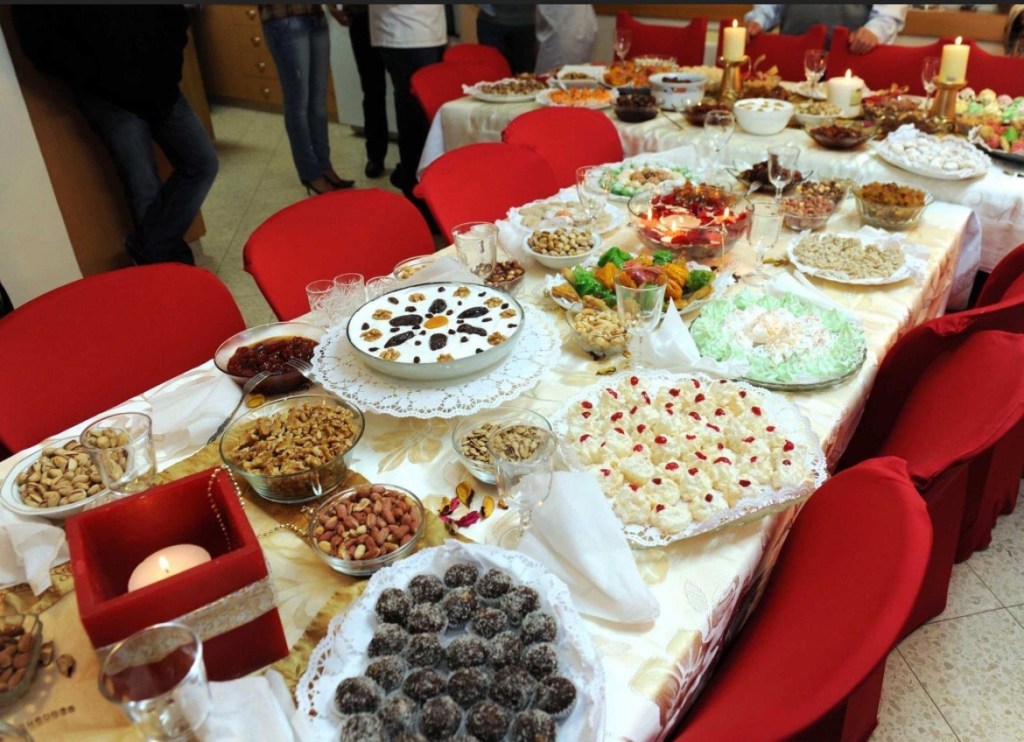
Passover ends this Shabbat for the Jewish people. Saturday night, as the Christians celebrate the start of Easter, Jews in Israel will be celebrating Maimouna. This party at the conclusion of Passover, comes from Morocco. But it has taken hold of the entire Jewish population here. It is a time of great merriment as pastries and tea and candies are piled high on golden trays. The revelers wear bright colors and lots of gold jewelry. There is music and dancing and fun to be had by all.
I wish all of my readers a meaningful, holy and happy feast. Next year I Jerusalem!!!!
This past weekend, the citizens of Israel celebrated the last of the Spring holidays. Besides Holocaust Memorial Day, Remembrance of Fallen Soldiers and Victims of Terror Day, Independence Day, and Jerusalem Day, there were the religious festivals. For the Jews there was Pesach with its grand Seder meals; the campfires of Lag b’Omer; the counting of the Omer from Passover to Shavuot and Shavuot, the Feast of Weeks and Spring harvest. The Christians celebrated Holy Week culminating with Easter Sunday, Ascension Sunday and Pentecost. And we all celebrated in our individual villages and cities without too many clashes. Despite what one hears and reads, most Israelis, regardless of their differences, really do want to live quiet, peaceful lives of coexistence.
The Galilee region of Israel is made up of rolling hills, not quite big enough to be called mountains, but beautiful nonetheless. The word Galilee comes from the Hebrew gal, or wave and the landscape is, in fact like the swelling of waves on the ocean. The Galil is indeed a holy land to both Jews and Christians. Much of the combined history interweaves and overlaps in this small strip of land. The Northern Kingdom of Israel; battlefields of Joshua; tombs and burial caves of prophets, martyrs (Channah and her seven sons) and great rabbis; the meeting place and codification of the Mishna; the home of the Blessed Virgin Mary, the Holy Family, the Disciples of Yeshua; Mary of Magdala; the place where Yeshua taught, healed and preached; the mountain where He was transfigured; the place where Mattityahu Ben Yosef/Josephus Flavius was governor and general. It is all here….and more!
On a small ridge, the next hill over from Nazareth, is Tsippori, also known as Sephoris. (I wrote an entire blog on this magnificent site 29 August, 2022) Perched at the top, the ‘Pearl of the Galilee,’ was an ancient First Century city. It was an exceptional place of co-existence, and the capital of the Galil during the Roman occupation. Tsippori was one of the few cities in the Galilee that was not razed by the Romans during their March to Jerusalem in 68 CE. It was a Jewish city, with mikvaot(Jewish ritual baths for purity), synagogues and Jewish homes. But it was also a Roman city, complete with amphitheater, Roman style villas, and a Roman street plan. Built during the last decades BCE, and the first decades CE, Tsippori is about a 45 minute walk from Nazareth. It is also a long morning’s walk to the Sea of Galilee, so it is most likely that Joseph the carpenter (mason) and Jesus were laborers here building the city. After the destruction of the Temple in Jerusalem, 70 CE, many members of the Jewish Sanhedrin and great sages of the Talmud made the Tsippori area their home. Today, the ruins of this large ancient city are preserved under the auspices of the Israeli National Parks. We have visited many times.
I had heard that there was an old church and monastery somewhere on the mountain, uninhabited, in disrepair, long abandoned. John and I had stumbled upon it once, not knowing its amazing history. It just seemed like an old, uninhabited place… and there are so many of those around. We ‘discover’ places in remote areas but have no idea what they are or the significance they held.
A new family of Olim (immigrants) recently moved to our neighborhood. They are an intermarried couple from Argentina. Daniel is a Conservative Jewish man and his wife, Rosa, is a practicing Catholic. In the short time they have lived here, Rosa has gotten to know all the priests and Catholic holy sites in the Galilee. Many of the priests here speak Spanish, so that has been extremely helpful to her. Last week, Rosa told me of a special discovery she made and she wanted to share it with me. She knows we are into history and that I have a blog, so this could be a potential story. It was quite the adventure!
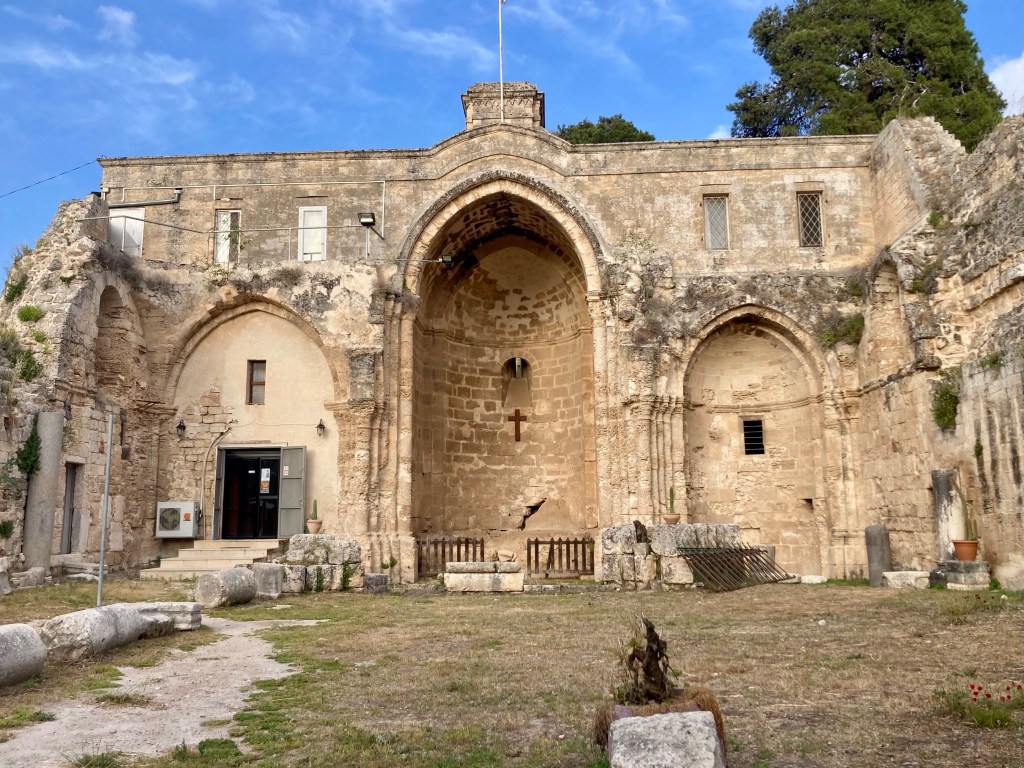
On the back side of the mountain ridge of Tsippori, on a small road that wound through a tiny Jewish village just outside the W fact that St. Joseph was from Nazareth and the Holy Family lived just a short walk away gave this place credence. The basilica was built on the foundation of the home of St. Anne, and was the largest church in that entire vicinity during that time. The dimensions of the church were unusually large, as typical Byzantine churches in the Galilee were quite small, so it must have held a special significance for the early Christians living there. It is exactly proportional in size and orientation to the grand Church of St. Anne in Jerusalem, also built in the 4th century, but intact and still in use today. At the basilica in Tsippori, the roof has long since collapsed, as well as the columns. The mosaic floor is barely visible. It is now mostly grass. Most of the church is now ‘outdoors.’ Behind the altar of the three-arched apse is the foundation of St Anne & St Joachim’s home. As the story goes, it was possibly the birthplace of Mary before they moved to Nazareth.
During the early-mid 1100s, the Crusaders took over St. Anne’s and rebuilt the surrounding walls. The Crusaders held the Holy Family and the Virgin Mary in very high esteem, so they would have revered Mary’s parents as well. They made additions to the Church with vaulted ceilings and more columns on the side apses. A monastery was added to the back, the monastery of Anna. Because this Crusader church was so close to the ‘Horns of Hattin,’ the great battlefield and final conquest of Saladin over the Christians in 1187, this was most likely where the knights would have celebrated their final Mass together. The large Crusader army met their defeat only three miles to the northeast. The church, and all else in the Levantine fell under control of the Ottomans.
The grand church eventually fell to ruins over the centuries. Then in the mid 1800s, the Franciscans, under the Custos of the Holy Land, bought the property (from Arab Bedouins) along with many other sites in Israel, and the remains of St. Anne Church came under their guardianship. Some minor repairs were done to the property in 1859, and a memorial plaque installed, but it was largely left uninhabited except for a few nuns who lived in the monastery for several years in the early 1900s. In 1973, the property was closed due to its dilapidated state and lack of resources. There were so many other holy sites in the Galilee that needed attention. When the new Custos, Pierbatista Pizzaballa (now Latin Patriarchate of the Holy Land), was put in charge of all the properties in 2006, he gave what was left of St. Anne to a newly formed order from Argentina. It was the Order of the Institute of the Word Incarnate (IVE), which “draws its spirituality on the Incarnation and the Consecration to the Blessed Virgin Mary.” It was through this Argentinian tie that Rosa found Fr. Jason and the basilica ruins.
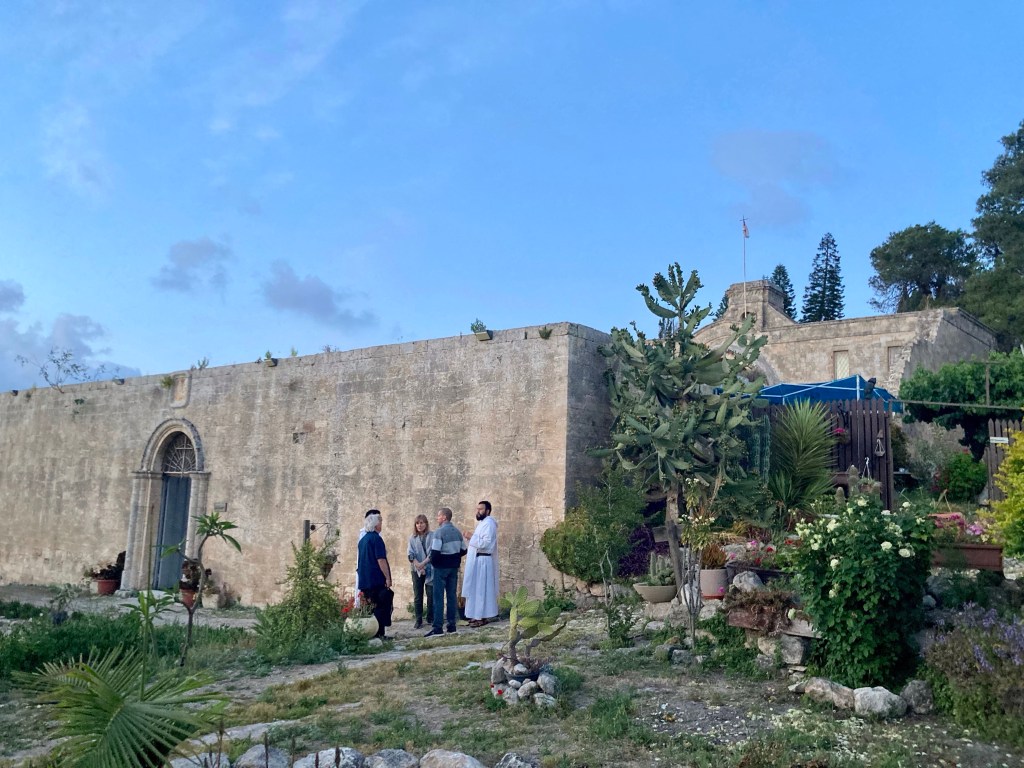
Outside the wallsA welcome from Fr JasonThe old basilica… reconstructed chapel at left apseThe foundations of the home of St Anne &Joaquin behind the altar gateByzantine sandstone. Crusader additions are the darker stonesOuter courtyard was one a huge church interior
Rosa had pre-arranged for me to do an interview, and we were warmly welcomed by Fr. Jason. Speaking in broken English and Hebrew with some Spanish thrown in and Rosa translating, Fr Jason told us of the priests’ personal history living in Israel at St. Anne. When the Institute of the Word Incarnate was granted custody of the property in 2006, the two priests and a seminarian who had traveled to Israel from Argentina found it in complete and utter disrepair. It was absolutely overgrown with weeds and downed tree limbs. The church was crumbling. Part of the old monastery in back of the church was in shambles. One large house in the back was now a Muslim orphanage.
The first stage of their mission was literally to rescue the church, to save it from total decay and to preserve what was left. That took the three men labored nonstop over ten years. The second stage was to prepare it for the arrival of pilgrims: to put in public bathrooms; to create places of quiet meditation with wayside shrines; to study the Hebrew language to communicate with the locals and to educate local tour guides about the place. They have just begun to advertise on social media that this holy site is again open and active. Today St. Anne is a working Latin Rite Catholic church. Masses are at 5pm in Spanish every Saturday. There is Eucharistic Adoration followed by a Rosary in Spanish every Thursday from 4-7 pm. A celebration is being planned for the feast of Sts. Anne & Joaquin on July 26. This last stage complete, it is now an official pilgrimage site.
Since the first days the priests arrived, they have worked hard to partially restore the property, clearing the basilica of old fallen stones; moving fallen columns, weeding and clearing the olive grove adjacent and making gardens. They put in electricity and water and built a little indoor chapel and rectory adjacent to the apse. The indoor chapel has been completely restored. It is tiny, holding only 20 people maximum, but it is beautiful inside. Bounded by high sandstone block walls with a vaulted ceiling reminiscent of the Crusader era, I immediately felt drawn back in time. The scent of incense hung heavy in the air, and the chapel was lit by the pink rays of the setting sun and candlelight. A large golden monstrance was placed front and center on the altar, and Diego, a young seminarian, knelt in silent worship. The most intriguing mosaic plaque, found in situ, hangs on one wall of the chapel and bears a Hebrew inscription. A remnant from the Byzantine era, it is only a fragment and missing tesserae. It was most likely a dedication plaque or a funerary marker from a burial site nearby.
During good weather, Masses are held outdoors in what was once the grand basilica. The old stone door which used to be the entrance to the basilica is now the outdoor altar. It is a most dramatic backdrop and scene for Church services. The priests are hopeful that they can garner enough interest to hold Classical music concerts here summer evenings. Until then people are encouraged to visit, to take in the holy silence, to stroll through the garden and olive grove and to attend Adoration.
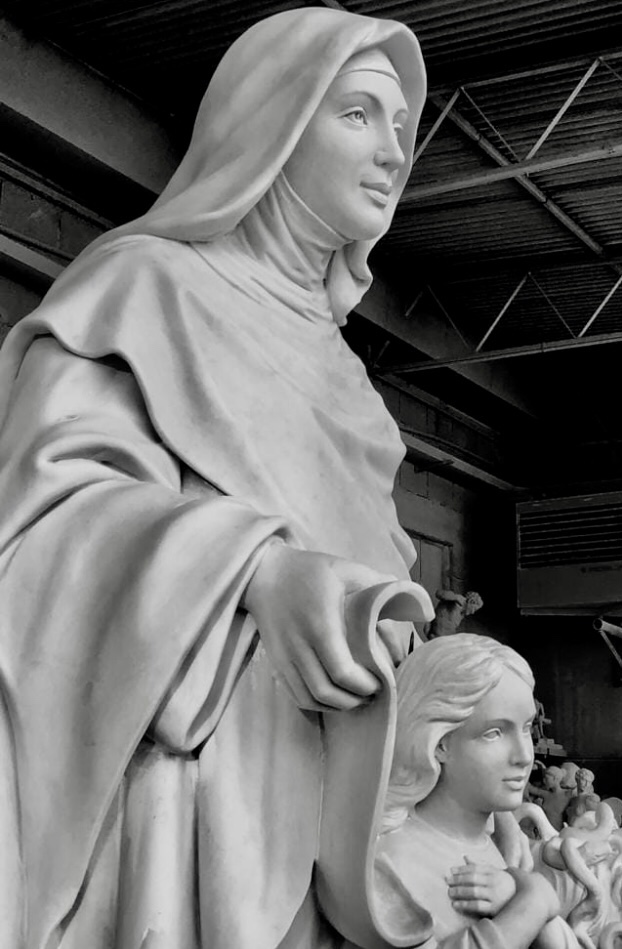
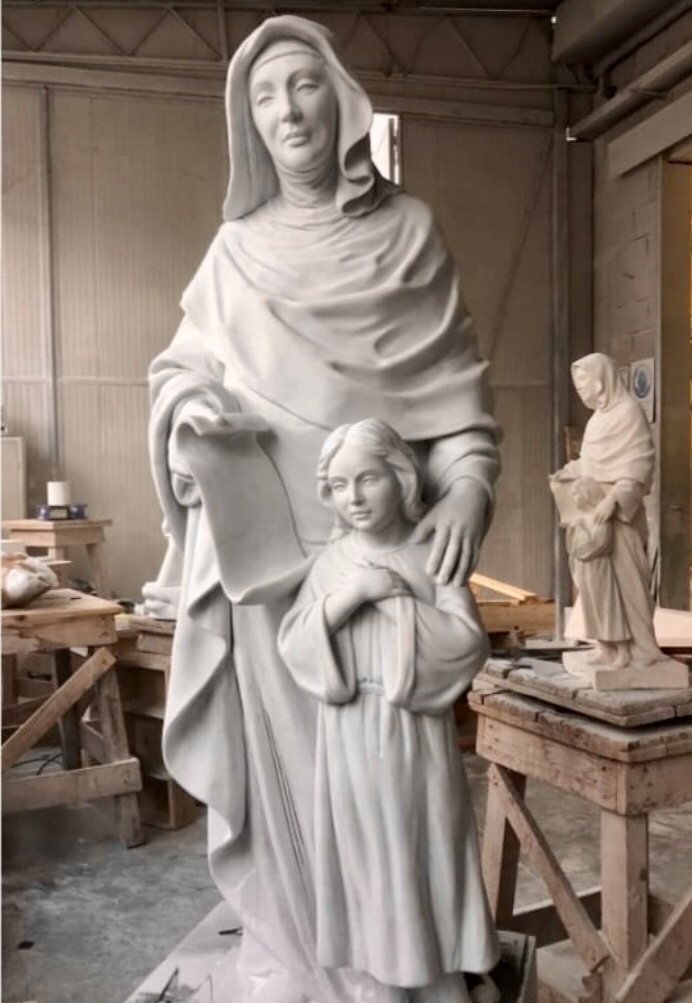
Recently, the priests received a gift from a gentleman in Italy of a beautiful Carrera marble statue of St. Anne & the young girl, Mary. It was delivered to the church last week and left in its crate near the outer wall. Funds are currently being raised to pay for a base for the statue and for a contractor to crane it into the church and to install it. These are photos Fr Jason sent of the life size statue when it was still in Italy:
We walked with Fr. Jason and Br. Diego through the newly tended olive grove. They wanted us to look out at the majestic view of the Netofa Valley. Not 100 meters down the hill I spotted it: the blue dome of a building. Living in Israel, I have learned that this can only mean one thing: the tomb of a tzaddik, a great prophet, rabbi or holy person. Orthodox Jews go to the burial sites of the holy tzaddikim to light candles (yarzeit candles) and to pray. It is believed that the prayers made in the vicinity of a holy one and in the merit of that tzaddik, gives the prayers ‘wings,’ so to speak. I inquired from Fr Jason as to who that was, and was told, “It is the tomb of Yehuda haNassi.” I knew this could not be correct because one of the greatest rabbis of all time, Judah the Prince (Yehuda haNassi) was buried not far from there, in Beit Shearim. Yehuda haNassi lived in the 2nd century, CE, A grandson of the teacher, Gamaliel. Yehuda haNassi was also a great teacher and became head of the Sanhedrin (the Jewish Council of 70 elders) when it fled from Jerusalem to the Galilee after the Roman destruction of the Temple. Not only was he sought after for his wise judgements in legal matters within the remaining Jewish community in Israel, but he was also revered as an important sage in Rome. haNassi was most famous for editing and codifying (putting into writing) the Mishna, the books of Oral Law, the traditions and history of the Jewish people that had been handed down throughout the generations verbatim since the time of Moses. Besides the Tanach, (Jewish Scripture), the Oral Law is perhaps the most holy. Yehuda haNassi died in Sephoris in 217 CE. This was definitely not he.
So who was it in the mausoleum below? It had to be someone important from the looks of things. The tomb belonged to Yehuda haNassi’s grandson, Yehuda Nessia, an important man in his own right. He was the last head of the Sanhedrin, the last ‘Prince’ of a long line of rabbis.
After visiting St. Anne’s, we made a little visit to the tomb below before it grew too dark
The grandson, Yehuda was nothing like his grandfather in scholarship or behavior. The great Resh Lakish befriended him and over a period of years tried to inspire Yehuda. There is written history of a dialogue between Yehuda Nessia and Origen at Caesaria (if only I could have been there at that time to overhear!!!) Nessia is known for two religious ordinances: reforming divorce law and allowing the use of liturgical oil prepared by Christians to the Jewish specifications. He did, however, hold firm, and would not allow the use of bread prepared by Christians to be used by Jewish people in any way.
So here we found ourselves at yet another place of coexistence in the Holy Land. A ancient city, Sephoris, shared by Jews and Romans and by Jews and Christians. A Byzantine church next to the final resting place of the last rabbi in a long line of Sanhedrin. Their lives definitely mixed in the Galilee. A few friendships were formed. Heated discussions were a part of life here at times. There seemed to be a “live and let live” policy as long as laws, religious or political, were respected and not violated, the land could be shared. It is that way today in this region. A place Jews, Christians, Arabs and people from all nations call home.
A friend of ours up here in the north of Israel wanted to tour the Negev area for a few days before he moved back to the States. He rented a large apartment just southeast of Beersheva and said we could come down and take one of the guest bedrooms. So, why not? We jumped at the opportunity. In my last blogpost, I wrote about the Yatir Forest, an immense manmade forest planted in the desert and an organic herb farm and world-class winery there. But there were more surprises in the land of Bedouins and camels than just the Yatir Forest.
John and I have taken upon ourselves to read through the entire Scriptures in one year. And not just to read the Bible, but to visit as many of the sites mentioned as we could. We wanted to get a real feel for the Land, the People and the stories – up close and personal – to be able to internalize what we’ve been reading. What an incredible gift it has been!!! In the books of Kings and Chronicles, especially, as we read through the actual historical accounts, I kept coming across qthe term ”high places.” It was a term I just glossed over and took for granted. Tel Arad changed that.
Canaanite city below & Israelite fortress at top
A high tel or hill(Hebrew) rises from the wide expanse of desert plain. It is a perfect spot, once settled and fortified, for defense because it provides a 360* lookout. It is one of the high places. Tel Arad is made up of two components: at the base of the mountain are the ruins of an ancient Bronze Age civilzation dating back to the third millenium BCE with a large Canaanite city built over it, and at the top, a huge fortified city from the Israelite period and time of the kings (12th century – 6th century BCE).
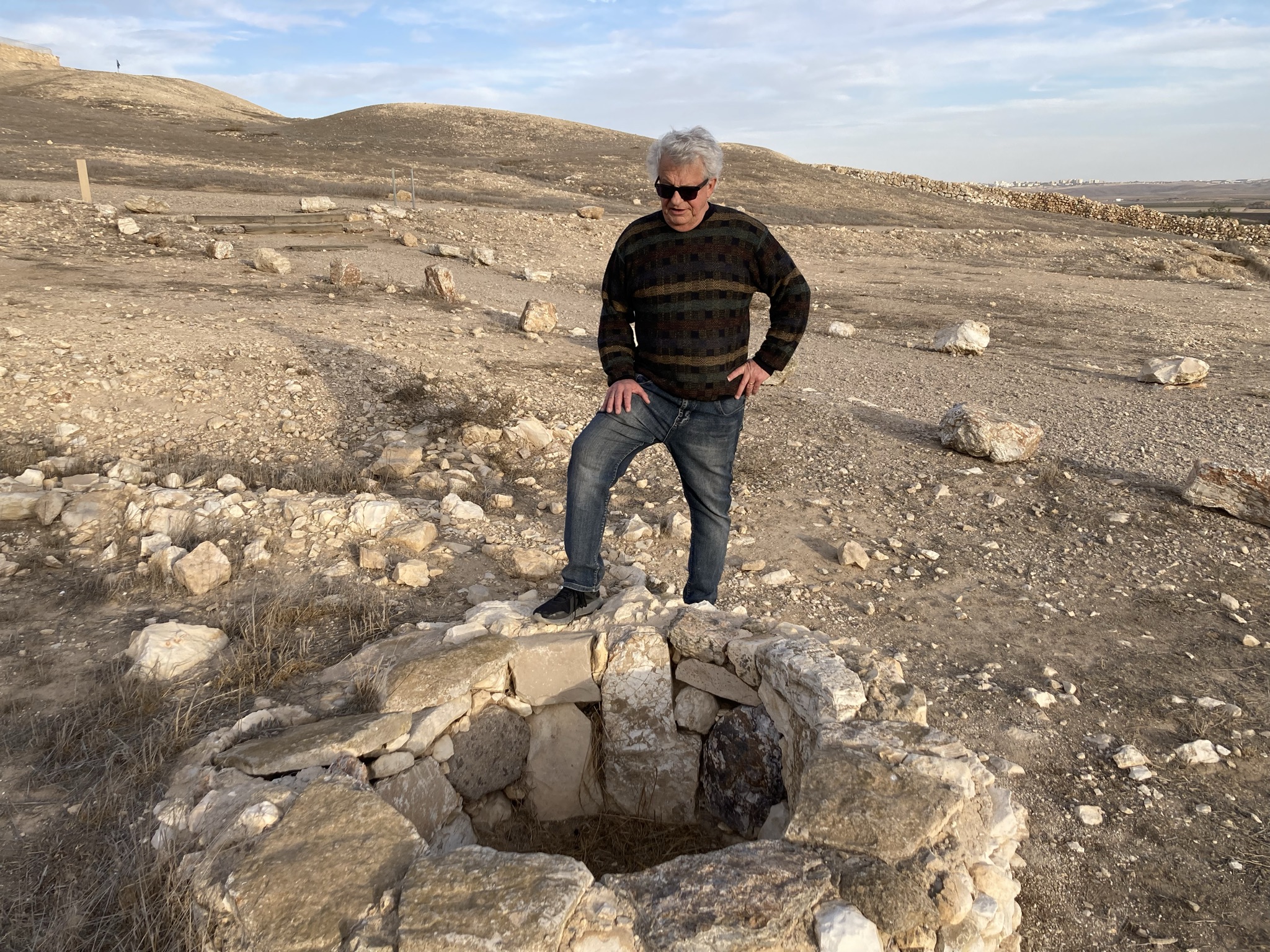
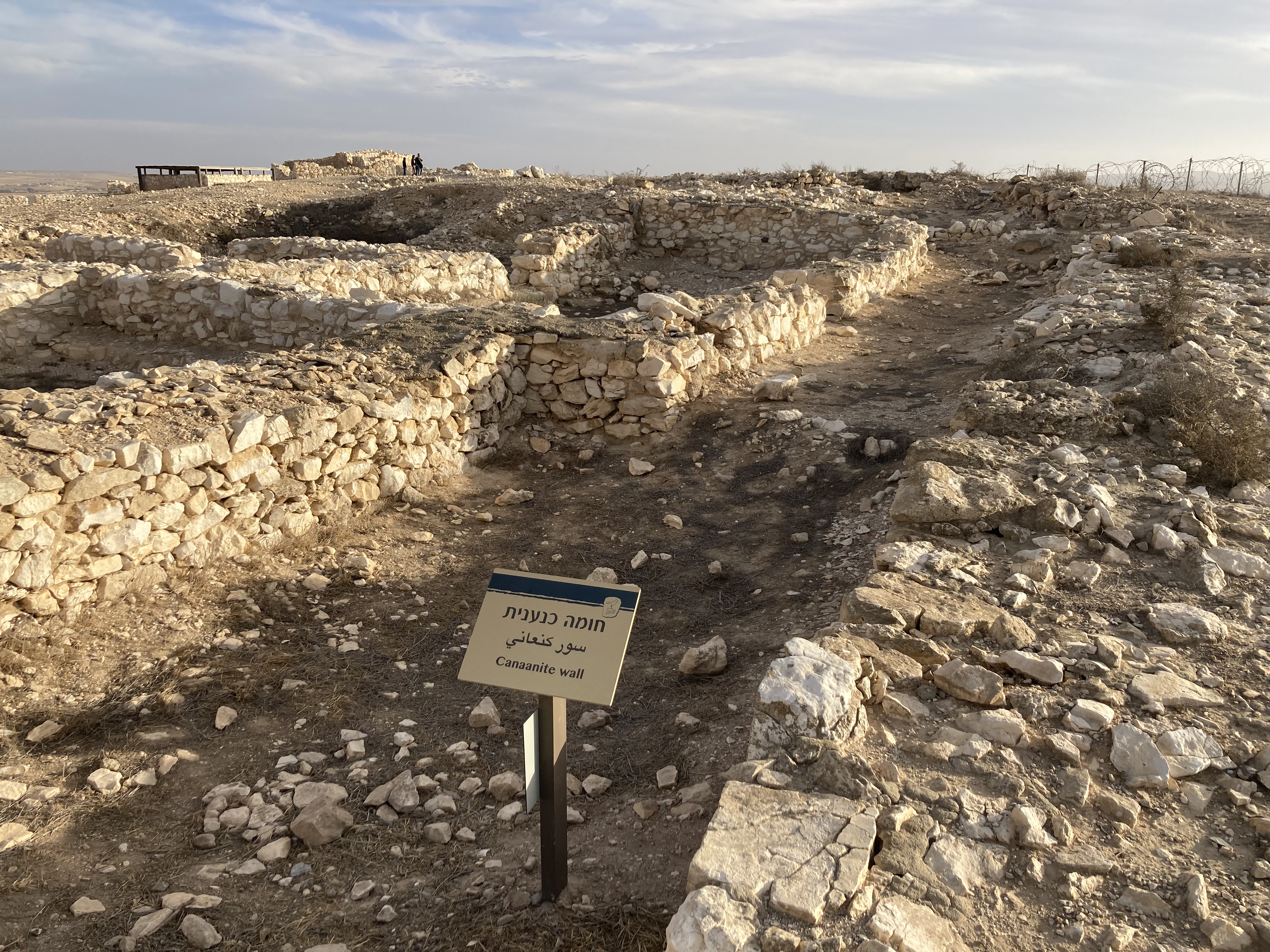
Why the Bronze Age inhabitants disappeared, know one knows, but the Canaanites built over top the remnants 1500 years later. A thick, double-layered wall runs along the perimeter of the village at the tel’s base. At various intervals along the wall and at the entrances to the city were once semicircular guard towers. A deep well and cistern which collected the rain runoff provided water for this desert community. Close in proximity to the Dead Sea, the Canaanites traded asphalt from there to the Egyptians who used it for mummification. There is evidence of small one-story and two-story residences, as well as larger living complexes with severals rooms and courtyards. There was a cultic worship area with the remains of two platforms with altar and nearby basins as well as shrine areas for idol worship. Arad is first mentioned in the Torah, in Numbers 21:1-3 ”…the Canaanite king of Arad, who dwelled in the south, heard from the spies that Israel had entered the land. And he fought against Israel and took some of them prisoners…and Israel conquered them and their cities.”
John looking into a wellThe walls (left) surrounding the Canaanite civilizationAn well leading to an ancient cisternEastern entrance to ancient AradComplex of pagan cultic worship with altarsStoreroomsCourtyard view of villa residence and outer rooms off the interior courtyard
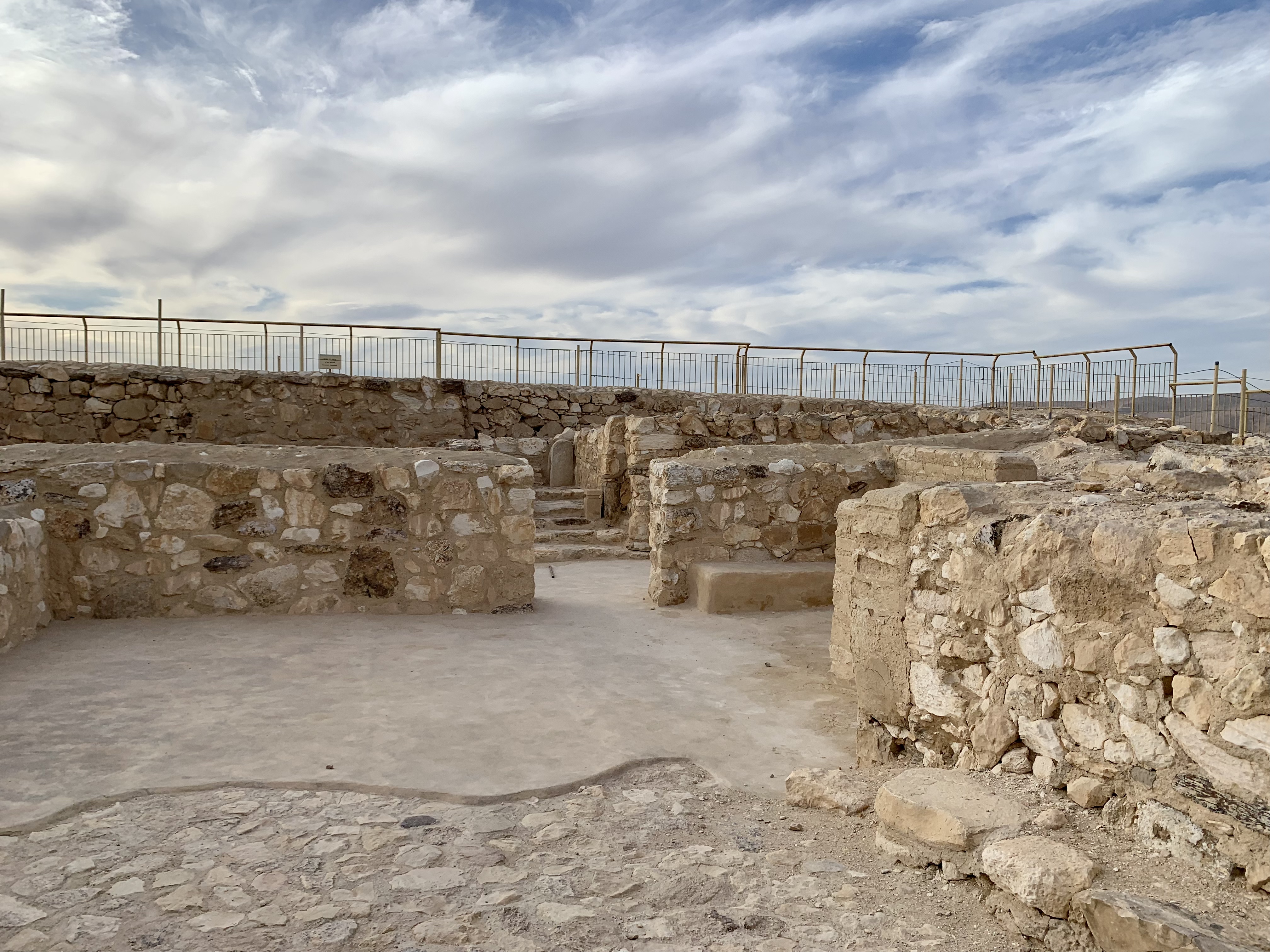
Climbing up the mountain was no small feat for me, but eventually we reached the smaller, square Israelite fortress constructed during the reign of King Solomon. It was built as a royal citadel to block any invaders, Moabites and Edomites from the Southern Negev coming into Judah. Two incredibly important discoveries were unearthed here that cement Arad to its Biblical references. The first finding was a pile of 107 ostraca, pottery shards of historical account and basic bookkeeping written in Both Hebrew and Aramaic. Some contain instructions for the disbursement of grain, oil and water to the troops stationed there. Others, dated to 600 BCE, were letters written to the commander of the garrison, Eliashiv son of Eshiahu. A seal was also found here bearing his name. Another had an inscription which mentioned a ”House of YHVH” that was there.
Israelite fortress at Tel Arad
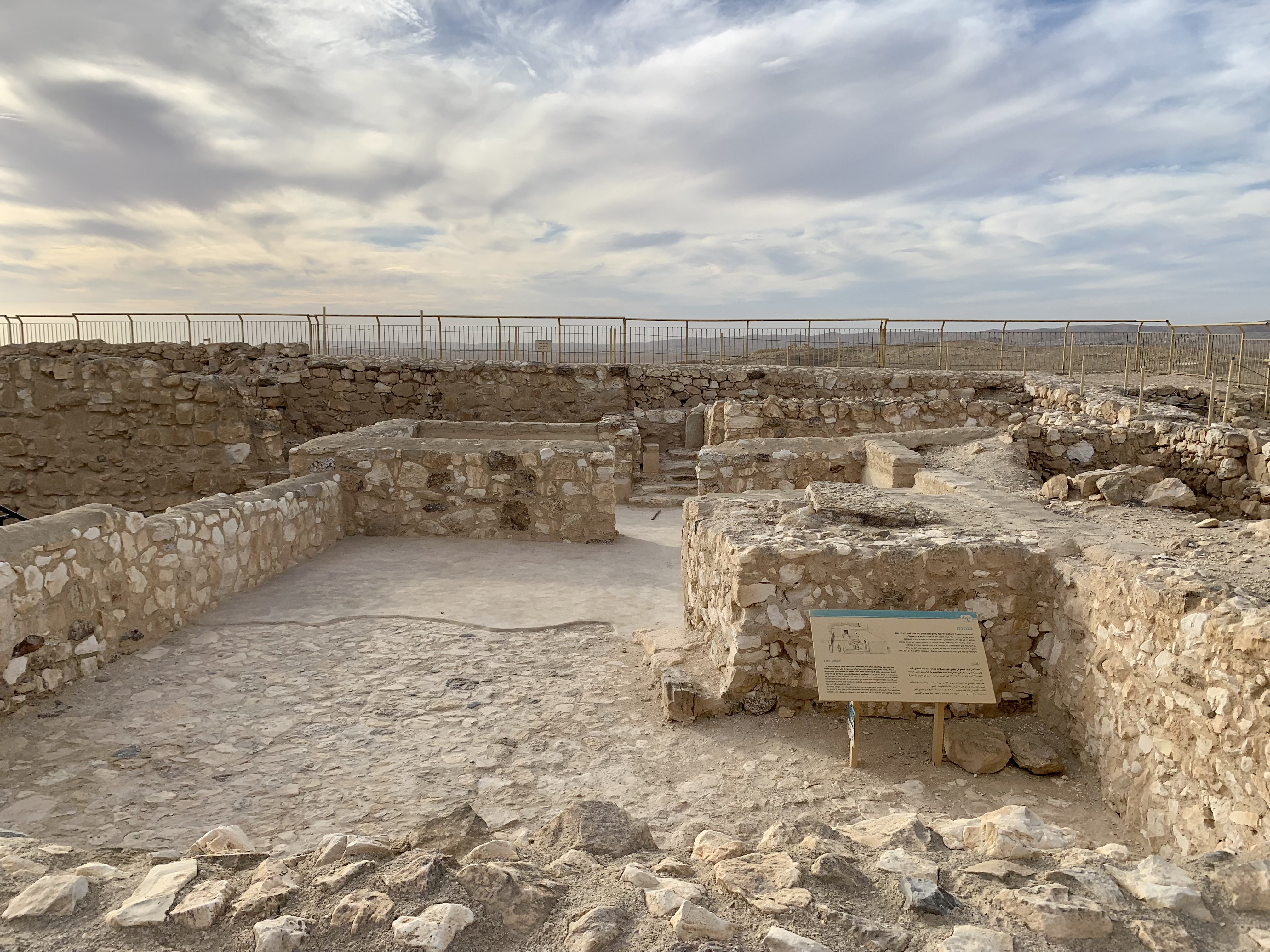
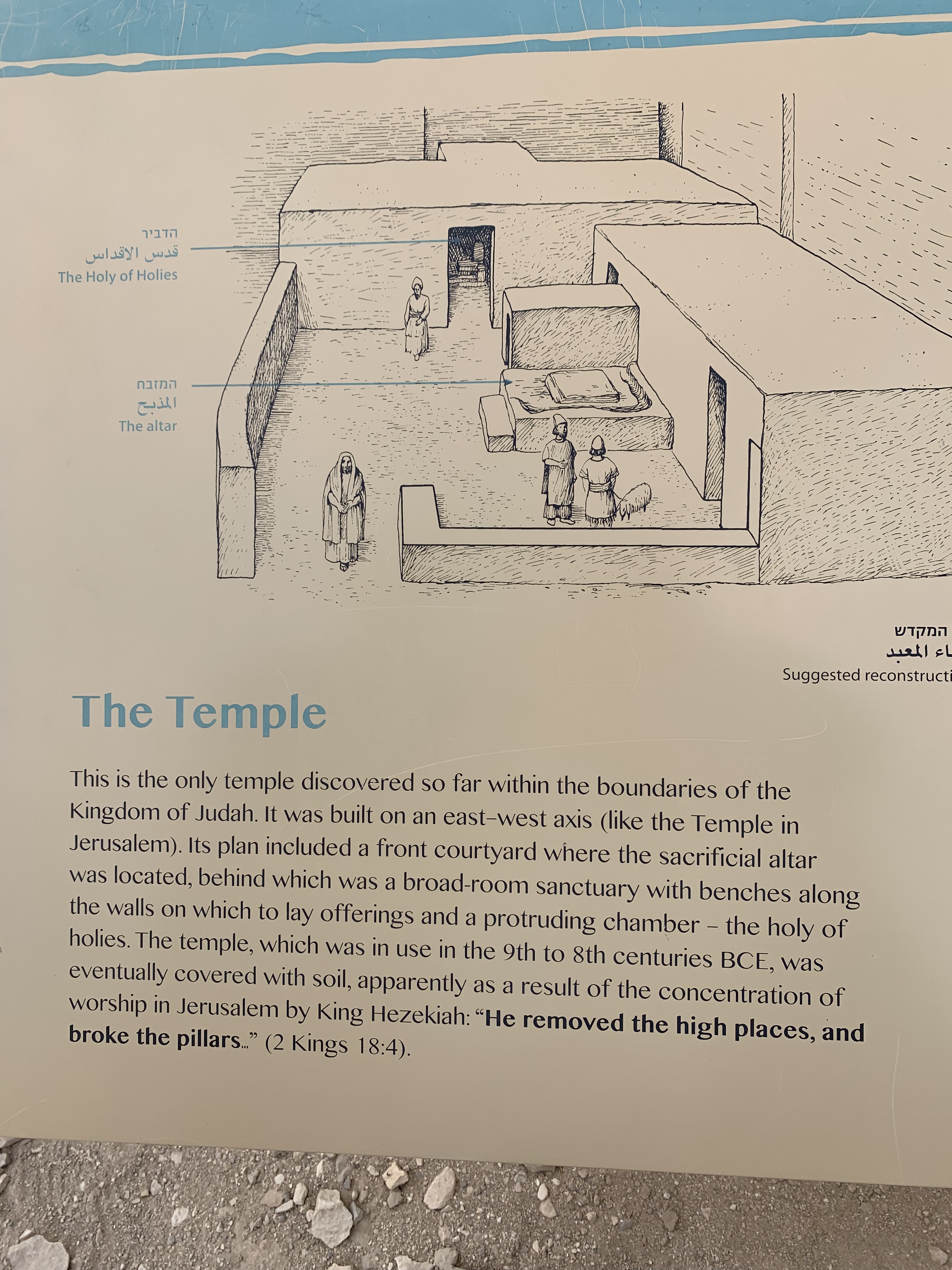
During the period of the Israel’s kings – found in the Bible in the first and second books of Kings as well as in First and Second Chronicles – several of the rulers decided of their own volition to build their own temples, alternatives to traveling to Jerusalem and the Temple Mount for Jewish worship, sacrifice and pilgrimage. The temple at Arad is a perfect example of this. With our guidebooks, our Bible and well-marked signs (in English!), we were able to fully comprehend what we were seeing.
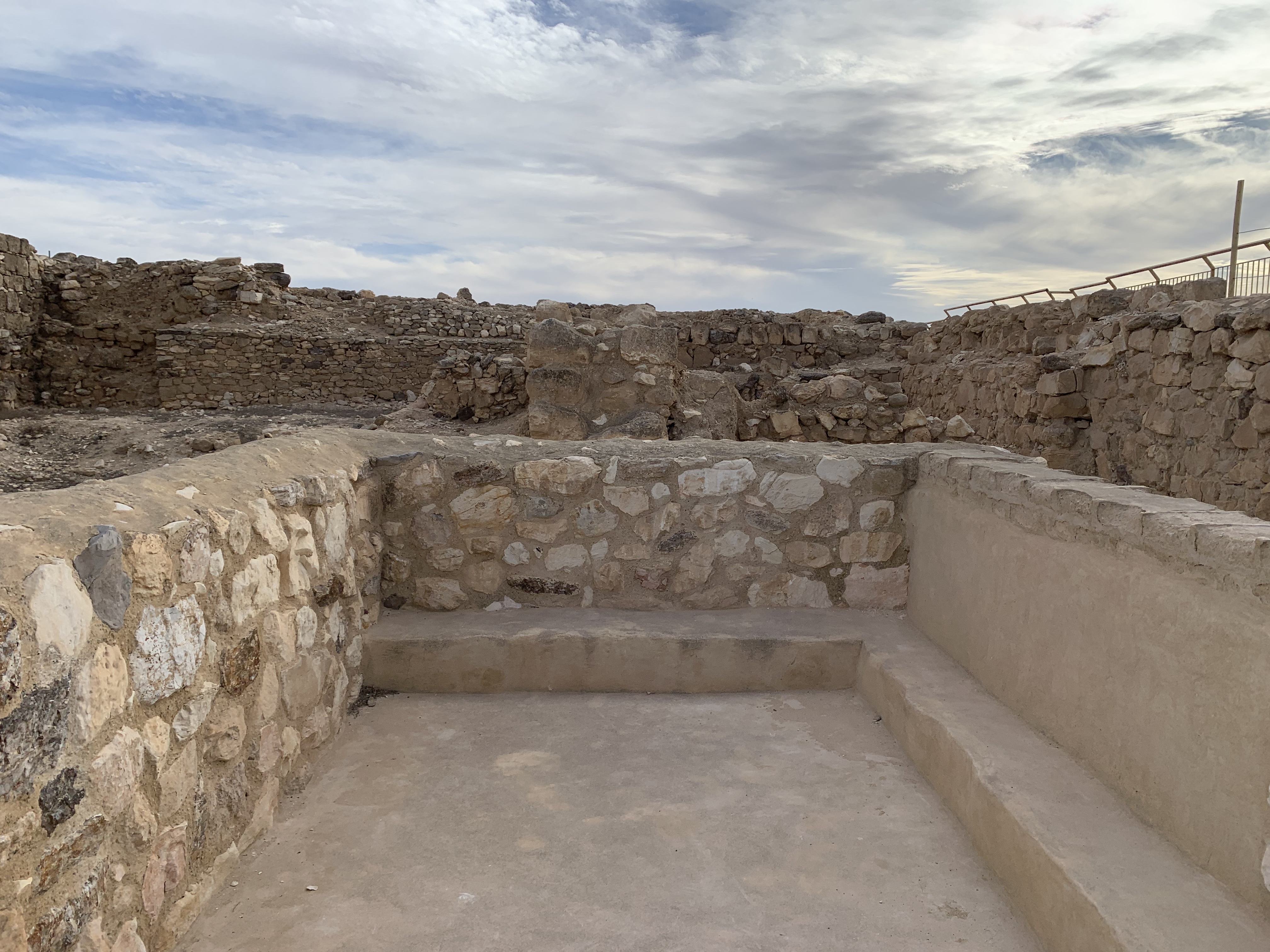
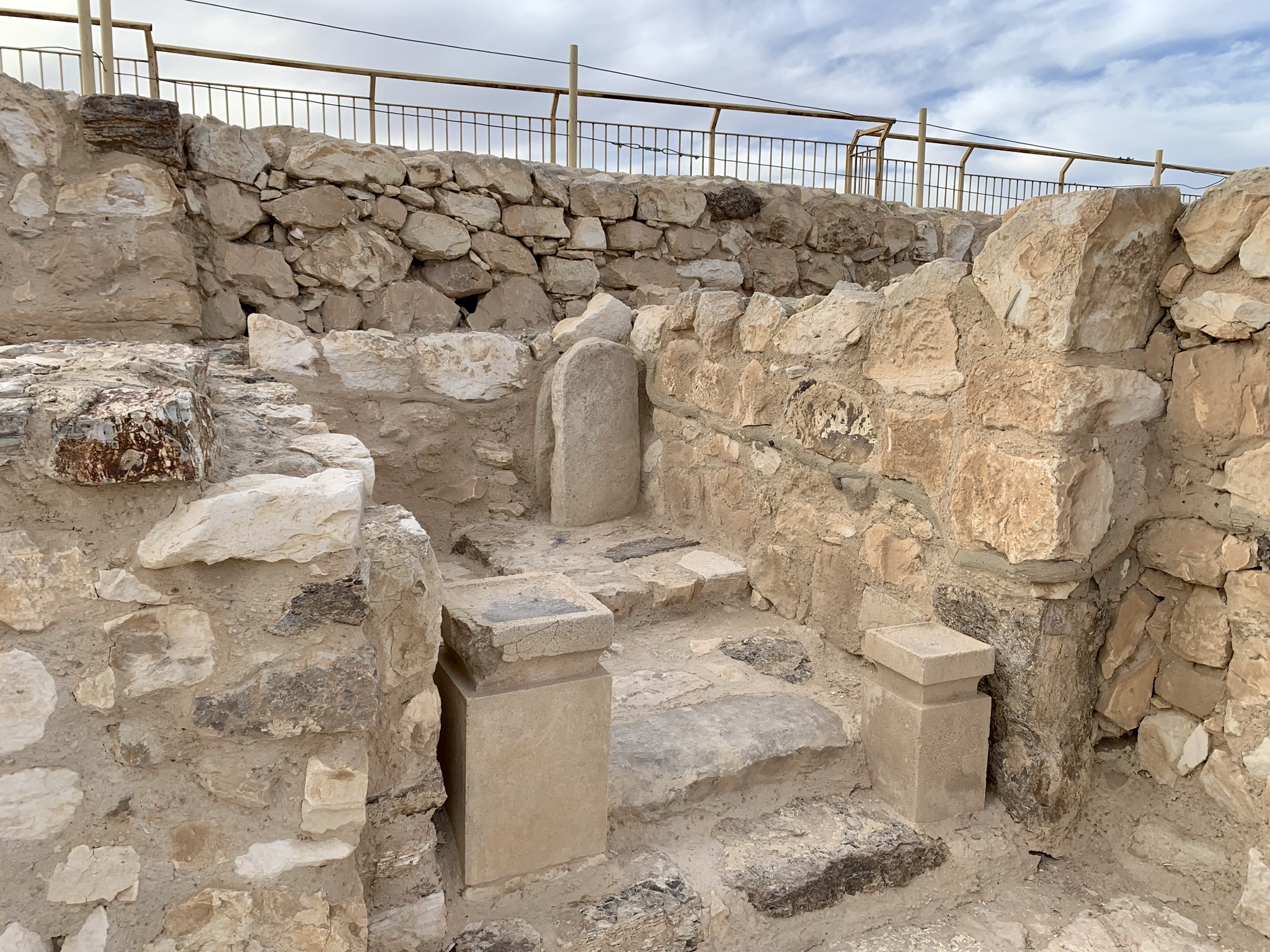
Not built according to the standards given by G-d to the Jewish people for authentic worship, the Tel Arad temple is completely out of scale and layout for the Holy Temple. This place was an extra-Biblical Jewish-pagan hybrid. It did have an altar for sacrifice and an inner sanctum, their version of the Holy of Holies. Two incense altars and a standing stone (the originals are now in the Israel Museum) were found in situ. The incense altars had a cannabis/frankensence remains, so was used for enhancing ecstatic states. There were two standing stones: a monument to G-d and one, a shrine to, Asherah, a pagan fertility god.
“And in every city in Judah he (King Ahaz) built high places to burn sacrifices to other gods and aroused the anger of the Lord, the G-d of his ancestors.”
– 2 Chronicles 28:25
“ In the seventh year of Jehu, Jehoash began to reign for forty yearsin Jerusalem. And his mother’s name was Tziviah of Beersheva. And Jehoash did that which was right in the eyes of the Lord all his days wherein Jehoiada the priest instructed him.But the high places were not taken away: the people still sacrificed and burnt incense in the high places.
– 2 Kings 12:1-3
During Josiah’s rule, the high places with their cultic worship were torn down, the temple at Tel Arad was buried, but this would only be temporary. It would be uncovered under successive kings and rededicated. Despite the warnings of the prophets, the high places were never fully destroyed. Under Israeli King Jehoash, the Babylonian King Nebuchadnezzar would sweep down and destroy the Southern Kingdom, taking the Jewish people away captive in 598 BCE.
Centuries after the Jews abandoned Tel Arad, the Greek Hellenists, then the Romans claimed the mountaintop. Both invading armies built on top of the Hebrew’s fortress, reclaiming the parts that were still intact. It fell into disuse over the years, then was retaken by the Ottoman Turks. Eventually that, too, was abandoned.
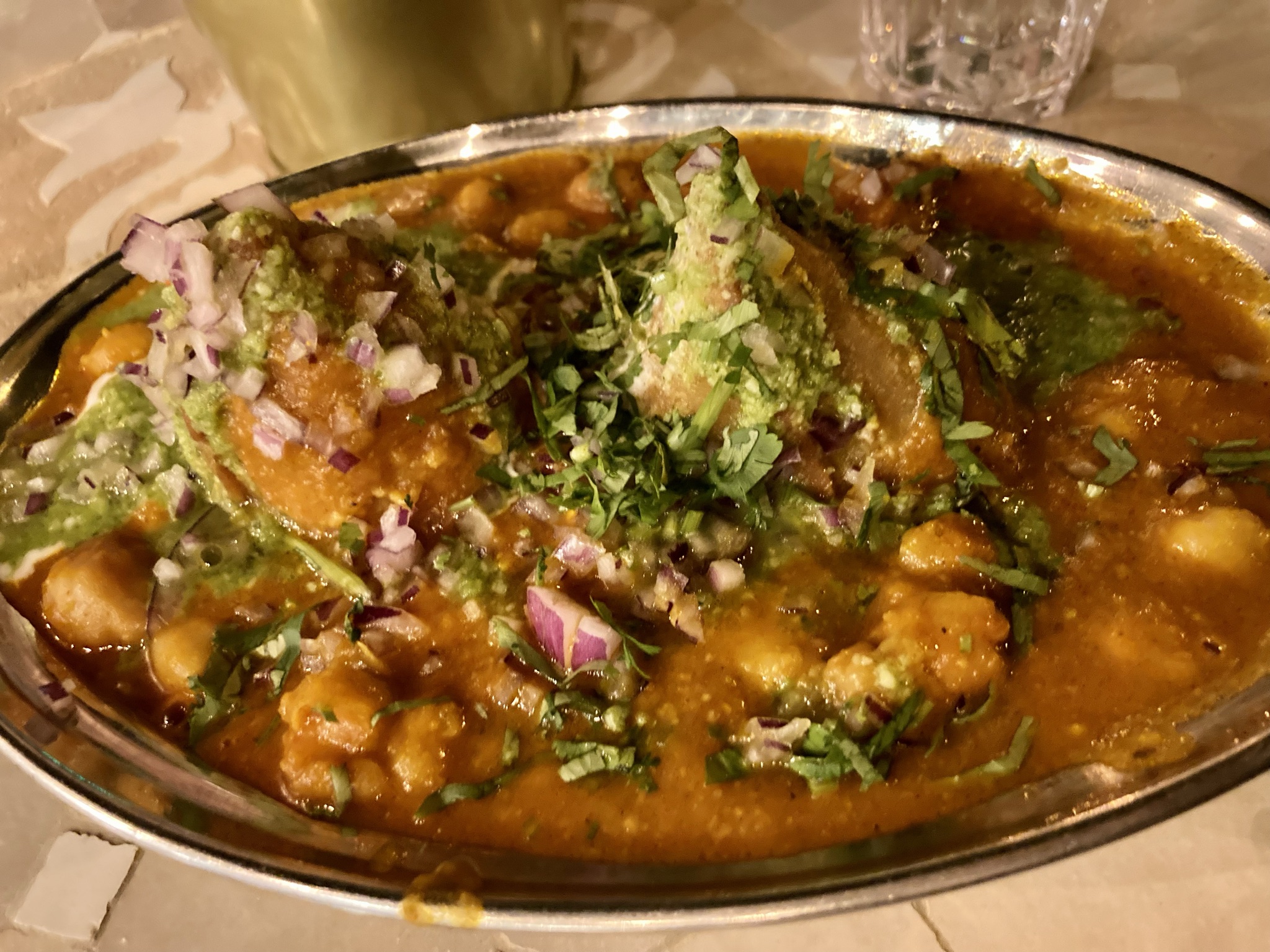
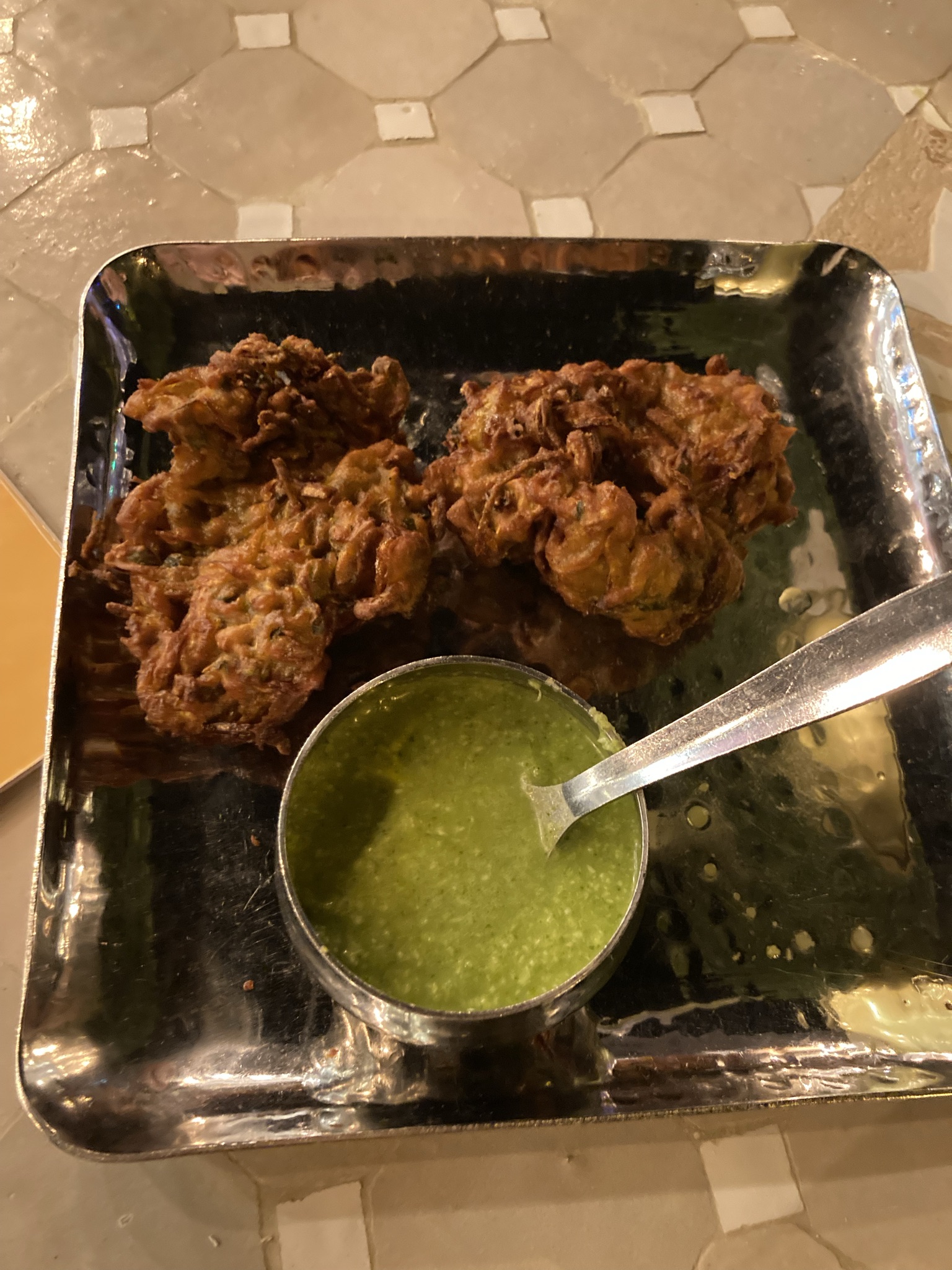
The December sun was casting long shadows as the afternoon grew on, and we had to meet our friend in Beersheva for dinner. It was a good half an hour drive back and Marc had found a wonderful authentic Indian restaurant, vegan and kosher. It’s name Hodoo haK’tannah, Little India in Hebrew. It’s owners are members of the tribe of Menashe, whose wanderings took them to at part of the world for nearly 2000 years. Most of the Bnei Menashe have returned home to Israel in the past 18 years, and are observant Jews. We ate out of doors and the food kept coming. Most was highly spiced, but we shared dish after dish of deliciousness. After this grand adventure, I was thoroughly stuffed… and completely exhausted, but couldn’t wait to see what surprises the next day’s travels would bring.








































 Israel Dreams