Out on a Whim. And Special Recipe!!!! 21 November, 2025

For any of you who know me, you know that although usually organized and scheduled, when the opportunity presents itself, I’m up for an adventure.

I signed up to take Hebrew lessons again. This time from Citizen Cafe Tel Aviv. Totally different approach, this time it’s just conversation. No books. No conjugations and inflections. Just street talk on Zoom classes with unlimited cafe time (chat room in Hebrew). And fun. Bimonthly they offer interesting talks in English on random subjects like cooking (fermentation anyone?), music, recent film reviews, livestream urban tours, technological developments in Israel, agricultural innovations and geology.

I took a class last Thursday night on the Ramon Makhtesh, a hugely expansive erosion crater out in the middle of the Negev Desert. So so interesting. Only 8 in the world, all in Israel, they are not impact craters (from meteors), but erosion craters.

Along the Syrio-African rift that runs along the length of Israel are tectonic plates. Millennia ago, they shifted. The present desert was flooded with water, grinding down the rock. Eventually leaving behind various strata of sandstone, limestone, marine fossils. There are tar mountains of basalt, deep red iron ore and yellow sulfur deposits as well as white chalk. In other words: gorgeousness!

I got this wild hair…. I turned and yelled at John in the next room,”Honey, can you Google when the Leonides Meteor Shower is?” They usually come around Thanksgiving. “They peak Monday night,” was the response. Mitzpe Ramon, the town at the very edge of the crater is a world-designated dark spot for astronomical observation.

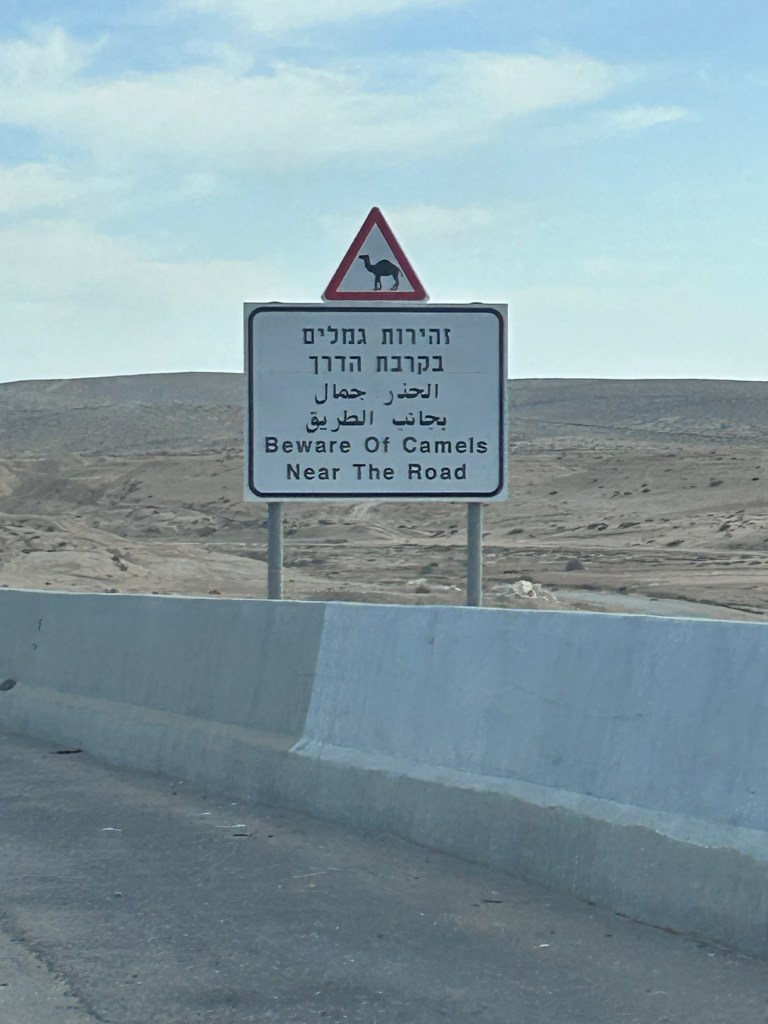
Monday morning we packed our blankets and lawn chairs, thermos, and dog into the car and we were off on an adventure! BeerSheva, where our patriarchs Abraham, Isaac and Jacob sojourned. I wonder what they’d think of the place now?

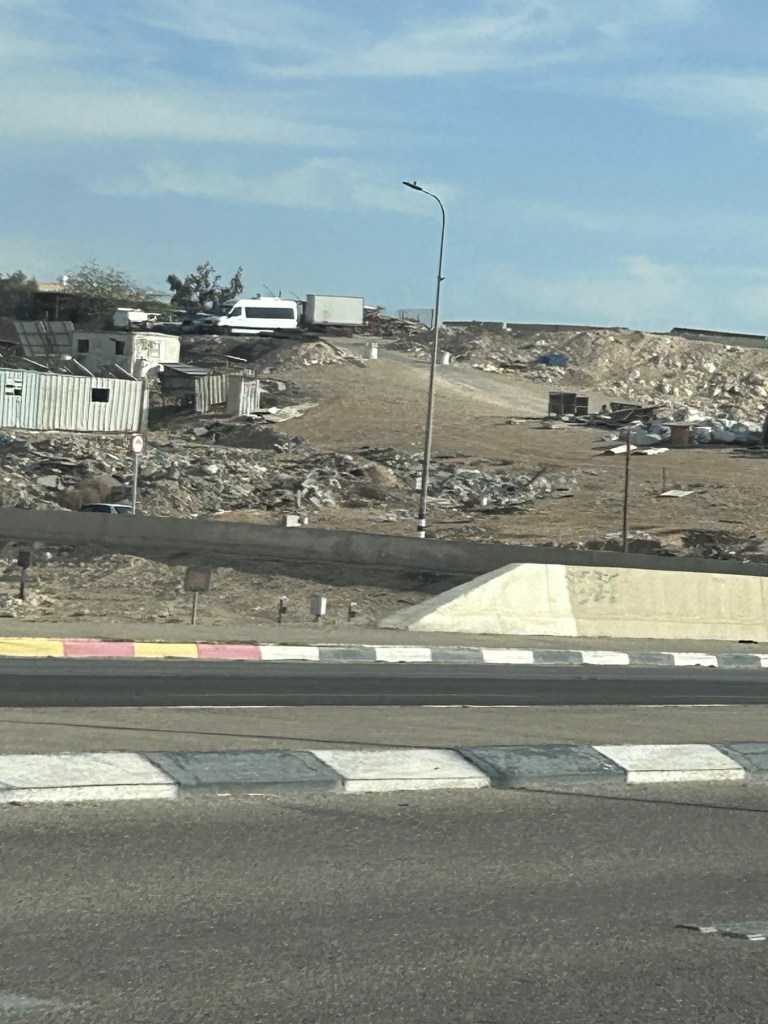
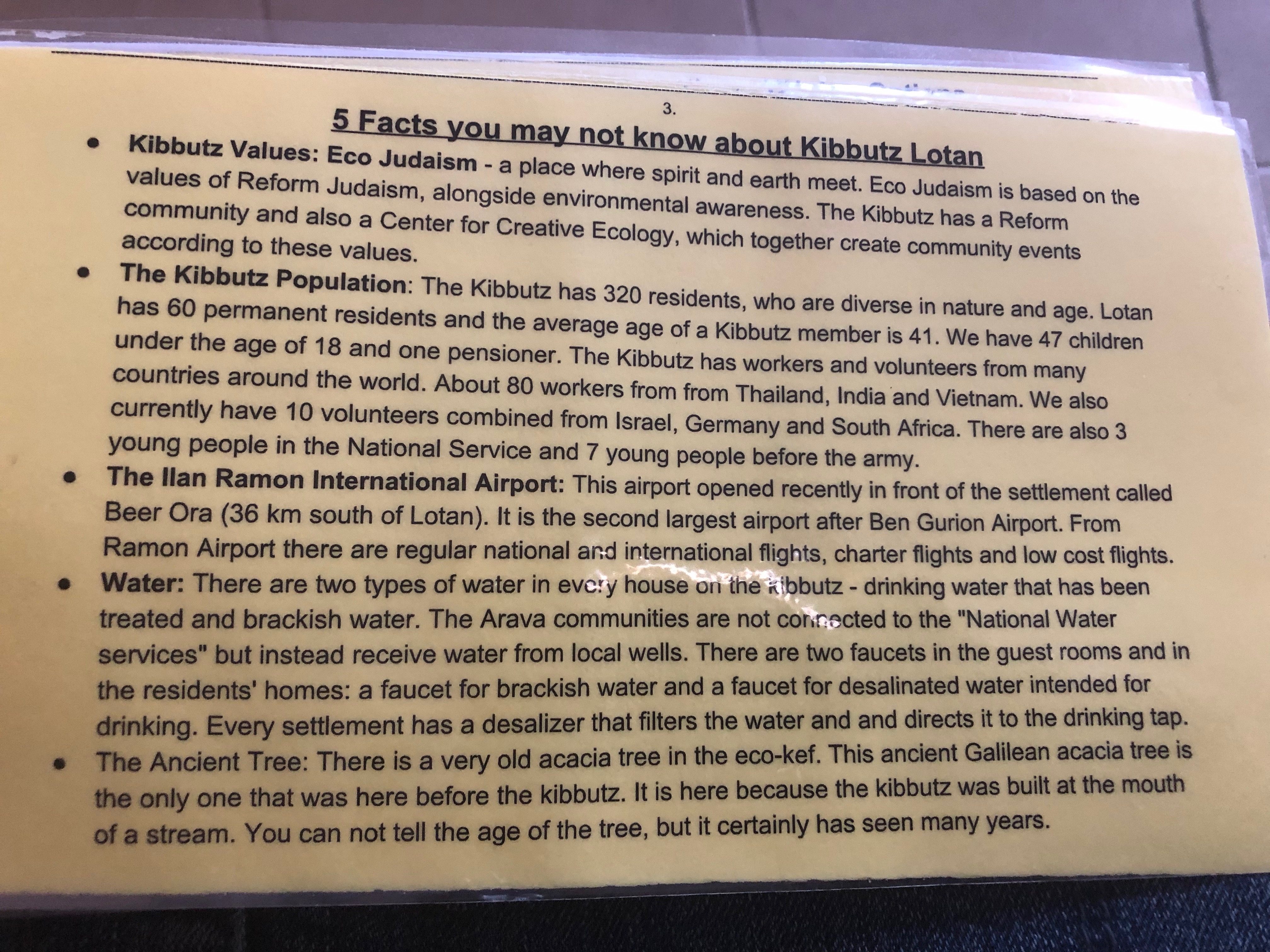
Past the Bedouin encampments:
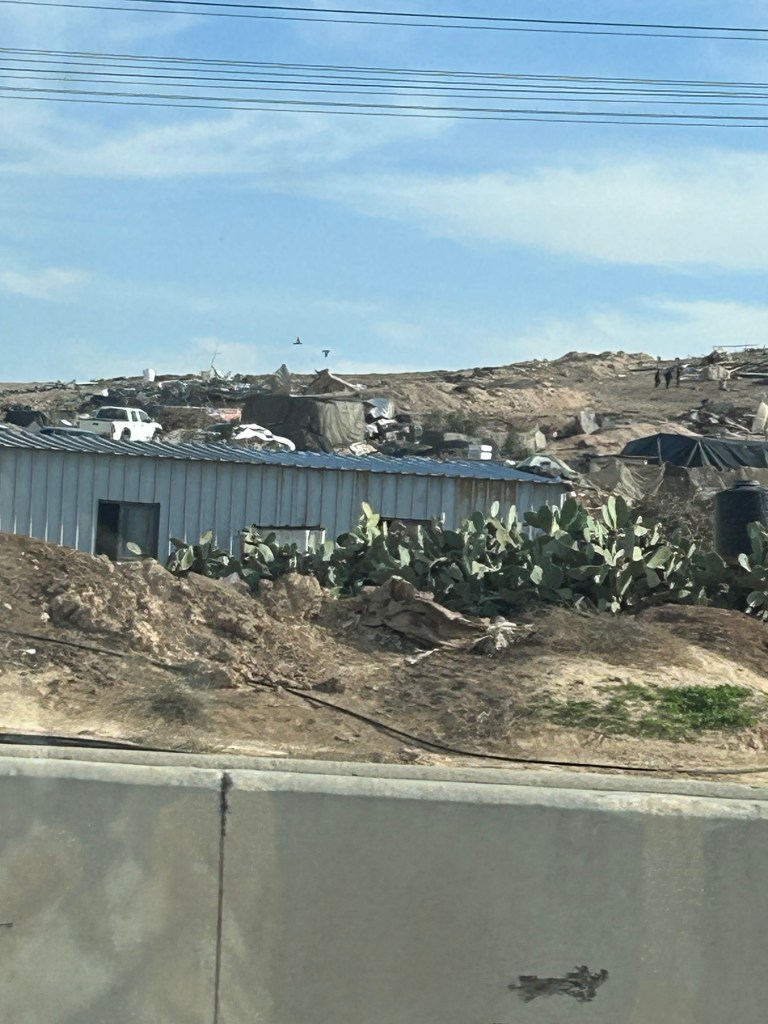
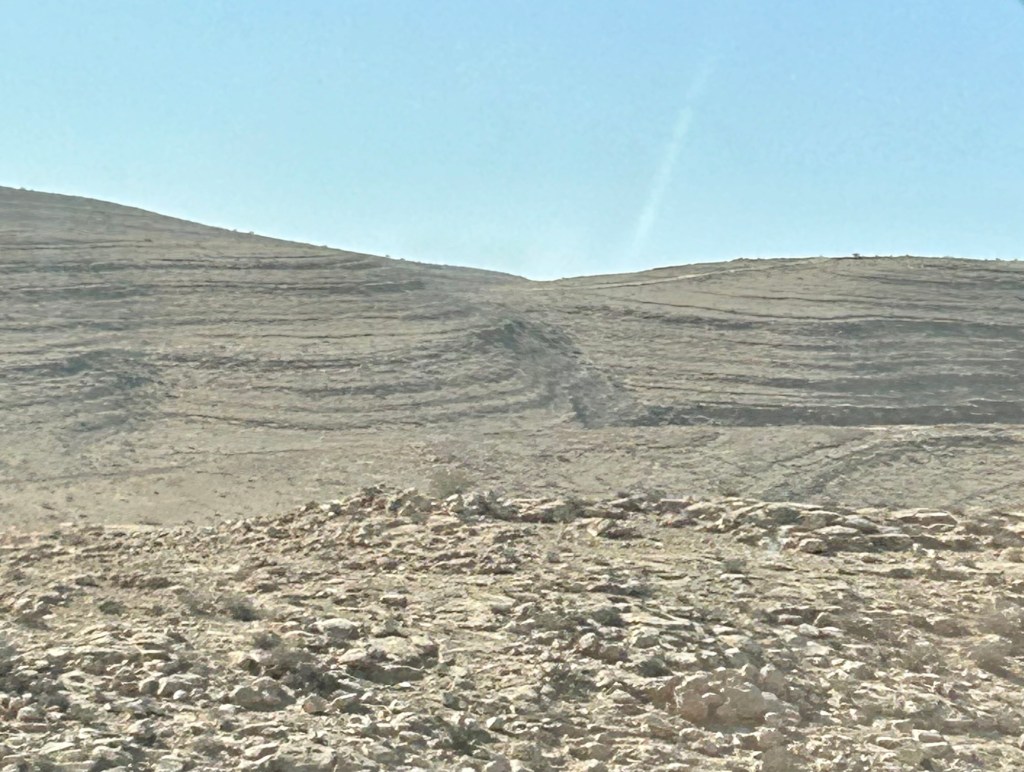
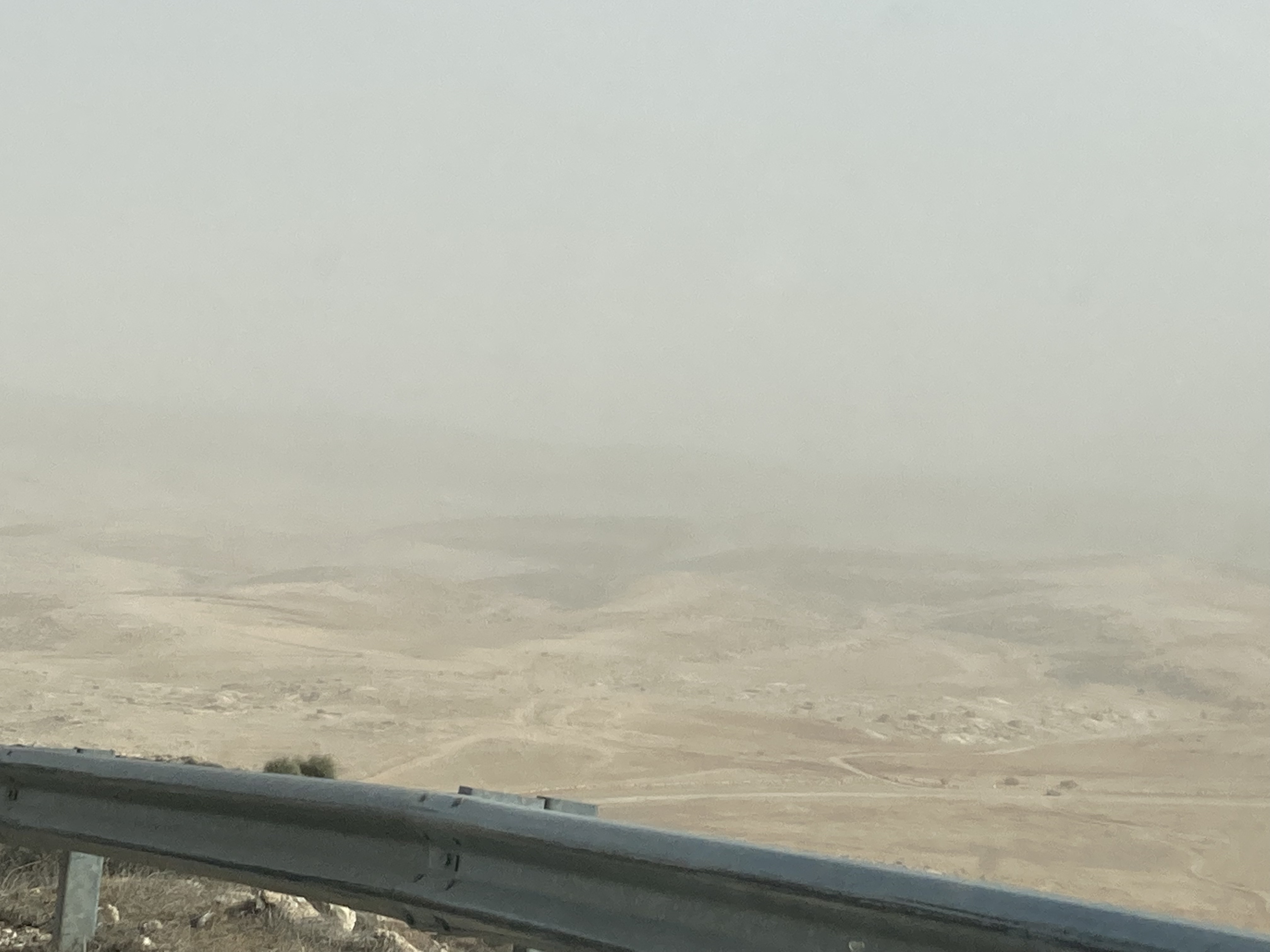
And into the heart of the barren, windswept desert!

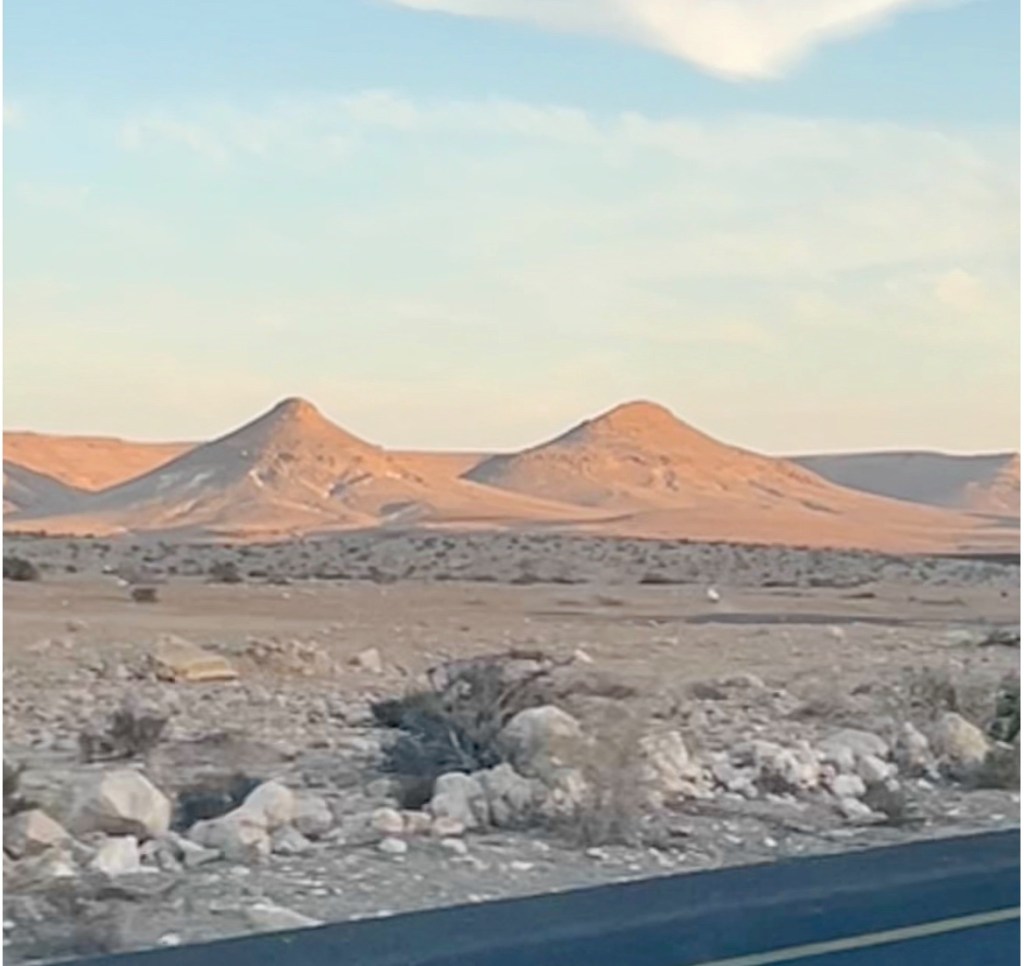
The Desert of Zin! Tsin! Sin!!! In the Bible

We had to get there by sunset… it’s all of 3 1/2 hours, but we kept stopping along the way-
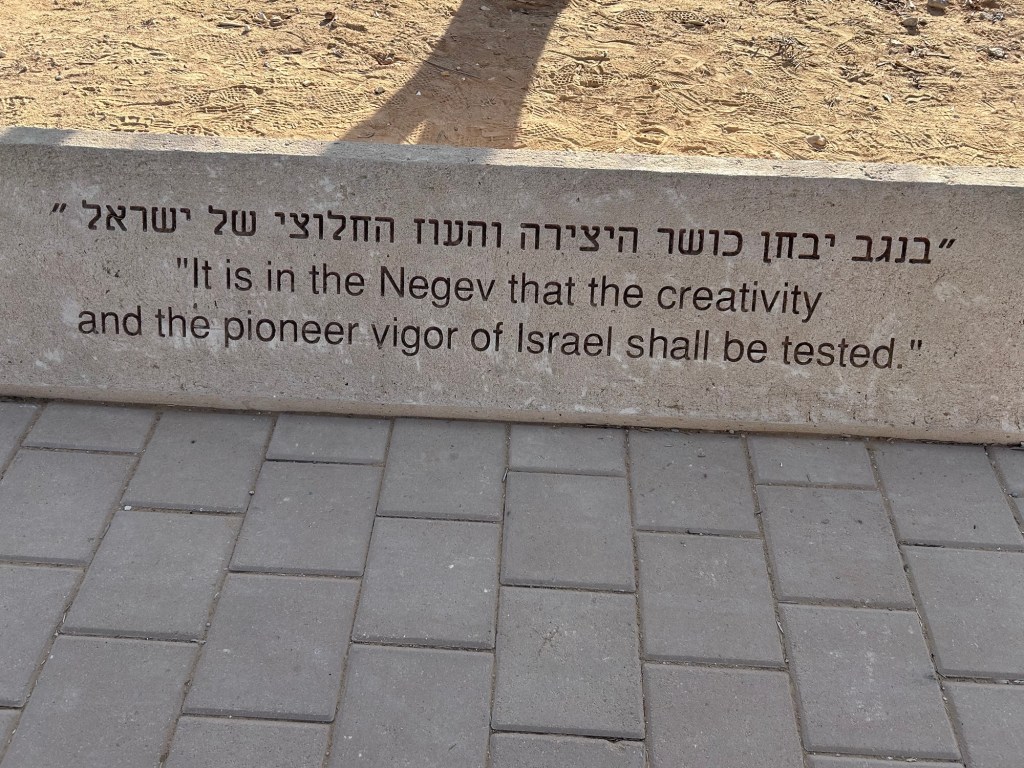
We made a big stop at Sde Boker, the kibbutz founded by first Israeli president, David Ben Gurion. Ben Gurion and his wife, Paula, lived the desert and thought it was the safe spot and key to future Israeli development. He foresaw the day when the Jewish people would learn to irrigate and farm the desert and make it bloom. He wasn’t wrong.

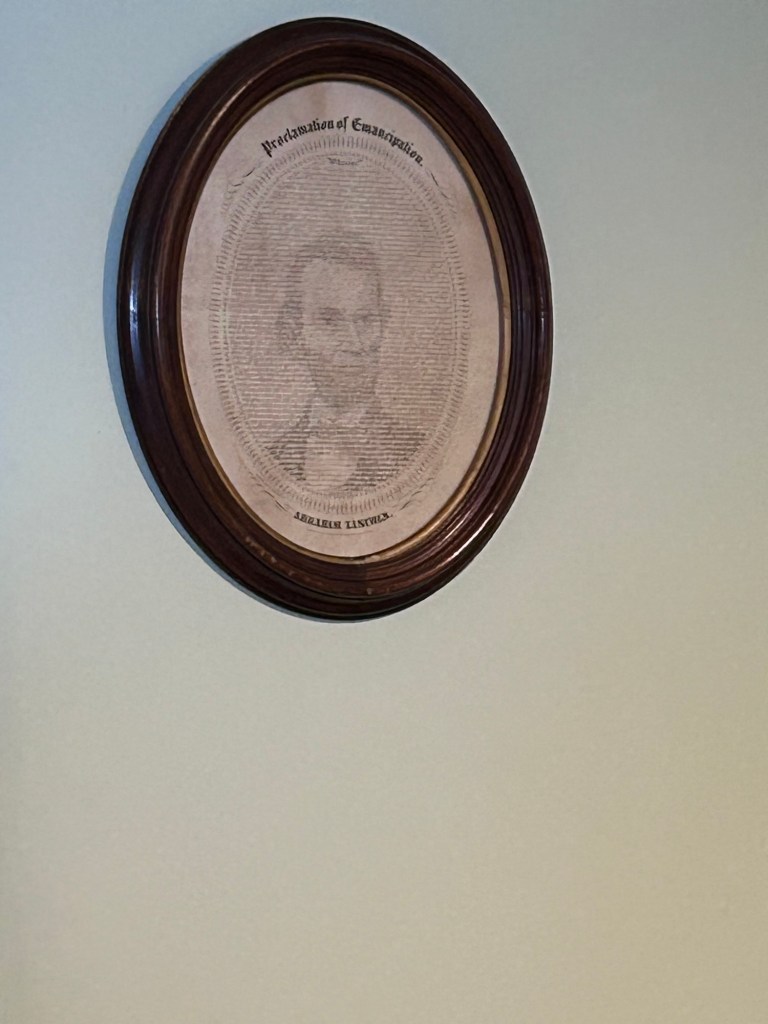
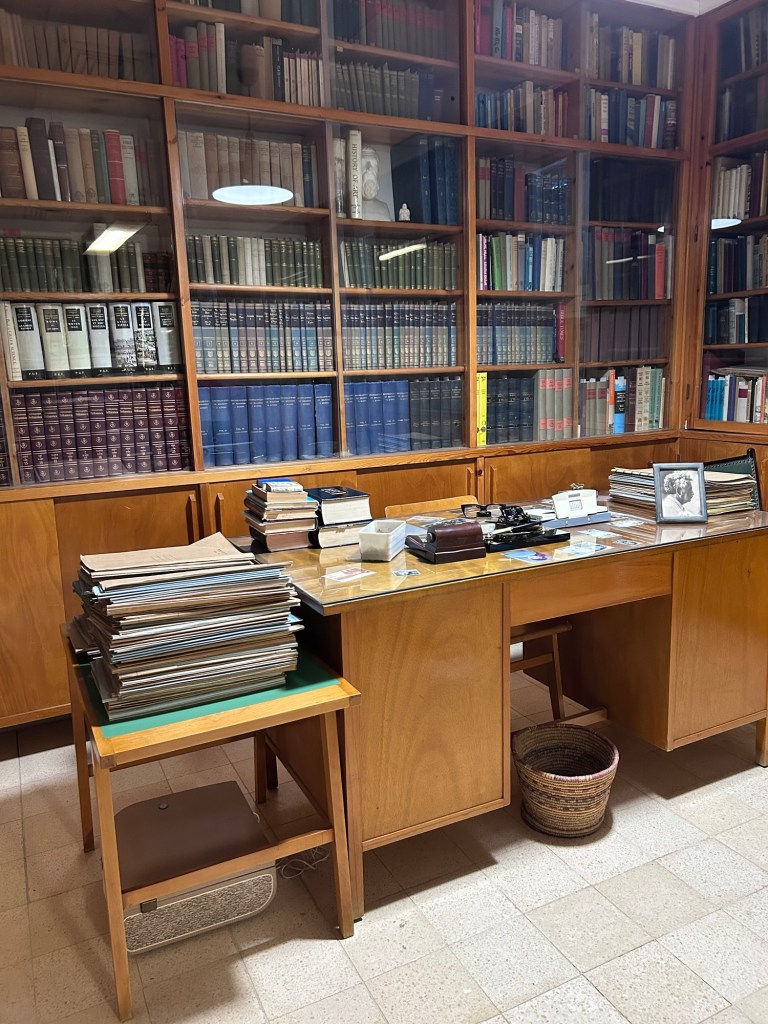
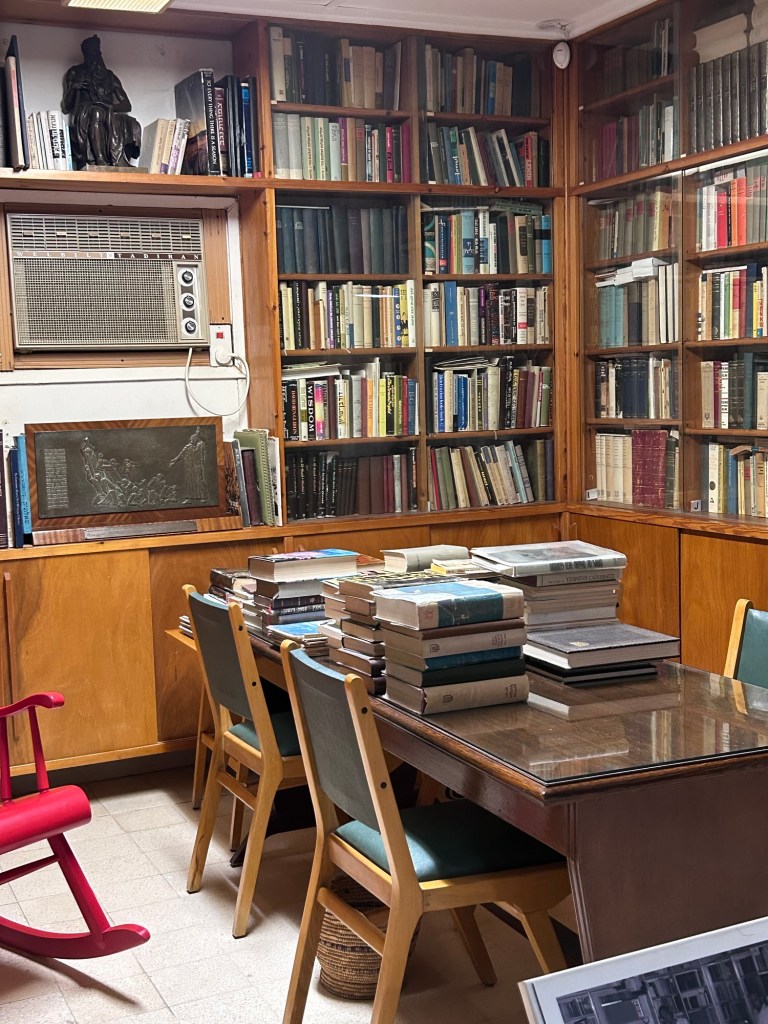
Today his home is a national landmark, open to the public. When we visited, there were only about a million school kids on tour. I was surprised that his home was so modest!!!! And tiny!!!! Like a summer camp bunkhouse. it had a living/reception room, his personal study, teeny tiny rudimentary kitchen and two sparse and small bedrooms- one for BG and one for Paula. He only slept 2-4 hours a night: was always up working, listening to radio news, studying – so Paula had her own quarters so she could get some shut eye. When there was a visiting dignitary, she’d go to a friend’s cabin and the important guest would take her room.

Hurry!!! We need to check in to our hostel!

We found a really remote spot on the edge of the crater. It was much darker than anywhere else (when we first moved to Israel the sky above our home was pitch black and filled with stars. Now, with all the new construction and light pollution, we see very little). John and I – and Haggis, our yappy little long-haired dachshund, sat and waited. We looked up for over 4 hours. The sky was beautiful and the stars many. We named the constellations. We waited. It grew colder. John saw 2 shooting stars. Another hour. I saw 1. So much for the Leonides, although it was a fun adventure.

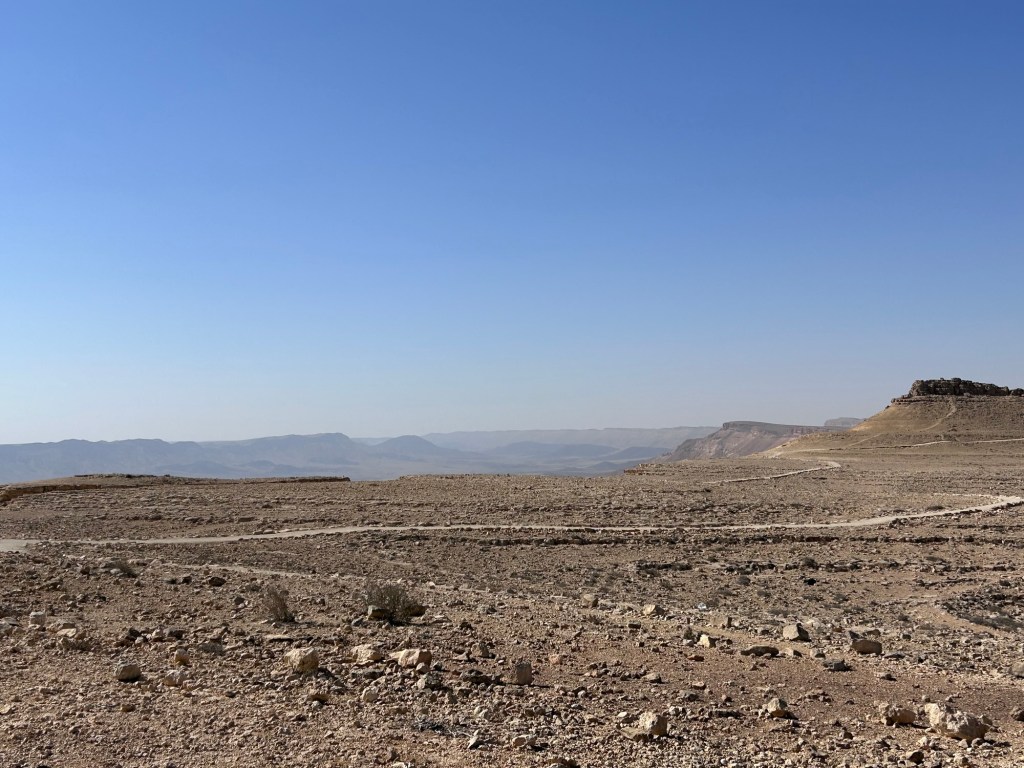
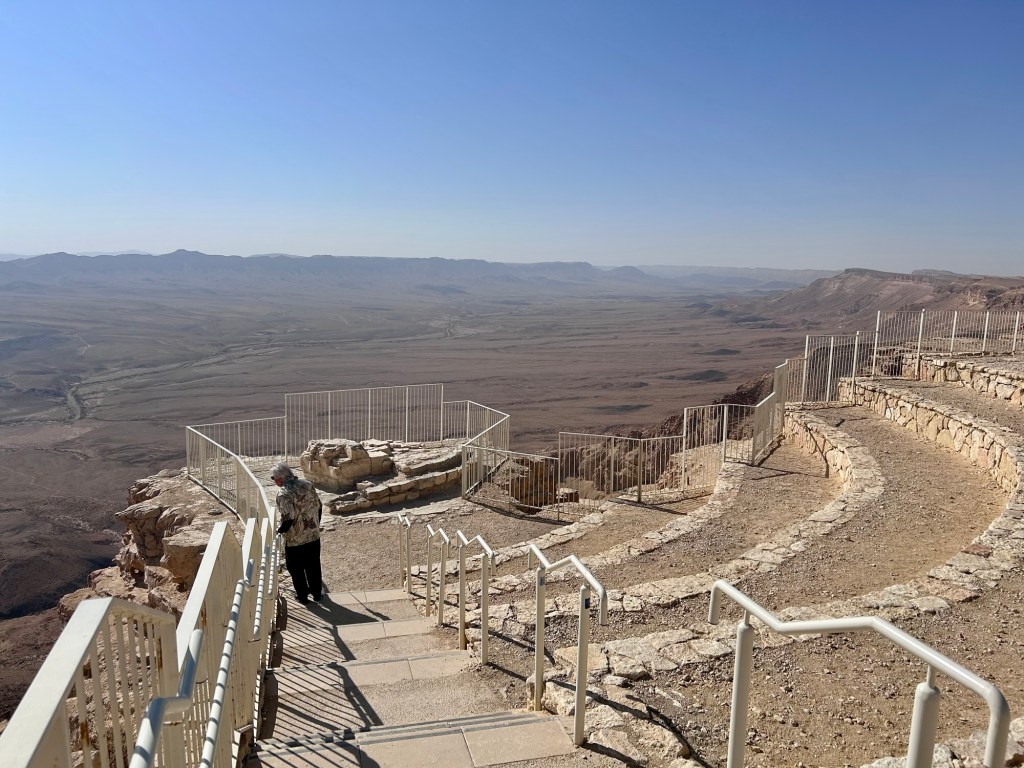
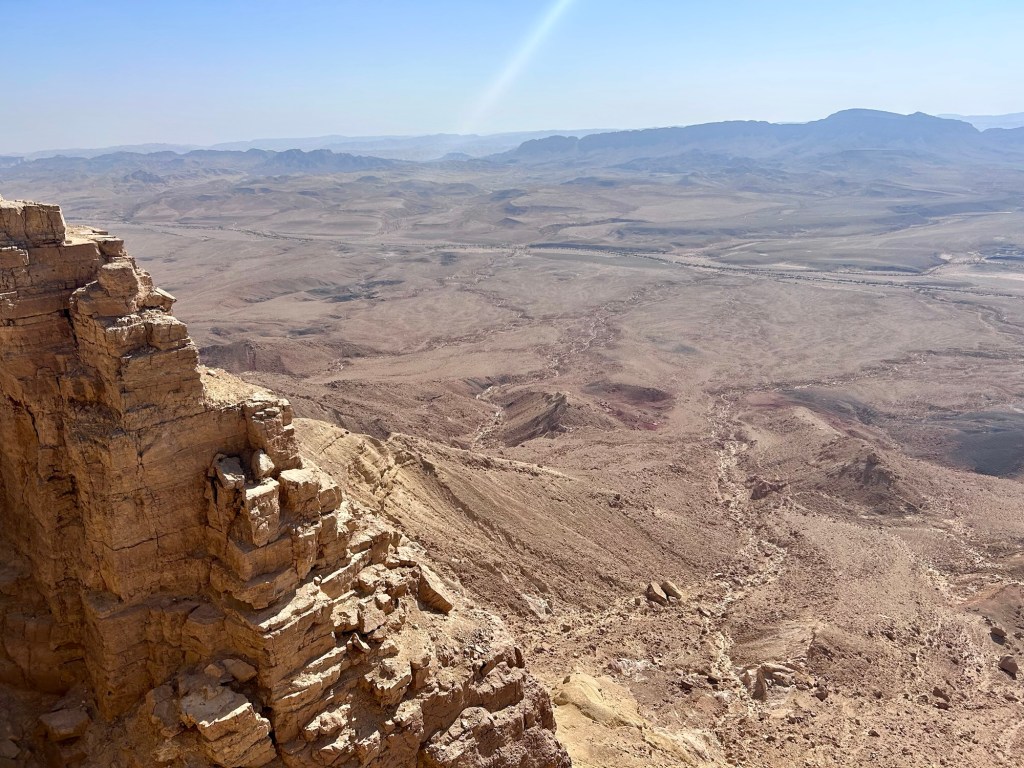
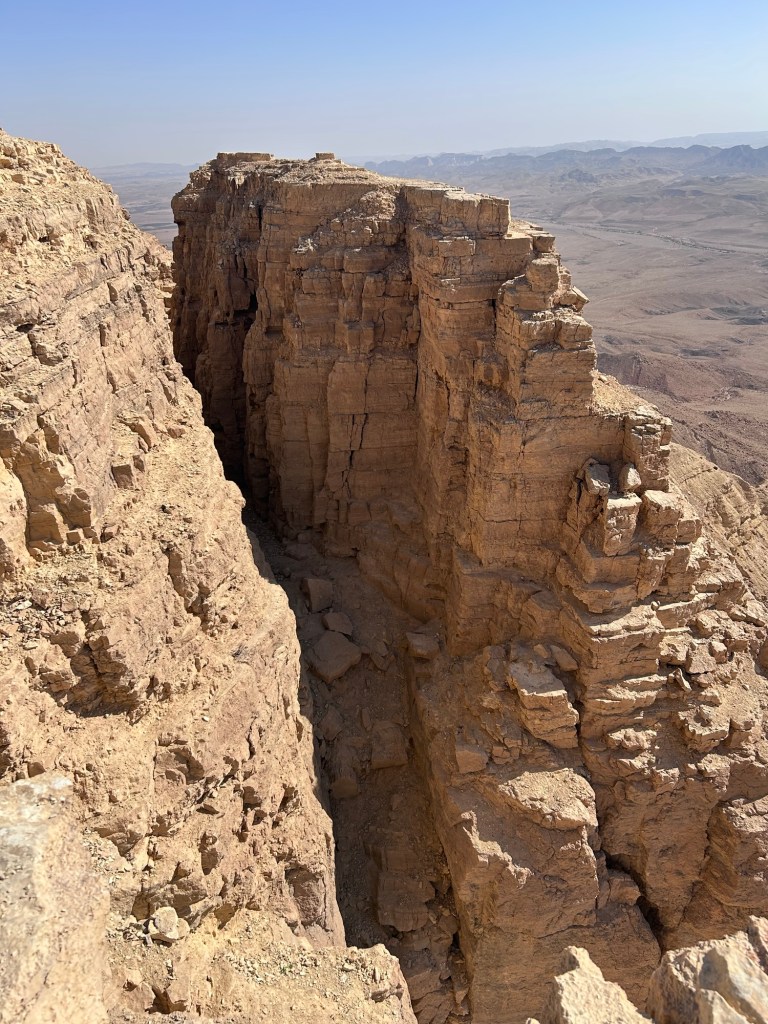
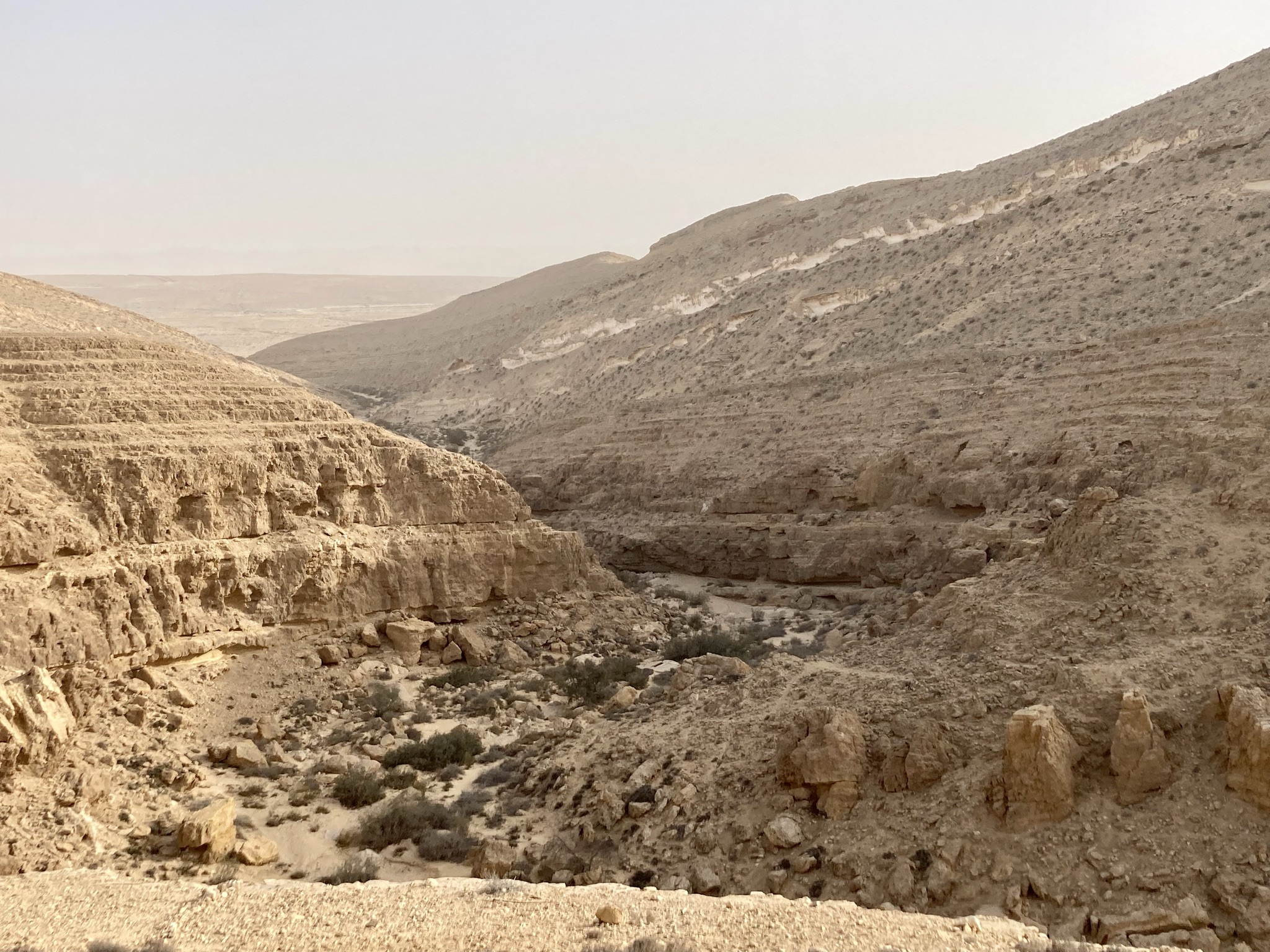
The next morning we got up early to actually see the Makhtesh. Spectacular!!!!

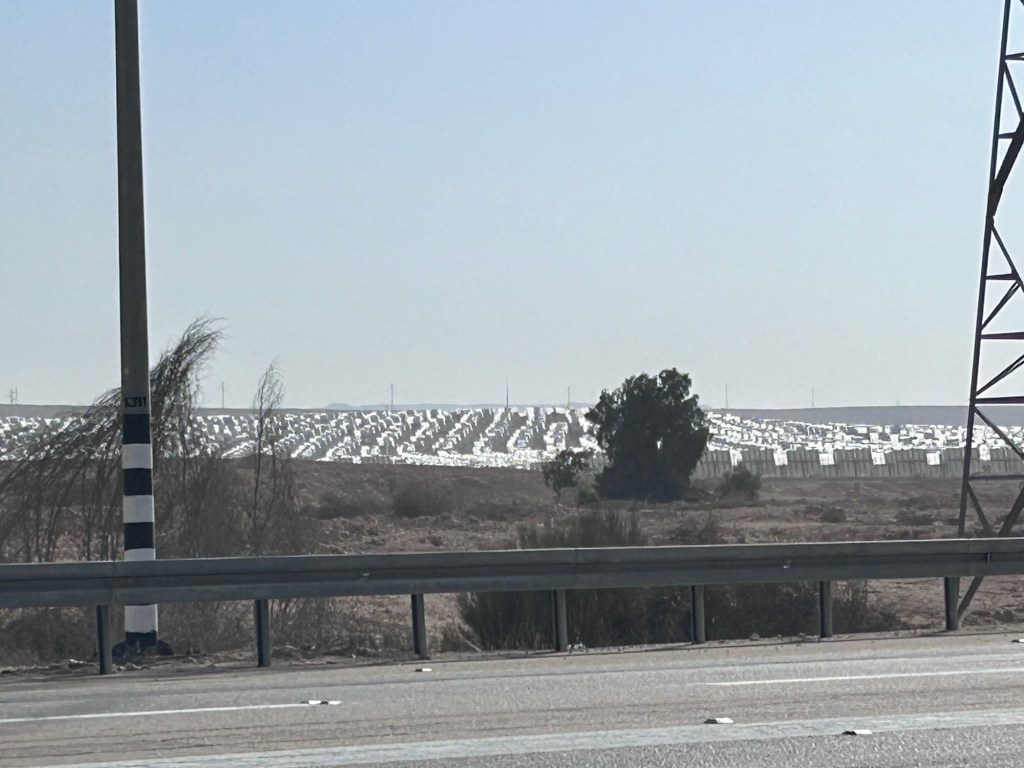
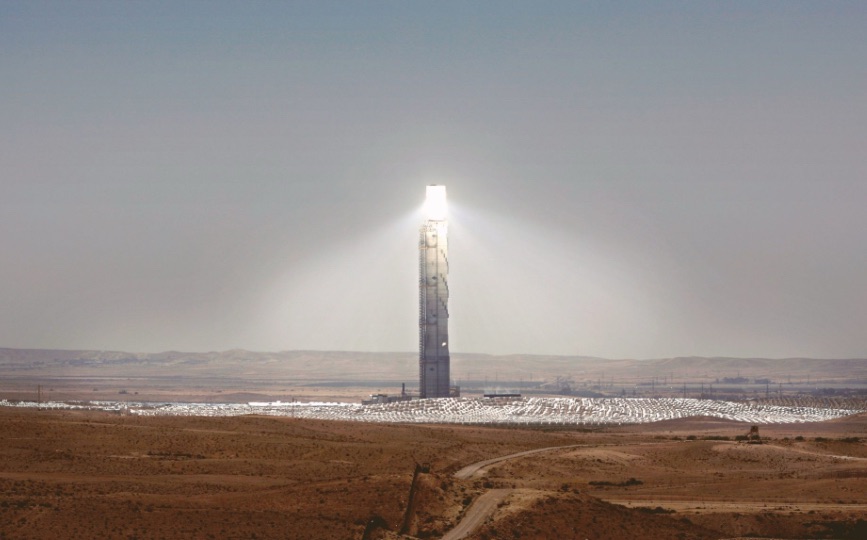
From Mitzpe Ramon, we made our way back to Beersheva. We kept seeing this bright flaming tower/beam in the distance – both coming and going. So we decided to check it out-

What IS that thing miles away?

How cool!!! The Eye of Sauron overlooking the wasteland of Mordor from Lord of the Rings!!!! We found it!!!!! In Israel!!! Actually it turned out to be the Ashalim Power Station. Decades ago, Elon Musk that you could take 10 square kilometers in the desert, put in solar plates and generate most of the electricity in Israel.

Ranking as one of the world’s premiere and few thermal solar stations, Ashalim is composed of 55,000 heliostats or solar panels that reflect the sun onto a huge mirror-like “Eye of Sauron” at the top of the tower which absorbs the heat and turns it into electric power.
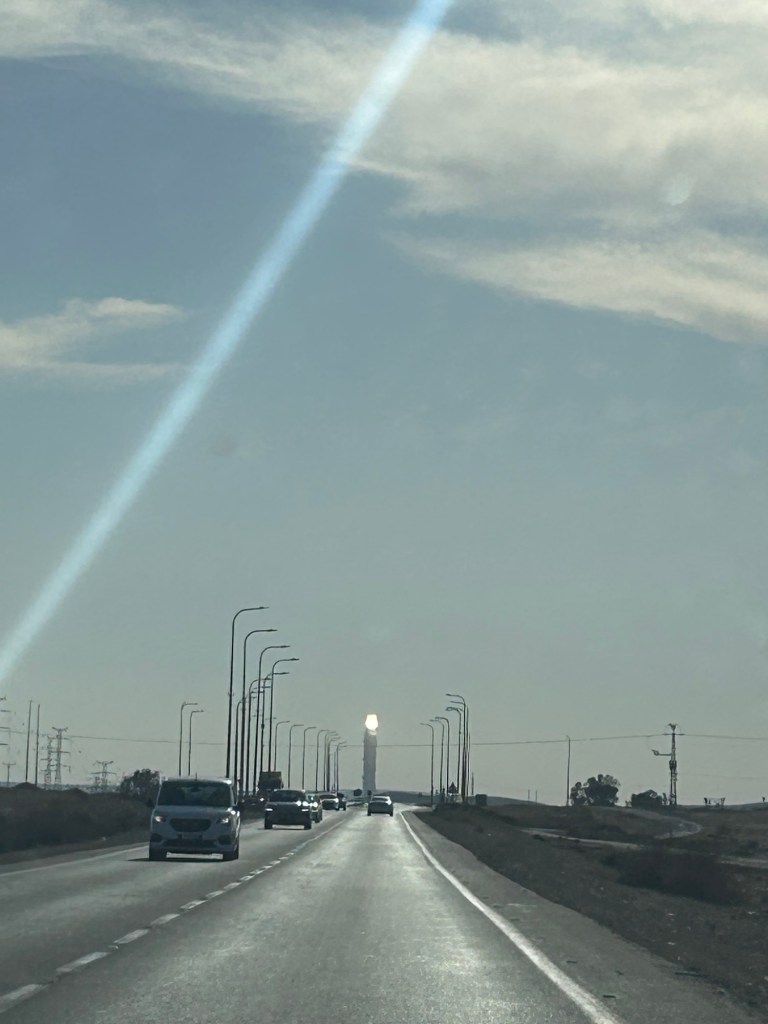
The Ashalim Power Station used to be the tallest solar plant in the world standing at 240 meters (about 790 feet), the size of a skyscraper. However, it was surpassed by Dubai’s Noor Energy 1, with a height of 260 meters (circa 850 ft). There is another (Israeli built) solar power farm in the California Mojave Desert. The reflector on the tower generates concentrated heat which reaches up to 1000 degrees Fahrenheit (over 500 °C) to spin turbines and generate electricity in high quantity. It generates enough power to keep 120,000 homes (5% of all Israeli homes) for a year fully lit. It’s green, renewable and sustainable. I hope to do a more detailed post on this and other amazing Israeli innovations shortly. All in all, it was an illuminating trip!

Now onto a completely different subject!!! Each year, when the Jewish people read the Torah story of Jacob and Esau, I get creative. Esau, a big burly, hairy, red-headed hunter and the favorite son of his father, Isaac, sells his entire inheritance to his younger brother. Jacob has cooked this amazingly tasty and great smelling lentil stew. Esau comes into the desert tent, after a long day of hunting (ibex???). He tells his brother “I’m dying. Just pour some of that red stuff down my throat!!!” Seriously. It’s what he said. I love it!!!!! Anyhoo- Esau winds up giving away the birthright to Jacob for a bowl full. It must have been delicious!!!

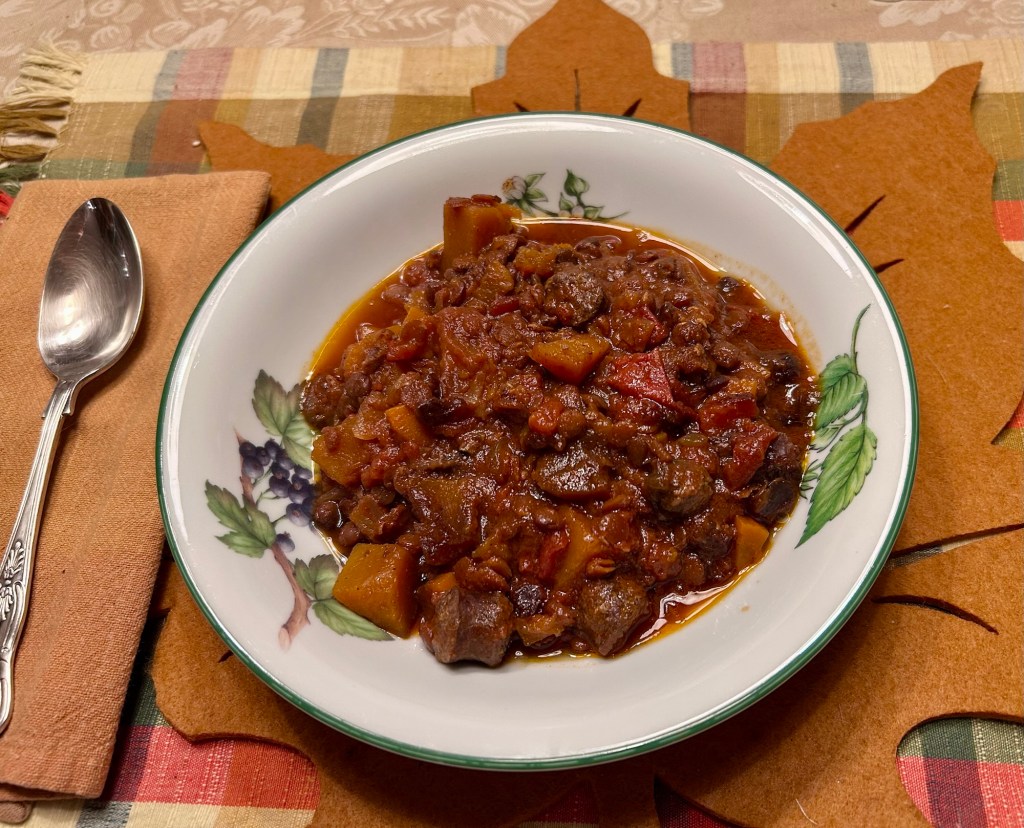
So, last week I worked out my own version: I wanted it MiddleEastern in flavor. With Israeli products. It had to have lentils. It had to be red. And it had to be prepared in a crockpot so I could keep it warm/hot through Shabbat. It turned out AMAZING!!!!!!! So here’s this year’s Red Stuff-

Jacob’s Lentil Stew

Ingredients:

  • 2 large carrots
  • 2 large onions
  • 6 long, thin Merguez beef sausages
  • 1 butternut squash
  • 2 1/2 cups green or brown lentils
  • 10 Medjool dates
  • 1 red bell pepper
  • 1 yellow bell pepper
  • 2 large orange sweet potatoes
  • 6 cups vegetable stock
  • 1 can large chopped tomatoes and juice
  • 1 small packet tomato paste (2-3 TBSP)
  • 2 tsp cumin
  • 2 TBSP baharat spice (cinnamon, cloves, allspice, cumin, black pepper, cardamom)
  • 1 tsp smoked paprika
  • 1 1/2 tsp sweet paprika
  • Pinch cayenne (to taste)
  • 1/3 cup Silan (date syrup) OR 1/4 cup honey
  • Fresh dill
  • 2 tsp salt

In a large skillet cook the sausages, removing outer casing if necessary. Reserve to plate to cool. In same pan, sauté the cubes of onions and peeled carrots – cubed to bite sized chunks. Chop the sausage into 1” thick coins. Add to crock pot. Chop bell peppers into small cubes. Put into crockpot. Peel and remove seeds from squash. Cut into bite sized cubes. Place in crockpot. Peel and cube sweet potatoes. Into the crockpot. Rinse the lentils well, removing any stones or “dry stalks” and dump in crockpot. Pour in the veg stock (can use all natural bullion cubes) and dump in can to tomatoes with juice. Stir well with a big spoon. Remove the pits from the dates and chop coarsely. Scatter around crockpot. Add the spices and tomato paste. Add the Silan or honey. Stir well. Chop about 1/2 cup fresh fennel and add to crockpot last. Mix well and cover. Set the power to low and let cook for hours (overnight). Can add more water if needed. Freezes beautifully.

Close Calls and the Miraculous. War Stories. Day 621/7. 19 June, 2025

After a restless night of running to the safe room, we were awakened again this morning to the sound of the red alerts They were first signaling UAV invasions into the Golan and Jordan Valley. Then came the huge missile barrage.

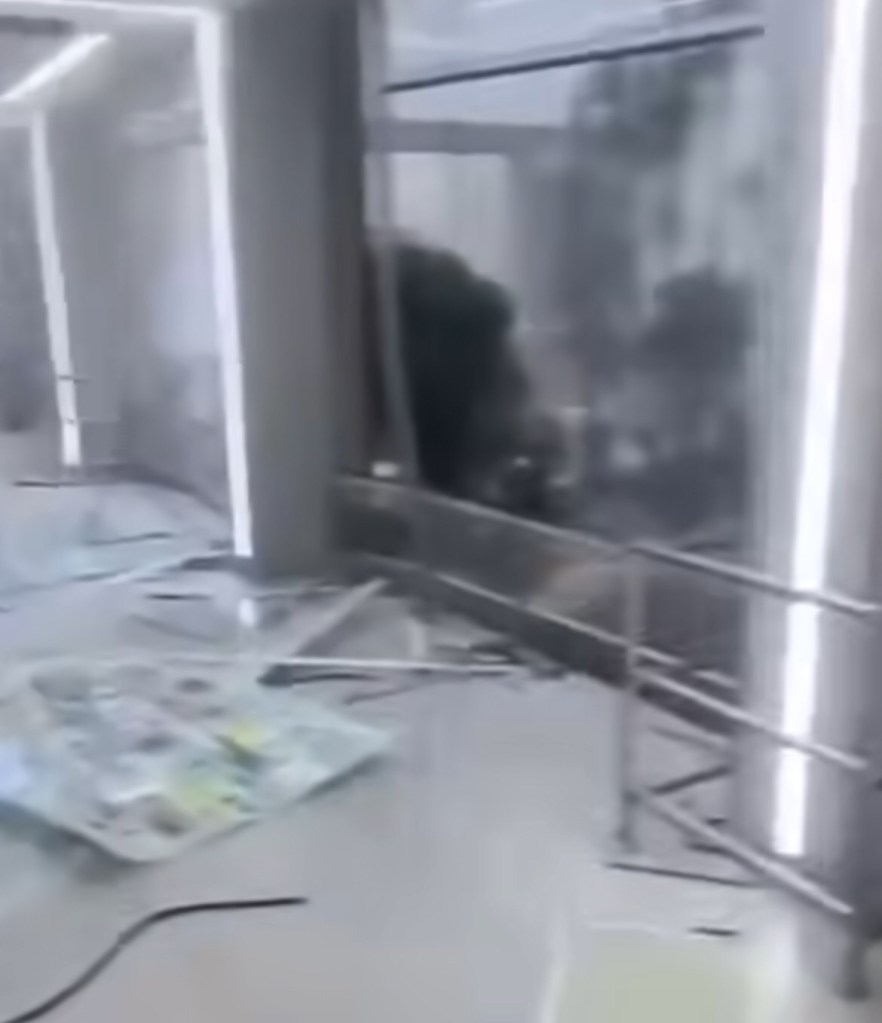
We are witnessing days of the miraculous, my friends. Last night, there was an emergency meeting of the board at Soroka Hospital in BeerSheva. It was decided for some reason to move the outpatient clinics and one-day surgery underground. At 07:15 am the sirens began to blare throughout the county signaling imminent attack. Shortly afterwards we received the news. Soroka had taken a direct hit.

Soroka is the largest hospital in the south serving all the Negev and Gaza Envelope communities. It is also one of the largest rehab units for wounded soldiers and is always full of patients. The missile hit one of the main buildings and yet no one was killed because it had been evacuated the night before. There were almost 90 wounded: 2 seriously, an 80 year old man and a 78 year old woman. There are 6 others in serious condition and 9 in moderate condition, but no deaths. Baruch haShem! Praise the Lord!

Now for my op ed. Last year, the IDF was quickly and falsely accused of bombing a Gaza hospital. It was immediately (within 15 minutes) reported that there had been over 5000 casualties! This was soon toned down to over 1500. The news spread throughout the world as reported by the unreliable propaganda arm of Hamas, the Gaza Health Ministry. Shortly thereafter, it was reported the rocket landed in a parking lot, killing 23 people. After a thorough investigation and review of drone footage from aerial surveillance, it was discovered that Hamas had launched a rocket from a pickup truck at the back of the hospital, which misfired and struck the hospital. The damage was done, and people still believe the IDF targets hospitals and innocent civilians.

The IDF targets terrorists. We have seen it in Gaza as well as Lebanon and now Iran. They go out of their way to evacuate civilians from active military zones and will abort a strike if there is the chance of killing an innocent people. Hamas placed their weapons in and underneath hospitals, schools, mosques and UN facilities. Underground tunnels are burrowed under homes and public places. Iran has exclusively been targeting civilians, mostly dense packed urban areas. Now a hospital. This is a war crime. Where is the outrage from the world?

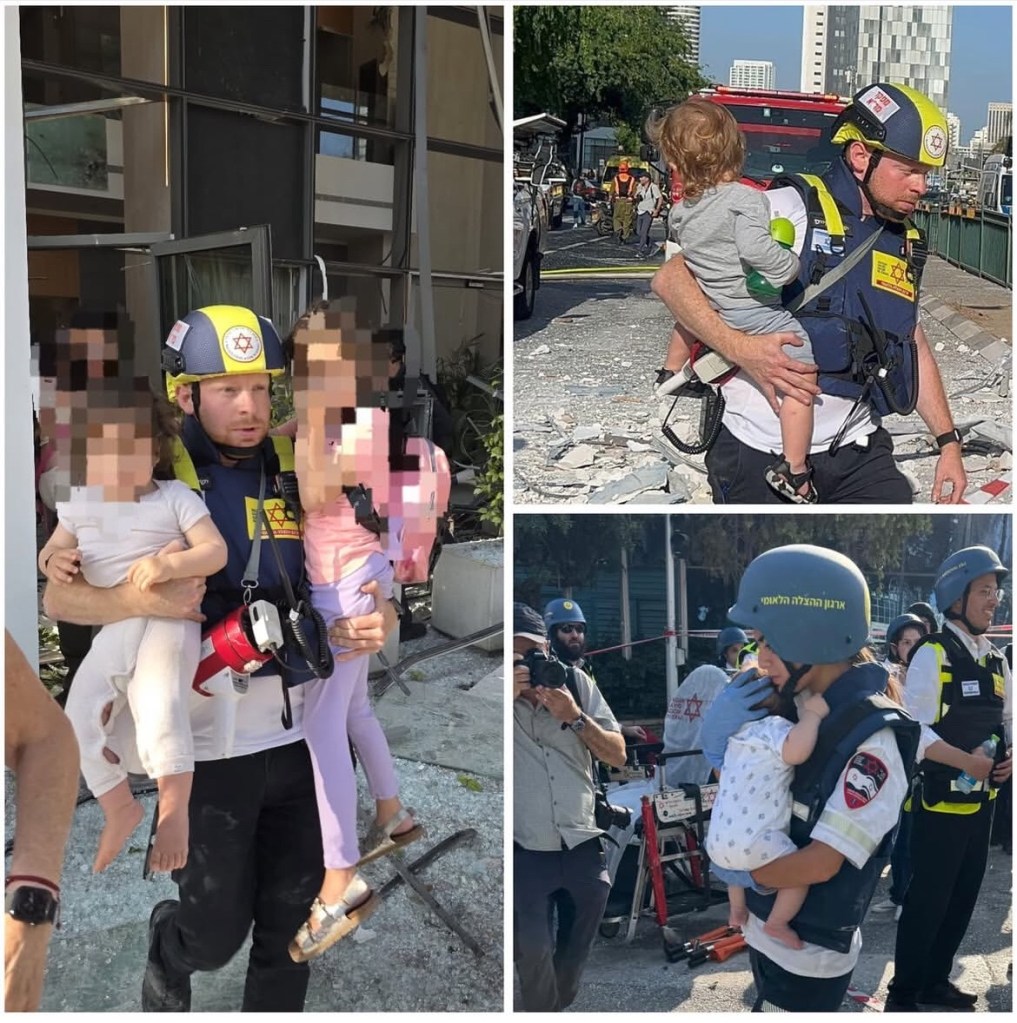
Also this morning, a kindergarten/day care was hit in Ramat Gan (all of this news has been cleared for publication. I reveal no secrets). All of the little children are fine as the classrooms were held underground. Rescue workers were there to evacuate all the little children and reunite them with their parents. Another miracle and narrowly averted disaster!

Two days ago, a direct strike hit the Weizman Institute of Science, one of Israel’s most prestigious research centers. Dozens of experiments were destroyed. The ICBM struck more than ten biology labs, including those focused on cancer, aging and A-I based personalized medicine. Work that was in progress for over a decade was all destroyed. Israel aims at life-saving research, for the benefit of mankind.

Hundreds of Americans on Israel birthright trips were evacuated by cruise ship to Larnaca, Cypress. They had survived the Iran bombardment. 1500 people were on board the ship, escorted by the Israeli navy. Florida governor, Ron DeSantis chartered four jets to pick them up and fly them back to the States where they can then take other connecting flights home.

Thousands of Israelis are waiting at American and European airports to return to Israel. Airspace opened yesterday for two packed flights (including scores of returning soldiers) to land at Ben Gurion. This morning, another inbound flight from Cypress was diverted mid-air back to Larnaca due to Iranian missile barrages. Hopefully flights will soon resume to bring stranded tourists and foreign nationals back home and pick up the returning Israelis.

Israel yesterday destroyed Iran’s digital nuclear archive backup, the last copy of knowledge on how to build a bomb. There are now no top scientists. No documents. And for now, limited ability fore a nuclear future. Strikes have been made on Iran’s Arak nuclear wastewater facility after the evacuation of all civilians in a wide radius. One of the last things left to do is to somehow destroy or incapacitate the Fordo nuclear facilities, which lie deep underground. Whether this can be done by stealth or even remotely remains to be seen. The only bomb that can reach the bunkers that far down are held by the United States and is carried by the stealth bomber. I pray America does not have to enter into the war!

Last night, the Iranian broadcasting company was hacked. Images of demonstrations and calls shown on screen for the Iranian people to take to the streets and protest against the regime were shown. The Crown Prince, Reza Pahlavi made a statement from outside the country: “The Islamic Republics has come to an end and is falling. What has begun is irreversible. The future is bright and together we will navigate this sharp turn in history. Now is the time to stand. It is time to take back Iran. May I be with you soon.” There have been reports of major demonstrations and young girls and women are throwing off their burkas and head coverings. The Iranian government cut the internet at the beginning of the war, but it was quickly restored (by Elon Musk) through Starlink. The channel also broadcast a statement from Netanyahu telling the citizens of Iran that Israel does not fight against them but against the totalitarian regime. The time of the people will come shortly.

German Chancellor Freidrich Meira, at the recent G-7 said, “ Israel is doing the dirty work for all of us.” There are unconfirmed reports which claim that Iran’s Supreme Leader, Ayatollah Ali Khameni is dead. In the meantime, Iran continues its own threats. “We are about to launch the largest and most violent attack in history on Israeli territory.” That was three days ago.

In the meantime, IDF estimates that over 60% of Iran’s missile launches have been destroyed by the Israeli Air Force. Still, over 100 remain operational. The IRGC has switched from static launches to mobile launchers which shoot much fewer missiles simultaneously, but can be moved around. Several have been hit within the streets of Tehran as well as adjacent to large mosque complexes. Israel is able to eliminate them with surgical precision strikes, that do limited damage to nearby surroundings (unless the launchers are loaded). The IAF reigns supreme over the wide open Iranian airspace.

In lighter news, an elderly British-Israeli couple were visiting their children in England when they became stranded. Taking matters into their own hands, they dressed as Muslims, traveled to Egypt and somehow found their way back into Israel through Eilat.

We wait with bated breath to see what will happen next. I shall try to keep you posted. Again, we watch and pray for good news. May peace come soon to all of us.

Israel’s Got Talent

When we moved from the greater Los Angeles area to Israel, we really felt we’d be giving up a lot. We were pretty spoiled, because LA/Hollywood is supported by “The [Entertainment] Industry” and so many of our friends and neighbors were connected in some way… stunt men, costume designers, editors, composers, musicians. We had so many musical genres represented from pop to hip hop and rap to Broadway, jazz and the best in classical with the Los Angeles Opera, Los Angeles Philharmonic, LA Master Chorale and smaller opera companies, choruses, and conservatories. We were never at a loss for entertainment from rock concerts to childrens’ choirs and loved our summers at the Hollywood Bowl and season tickets to the opera.

I really didn’t know what to expect culturally when we first moved, but I was told that each large city had its own first-rate music conservatory. This was important, as our son was a trumpet player, and I wanted to afford him the opportunity to continue his lessons and have performance venues as well. In addition, throughout the year different cities and kibbutzim host all types of concerts and festivals featuring both local Israeli talent as well as talent brought in from abroad.
Music speaks to the soul and as such, is so important across cultures. We’ve had the chance to experience firsthand the local flavor of the Arabic music and have visited some of their music schools. We’ve enjoyed Yemenite bazooki concerts and French café style entertainment. The Ethiopians have brought with them their own heritage in liturgy and contemporary music and the immigrants from the former Soviet bloc countries are known for their early training in the classical arts. We’ve found Arab Christian bagpipe bands in Nazareth, a hold-over from when Scottish missionaries came to the Holy Land in the 1800s. And we even have a good friend who is the promoter of heavy metal concerts coming to Israel.

Each year, our local music conservatory hosts a fundraising concert with all the proceeds going back into community programs. At first, we were reticent to go, but now look forward to this event as the range of musical talent is representative of the diverse fabric of our society. There is a beautiful women’s chorus made up of religious Jewish, Arab Christian and Druze and secular young ledies. They sing liturgical, folk and classical chorale pieces.

There are several sopranos, who sing the standard art song repertoire in Italian, French, German and even Arabic:

Our mid-sized city has so much talent, including a young woman cellist who has won several international competitions and will go on to study music after her army service; Russian siblings, ages 11 and 13, pianists who both perform solo and duets; a flutist from Canada and a Ukrainian balalaika player who has been performing professionally since he was six and now serves in the IDF, but made the time to play at this concert.

Karmi’el is one of several cities that prides itself on its Children’s Village. There are 200 children from grades 1-12 who live on the spacious and well-manicured campus. Some are orphans, but many come from broken, abusive or disfunctional families. Separated into 16 “mishpachtim” or family groups, they live in large, specially designed homes with sponsor parents and their families. All the kids attend the public schools, but return to the village for afternoon activities, clubs, music and dance lessons, therapy and sports. In this well-rounded program, the older children help with volunteer service projects within the city. Their success rate in academic excellence, reintegration into society, military service, sports and entertainment is unparalleled. One of the young men recently won Israel’s version of The Voice, Junior. Each year, they put on an amazing show for the community at our local theatre arts complex.

Just before the first wave of lockdowns due to the pandemic, John and I went to a hands-on drumming workshop in Nazareth. It was tremendous fun learning about the darbouka, made of wood or aluminum and covered with leather from donkey, goat, camel or skin, each having a different sound. Demonstrations even included a fish-skin covered tambourine, a bandir, based on the ancient models. The last clip in this series was an ancient Aramaic song from the book of the prophet Jonah: the prayer he made from the belly of the fish. The melody itself is centuries old.

During the summer, neighboring Tsfat hosts a three day Klezmer music festival. At Kfar Blum, a kibbutz in the Upper Galilee, there is a weeklong classical music festival. The kibbutz operates a first class hotel and the venues, for both indoor and outdoor concerts are said to be quite pleasant. The festival features vocal and instrumental music with world class guest artists from throughout the world. Jerusalem hosts an international oud festival (an ancient stringed instrument), and the Red Sea resort city of Eilat is famous for its international jazz festival.

In years past, in the Galilee, there was the twice annual Jacob’s Ladder Festival with the best in bluegrass, Celtic, and blues. Most festivals here are very family friendly with activities and workshops for even the youngest. In the early summer, on the shores of the Sea of Galilee at Ein GeV kibbutz, there is an choral music festival of mostly Hebrew and European choirs. It also includes a competition.

Speaking of competitions, Israel has been placing first in the Eurovision Competition, a huge international “Who’s Got Talent?” show broadcast throughout Europe. Israel hosted last year in Tel Aviv. The Abu Ghosh Music Festival (just south of Jerusalem) is home to a classical vocal competition in the Spring. Vocalists come from all over the globe. Performances are held in ancient churches and cultural arts centers in the area. Master classes are open to the public.

We had tickets to the Liturgical Festival, but because it was during the pandemic, the events were all livestreamed.

There’s something here for everyone. If you’re into indie, the InDNegev Festival each October is the place to be. The event has grown each year since 2007, and now includes art exhibitions, poetry readings, movies, and huge parties lasting all night. As with several of these types of festivals, camping is strongly encouraged. Every winter, there is also a Grateful Dead festival with live music cover bands as well as dance tents and hippie art shows. If raves are your thing, then there’s the Minus 424 (meters below sea level) Dead Sea Rave. Electronica, lots of DJs and laser light shows have festival goers dancing from sunset to sunrise with the red desert mountains as part of the surreal backdrop. And not to be outdone by America’s Burning Man Festival, there is the infamous Midburn Festival in the Negev Desert each October. A combination Woodstock, Coachella and Burning Man, the participants themselves are the ones who create the performances. They set up an entire weeklong installation in the desert. It has become so popular, that you need to know someone who is part of the event in order to get a ticket.

Israel is truly a crossroad of the world. Because of its proximity to Africa, and due to the influence of our Ethiopian, Eritrean, Nigerian and Ugandan immigrants and visa holders, there are several AfroBeat, AfroJazz, heritage and Reggae concerts throughout the year. Every city has multiple entertainment venues, and most events are free to the public, like the Nuite Francaise which even included a wine and cheese bar and ballroom dancers!


And of course, we have our own mega stars singing pop, hip hop, and indie folk. All during the summer, our Israeli entertainment icons perform concerts in amphitheaters all over the country, many are free, sponsored by the municipality.

(Warning: the next two video clips include bright, flashing lights-)

The very popular Hatikvah 6
Static & BenEl, a high energy boy band, is extremely popular here

Saving our favorite Israeli performer for last: John & I first heard the music of Idan Raichel in Los Angeles in 2010. We saw him at different locations in California and we haven’t missed one of his concerts here (which always sell out in hours). Idan first started performing (accordion) at age 12. He’d play for the dancers at the Karmi’el Dance Festival every year. Last year he, most deservedly, received an honorary PhD in philosophy from BarIlan University and has been named Israel’s Poet Laureate. His music is not only beautiful, but the words! About the beauty of life, of love and friendship, of peace and unity. Many international recording stars have teamed up with Raichel to form the world-beat Idan Raichel Project. It truly is peace through music. So I leave you with this- Enjoy!

Solo performance at the Elmaa Arts Center, Zichron Yaakov

Ancient Mysteries

The last day of our three day desert adventure this past December was incredible in several ways: it was midweek and there was no one else for miles so we were alone in the desert – a special experience; we were able to cover a tremendous amount of territory and make it to three amazing and different archaeological sites; we were trying to do it all before the predicted high winds, sandstorm and first major storm of the winter hit.

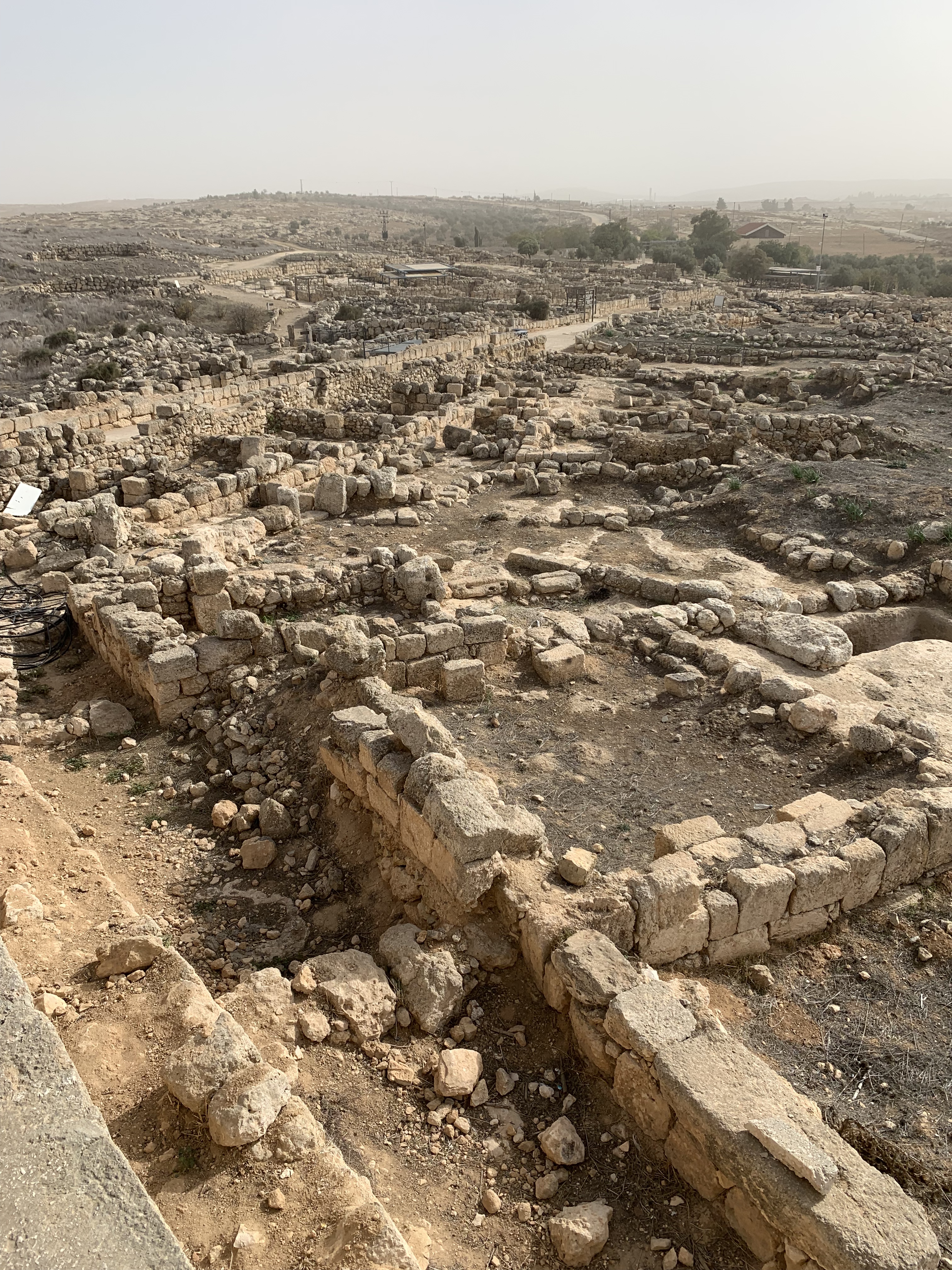
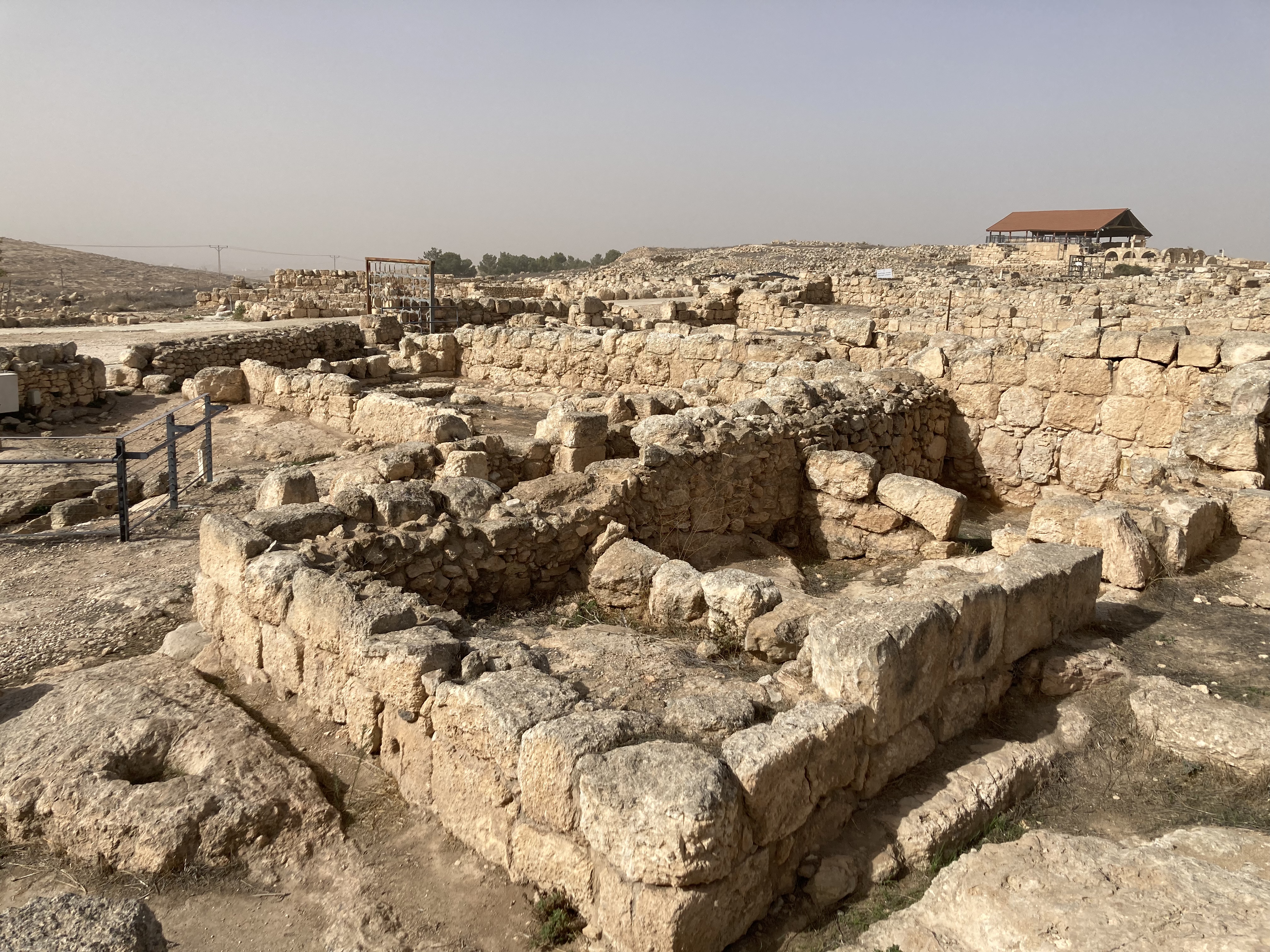
Our adventure started early in the morning at the ruins of Susya, an ancient city that was excavated from 1985-2000. On the eastern fringe of Mount Hebron, southeast of BeerSheva in the area once walked by Abraham and the Patriarchs of monotheism, settled by the tribe of Yehuda (Judah), a large town was built by Jews after the Roman destruction of Yerushalayim. It is one of the most unusual ancient towns we’ve ever visited, a town filled with mystery. Sometimes there is only so much that archaeologists and anthropologists can put together from their findings. Stones are uncovered which tell only part of a story. Without first-hand written records or documents much is left to speculation.

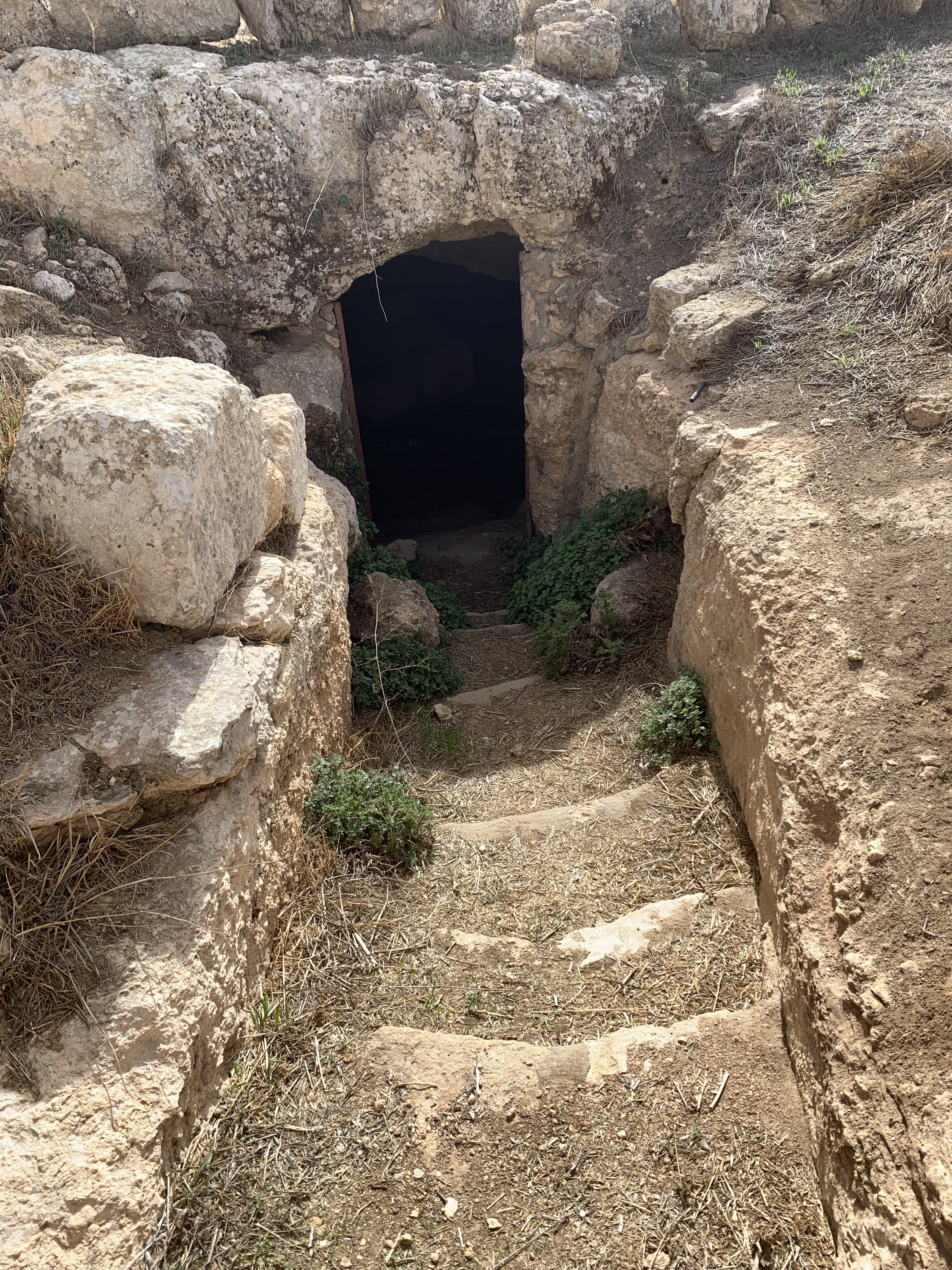
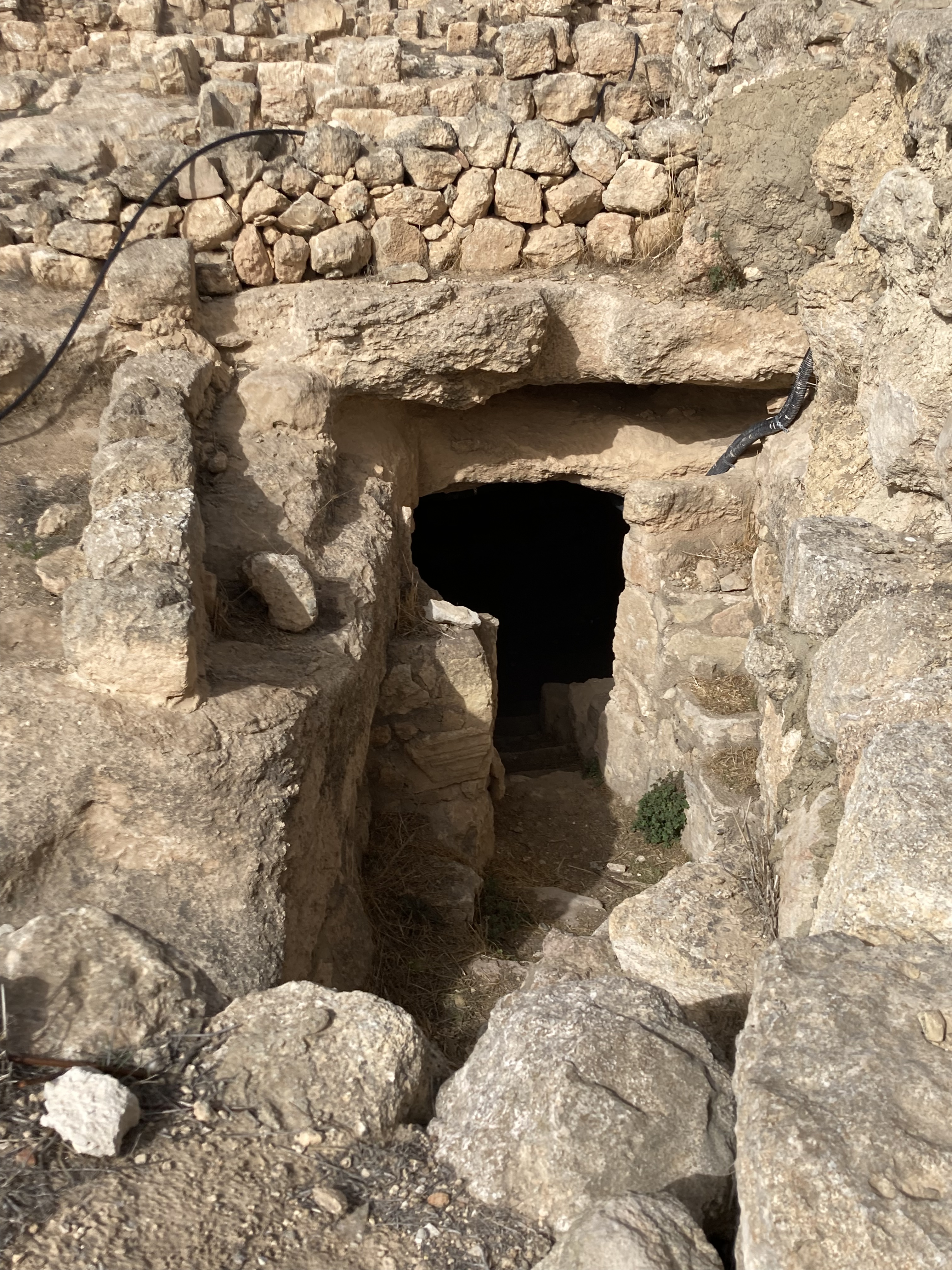
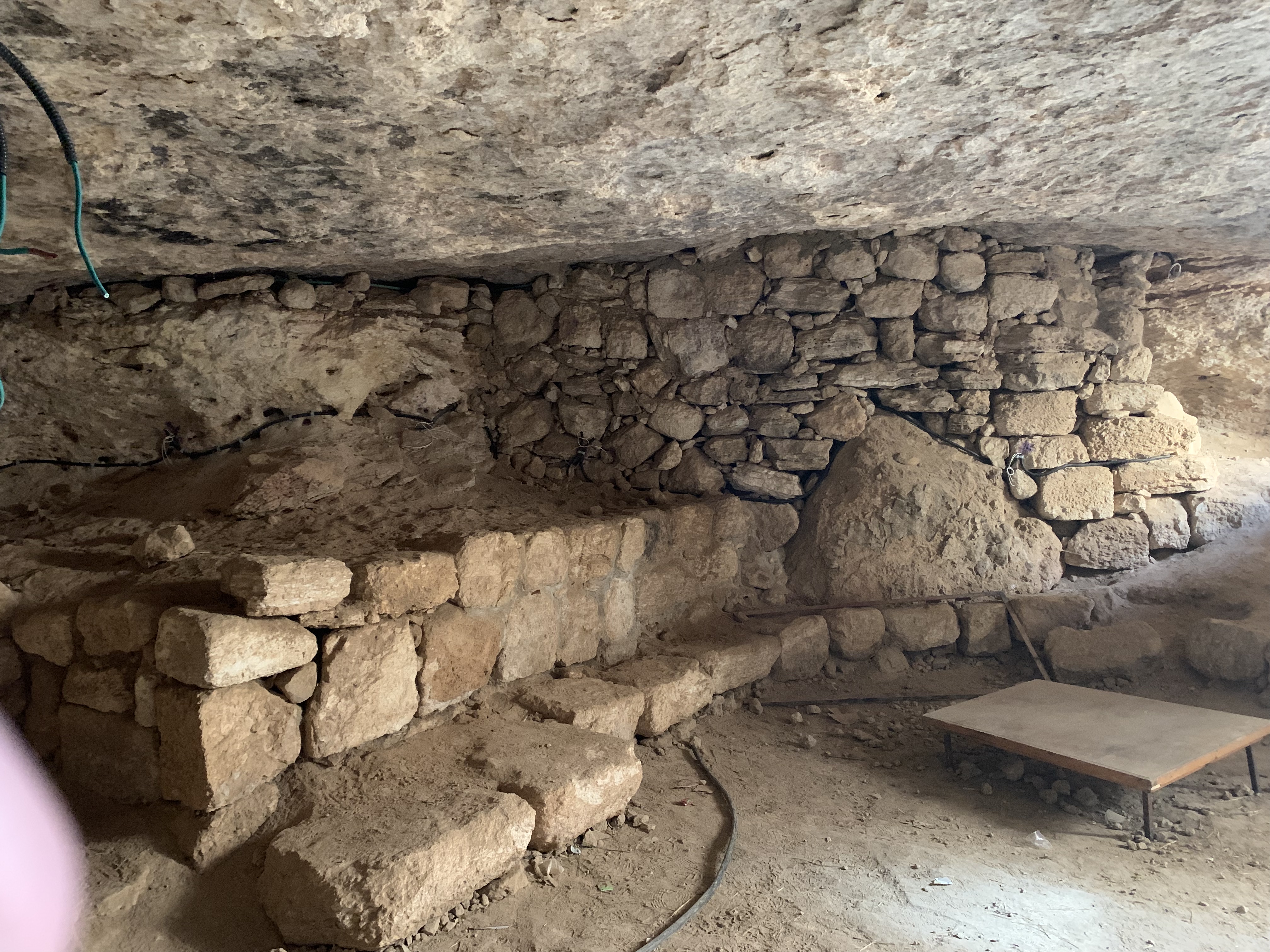
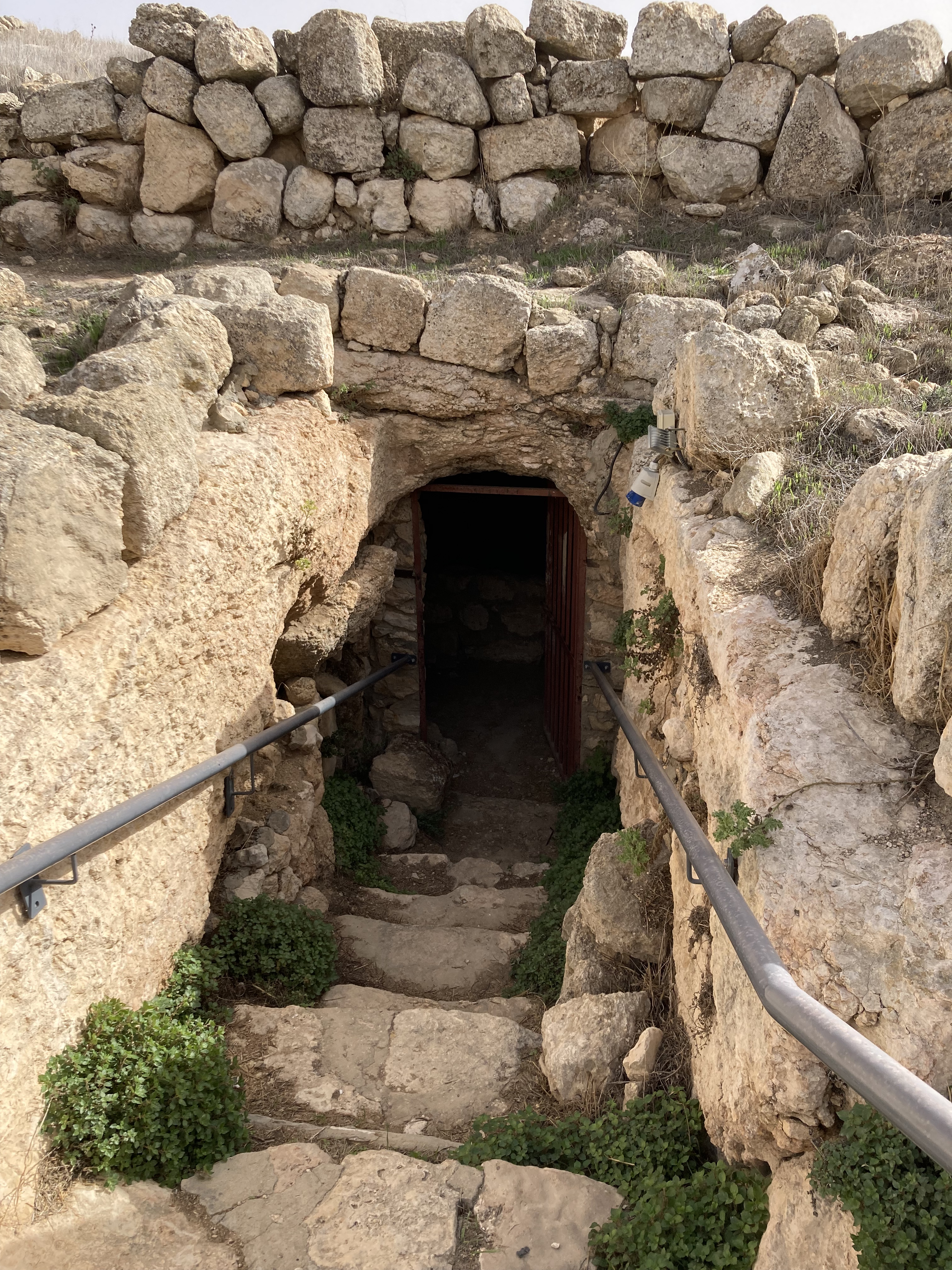
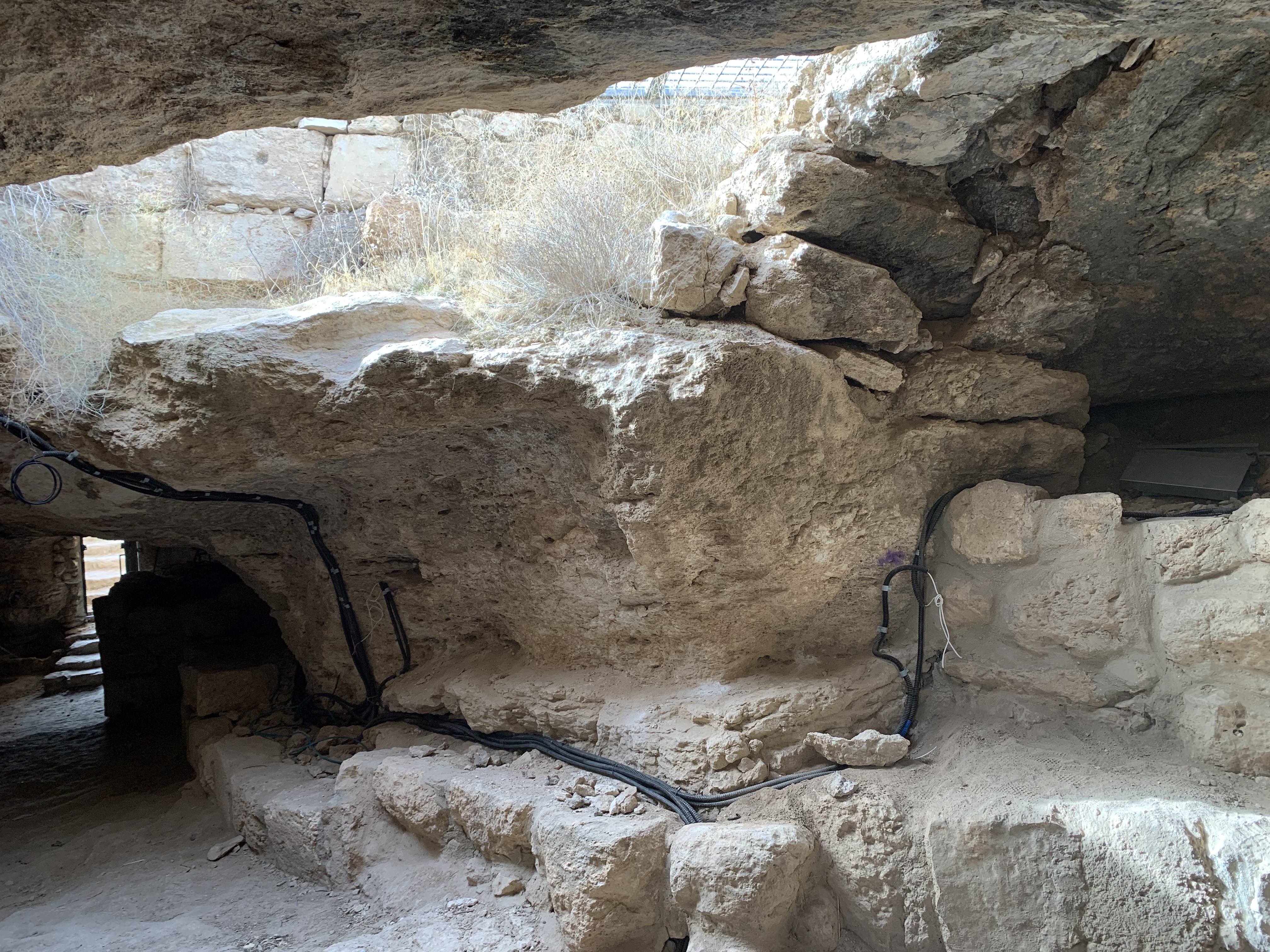
Susya was a fortified city built on a high plateau, excellent for defense. As in most ancient towns, it was surrounded by a high stone wall at one time. It was built after 70AD and lasted until the end of the Byzantine or beginning of the early Arabic period. After that, it seemed to have been abandoned. Why? A mystery. The town had homes separated by streets and alleys, but most of the homes and businesses (potter, forge, olive production, wine production) took place underground! Homes were connected by subterranean passageways. Many of the ”buildings” were carved out caverns. Huge underground chambers, many linked together. Why? Was it for defense? If so, from who? Perhaps because it was cooler underground in the summer and warmer in the winter? Without written documents, it’s difficult to piece together the whole story.

More than 70 of these underground spaces have been uncovered at Susya. What is known is that it was a Jewish city. Both private and public mikvaot (ritual baths used for purification purposes) were found. Such a large number of these purification baths testifies to the great importance of their adherence to Torah law.

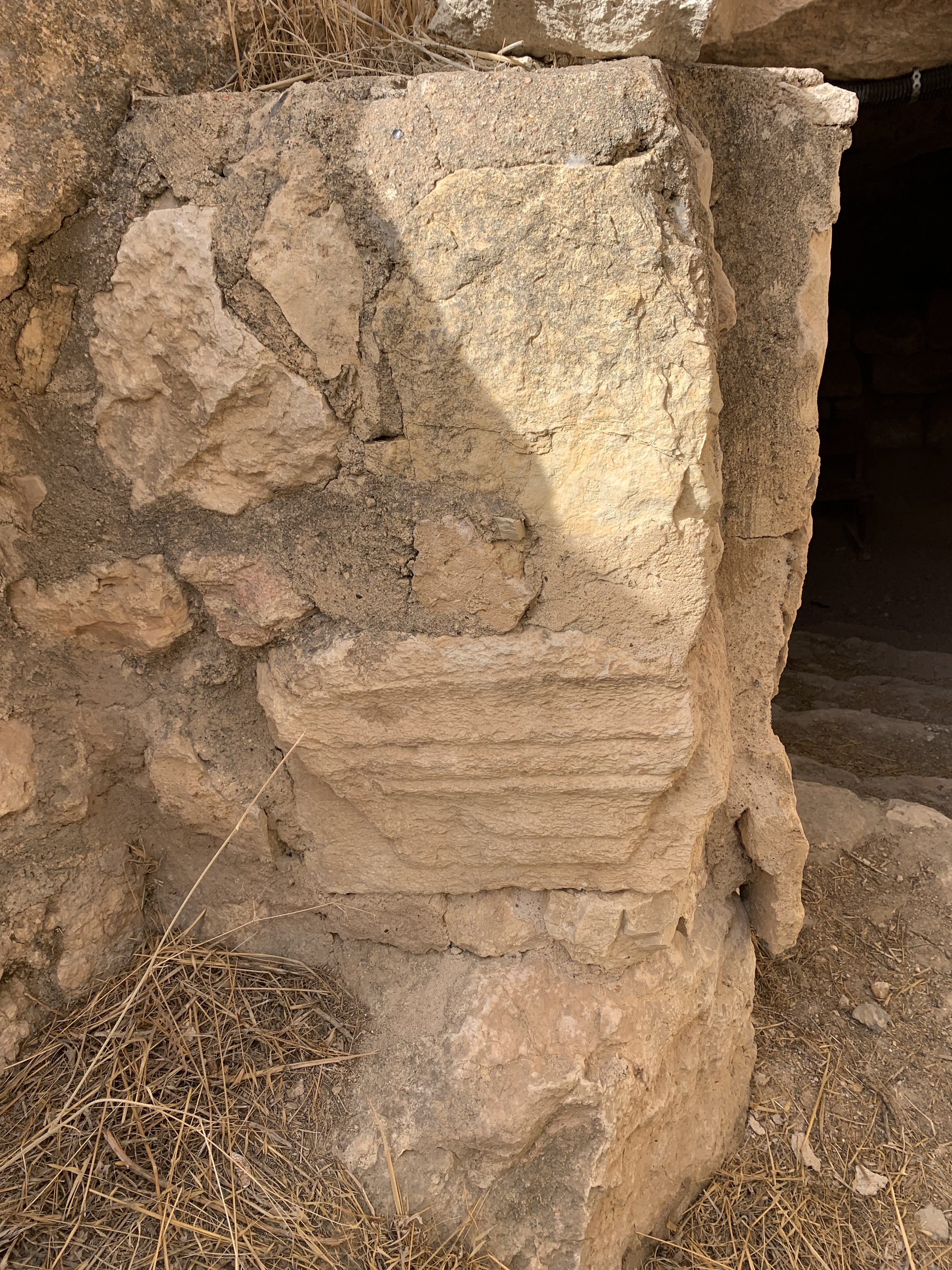
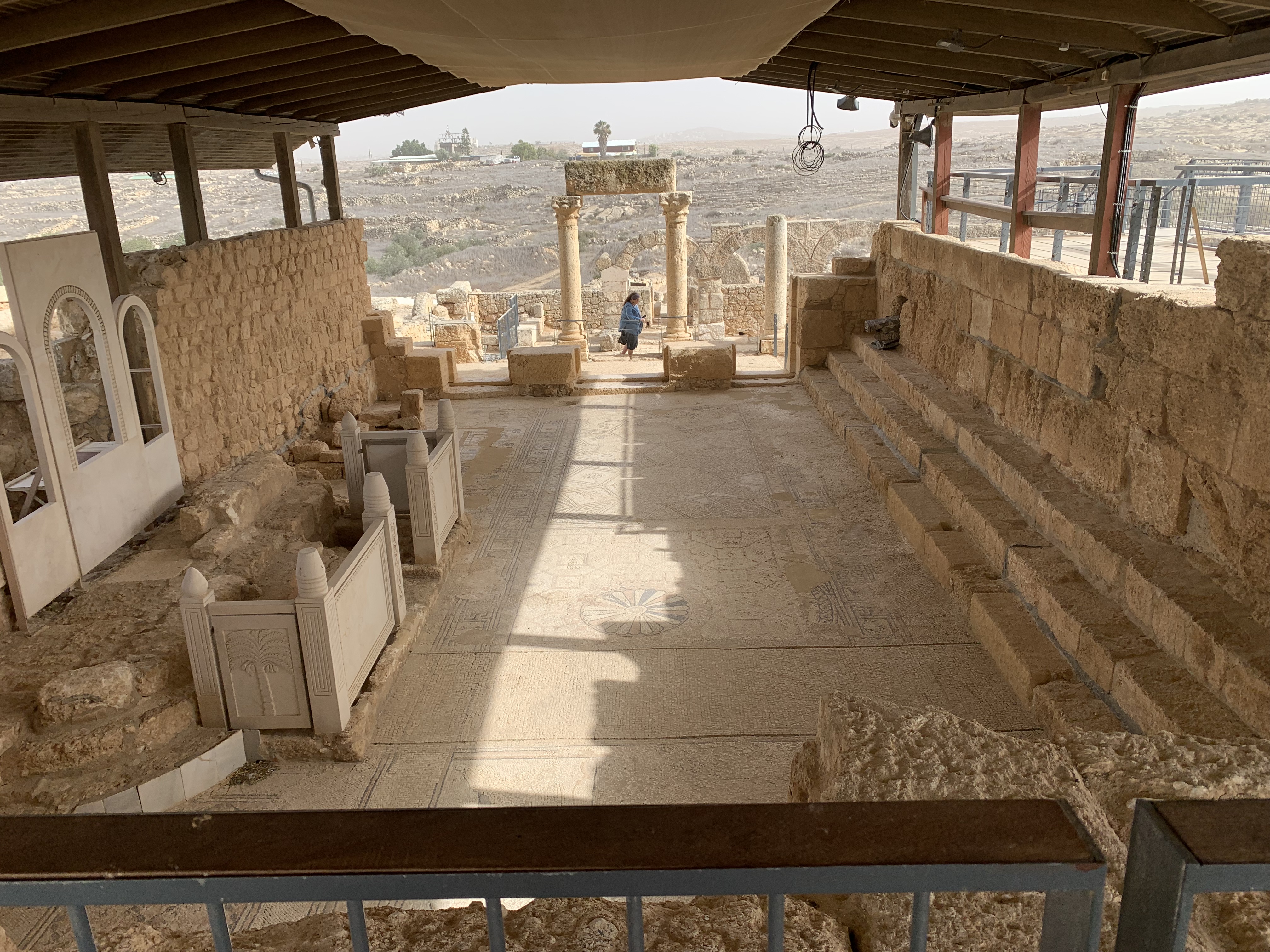
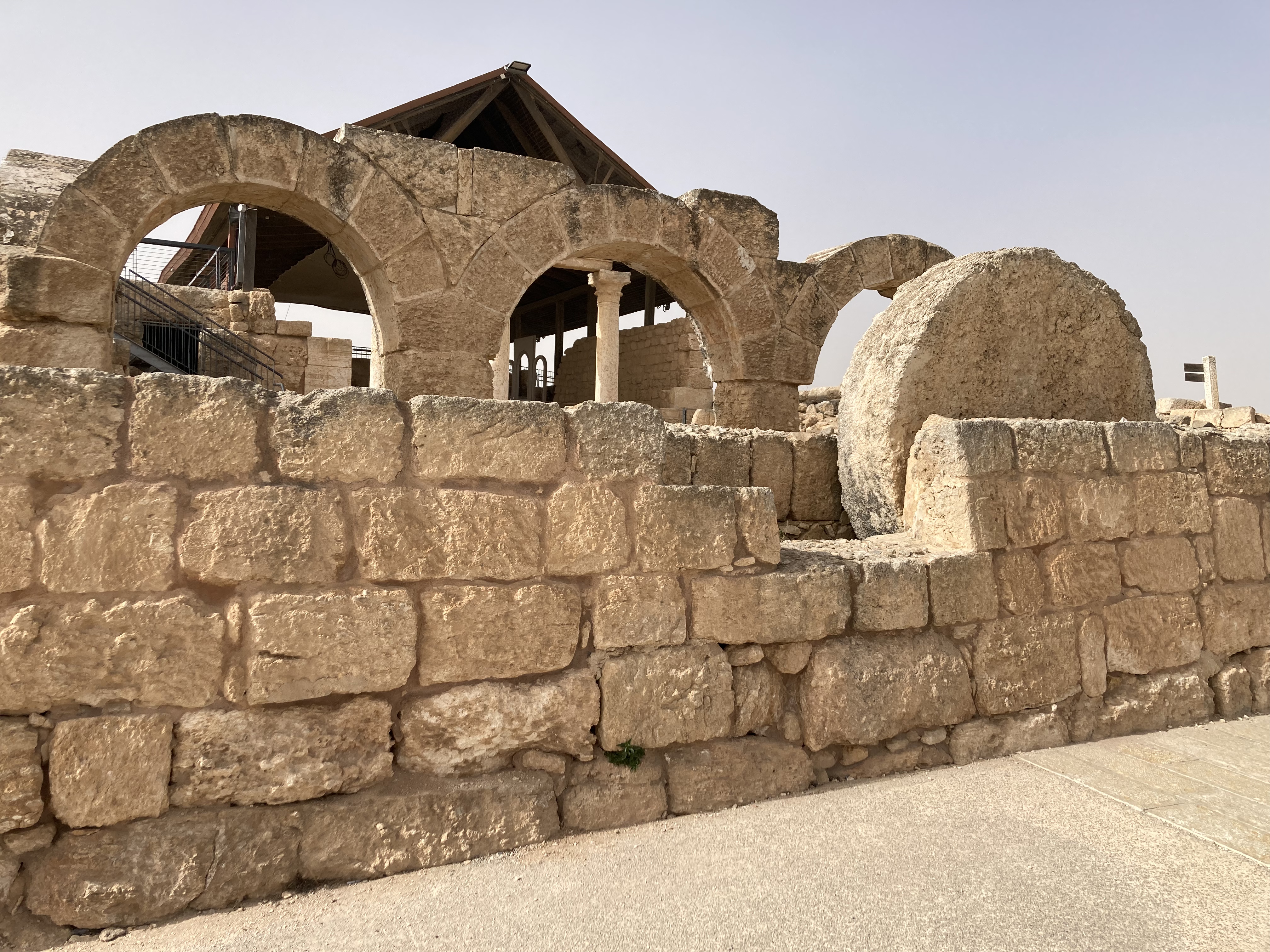
The crown of the city is its spectacular synagogue, which is still fairly well preserved, considering its age. The entrance to the synagogue can be approached through a large arched portico surrounding a central congregating area. An enormous round stone, which can be rolled by many strong men along an outer track, can block the main entrance to the courtyard. From the portico, there are high steps and Doric columns leading into the large worship/study area.

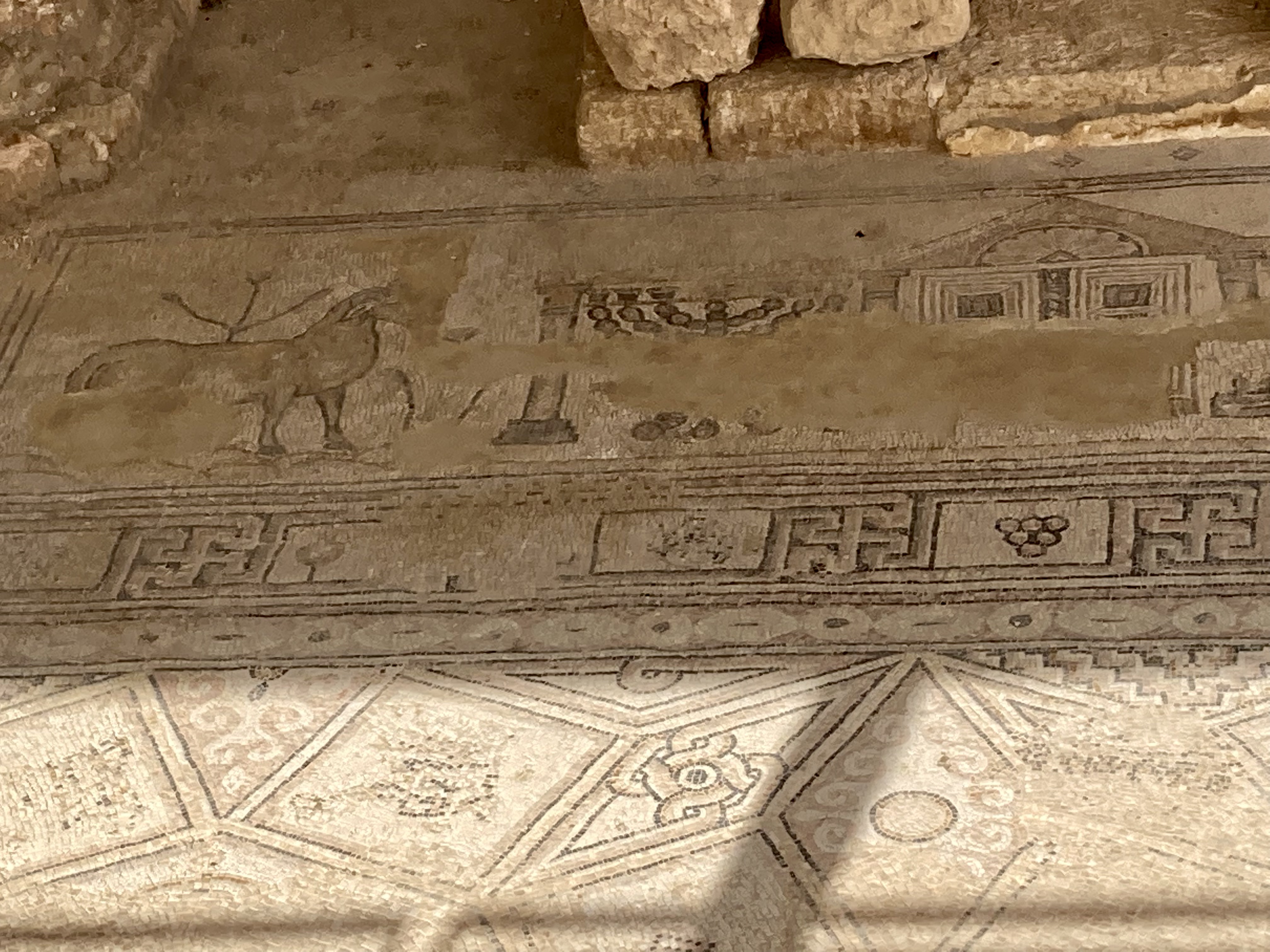
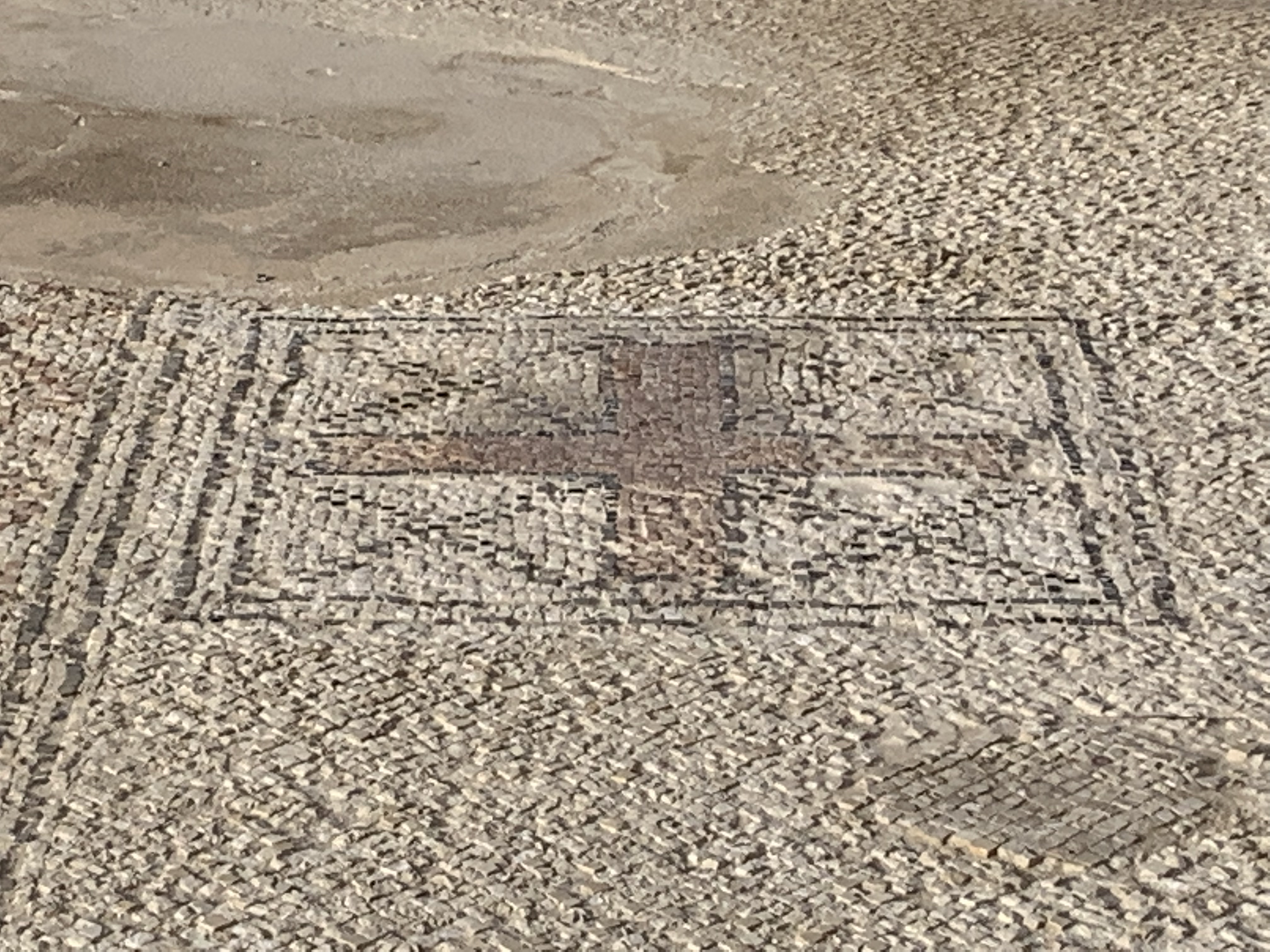
The floor of the synagogue is covered with a well-preserved mosaic floor. The mosaics include two menorah/lampstands, a shofar, lulav branches and etrog, and an immense zodiac calendar. There are many blessings written in Aramaic including one that reads, ”remembered be for good the comforter Yeshu’ the witness and the comforter that [……]”. What does this mean? Was it an early Messianic community? Was that why they were so concerned with defense? Was it part of another group?The rest of the inscriptions are all typically Jewish. There is a raised platform or bima and a space where the ark containing the Torah scrolls would have been kept. The synagogue also had an upstairs gallery for women. But here, too, in the synagogue are escape tunnels and stones to roll across doorways to block the ebterances and exits. From whom were they hiding and trying to escape? So far, archaeology gives us no clues….Today the synagogue is used for weddings and Bar Mitzvahs.

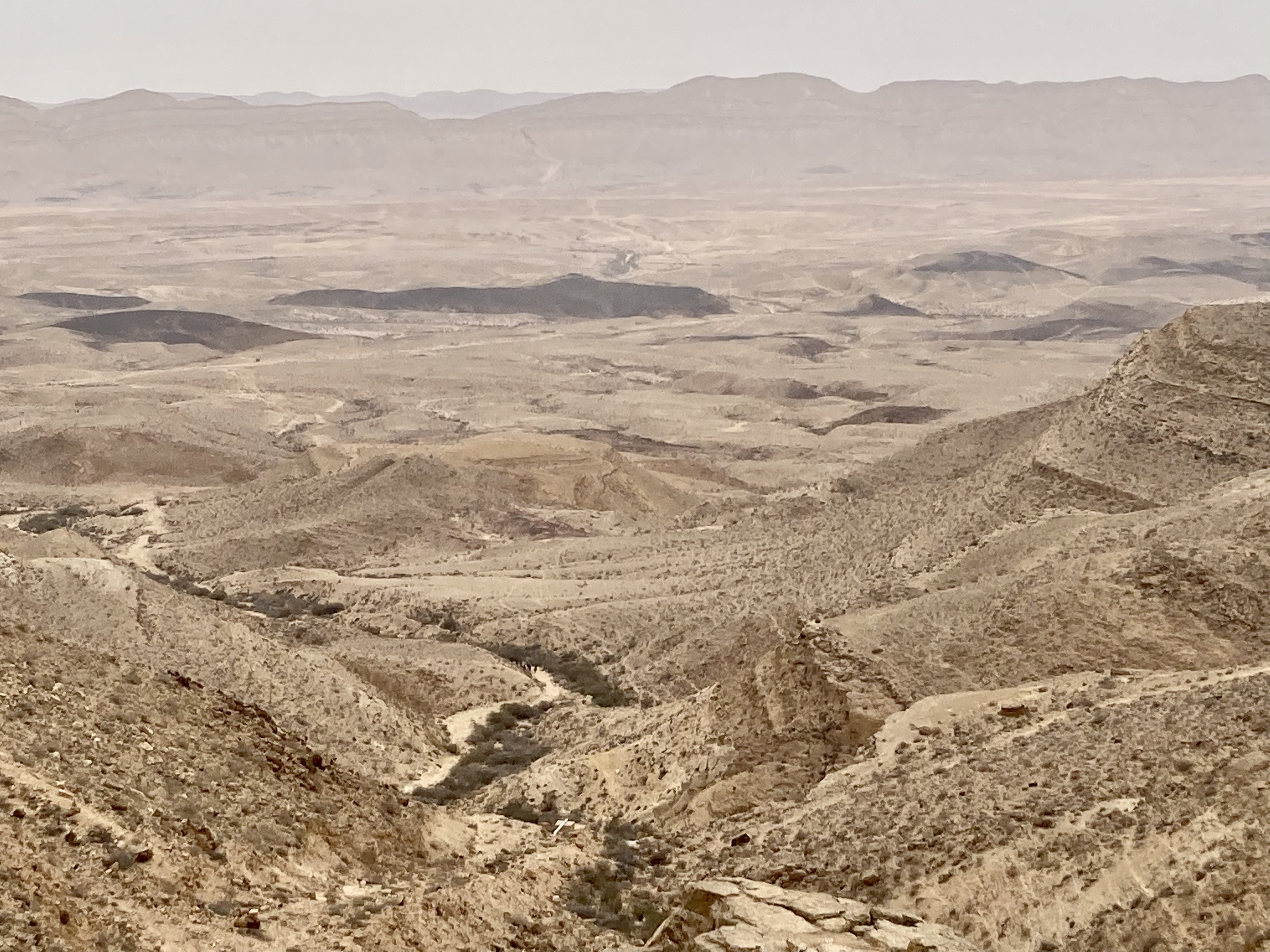
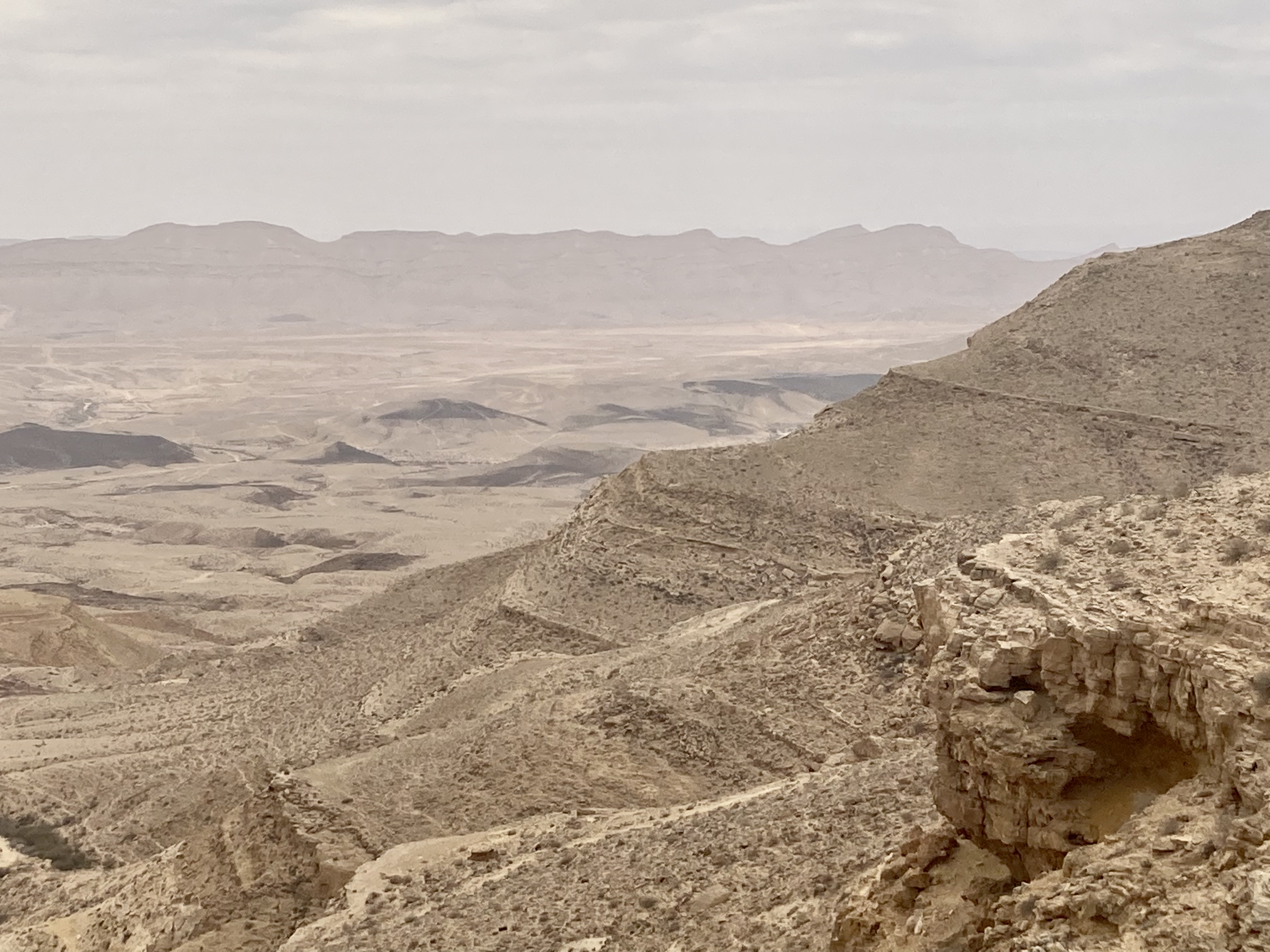
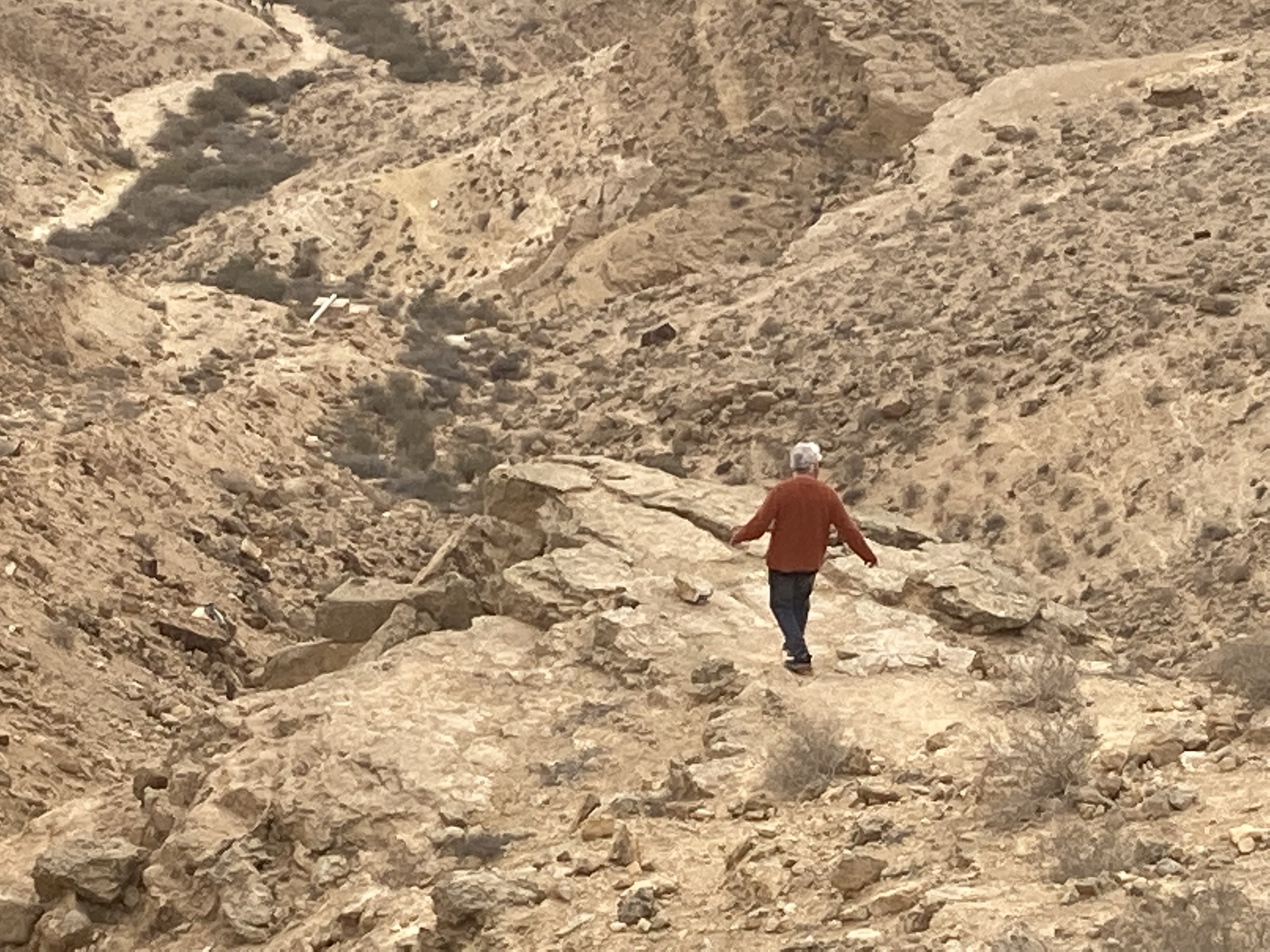
The next stop on our desert adventure was at an overlook along the high cliffs of the Maktesh Kattan. A maktesh is a geological formation that only occurs in the Negev. There are three of them here, kattan meaning the smallest. It’s s a completely sunken hole, a huge round crater that was naturally formed as the ground there collapsed millennia ago. We were beginning our descent onto the desert floor. I got out of the car to take photos and John got out… well… to be John.

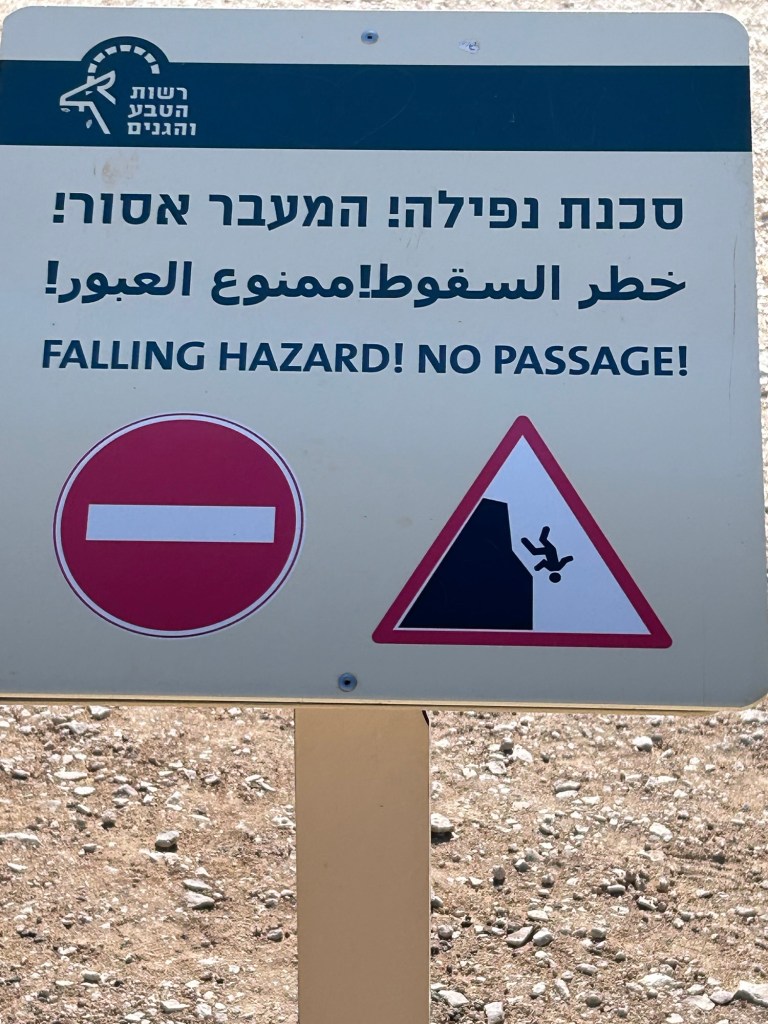
I really shouldn’t have been nervous at all when he scurried down to the edge of the ledge. He’s done it at the Grand Canyon. He did this at Maktesh Ramon years ago. I think he’s part mountain goat. Truly. Still, I just about had a heart attack and he got some pretty great pics: the Thelma & Louise remnants of an old car crash; the white and blue stripes signifying the Israel Trail (seriously, who would hike down this cliff into the desert?); a hidden party terrace.

The road we traveled was tortuous… a real snake path. No safety barricades on some of the cliff edges. Hair-raising! The panoramas absolutely gorgeous! Once on the desert floor, we quickly headed for the painted desert. Mineral deposits left not only lots of iron, but also copper, magnesium, manganese, sulfur. I forgot to mention that this was in the area of Biblical Gomorra….hmmm…. There were huge chunks of iron ore in the sands – and tons of white snails! In the desert sands!! Snails! Still, my first reaction when I saw the beautiful palette of colors? Make-up!!! The shades of pink, rose, purple, yellow, red, brown, orange, ochre. Nothing short of magnificent!!

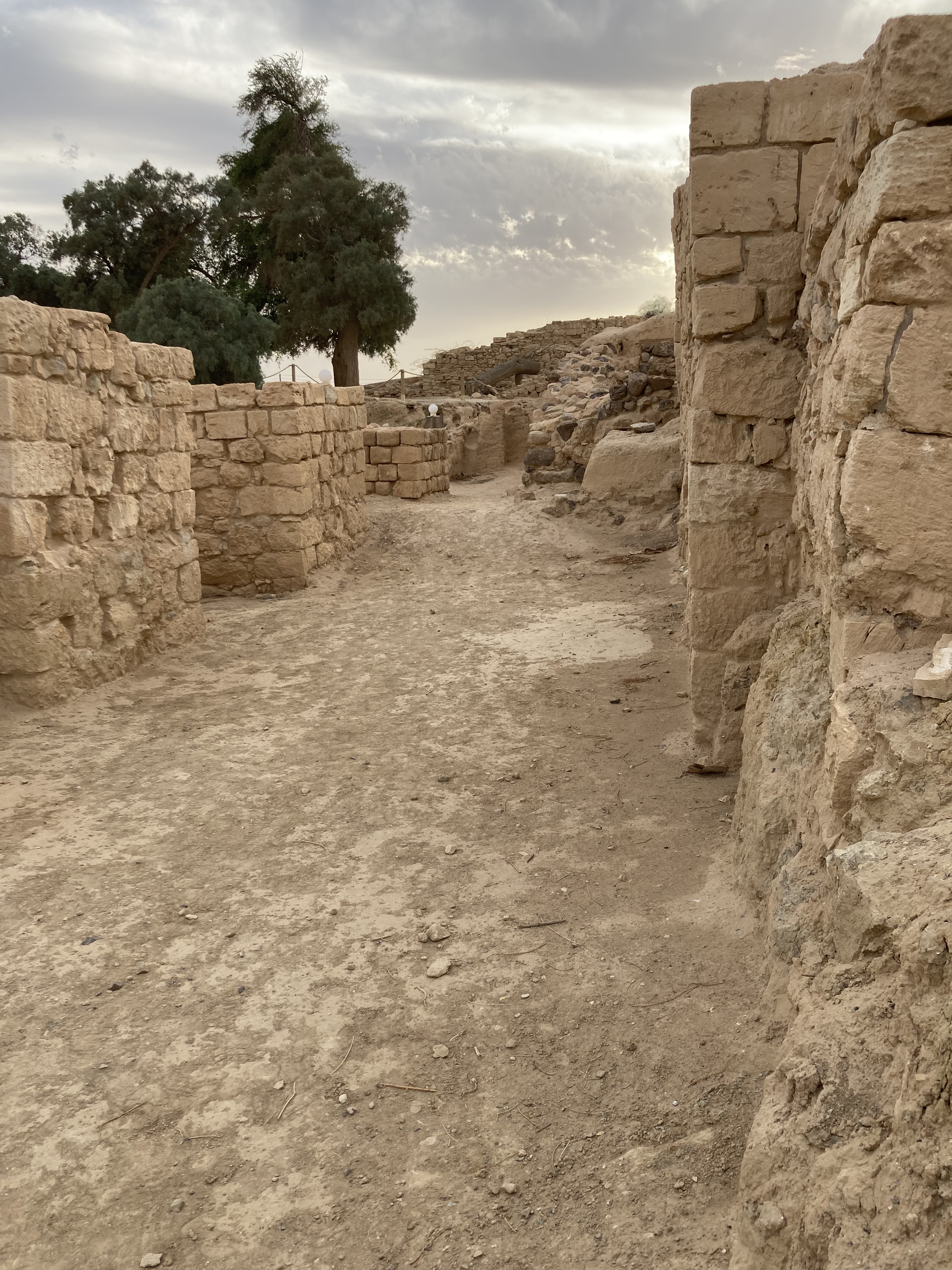
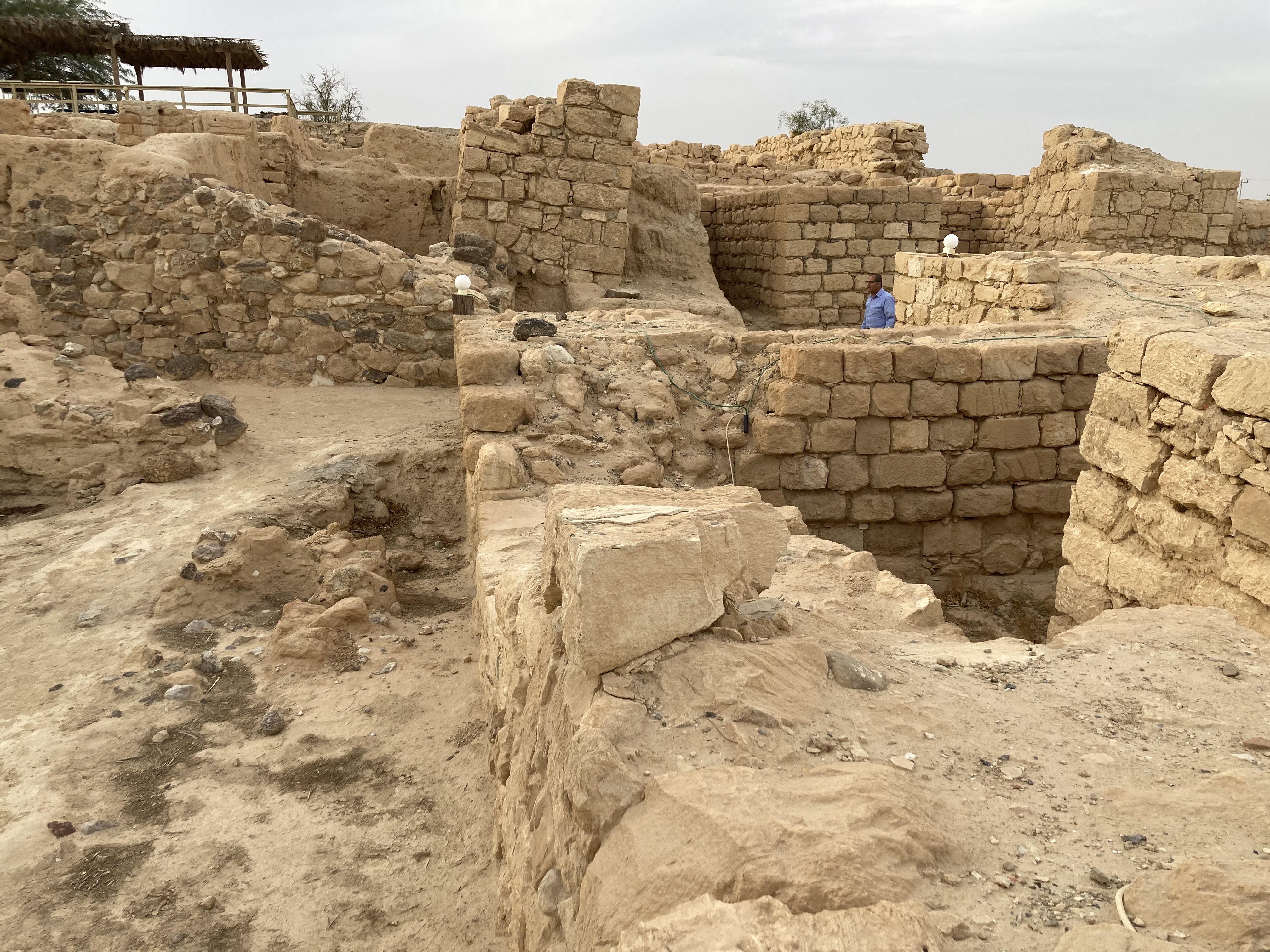
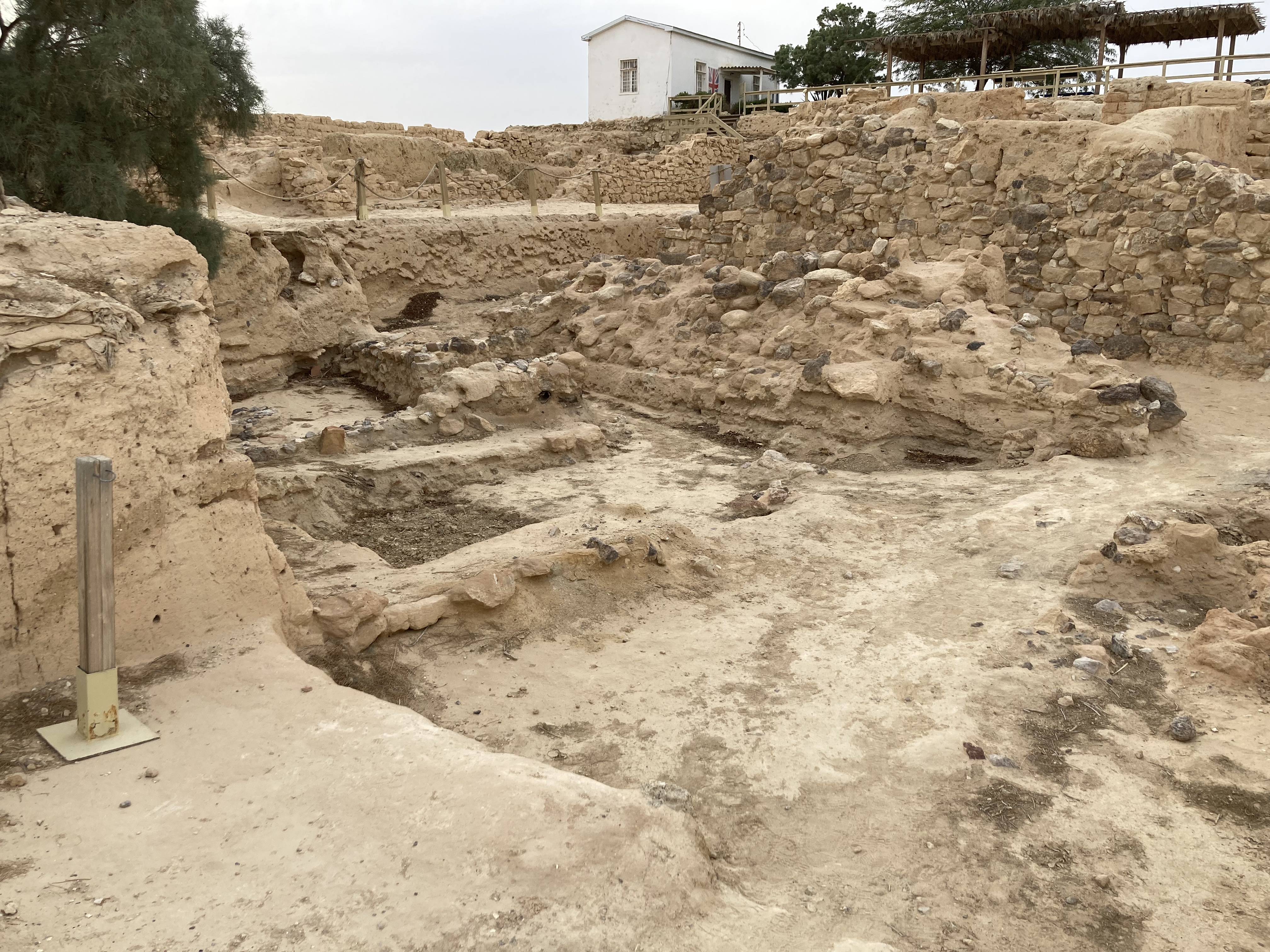
We still had two places to visit. No time to dally! Back in the car and on to Tamar Fortress in the Arava part of the desert, about 30 miles or so south of the Dead Sea. Tamar was once just an oasis, a desert watering hole where the Moabites and Edomites used to frequent. Mayaanot, underground springs surrounded by date palms, or tamar in Hebrew (yes, my Hebrew name means date palm). The place was well known to the ancient Israelites. It is mentioned in the Scriptures. During the reign of King David, it was the southernmost outpostfor the tribe of Judah. King Solomon built a fortress here, serving not only defensive purposes, but it was strategically positioned to monitor caravans traveling to and from distant places in the east, and to protect the southern copper mines. We read in the book of Kings that King Josiah destroyed the pagan idols that had been set up there. Archaeological remains are always confirming the words of the Bible. It is an irrefutable claim that the Jews inhabited the land of Israel from ancient times. Tamar Fortress (excavated by archaeologist and adventurer, T.E. Lawrence ”of Arabia”) is an incredible fortified walled city. Strata upon strata of different civilizations have built layer upon layer. Ancient Israelites, Greeks, Romans, Mamelukes, Ottomans. And at the top of the hill, the offices for the generals of Great Britain during the period of the British Mandate in the early 1900s. Today it serves as a museum to the history of the area.
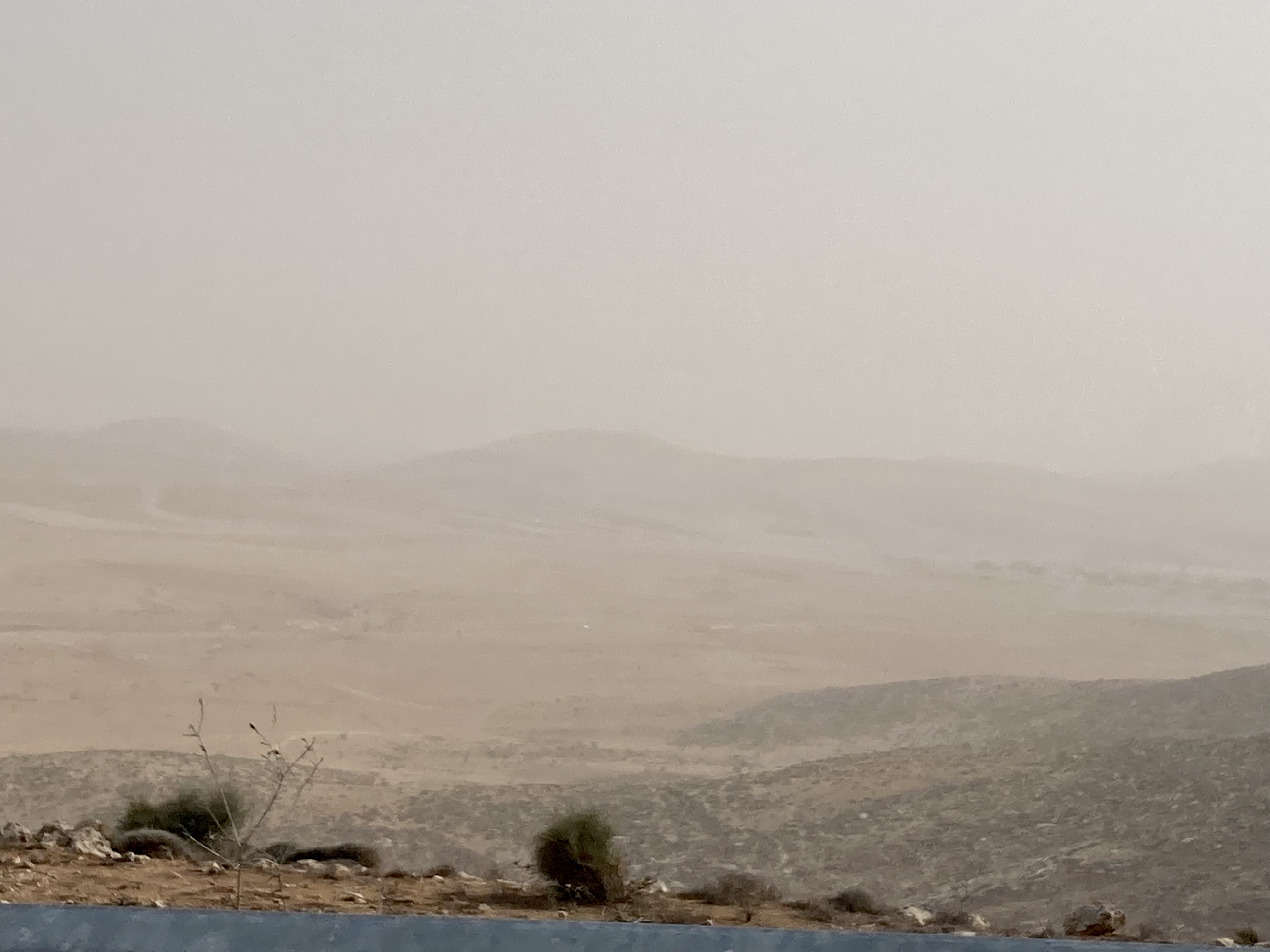
It was getting on in the afternoon, one of the shortest days of the year. The trip had been an incredibly hard one for me, as I was still in the process recovering from an extensive spinal surgery. I was exhausted. My legs stiff and heavy. The wind was picking up and a dusty haze was limiting visibility. We had one more stop: the Nabatean city of Mamshit (pronounced MomSHEET). So we pressed on.

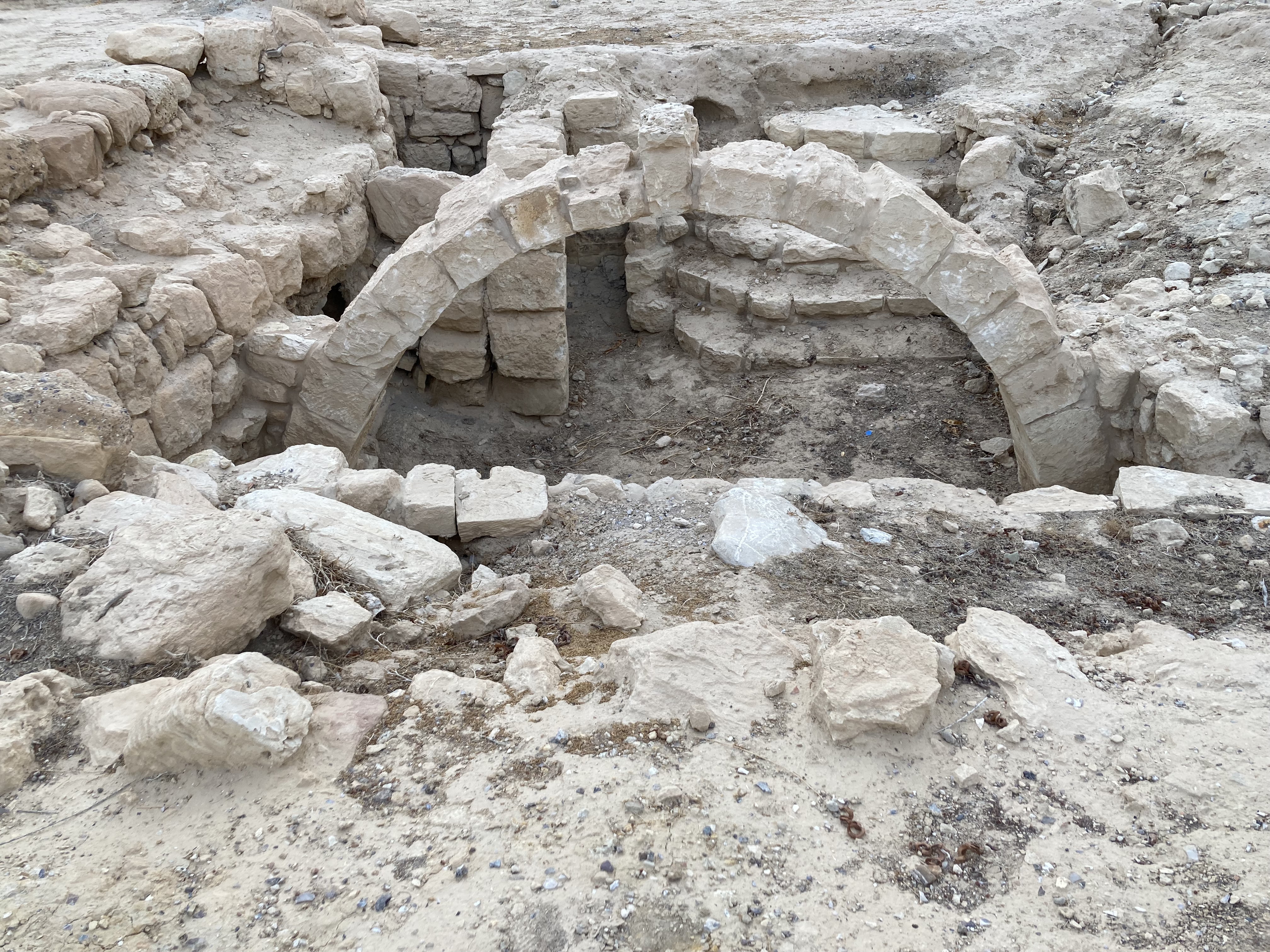
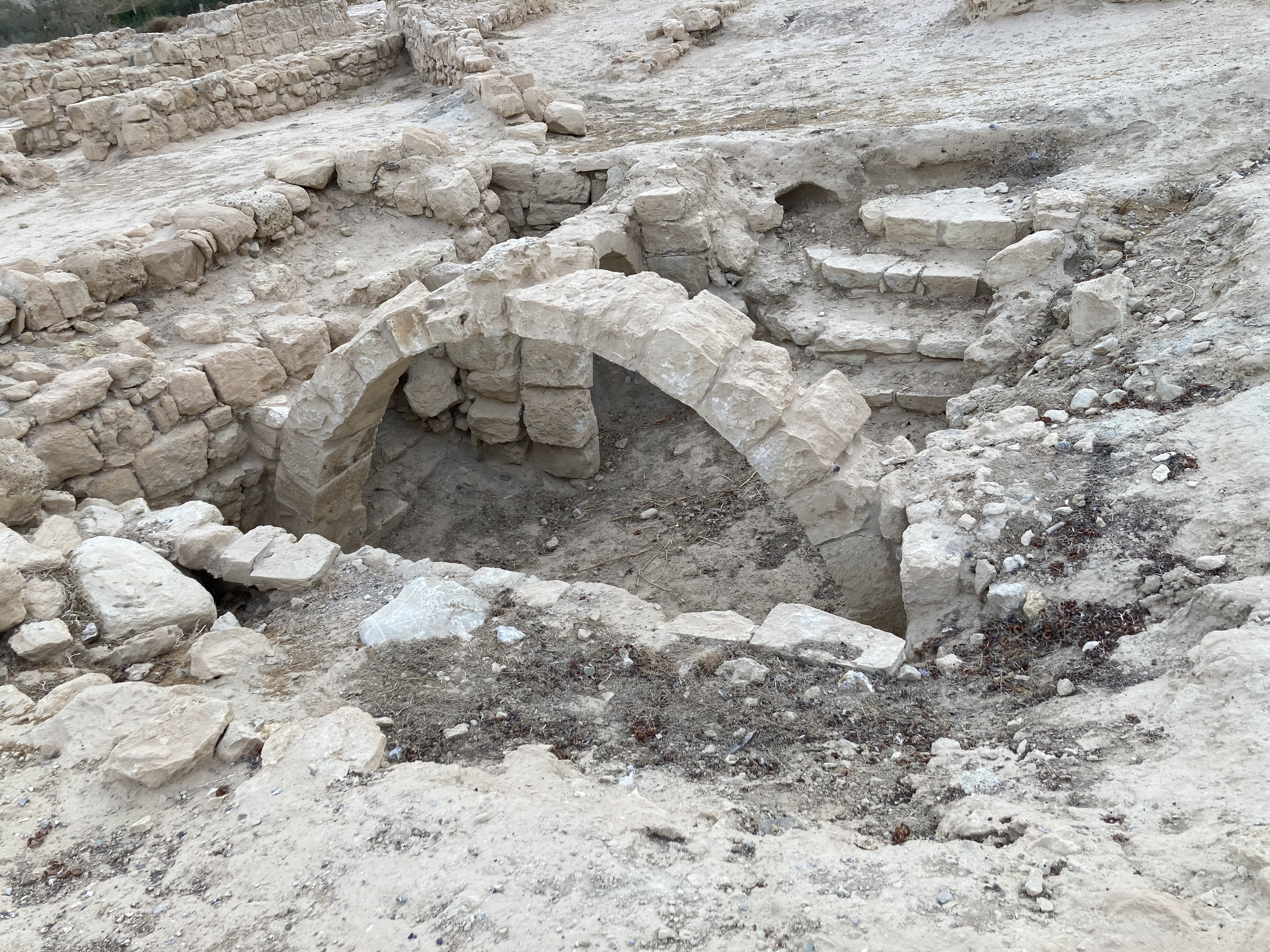
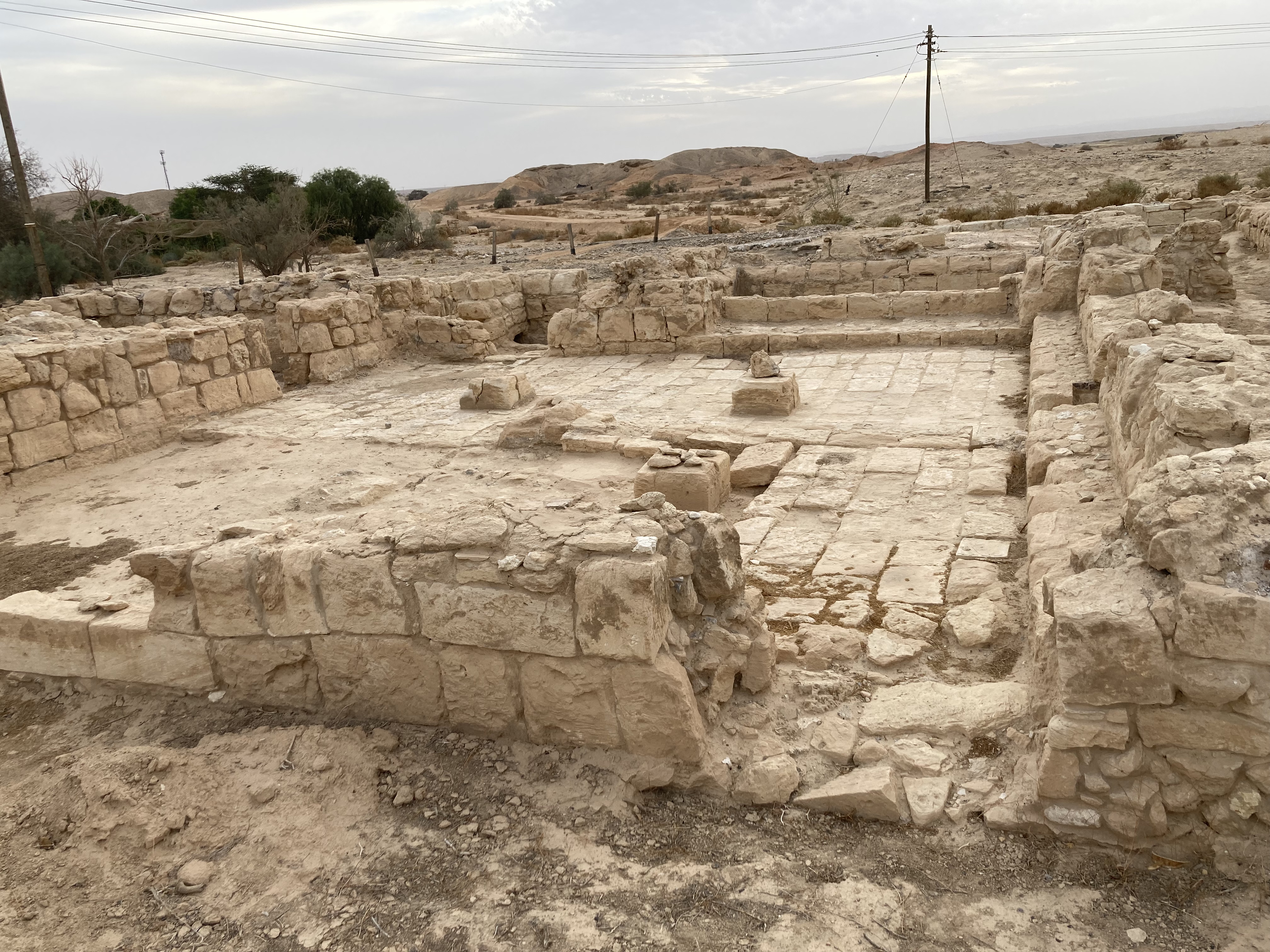
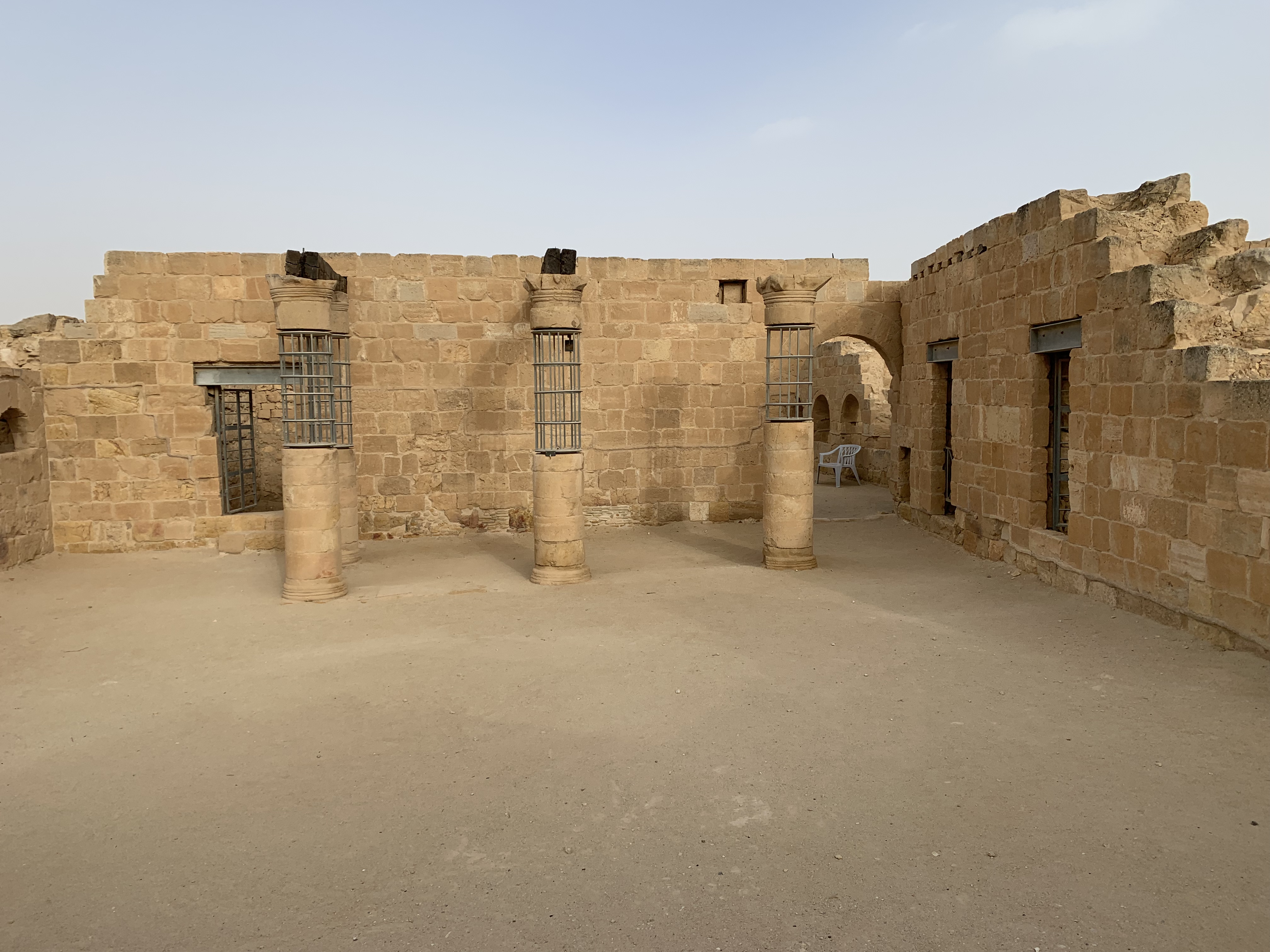
Mamshit was a Nabatean city. The Nabateans were spice traders. Their caravans of camels traveled from what is now Saudi Arabia, through Jordan, through Israel to the Mediterranean laden with frankincense, mhyrr, spices and jewels. Mamshit sits at a crossroads on the spice route. A permanent settlement was established here in the first century BC. It consisted of villas for its wealthy inhabitants as well as khans, or inns for travelers!and large and extravagant stables. It is believed that they were also breeders of stallions from the stables and implements they found in situ. By the second century AD Mamshit had been annexed by the Romans. The extravagant building projects continued.

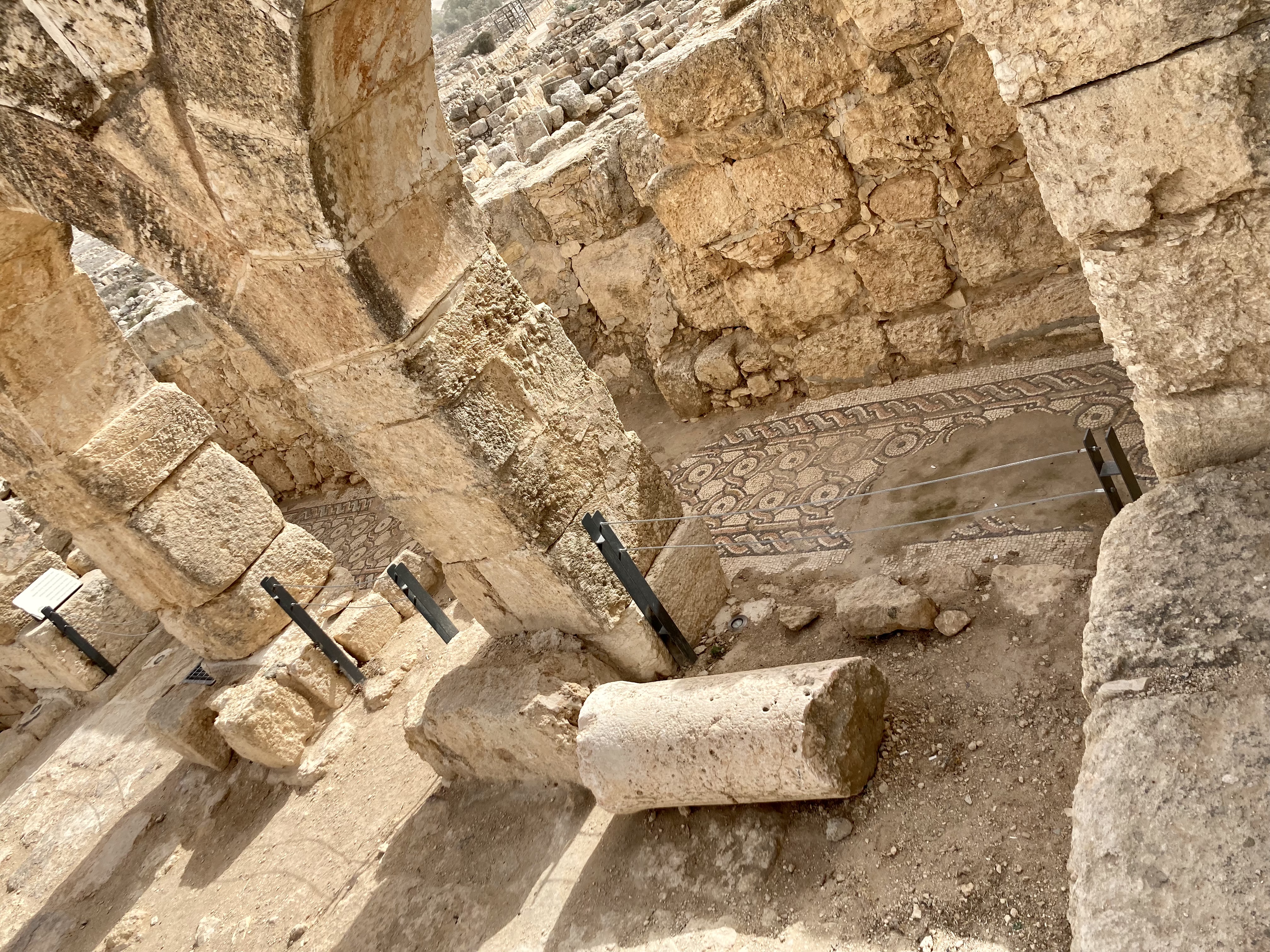
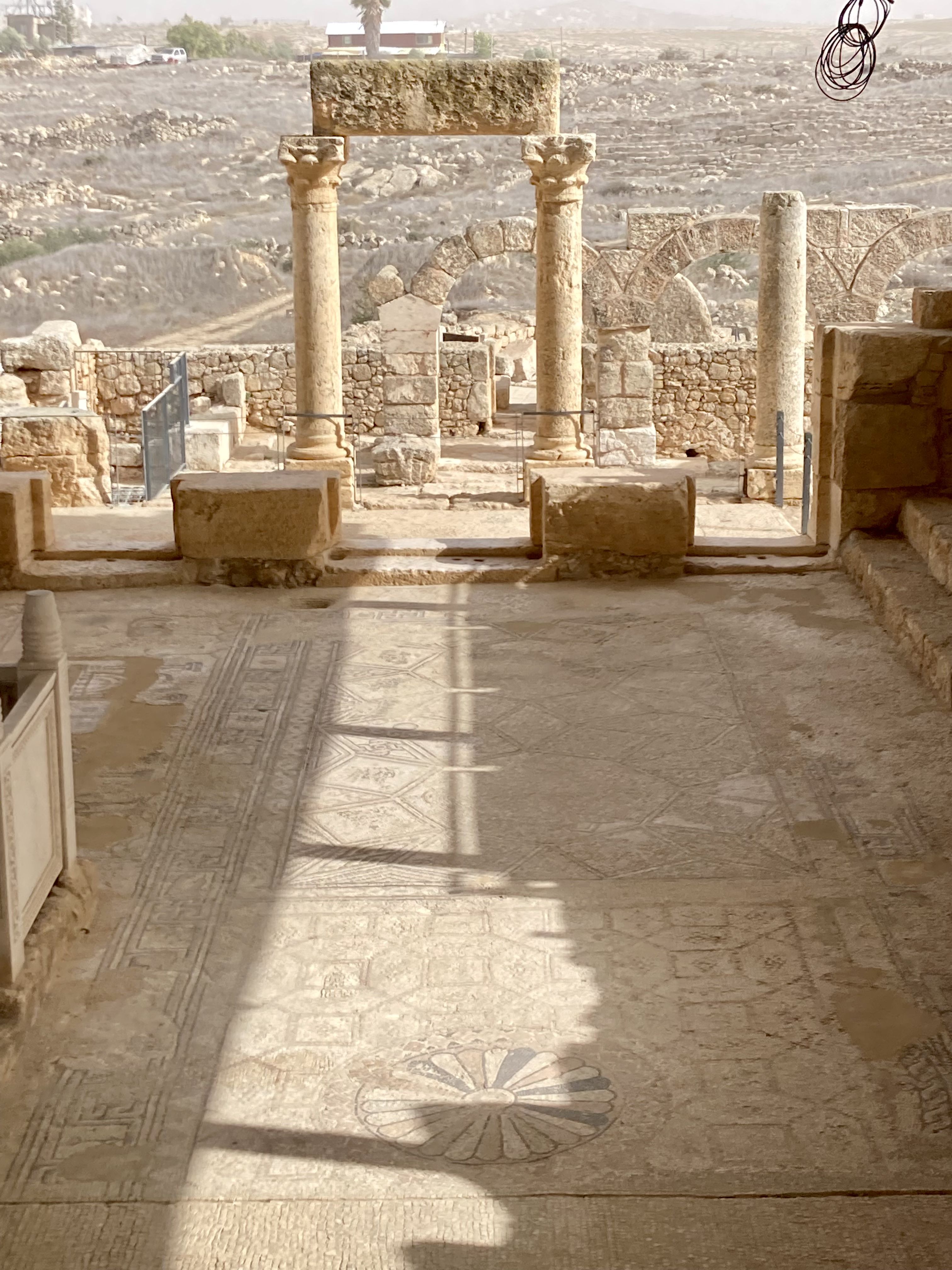
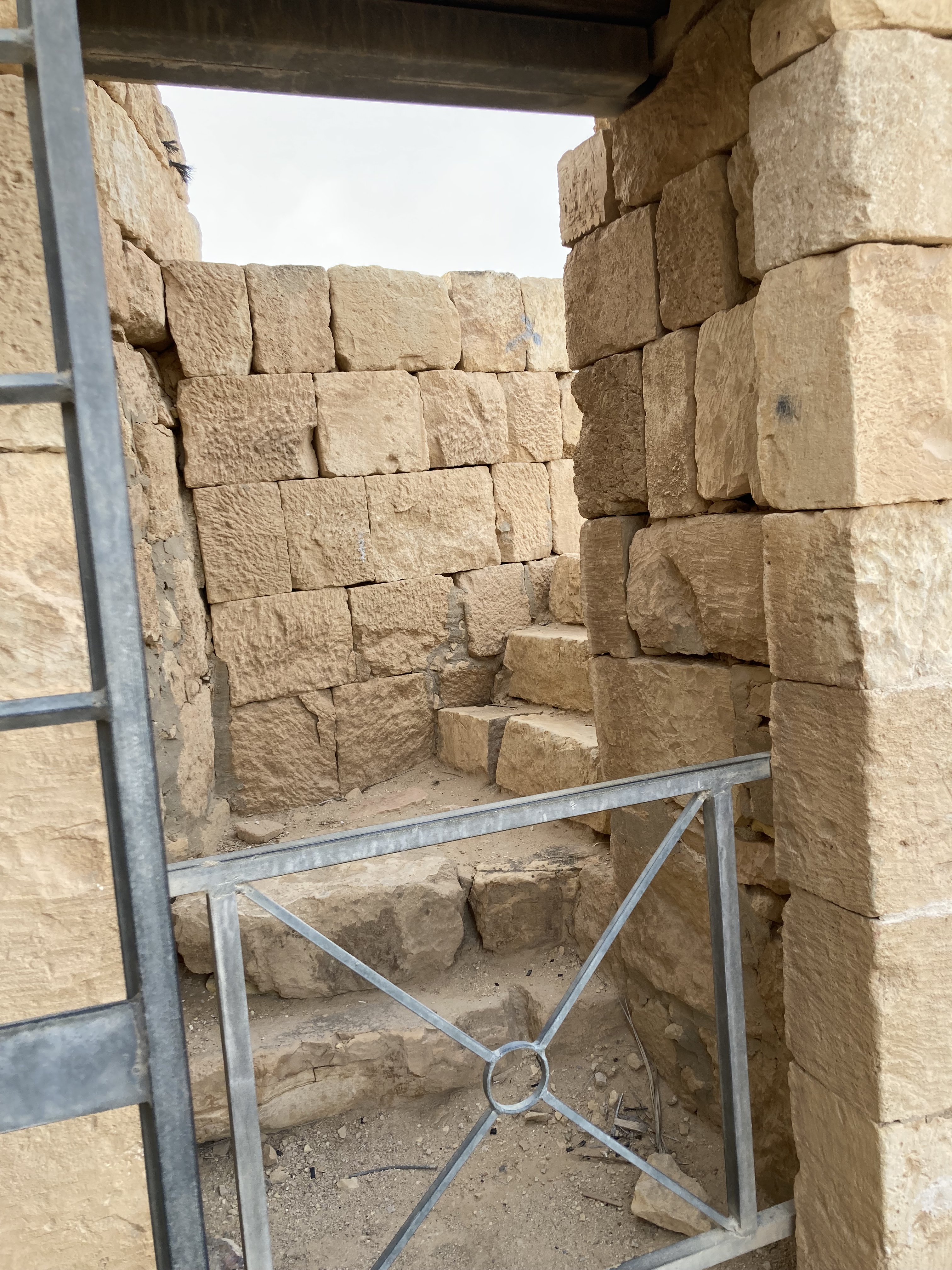
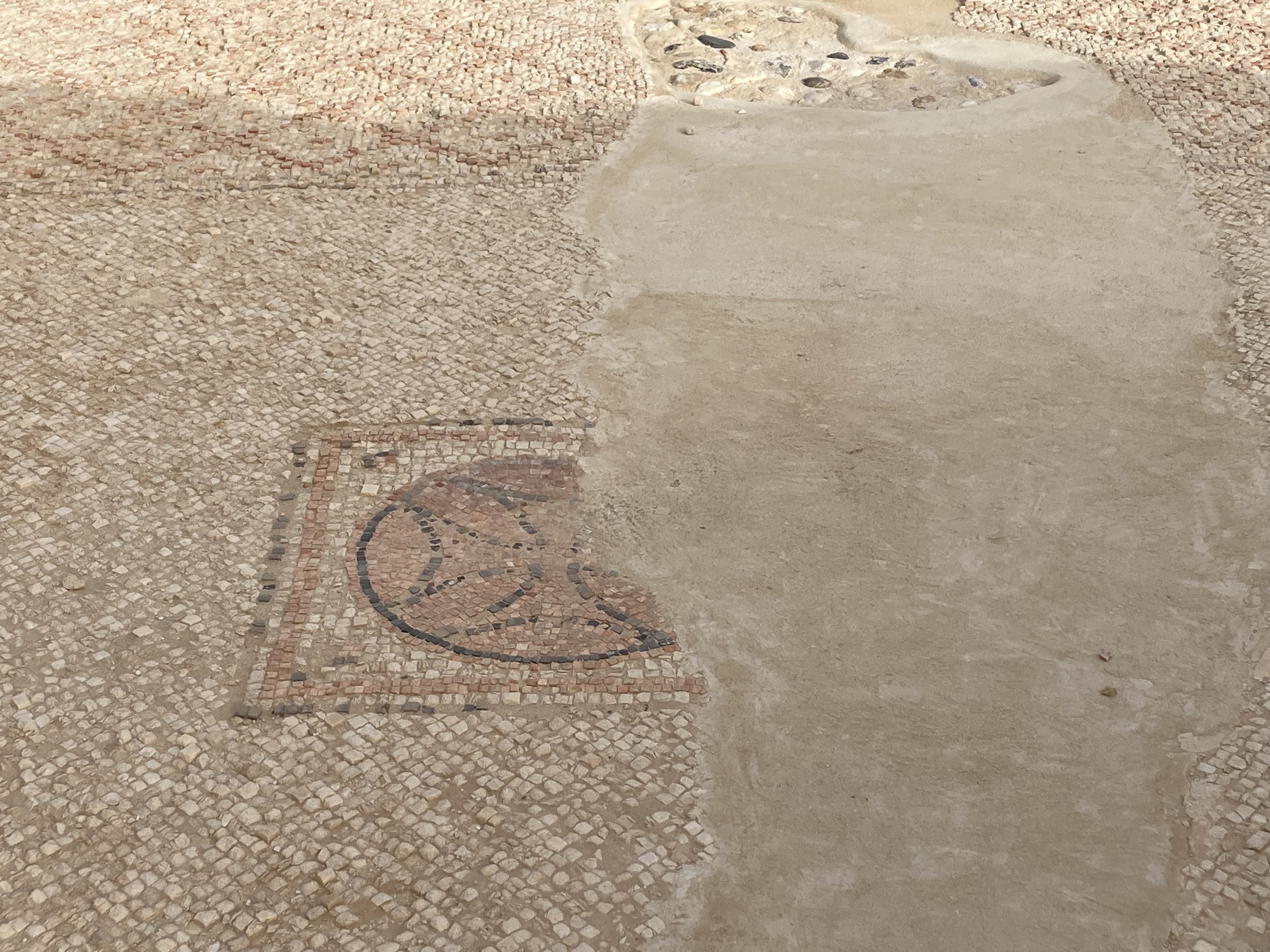
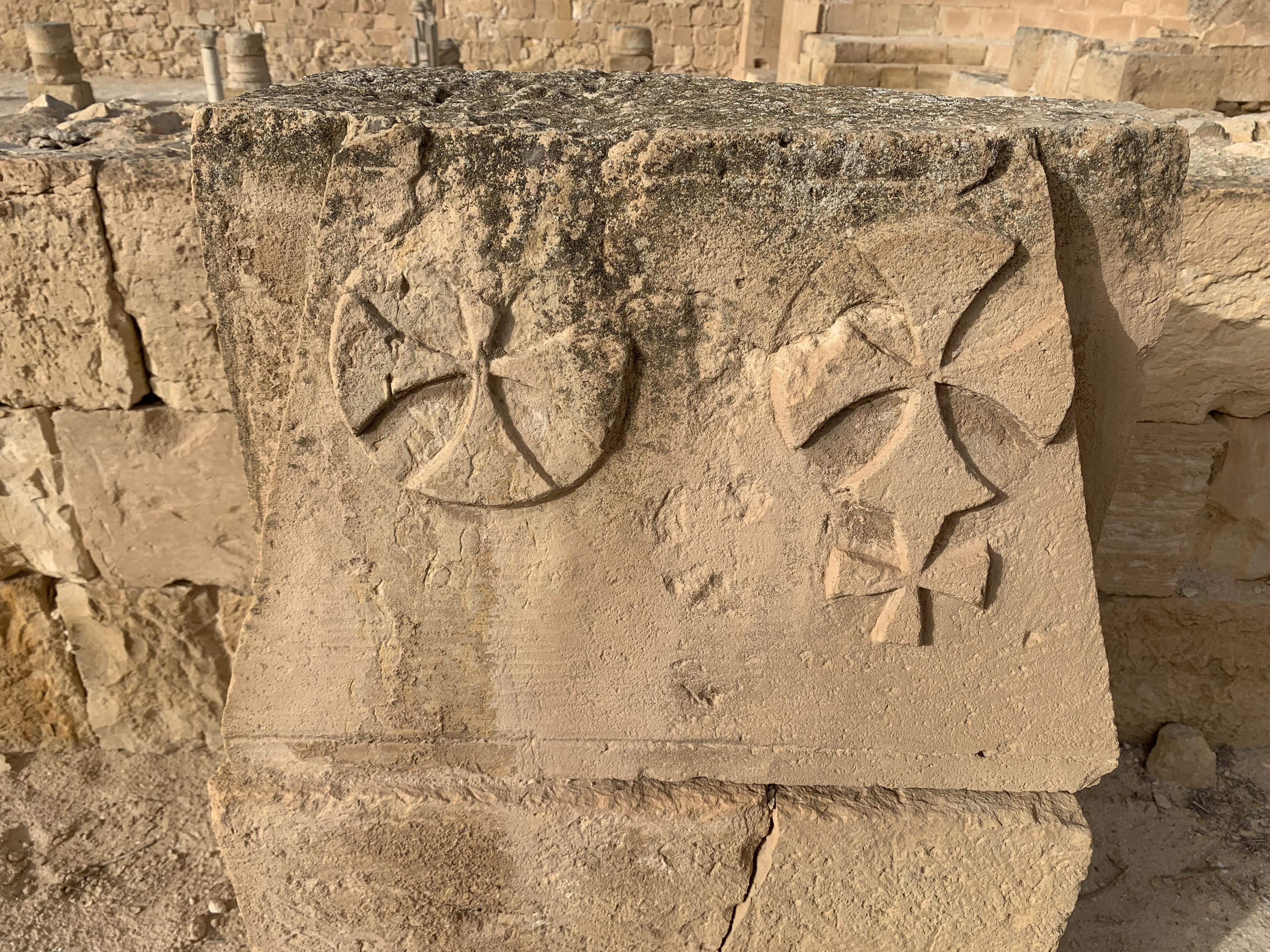
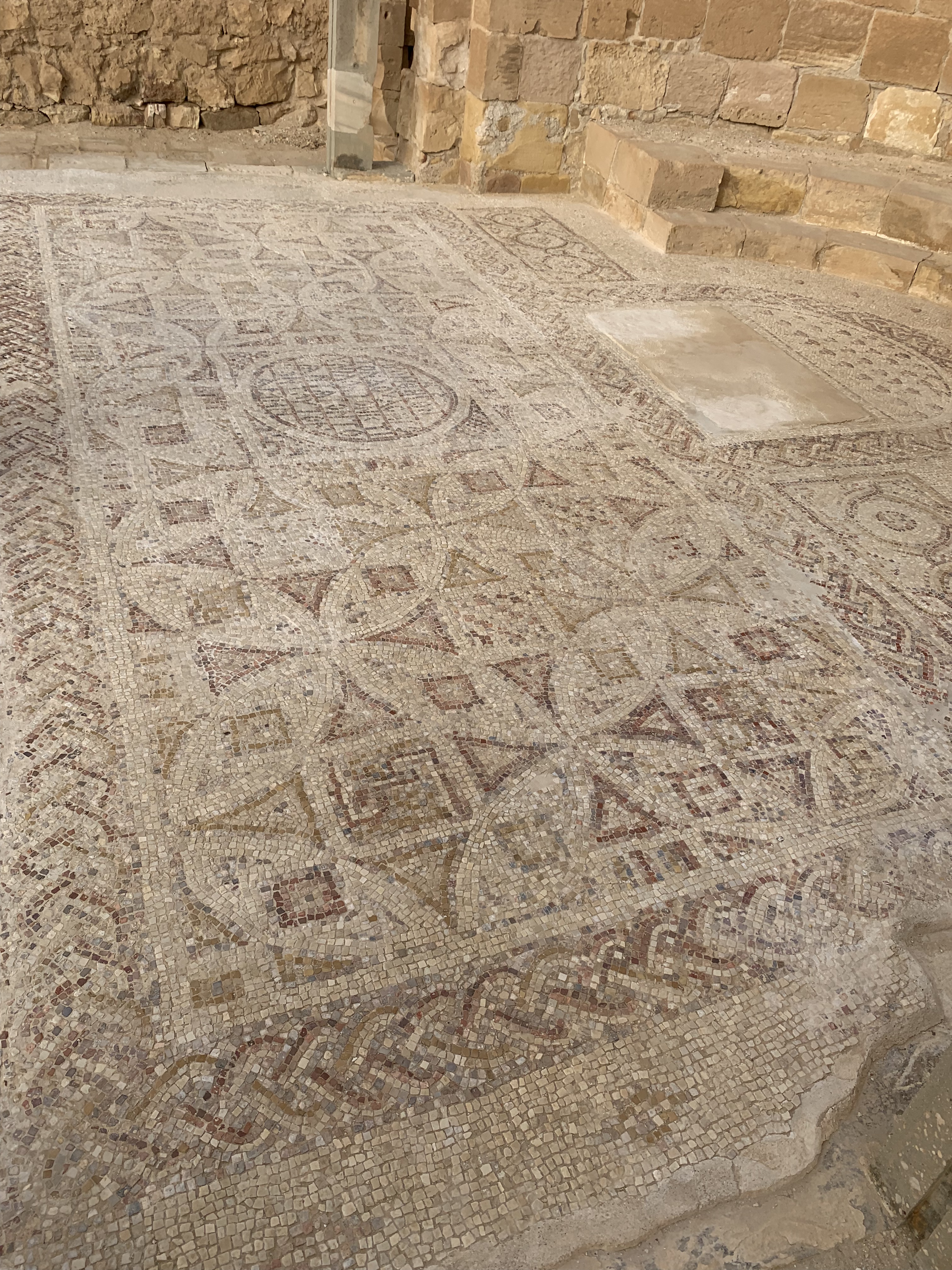
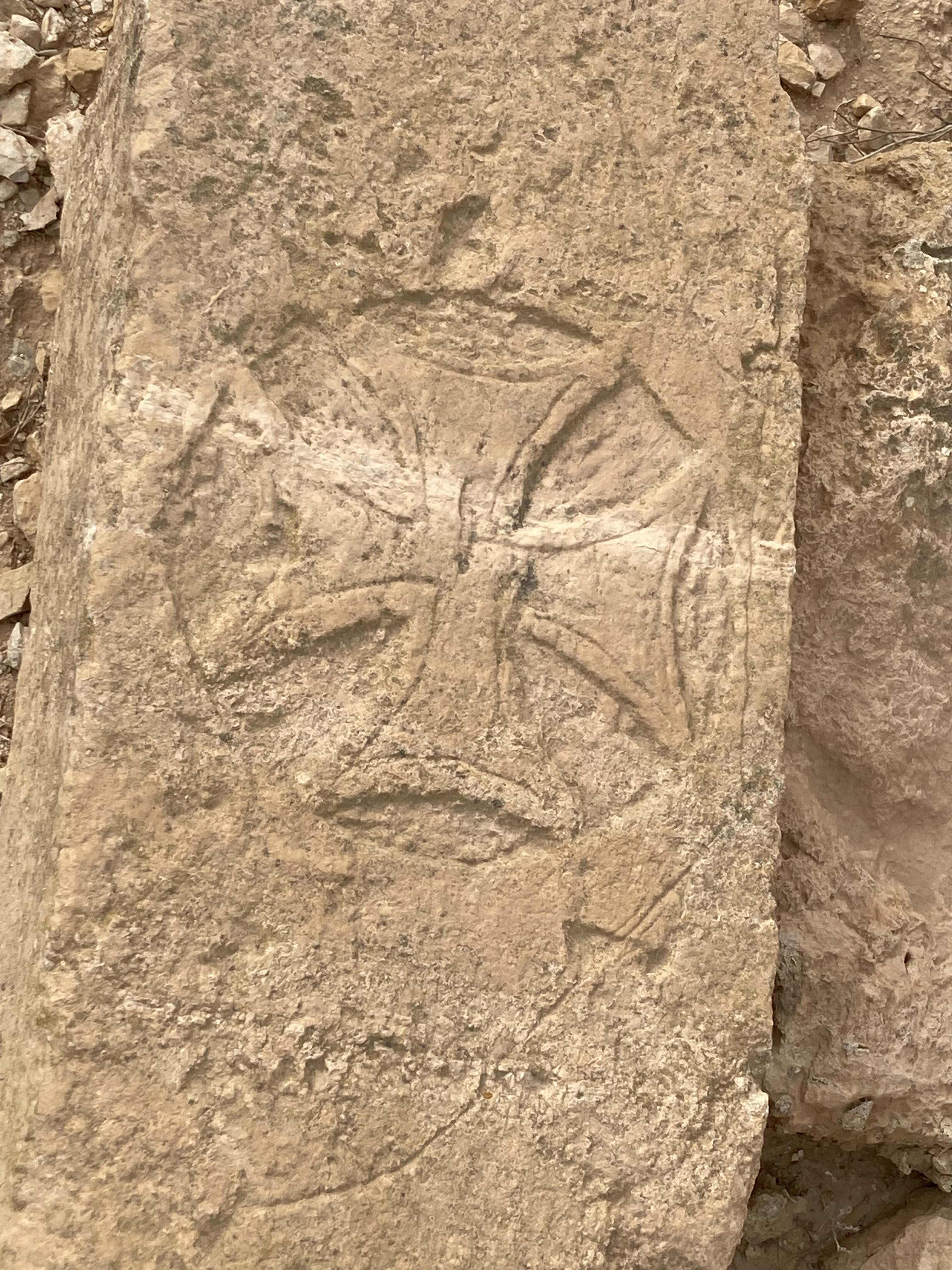
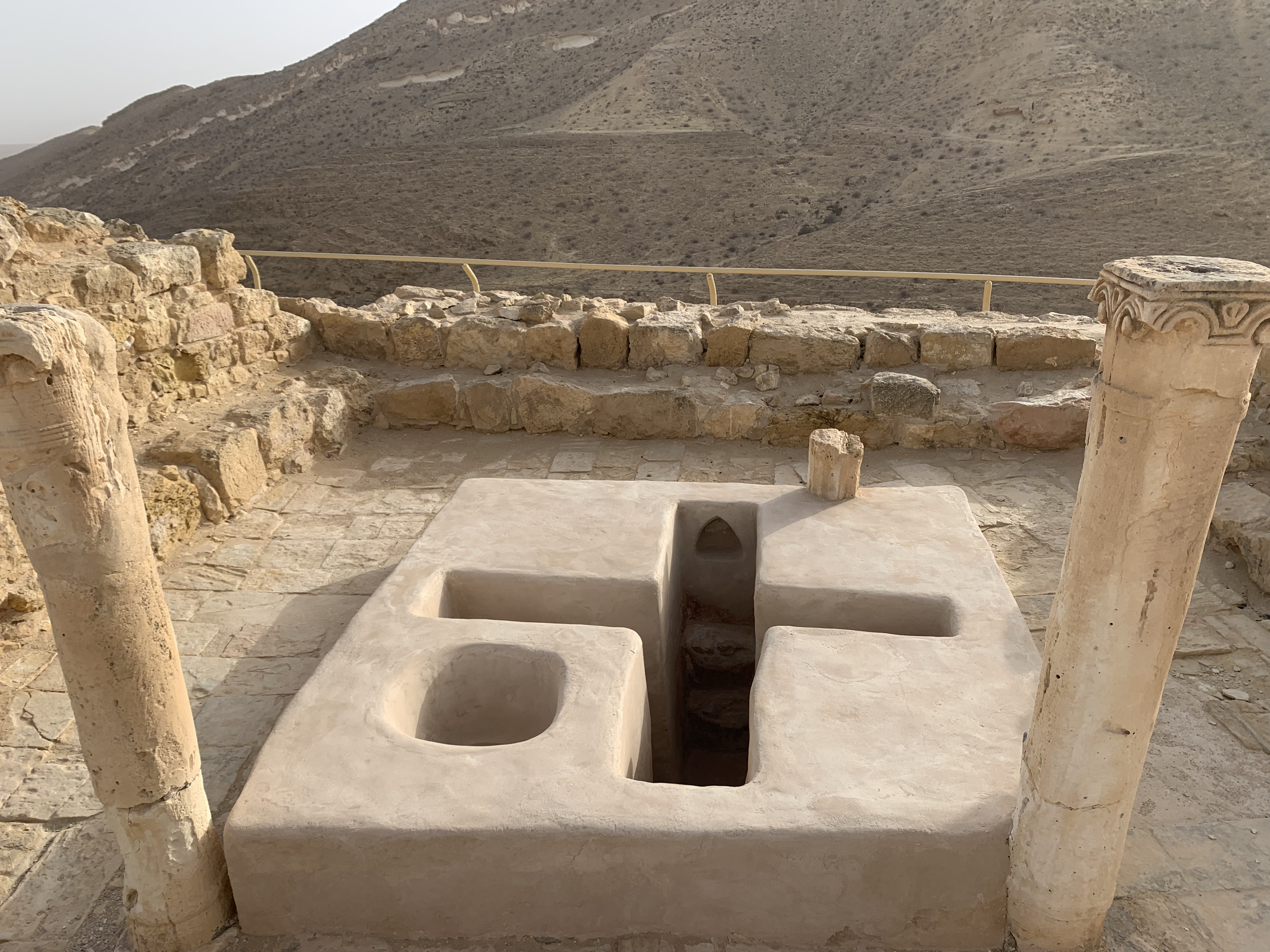
The Nabateans were converted from their polytheistic idol-worshipping religion to Christianity by the third century. At the beginning of the fifth century, two magnificent churches were built here: the Western Church and the Eastern Church (named for their locations in the city). They were in use until the Arab conquest in 636AD. After that time, Mamshit ceased to exist. The Western Church was a basilica shaped church, built at a high point in the city. It was entered through a colonnaded courtyard or atrium. The main part of the church was divided into three parts: a central nave and two side aisles. At the front was a semicircular apse marking the sire of the altar and the direction of prayer. The floor was paved in mosaics featuring geometric patterns, birds, two peacocks and inscriptions.

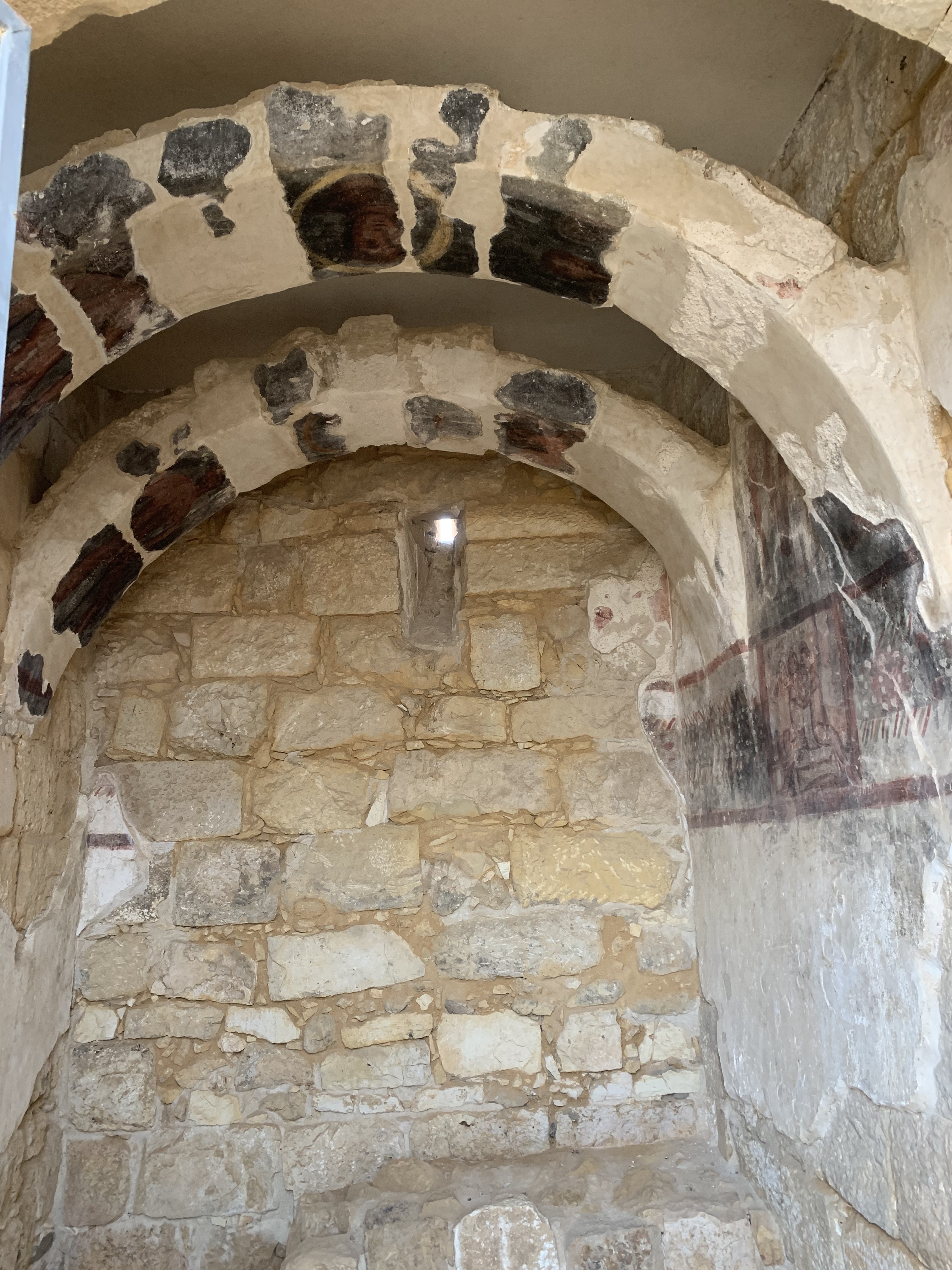
The day was growing short. The wind was whipping sand through the air. I was most exhausted, but we wanted to see the other church and the ”Nabatu house.” John and I (foolishly) split up. He was more able to make the long haul and climb the stepped ruins up to the Eastern church – and he was able to get some great photos of the frescoed walls and mosaics. He said there was also an incredibly deep baptismal pool there as well and that the mosaics here were incomparably beautiful and really well preserved.

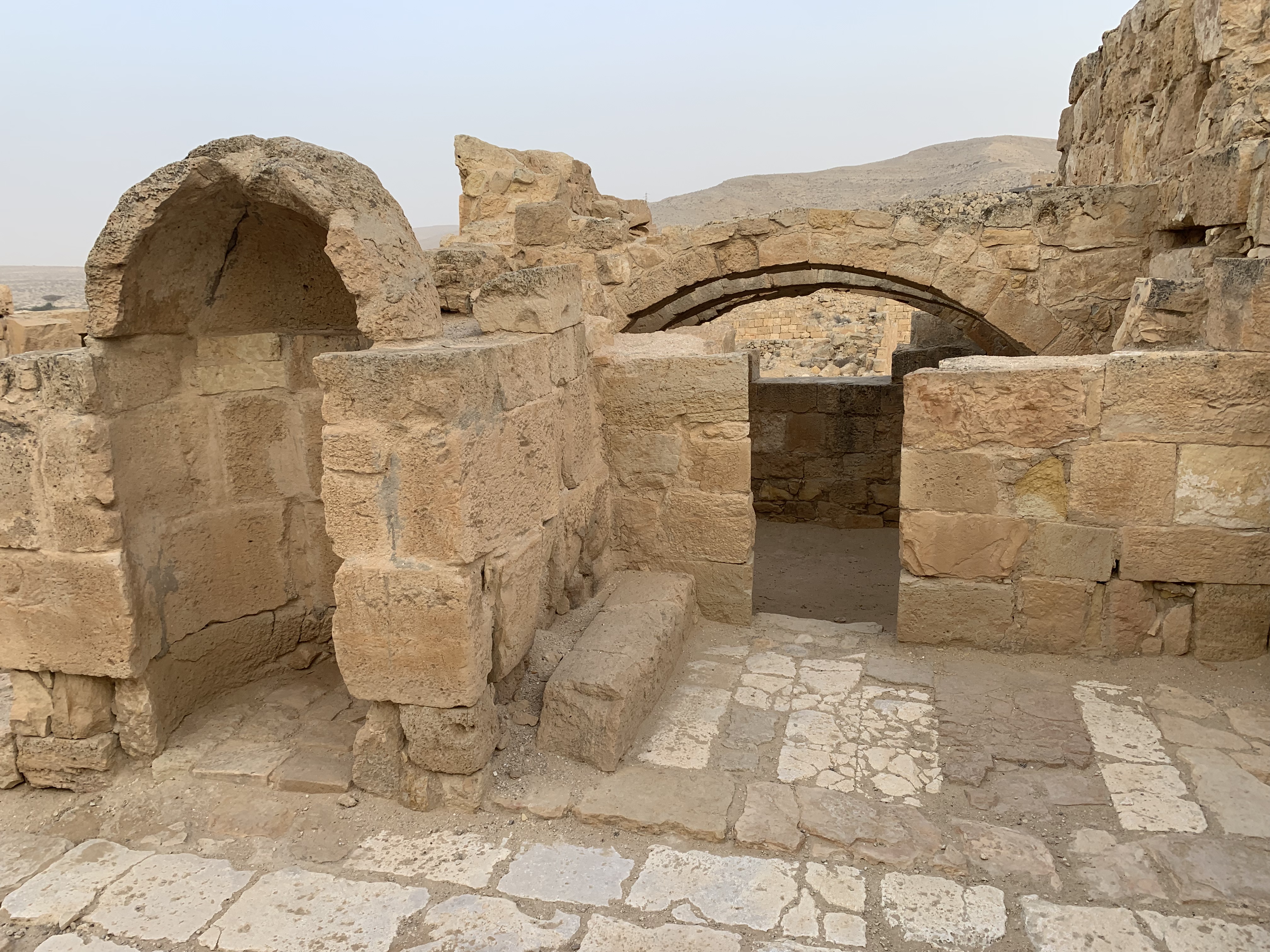
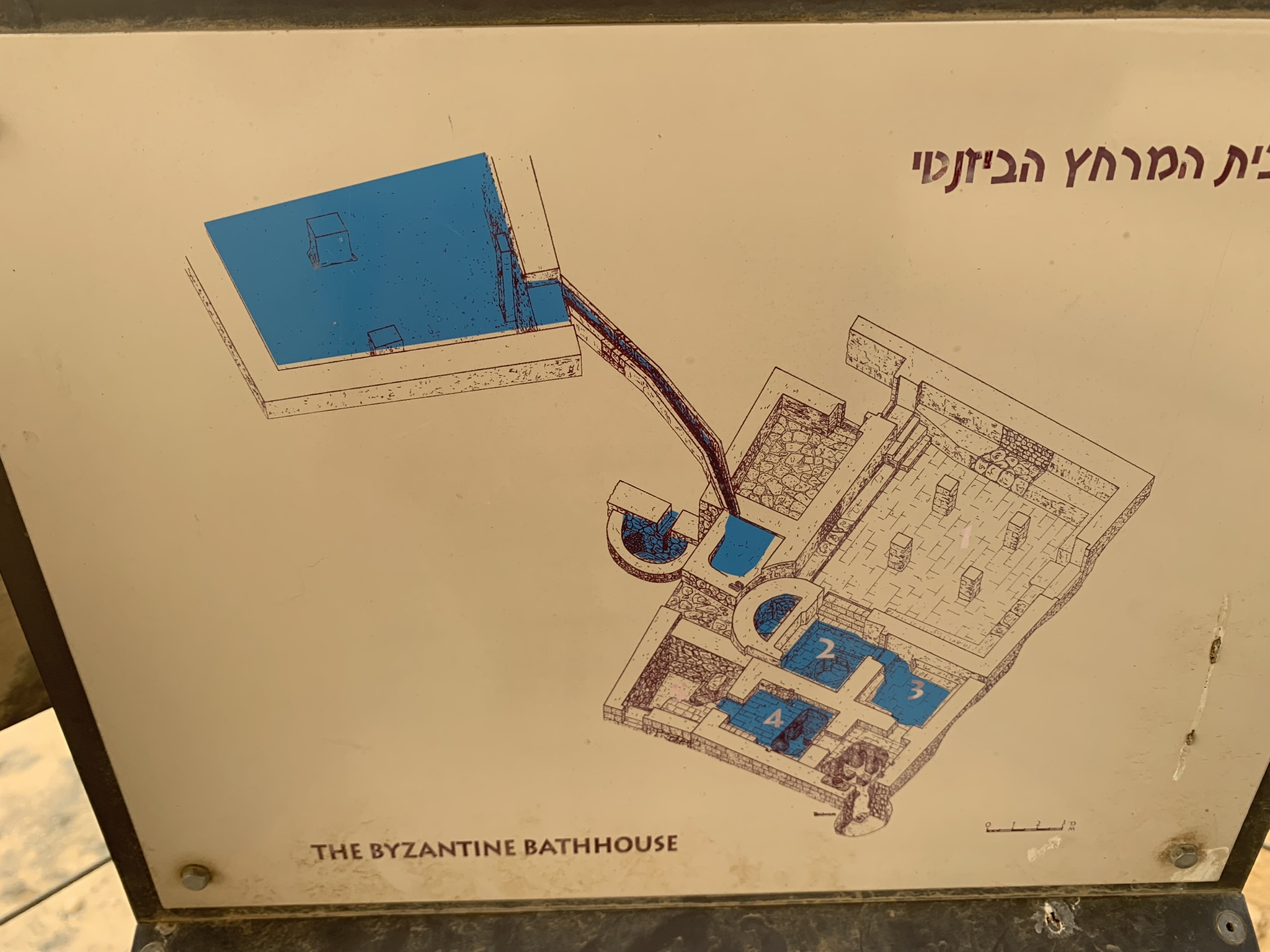
Iwent to visit the largest villa, known as the Nabatu house as well as a three room bathhouse next to it. The public bathhouse ( because you know – Romans!) was made of three rooms: the caldarium, a forced air steam sauna and hot pools; a frigidarium, a cold water pool from the reservoir for a quick plunge after the sauna; and a forum or dressing/social room. The furnace room consisted of red bricks heated by a massive fire and clay pipes through which the hot air flowed. It was all very interesting.

I really don’t know what happened next. I was walking with two crutches. The pavement was really quite uneven. Theres a metal pole sticking up from the ground about three inches. It was very windy and getting very cold. My legs were very heavy and my body aching. My back was screaming at me. I was trying to take pictures… and I went down. Really hard. I felt whatever surgery corrected in my back completely shift. I screamed, but there was no one else around. And that marked a dramatic end to our Negev adventure. The drive home was dusty with limited visibility. We made it just in time- through a sandstorm and before the rains hit. Since then I’ve been laying low, literally, and have been enjoying our rainy season. The winter has finally arrived with storm after storm. We made our trip just in time. It was totally worth it. Until the next adventure –

Adventures in the Desert

IMG_5274

A few weeks ago I mentioned to a friend that I had always wanted to see (but never had) the film, Lawrence of Arabia starring Peter O’Toole and Omar SharifObviously, things in the universe aligned, and I jumped at the opportunity to accompany friends on a spectacular field trip. 36 hours in the Negev Desert and the Arava region of southern Israel, which included a one-time screening of the movie about 20 miles from where it was filmed in Wadi Rum, Jordan.

The verdant fields of central Israel soon gave way to blowing sands, Bedouin villages, and the desert. Now I could experience, at least for a little while, the footsteps of the Patriarchs. In front of me was the eastern Negev: the Arava. To the North, the Dead Sea Valley. To the extreme south, the Red Sea. This region is part of the Syrian-African Rift, stretching from Turkey to Africa about 3000 miles. The Trans-Jordan cliffs to the East (Biblical Edom) and the mountains of the Negev that run parallel to the West make up the 110 mile Arava Valley floor. The sandy expense of the Negev makes up more than half of Israel’s land mass. It was the land of Abraham, Isaac and Jacob. Of Moses. And later in history, under the British Mandate of Palestine, the land of T.E. Lawrence.

Except for stopping the car every 15 minutes to get out and take pictures, I made record time to the kibbutz where we would drop off our things before heading to the Arava International Film Festival in the new little village of Zukim (Tsookim/Zuqim/Tzukim). Tzukim in Hebrew, means cliffs. This community, first established by a group of Israelis and Anglos from the Southwestern United States in 2003, reminds me of communities one would find in Arizona and New Mexico. From the landscape to the architecture, it all seems strangely familiar. This little yishuv has big plans to double its size of 300 residents within the next ten years. Its main economy comes from travel tourism. Many of the homes have adjoining tsimmerim or guest lodges offering magnificent views and spa services as well as a small selection of gourmet (chef) restaurants. A community and sport center is currently under construction. Large buildable lots for sale offer expansive views of the red rocks and sandstone cliffs of the Negev. And what a magnificent view!!! There is also a funky desert artist colony there featuring sculpture, pottery, weaving and paintings.


For the past eight years, Zukim has hosted the Arava International Film Festival each November. Featuring the top tier of global cinema, the movies include old classics, international award winners, animation, shorts, documentaries, and films for children and adolescents. This film festival is garnering worldwide critical acclaim. The specially constructed “theater” is situated outdoors between the desert bluffs, yet consideration has been made for maximum comfort. Moviegoers recline on super-comfortable pillows lining the stands and are provided with individual luxurious fleece blankets for snuggling under during the chilly desert evenings. Pop-up restaurants line the path to the entrance, featuring fast food, gourmet, vegan, and Kosher options. Dine in a desert tent or take the food with you into the stands.

The filmmakers (or in our case, the immediate family members) are invited to share their experiences in the making of the movie featured that evening. What a treat! Both David Lean’s and Sam Spiegel’s families were there to speak on their travels in Jordan, Morocco and Egypt to film Lawrence of Arabia. Sam Spiegel was an ardent Zionist. Who knew?  As Jordan’s Hashemite Tribe controls the Temple Mount in the Old City of Jerusalem, and they were so pleased with the movie, Spiegel was the only Jew to be allowed to pray at the Western Wall between 1948-1967. For us, the once-in-a lifetime opportunity to watch this masterpiece under the stars near its actual location was, as Sam Spiegel, Jr. said, “almost as good as watching Star Wars from outer space.”

The following morning. we woke up early to explore Kibbutz Lotan, where we spent the night. It is located about twenty minutes north of the city of Eilat on the Red Sea. Founded in 1983 by the Reform Judaism Movement, Kibbutz Lotan is “a place where spirit and earth meet.” IMG_5245.jpeg

IMG_5246.jpegIMG_5247 2.jpeg

The community thrives on eco-tourism and its date farm. At one end is the kibbutz housing for the residents and the guesthouses for visitors. Each structure is made from straw and desert earth and is powered by solar and wind energy. As with all kibbutzim, there is a central dining hall, a kindergarten, and an elementary school as well as a library, synagogue and community center. A swimming pool and tea house/cafe are available for kibbutzniks and visitors. Bicycles, the preferred method of transportation on the kibbutz, are also available for the guests. Birdwatching and frisbee golf are favorite pass-times for both residents and visitors to Lotan. Eco-tours are given daily.

Of special interest is the Center for Creative Ecology, a sustainable community consisting of a dozen cottages where participants live, farm, and cook their meals. Recycled vegetable oil is used for fueling many of the kitchen appliances. Everything is recycled and composted for use in the desert vegetable garden and fruit tree orchard. Except for potable drinking water, all of the water used for irrigation, cleaning, laundry is recycled gray water or desalinated water from the Mediterranean. Vegetarian  cooking classes are offered where participants can bake breads and pizzas in the hand-crafted clay ovens.

Before our return trip to the North, a visit to Kibbutz Yotvata, the oldest kibbutz in the Arava, was in order. The Yotvata Dairy is famous throughout Israel for sakit shoko (sa-keet’ show-koh), chocolate milk that comes in a hand-held plastic sac. Every kid here loves it! Tear off a corner of the bag with your teeth and enjoy sucking out the velvety, rich chocolate milk inside. It’s an Israeli institution. And at the tour, you get to taste that shoko. In my opinion, Yotvata is some of the best milk in the country. And their homemade ice cream (glee-dah’ which is only available at the Yotvata Factory store) is the best in all the land! Even though they live in the desert, Yotvata cows are happy cows and their milk is a testament to that fact.

It’s amazing to see how these adventurous, hard-working Israelis are cultivating the barren desert. David Ben Gurion, Israel’s first prime minister, had a dream of making the desert bloom. A blooming it is. All along Highway 90 are date farms, pomegranate orchards, and rows and rows of covered agricultural tents. Using desalinated water, recycled water, and water from the Red Sea, there are tropical fish farms – yes!!! You read that correctly! We found Nemo in the desert! And herb farms – we found fresh Basil in the desert! And tropical flower farms! You can even visit the most eccentric place called Crocoloco, a crocodile farm in the desert. It is definitely a land of ingenuity!!! G-d promised He would make the desert bloom again –

Israel is a land of history, archaeology, culture, and breathtaking beauty. For a country smaller than the state of New Jersey, it never ceases to amaze me! It takes a certain kind of person to settle in the desert – and the people we met were part visionary, part stout-hearted – quirky and eclectic people. People devoted to a dream. Fiercely independent, a bit alternative, totally Israeli. I leave you with a bit of that quirkiness found in the most extreme regions….