"When G-d will return the captivity of Zion, we will be like dreamers. Then our mouths will be filled with laughter and our tongues with glad song." Psalm 126
I’ve taken a break from all the bad news lately. It seems never-ending. We’ve opted to focus on Chanukah. To light the lights in resolve and rededication to shine forth brightly as the world seems to be getting darker.
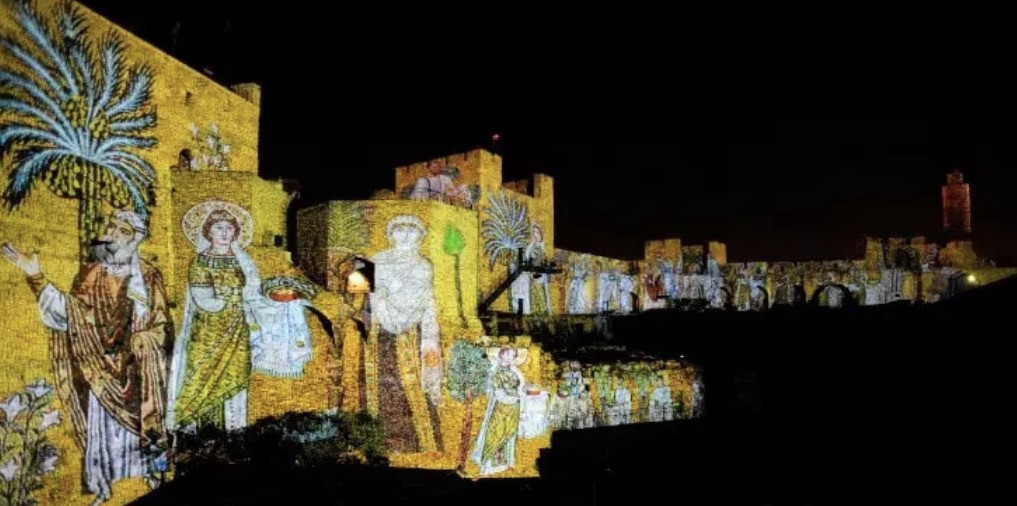
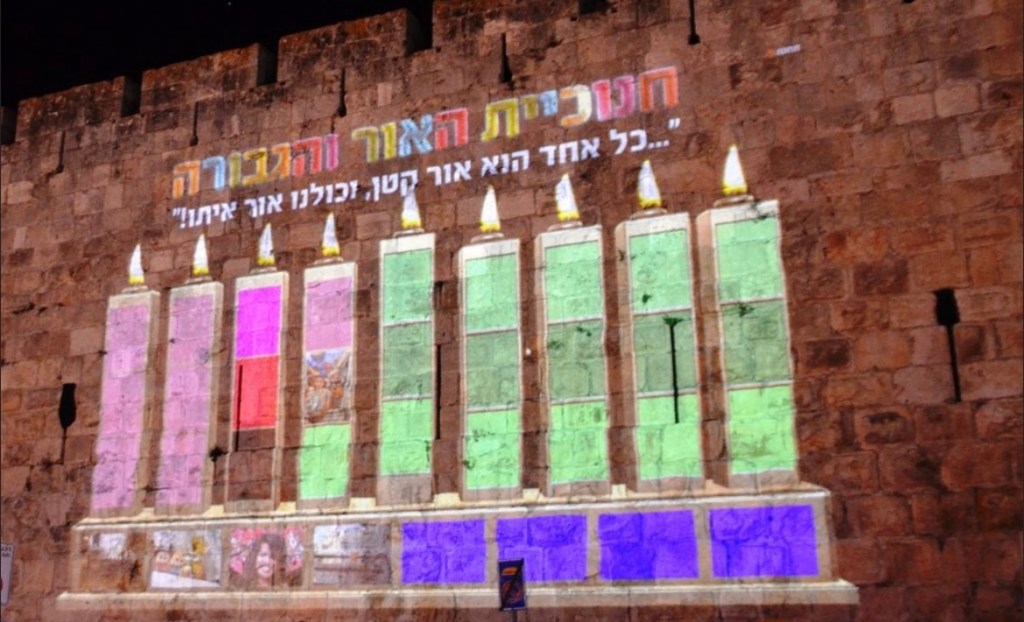
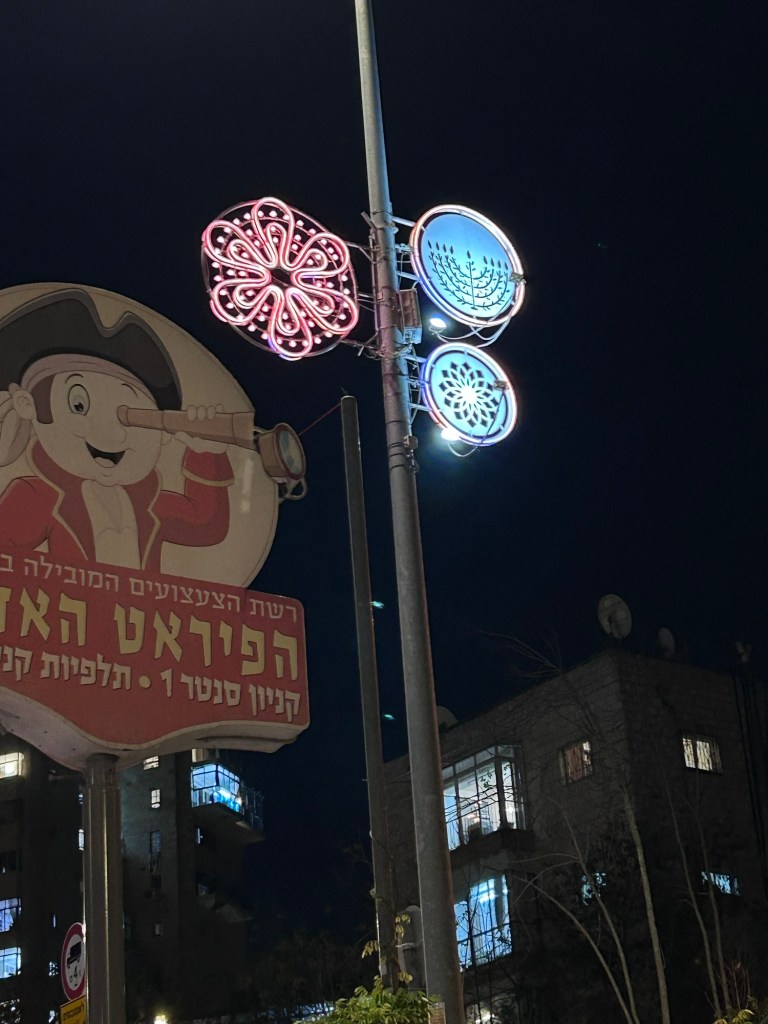
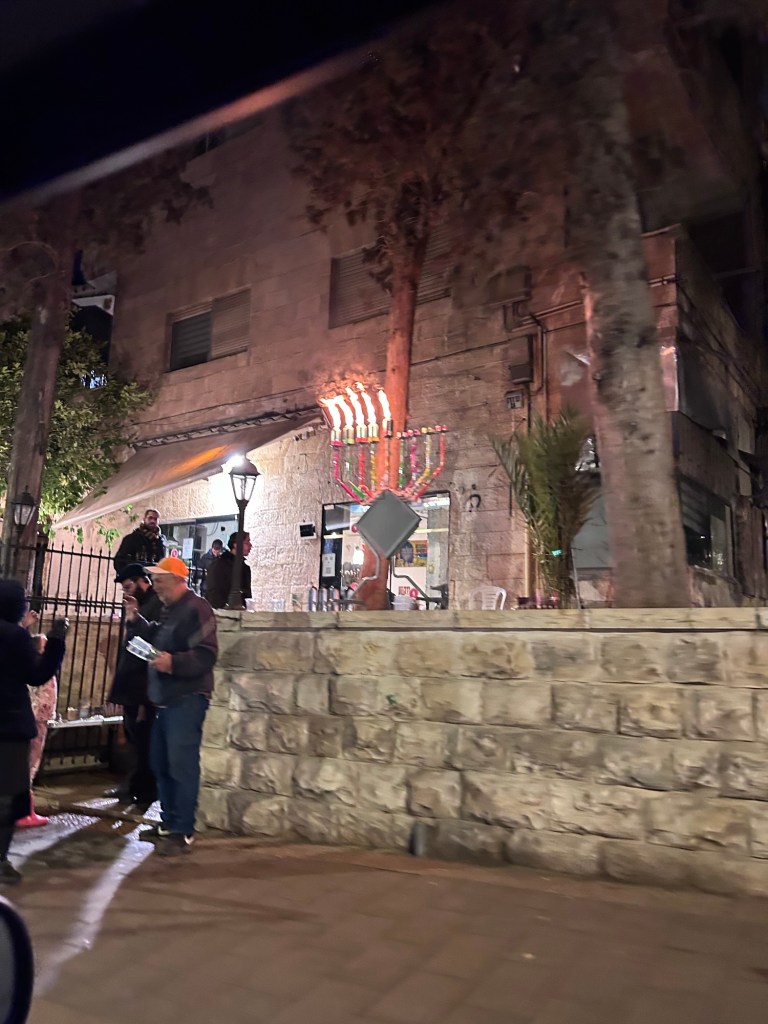
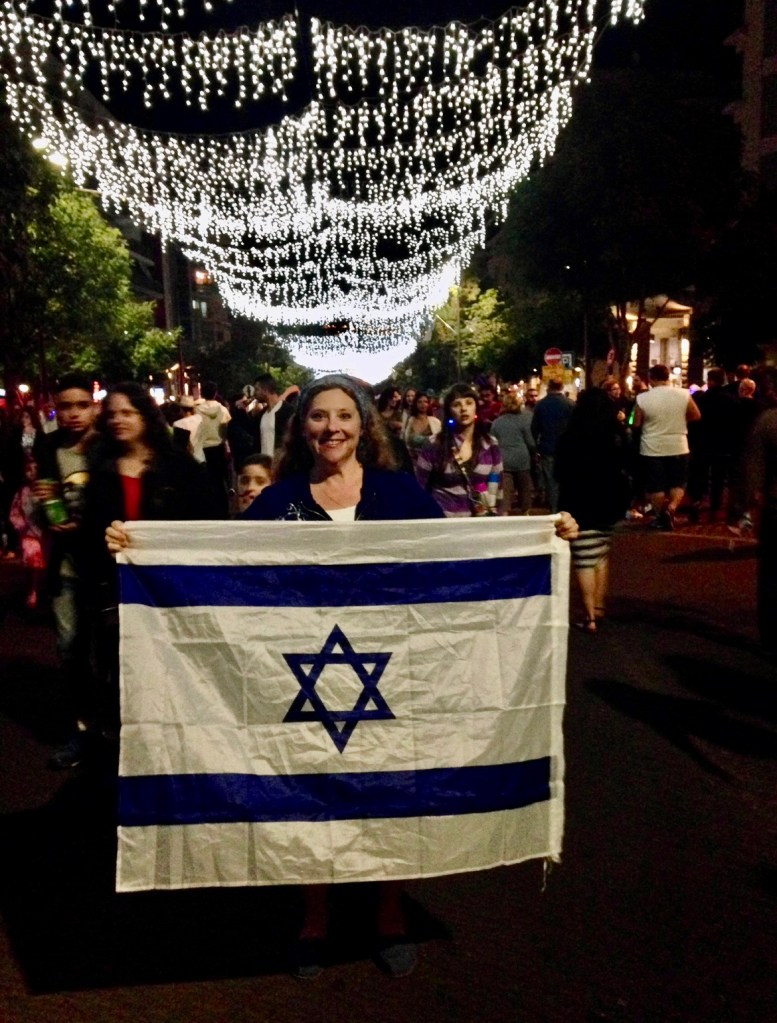
This past week, John and I decided to spend an evening in Jerusalem. I’d always wanted to see the Chanukah decorations and lights and experience streets and windows bathed by the glow of Hanukkiyahs (menorahs). The spelling always looks wrong on that one. But we did get to Jerusalem by sunset and it did not disappoint. We first drove around to see some of the decorations, and the walls of the Old City were lit up with special light projections.
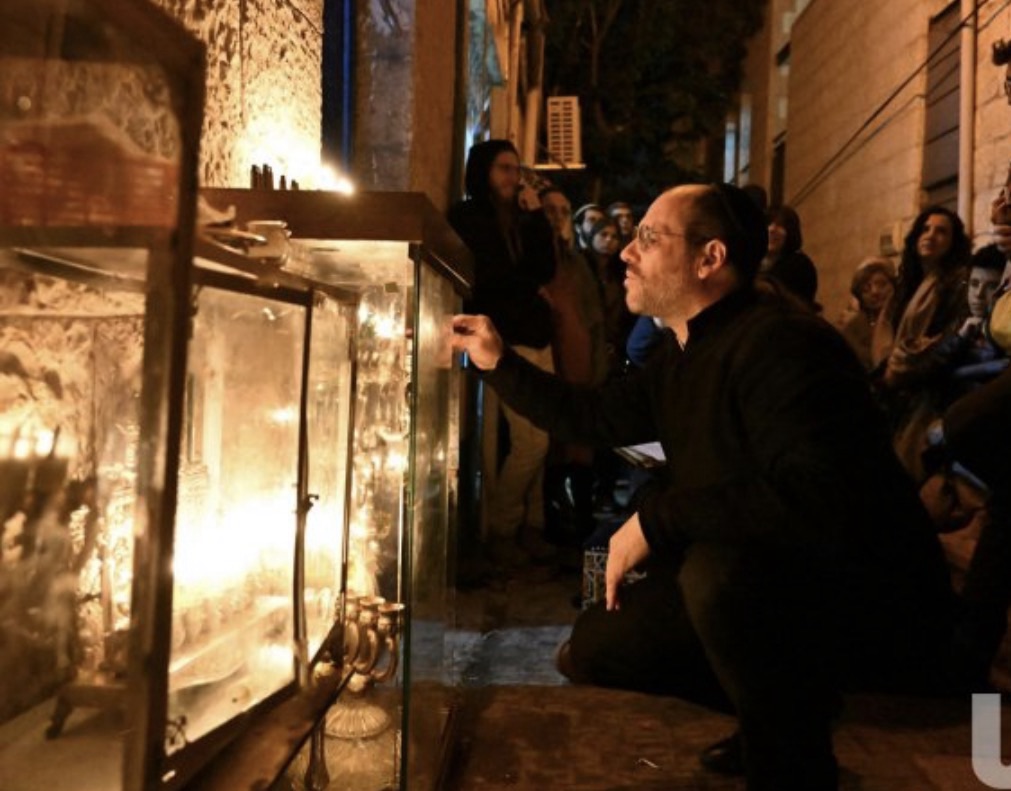
And yes, there were all sorts of individual Chanukah oil lamps in glass boxes along the streets. Many people in Israel put their lights out at street level so passers by can enjoy the flames. Most are lit with pure olive oil.
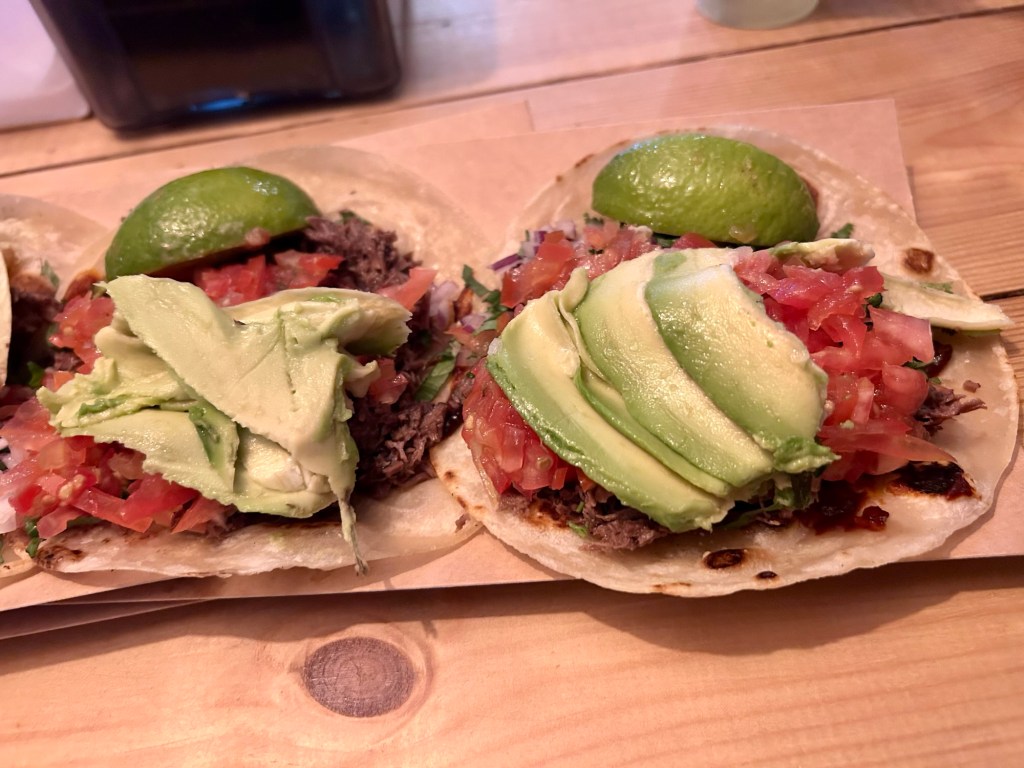
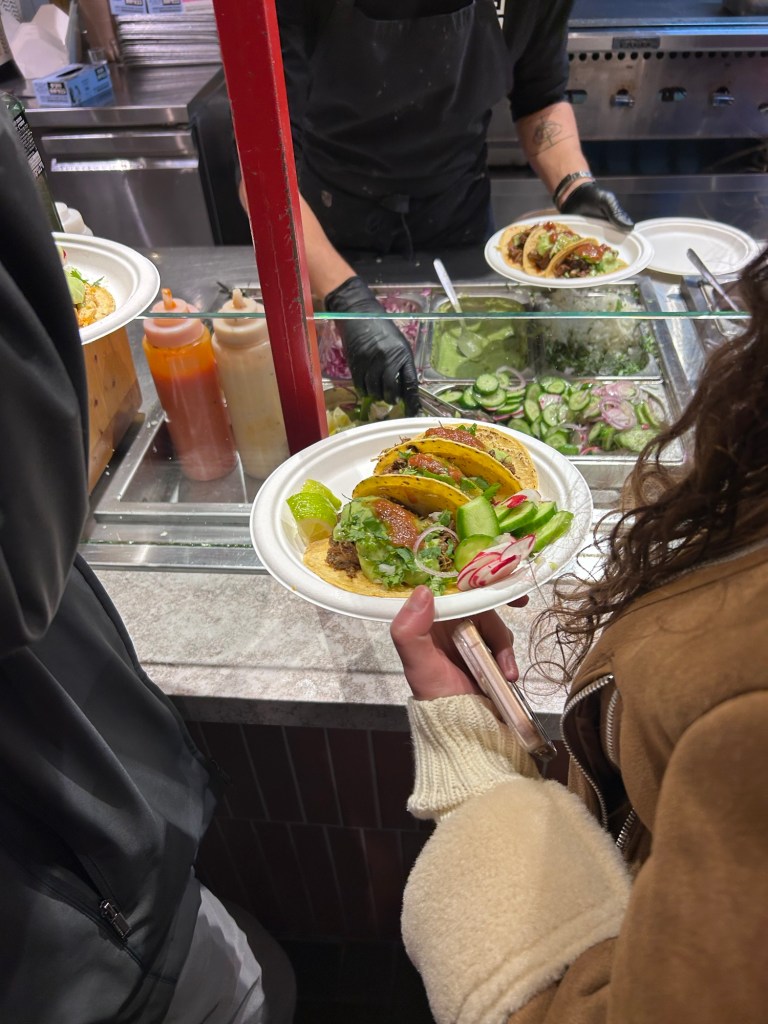
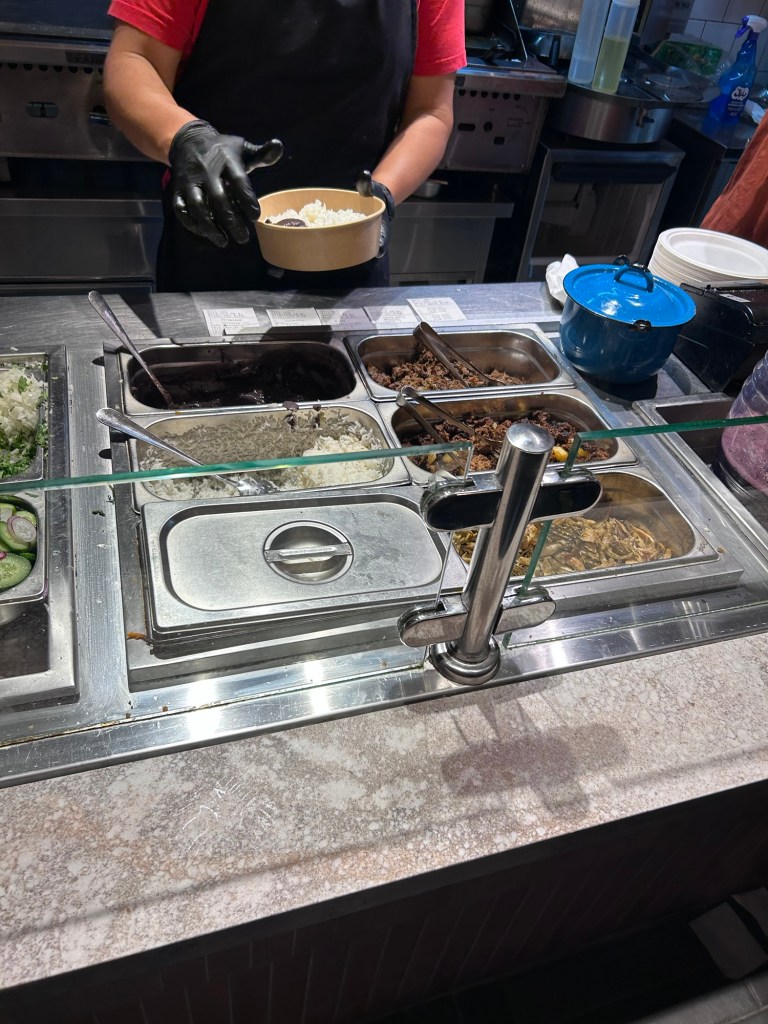
As is our tradition, coming from Souther California where Mexican street food is prevalent, we stopped at one of the three authentic Mexican restaurants in Israel. Two weeks ago, we visited HaTaco in the Shuk haCarmel, Tel Aviv. The tacos were really tasty, but the margarita was bland and for street food, we wound up paying almost $60 for 3 beef tacos and 2 drinks.
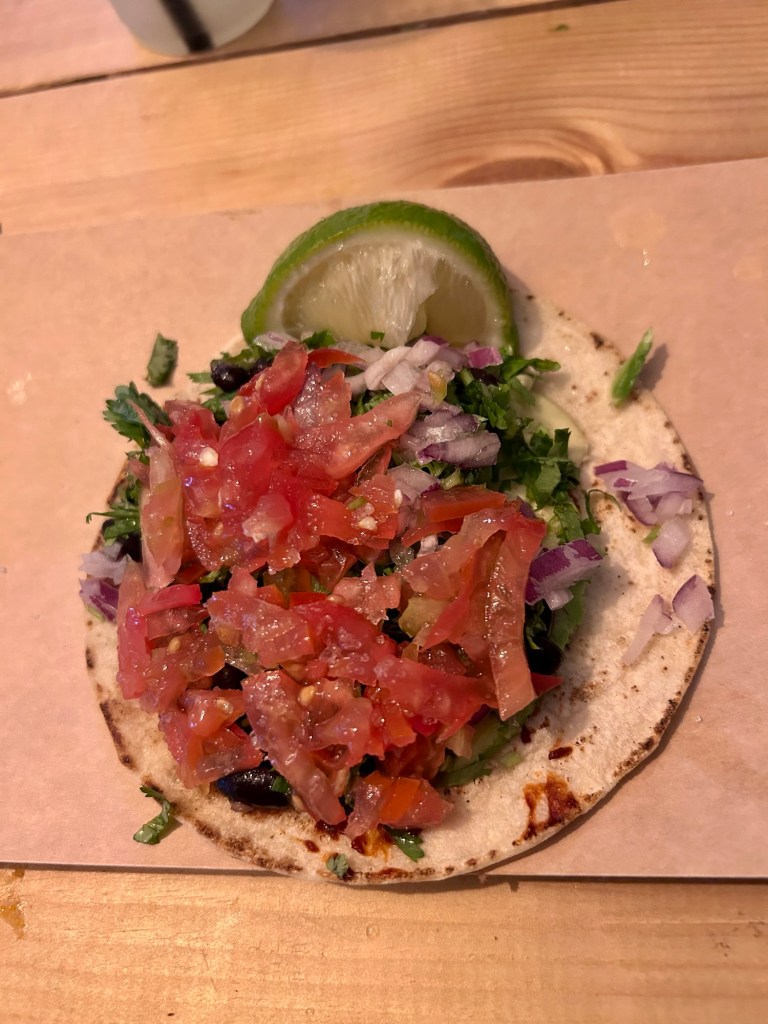
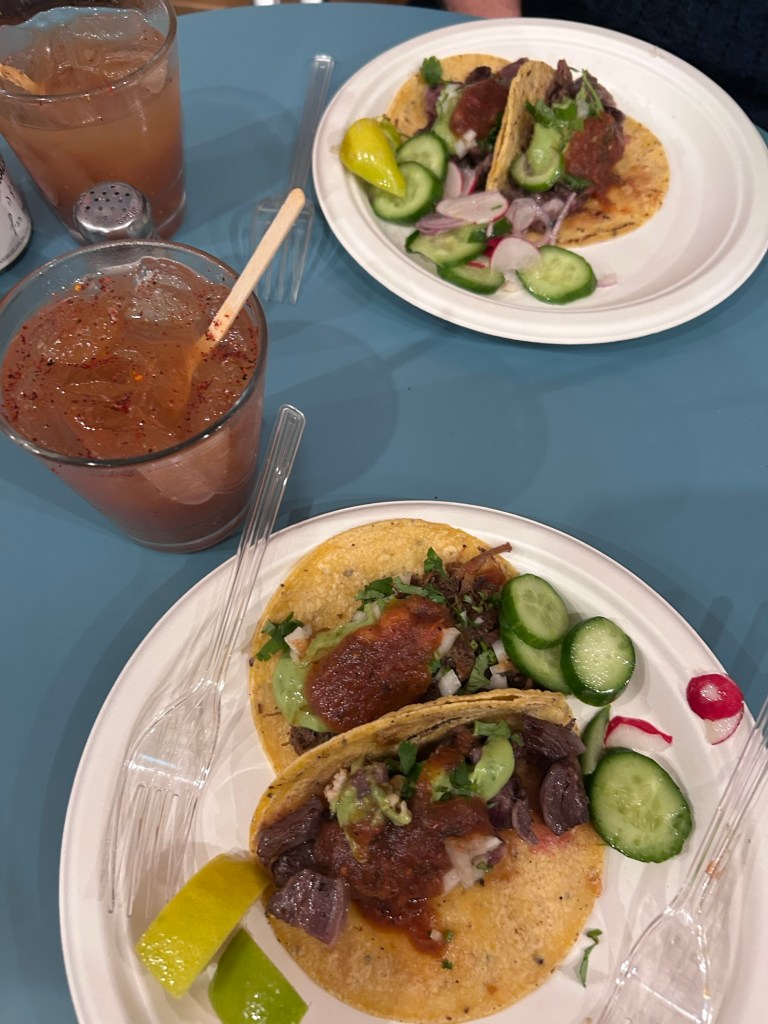
In Jerusalem, we go to Tacos Luis, an amazing Kosher restaurant that has authentic Mexican food and lines out the door. We usually wait 30-45 minutes just to place our order, but it is more than worth it. The food is fantastic. The margaritas strong, served with Tajin and a lime on the salt-rimmed glass. Corn or flour tortillas and rice bowls with vegetarian options as well as beef and fish. They had tamales, both chicken and beef, but had run out. Luis is always behind the counter serving up smiles and conversations in Spanish, English and Hebrew. Plus you can now buy jars of salsa verde, salsa roja, mango salsa and pico de gallo. The prices are more than reasonable. And the beef taco had cubes of steak that were tender and juicy. A must try in Ylem. Our 3 tacos, 2 margaritas, and 2 jars of salsa verde cost about $35.
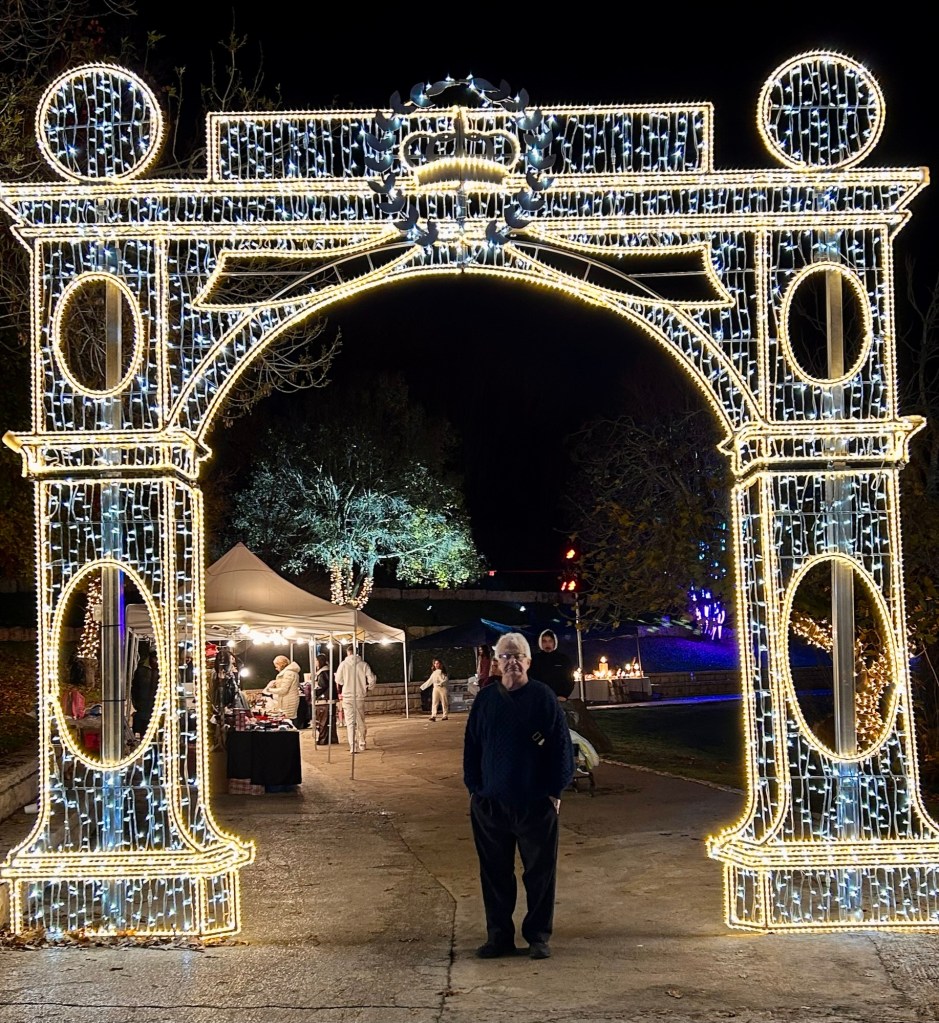
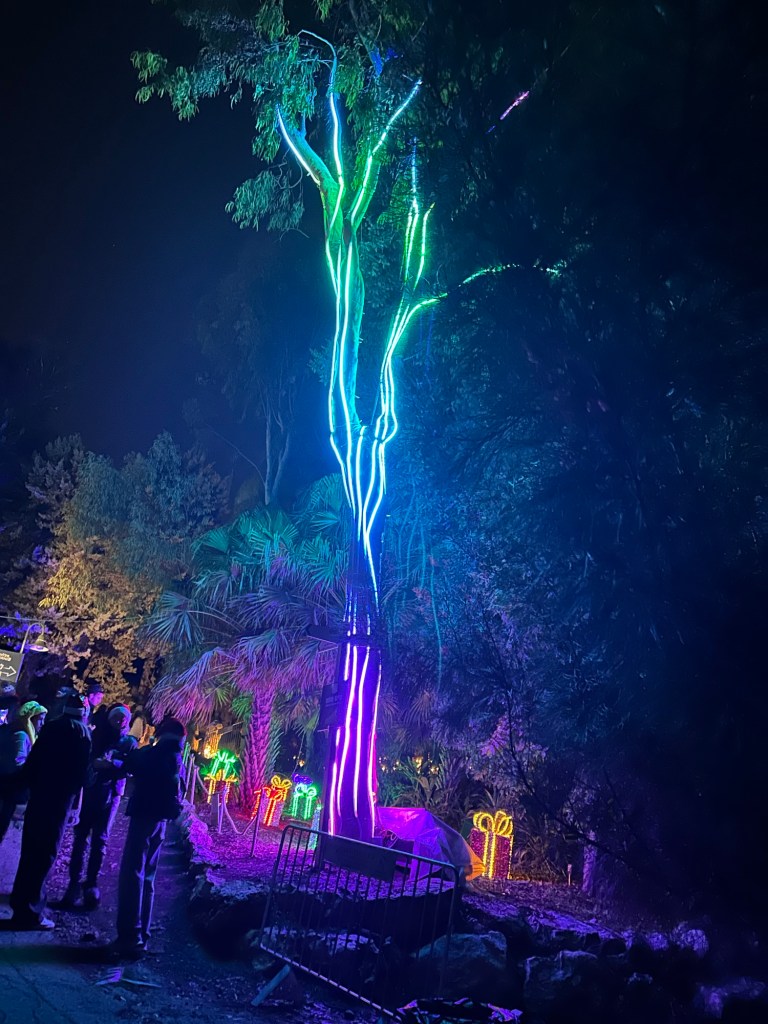
I’d bought tickets to Winter Dreams at the Jerusalem Botanical Gardens weeks ago. This light show spanning over a mile has visited London, Paris, Berlin and Vienna. All I can say is “Wow! Am so glad we went!” It’s a bit hard to explain, but the entire botanical garden was awash in light sculptures, walkways, interactive displays. All themed to different music. It was spectacular!
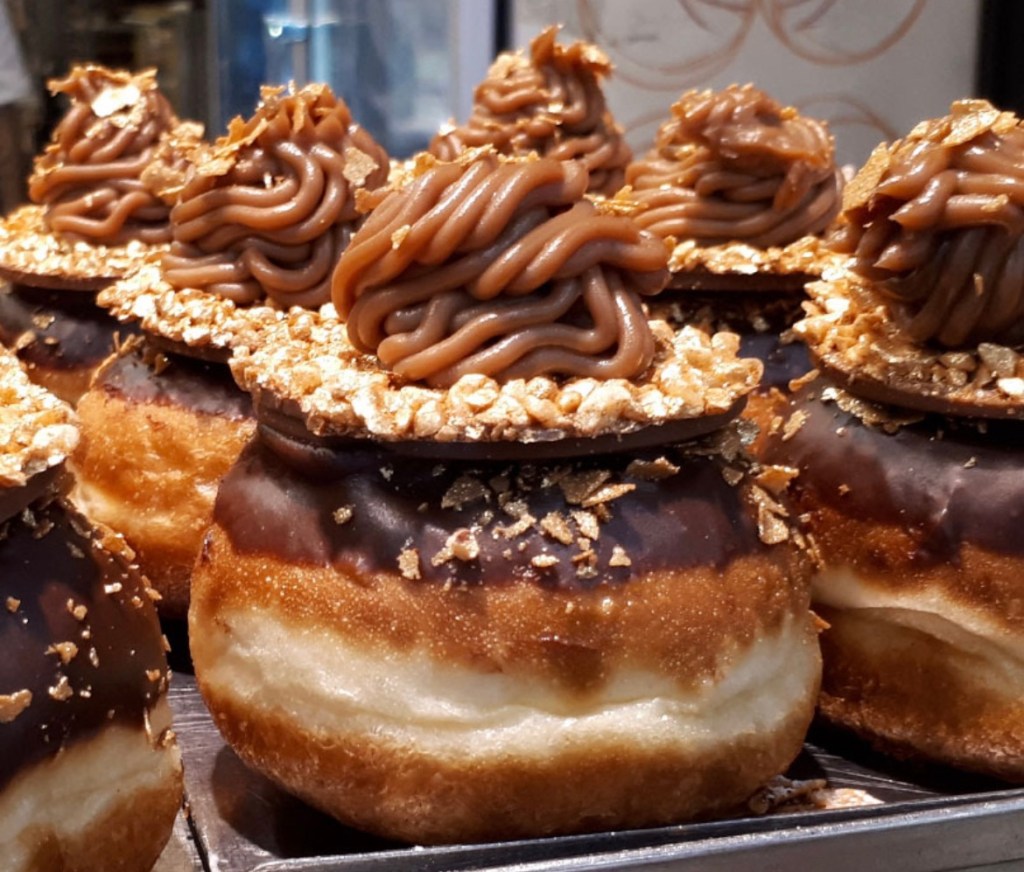
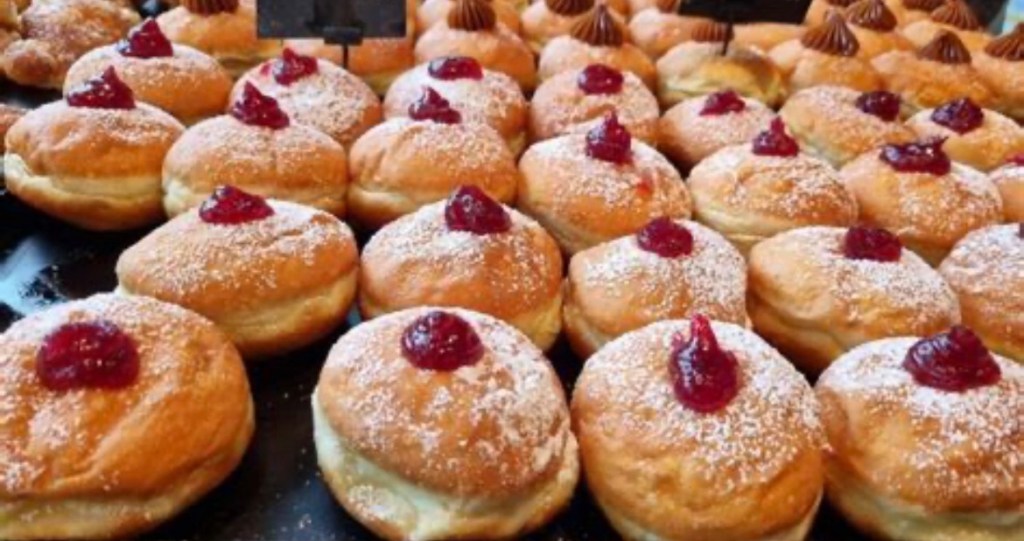
The night in Yerushalayim get really chilly in winter, so there were stands with hot sangria, sachlav, a Middle Eastern favorite drink. It’s rich and hot and made from orchid tubers, creamy with coconut, pistachios and cinnamon sprinkled on top. Pure heaven. Hot roasted chestnuts, hot cider and hot chocolate… and of course jelly filled doughnuts, called sufganiot.
There were so many families. Lots of small children. Older people. Religious Jews. Secular folk. Arabic women in their hijabs. Groups of priests. It was wonderful to see the diversity. Israel is such a mix of cultures and when everyone can be peaceable, it’s perfection.
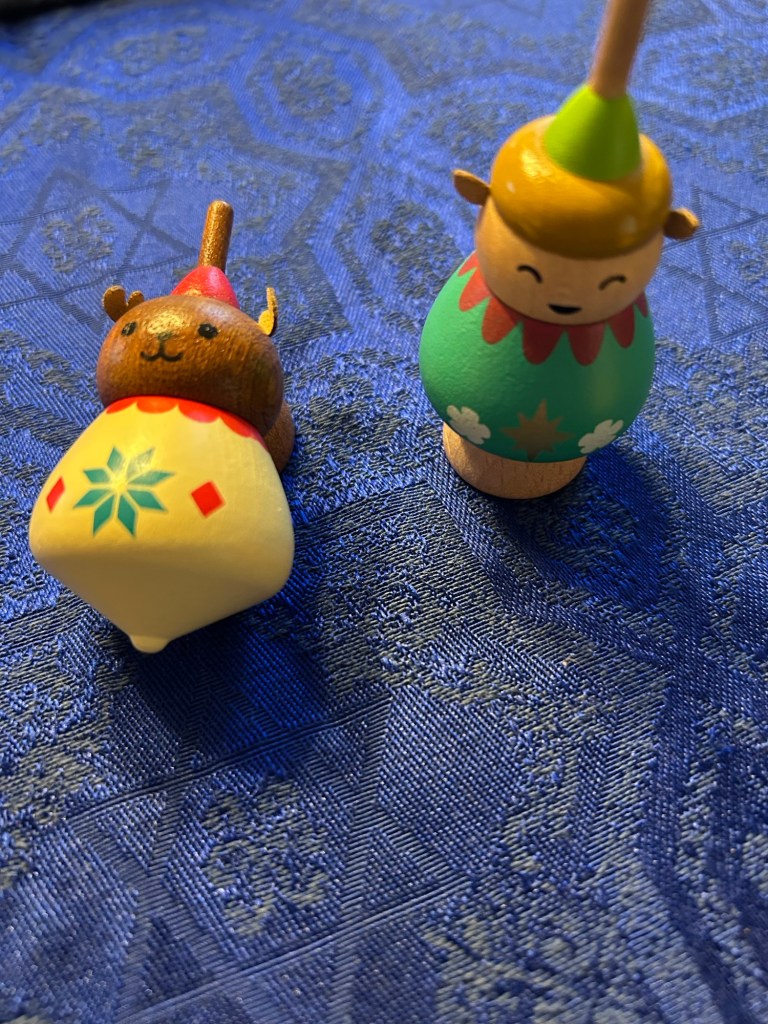
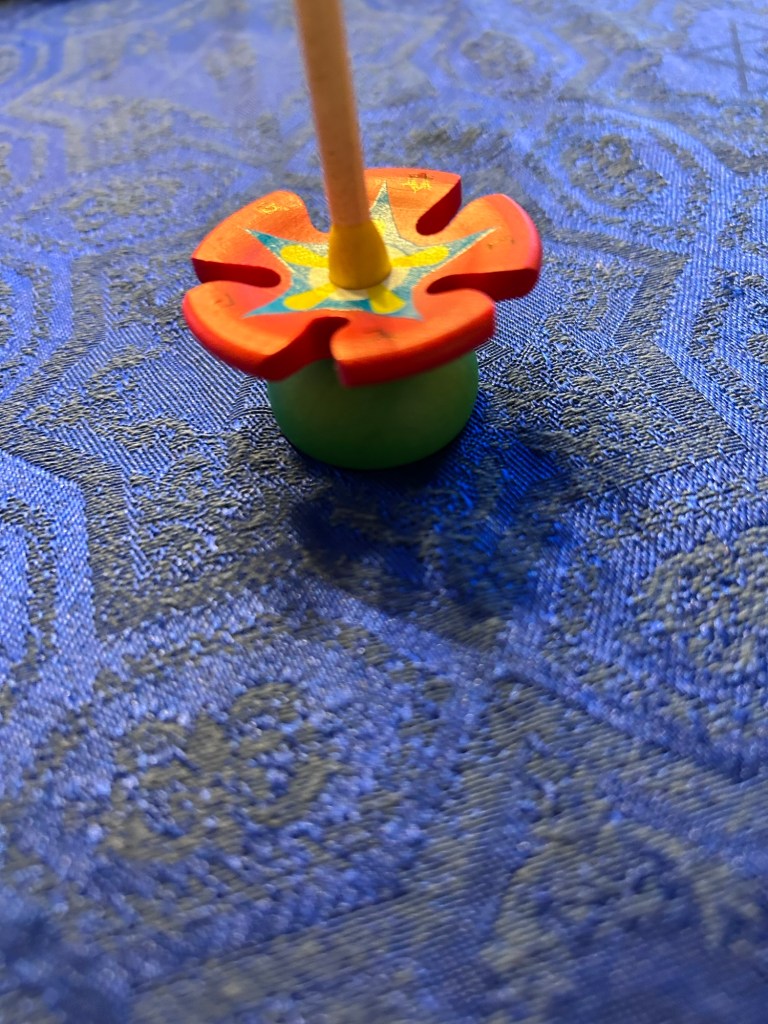
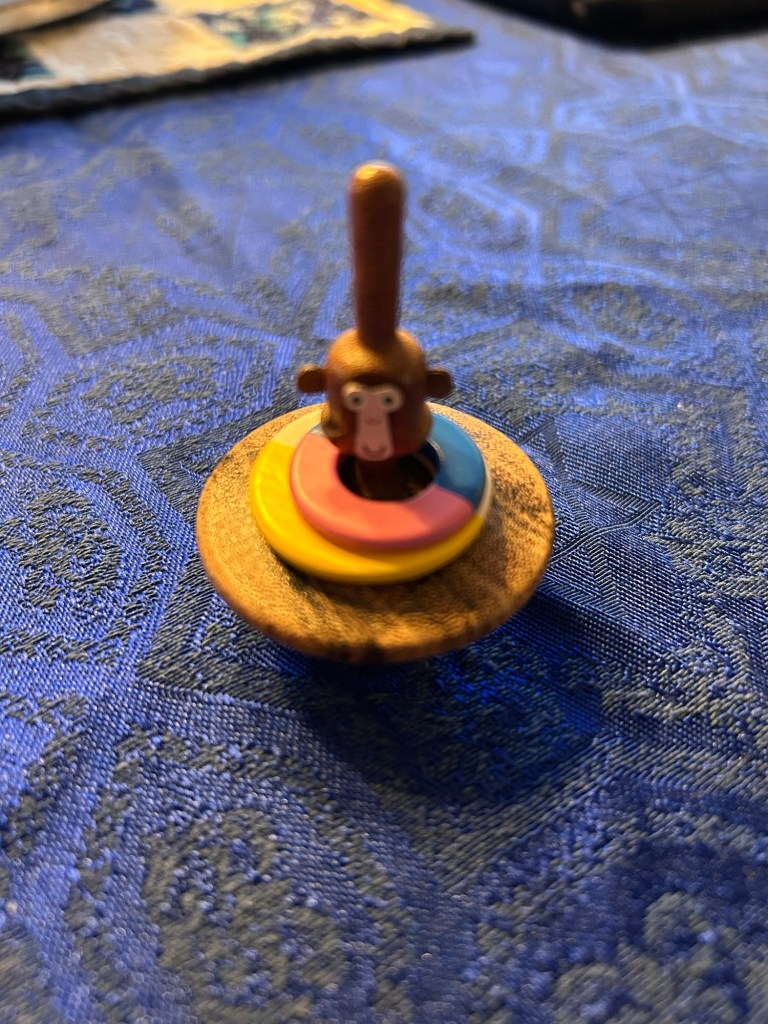
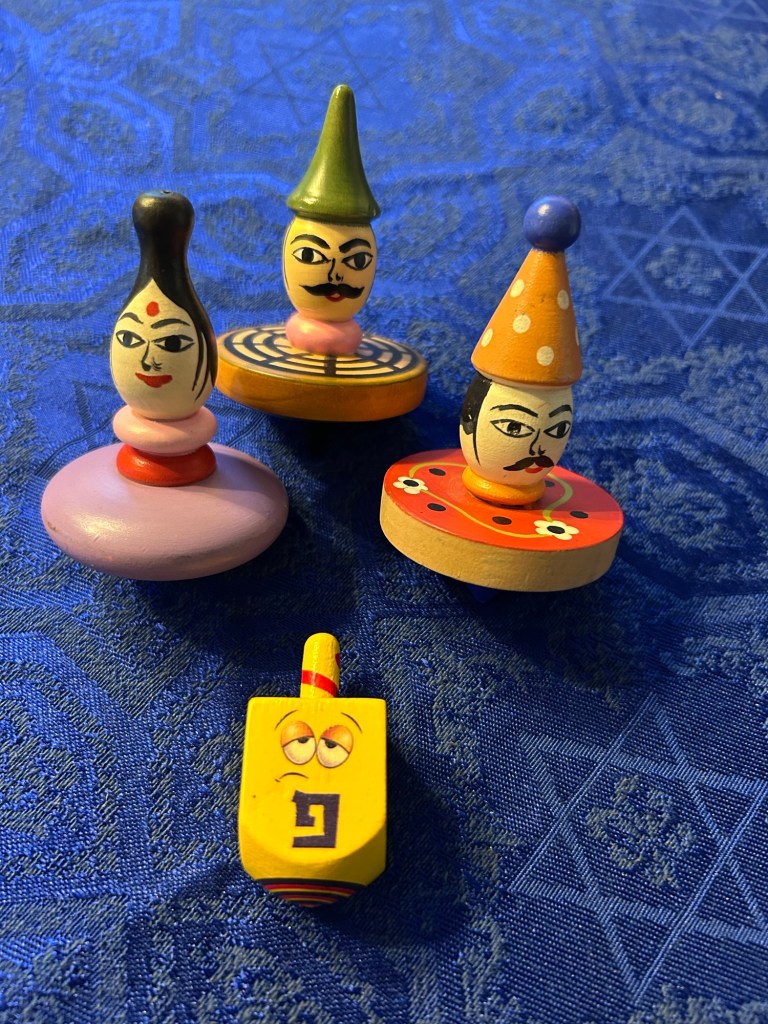
Afterwards we stopped by the First Station for some shopping and doughnuts. Dreidels (the Ashkenaz Yiddish word) or in Hebrew, Sevivonim are spinning tops. Traditionally in Hebrew, the four sides are marked with Hebrew letters which stand for the words ‘A Great Miracle Happened Here.’ There are games that center around the children playing with the tops and collecting prizes of candy and coins. One shop had hand made, carved and painted sevivonim, the likes of which I had never seen. The prices were more than reasonable, so I bought one for each of my grandchildren. They are nothing short of magnificent!
And the sufganiot!! Many have little plastic syringes filled with flavored jellies and creams that you inject into the puffy fried doughnut. All were very fancy. I don’t think you can find them anywhere except in Israel at Chanukah!
We left J-town around 11pm, exhausted, but happy and with sugar highs. There’s really nothing like celebrating Chanukah in the city.
It’s been a long couple months, but we are back safe and fairly sound (still recuperating) from our adventures in England and Amsterdam. My son graduated university with a masters in Public Policy and is now looking for employment in the E.U. His fiancé lives in the Netherlands, so we took a short trip to visit with he family there.
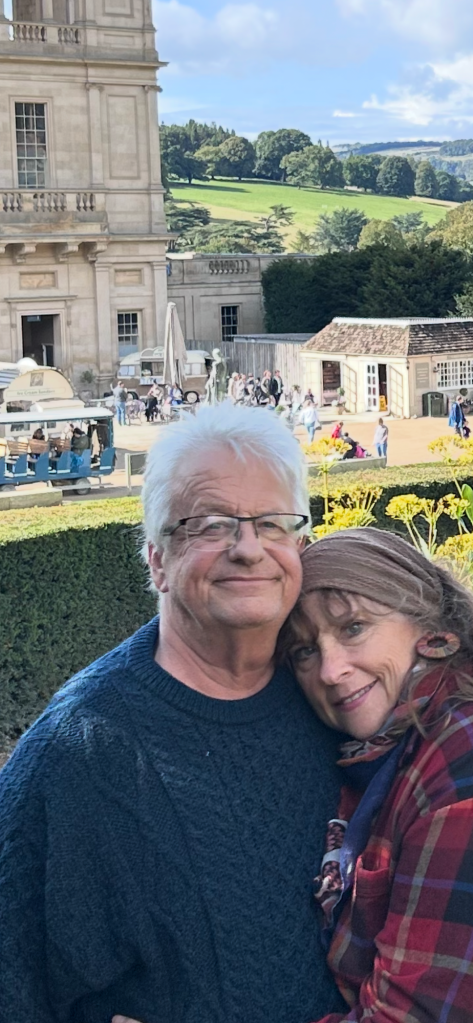
After a most glorious and incredibly jam-packed stay in London, most of our time was spent in the gorgeous English Derbyshire countryside (they pronounce it ‘Darbysher’) with our daughter, her husband and two small children. They’ve requested not to post photos of names of the kids, so….the newborn granddaughter was teeny, tiny, soft and gentle. Holding a baby again – well, there’s absolutely nothing like it! The grandson turned two last week. An incredibly smart and inquisitive and fast as lightening adorable little imp who is both a bundle of joy and a mischievous imp into everything. He thinks he can cook, make a pot of tea, and drive a car…. all very dangerous. But he is amazing and we love them all so much.
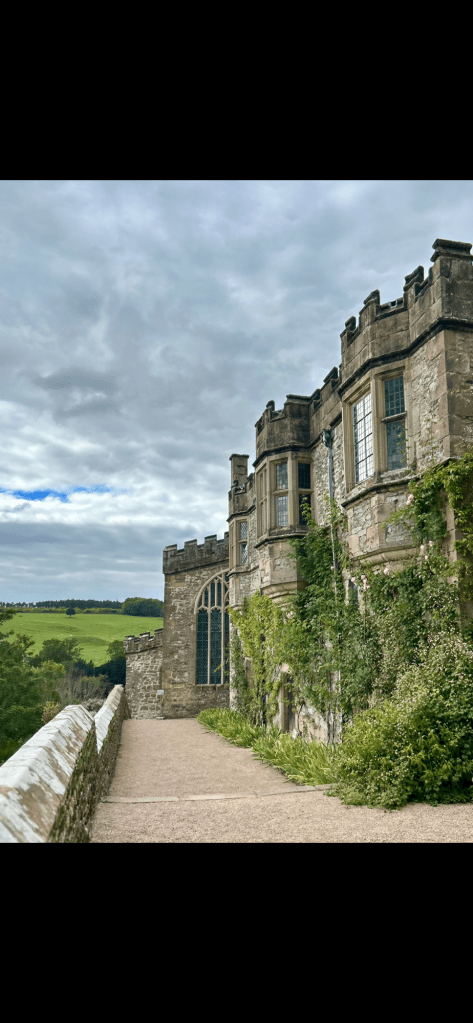
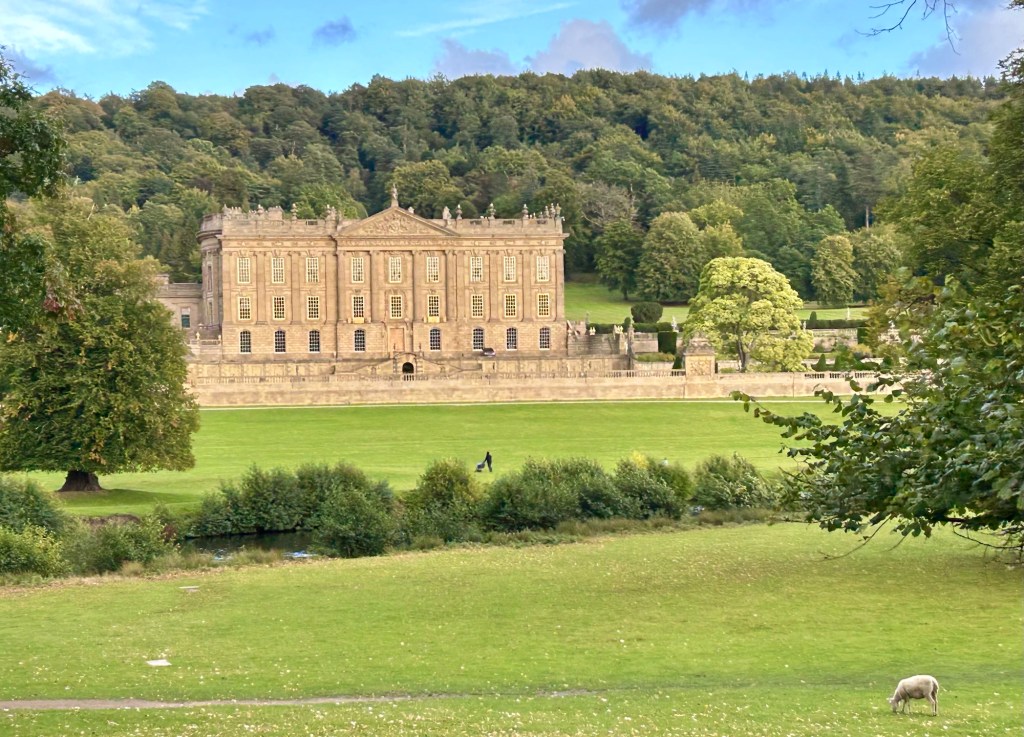
We were able to take quite a few long weekend trips together: Chatsworth Estate where Pride and Prejudice was filmed; the Medieval estate, Haddon Hall; quaint villages and hamlets. Small artisanal dairies (Red Leicester, Stilton, Cheddars), charity shops and antique shops emptied our wallets. I had to buy two more huge suitcases!
Rosh haShannah was the start of the Jewish fall festivals. I decided to attend synagogue in Leicester. It was a large, stately red brick building, quite historical from the 1800s. They used to have a school and community center across the street, but it was sold several years ago as the Jewish population had dwindled and the upkeep of the properties too costly. Now the buildings are an Islamic center and a mosque. The once upscale neighborhood of large brick townhouses are now marked by trash outside and Palestinian flags flying from every home. Burkas and hijabs are standard fare. I was more than shocked that there was no police presence outside. Not a good feeling. It was actually quite terrifying as I was scouting out the place for unsavory suspects. In addition, there was no armed quart at the doors (a given in California, unheard of in Israel). Services were absolutely lovely, but not terribly well attended.
I had decided that we would go to synagogue for Yom Kippur in Manchester, a much larger city. Except every single one of us including the kids came down with the flu. That was the day an armed Arab terrorist ran into a group of synagogue-goers before shooting and stabbing his way through the crowd. He claimed to have explosives tied to his body. Thankfully police were close by and he was neutralized. I’d had an ominous feeling that something awful would happen.
Since then, in world news, the flotilla to Gaza with Greta Thunberg, Susan Sarandon and other notables made their way to Israel supposedly carrying lots of aid for the residents of Gaza. Only, they were stopped by the IDF navy before they could enter war zone. The boats carried absolutely no humanitarian aid. About 100 activists had abandoned the flotilla and decided to reach Gaza through the Israeli border by foot. They were promptly arrested. The BBC only reported Thunberg’s statements of “dehumanization and torture in the Israeli dungeon.” They had to sleep on hard mattresses on the floor and the sandwiches given them were very dry. A guard pulled Greta’s hair at one point, which was her version of torture.
All of the BBC news was absolutely antithetical to Israel. Every report spoke of genocide and forced starvation of the Palestinians. Israel, the colonial aggressor, was indiscriminately bombing and leveling civilian areas according to BBC. And Prime Minister Kier Starmer publicly recognized Palestine as a state at the UN. Also, while we were in the UK, there was a march in London led by Tommy Robinson. A few days after Charlie Kirk was assassinated, the rally was anti immigration, pro Israel, standing for taking back Western civilization and culture which is disappearing in Britain. The BBC reported about 60,000 participants but aerial footage estimated the rally neared 800,00 people.
The week following, a woman was arrested for waving the Union Jack in public, and scores of elderly and disabled people throughout the country were arrested for social media postings that were deemed “upsetting” because they came against the government or were anti immigrant, flags of England and of the UK started popping up everywhere. Soon every town had flags and banners hanging. Houses were proudly hailing their red, white and blue, and the Union Jacks were waving from most highway overpasses. It seems the Brits are beginning to wake up.
Everyone now knows about the Trump MidEast deal and all the fanfare that went with it. I’ll write more about that deal in another post, but we are crying tears of joy that 20 hostages were released alive after exactly two years of living hell. Hamas was supposed to release all live hostages and return the 29 dead bodies they were keeping within 72 hours of the signing of the deal.
Israel set free 195 Jihadi prisoners serving life sentences for mass murders, planning massacres of Israelis, car rammings, multiple stabbings, and detonating bombs in grocery stores, nightclubs and on busses. They also released 2000 additional prisoners, most were terrorists caught in Gaza for committing the 7 October atrocities and for fighting as “civilian” Hamas militants.
We were all glued to the internet crying tears of joy as our prayers were answered. Thank you HaShem! 20 live hostages were brought back to their border. All Israel was blazing with joy as the grief of exactly 2 years finally seemed to be ending. The returning men were welcome,ed with tears, hugs and kisses by their families. And the entire country was dancing and singing. Such a part, the likes that Israel had never seen. Thousands of people were rejoicing at the Western Wall. Also thousands dancing in praise to G-d at the Nova music festival site.
As expected, Hamas has delayed and has not returned the promised bodies they are holding. At first, 4 people were brought back. Then four more, one of whom was identified as a Gazan, not an Israeli. Two more were returned after extreme threats and pressure by Trump, Israel and several Arab countries. The other 20 cannot be located, or so they say. As far as John and I are concerned, the agreement has been violated and now is the time to disarm them completely. No questions asked. No more time given. No more excuses accepted.
Footage is being shown from inside Gaza that Hamas is publicly executing hundreds of Gazan civilians in the streets in order to to reassert their control. It seems that families are fighting families, with different clans trying to gain dominance. It’s being reported that Khan Younis and Gaza City are experiencing all-out chaos. And those openly associated with Hamas are unwilling to disarm or give up power. So much for Phase 2.
It’s nearing Shabbat prep time, and I still have loads of laundry and unpacking to do. We’re still fighting nasty coughs and the creeping crud, and both John and I are more than a bit exhausted. So much other stuff happened while we were away (deaths in the family; infighting within a group I was in…I was on the Board of Directors of an Inter-religious Dialogue group. The “Israelis” (me included) were invited to retire due to political unease. This has dragged on for weeks now and I’m drained.) Being with my kids and grandkids was a tremendous blessing and source of joy, but it is so wonderful to be back home in Israel. There is no other country like this one on earth. Shabbat shalom.
In Israel, many people who are elderly, infirm or recovering from severe illness or surgery have a live-in mittapellet, a care giver. Trained and certified caregivers come here from India and the Philippines. These lovely, self-sacrificing women leave behind families for a period of 1 to 5 years for gainful employment here. Most of them have very small children back home.
Here, they take care of their patient, do housekeeping and shopping and learn to cook in a kosher home. Many learn to speak Hebrew as well. All of the ladies were fluent in English. It is so interesting, and they are all the most amazing women. They are vetted, hired and placed through an agency. All that I’ve met are very loyal to the family they care for. They get paid well and all room and board is included. They have days off and also get a two-week leave to visit family back in India.
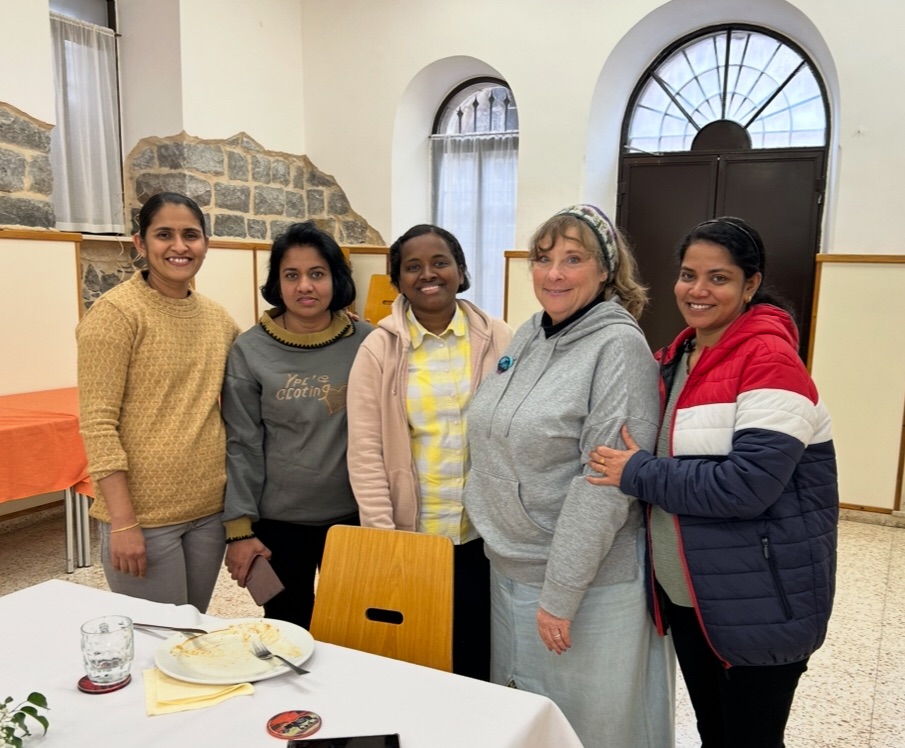
On October, 2023, many communities along the Northern border were evacuated due to the threat of Hizbulla invasion. And the fact hat Hizbulla were making sniper shots and RPG attacks made these kibbutzim and border towns completely unsafe for habitation. So they moved with their patients or host families, kit and kaboodle, to safer communities. They stayed in hotels and other kibbutzim that took them in. And that is where I got to meet a charming group of Indian women and we became fast friends.
Janesha, Sumita, Steffi, me and Mary
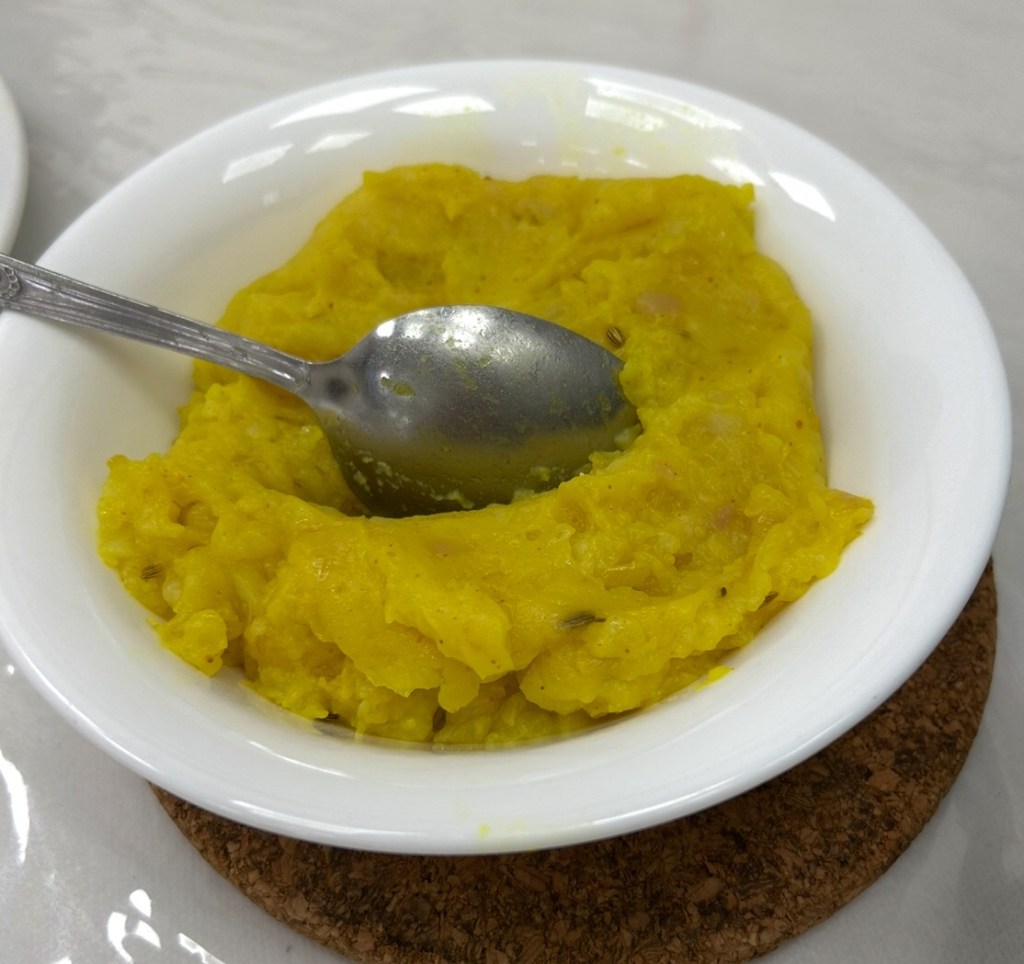
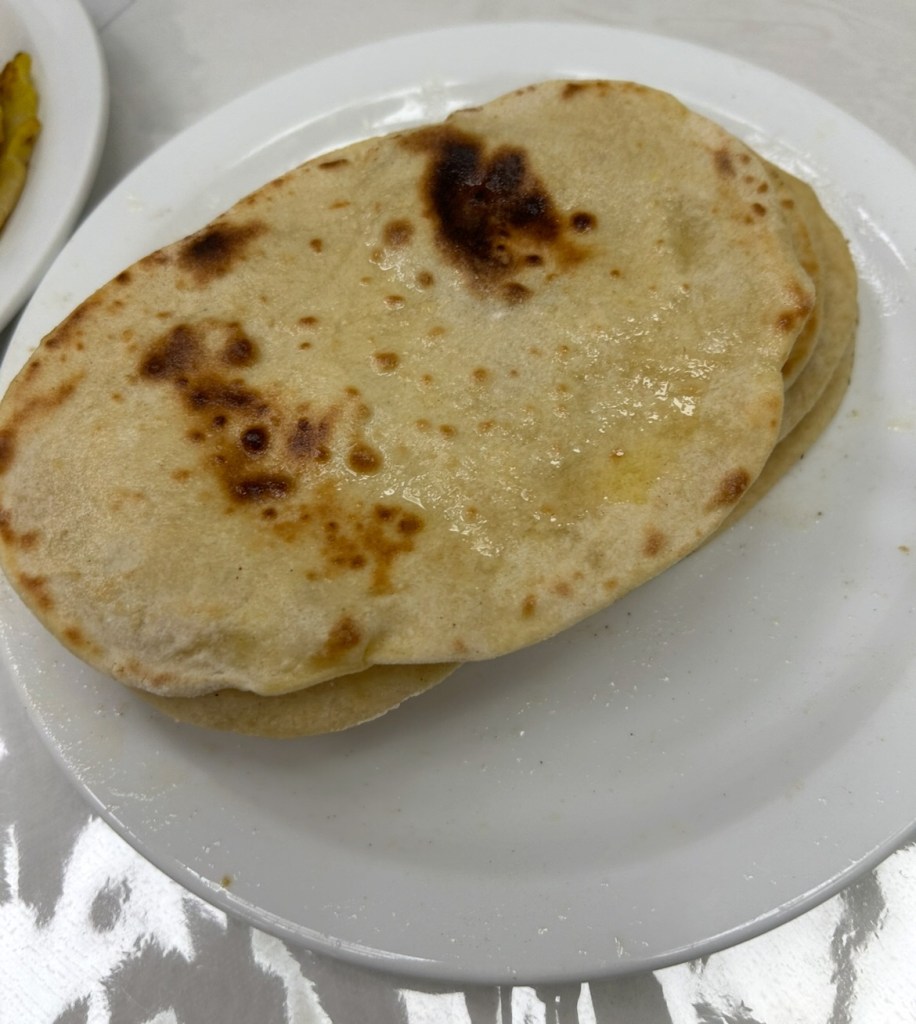
Last April, as some of them were preparing to leave, we decided to get together in their dining hall and have an Indian feast. It was amazing as authentic and delicious Indian food is hard to find here. And feast it was!!!! I’ve been preparing daal (yellow split peas) and aloo gobi (potatoes and cauliflower), curries, chutney and many other dishes. But now I got to watch as naan and biryani and other amazing foods were prepared. Just as I bring ethnic foods (corn tortillas, salsa verde, flavored coffees and cans of mandarins and albacore) with me to Israel, these ladies brought lovely containers of Indian spice with them.
The kitchen was kosher and because meat and dairy products don’t mix, the chicken was bathed in coconut milk and exotic spices. We listened to and danced to Indian music. It was basically Bollywood on the kibbutz.
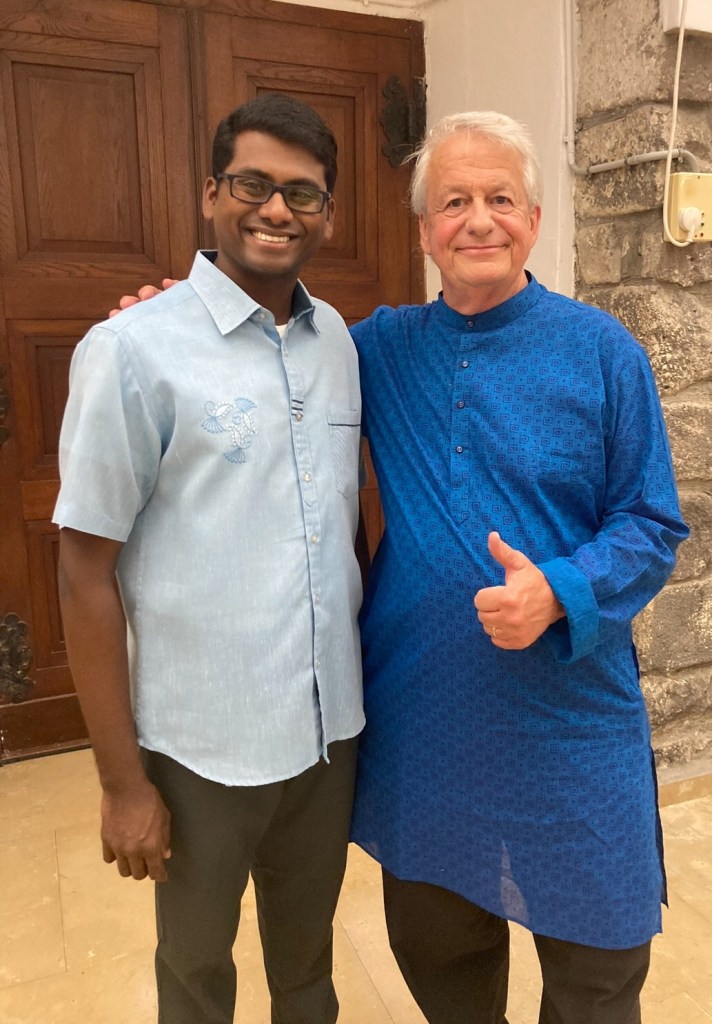
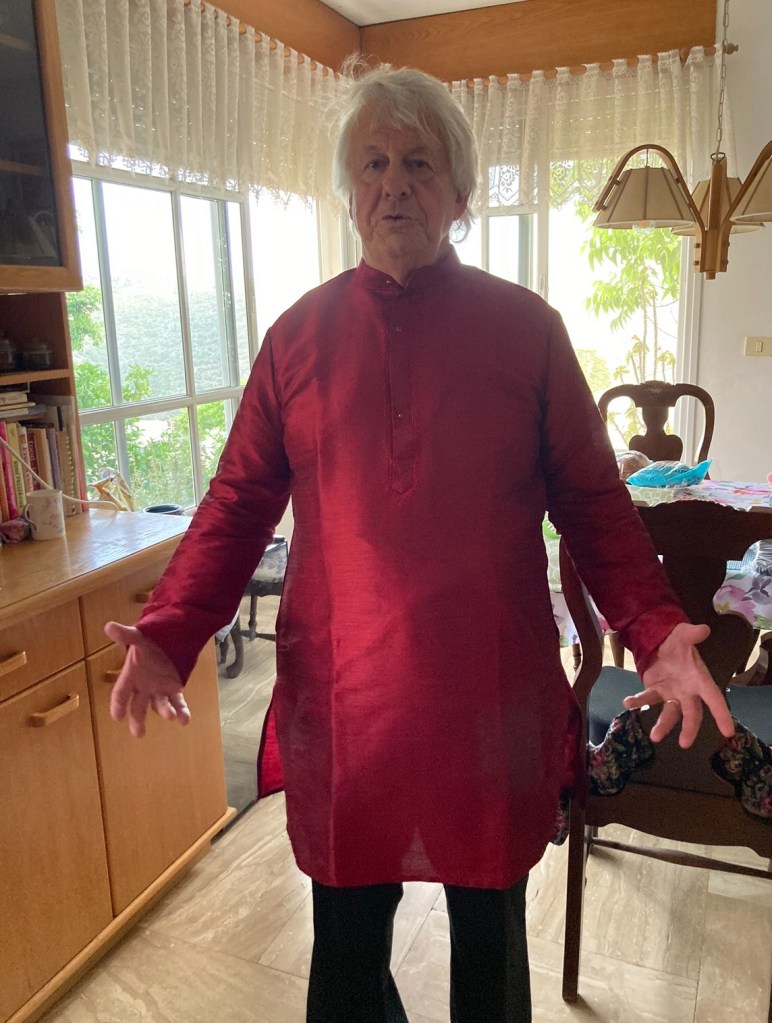
John has a friend, too, Rathin, who was here on his residency/internship. Rathin and Steffi both live in Tamilnadu province in the very southern tip of India. John, who always admired Rathin’s clothes, was gifted two gorgeous silk shirts. And I received the most beautiful sari. In turn, the Indians do lots of shopping for religious and holy objects, dates and dried fruit, techineh and MiddleEastern spices and trinkets to take back home with them.
In India, there is much hatred and persecution between the Hindus and the Christians. We’ve heard some incredible stories of the pogroms that happen to the Christian communities. But here in Israel, something magical happens, and everyone seems to get along splendidly.
In the previous generation, it was not uncommon for women to have five and six children. That is now frowned upon by the Indian government/health authority. Two of the women were forcibly sterilized after the birth of their second child. It’s just the way things are there. And there is so much poverty that they come to Israel and send the money back to their families. Thank goodness for modern technology, that we all share something in common – longing for our families (children and grandchildren) and the ability to reach them frequently by FaceTime and WhatsApp.
I asked the ladies what their favorite thing that they’ve seen or done here was. Resoundingly, the Catholic ladies all chimed in that to be living in the Holy Land and getting to see the many Biblical sites enriched their faith. All thought it excellent that so many people here do yoga and meditation. India is a popular spot for Israeli tourists and for kids to go after their army service. It seems there is quite the lively exchange.
John and I love the diversity here…being able to learn about and share in the different cultures. We have both been invited on a trip to India next year. It’s a huge country, so besides Kerala/ Tamil we hope to go to Bangalore and Mumbai. I don’t know if we can even get to the Taj Mahal, but at least we can experience the country authentically and first hand. I am so hoping this trip will come to fruition. Until then, I shall enjoy a few new “pen-pals.”
A short, but uplifting post as I must now prepare for the Shabbat. May the coming week bring peace and joy to all-
The religious Jewish people count the days between Passover and Shavuot, the Feast of Weeks. It’s a Biblical mandate in Leviticus and Deuteronomy. Seven weeks of seven days of the Children of Israel traveling from Egyptian liberation under Pharaoh until the entire entourage arrived at the foot of Mt. Sinai. There, on Day Fifty, Moses received the Ten Commandments from G-d.
Every evening after sunset the count is called out. A blessing is said. Each day there is a meditation on a virtue like kindness or patience or wisdom. During the time of the counting of the Omer (a measurement of barley), there are no marriages. It is a time of seriousness, like the Christian Lenten season, in a way. No parties. No haircuts. No frivolity.
In Israel, for Shavuot, the more Orthodox visit the Kotel, the Western Wall in Jerusalem. A visit to the tomb of King David is part of the tradition. People stay up all night (Jewish people all over the world) studying Scripture. The reading of the book of Ruth is a custom as it takes place during the barley harvest. And in synagogue, the Ten Commandments are read. Oh, and people gorgeous themselves on dairy products.
Yes. Dairy. For the observant Jews, the Bible or the Torah is compared with dairy or milk which nourishes infants. Also Israel is the Land of Milk and Honey. For the more secular, Shavuot is the beginning of summer. The farm animals have had their baby lambs and kids and calves and the milk is literally flowing. And the harvest has just come in. Barley. Fruits. Vegetables. In Biblical times, Shavuot was a mandatory pilgrimage holiday when all the people were required to bring in their tithes to the Temple in Jerusalem. This is a huge agricultural festival, the First Fruits, or Bikkurim.
I am currently studying Scripture each week through Partners in Torah. Can’t speak highly enough about this organization. My partner, Shari, and I meet weekly by FaceTime. She’s in New York City, and I like her so so much. She challenges me often. And I rose to her Shavuot challenge. I’d always wanted to spend Shavuot at an agricultural kibbutz. It’s one of the most incredible truly Israeli experiences, or so we had heard. So I did something quite presumptuous.
Sunday morning, I called up a friend from Kibbutz Ginosar (Genesseret) on Lake Kinneret (Sea of Galilee) and asked her what she was doing; the kibbutz activities; and swiftly inserted myself into the middle of her family. In other words, I invited myself and John at the very last minute. Complete Chutzpah for this reserved American. “Evelyn, I’ll even bring a huge dairy savory cheesecake with vegetables. Anything.”
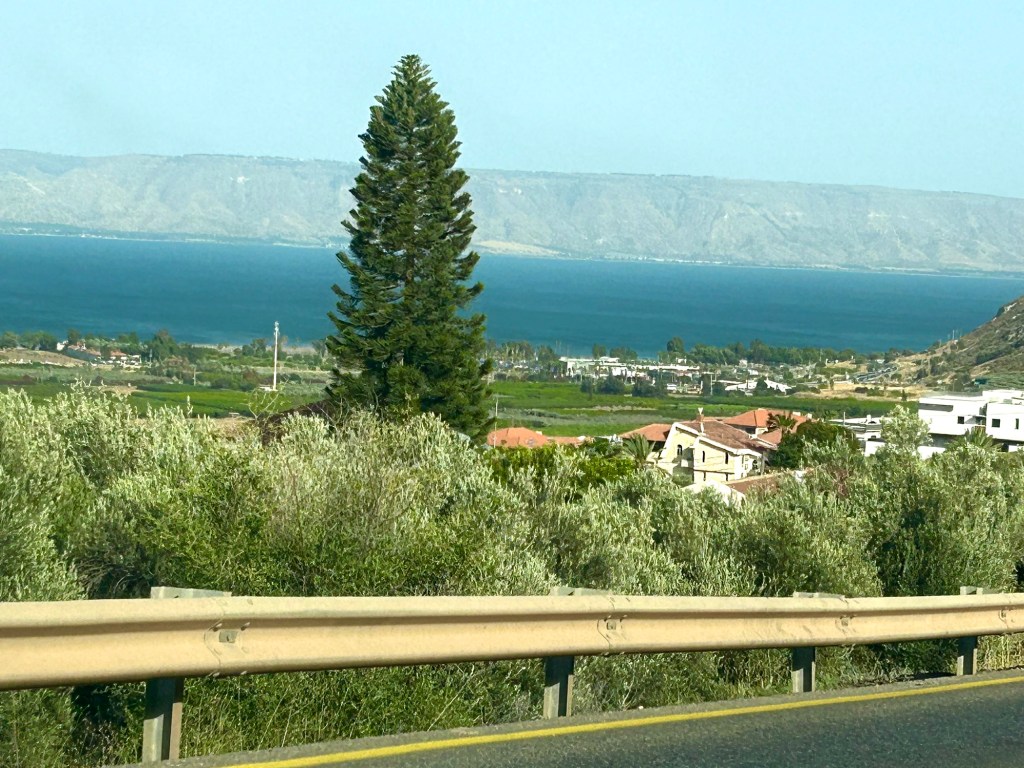
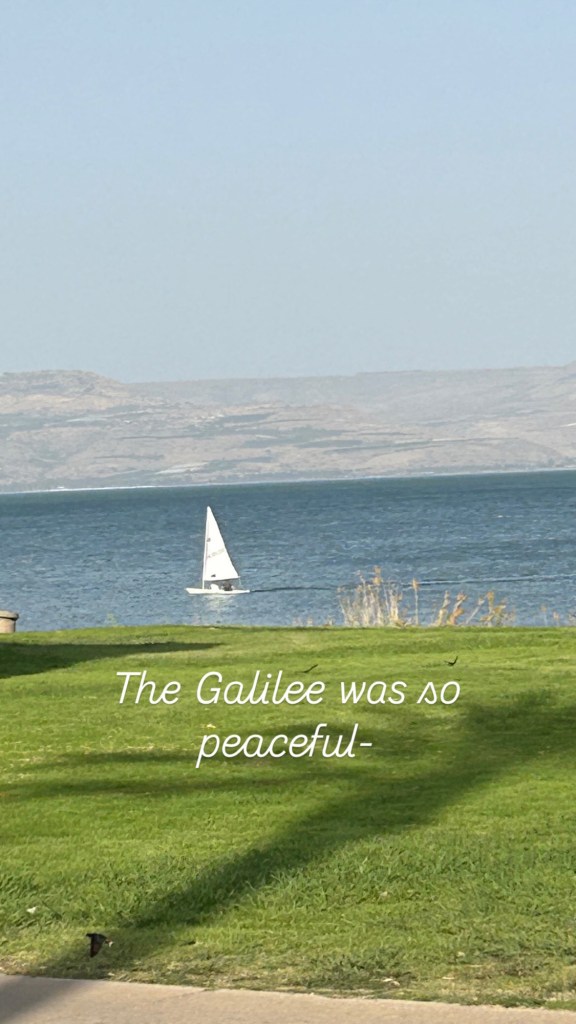
We drove down to the lake Sunday afternoon. It was absolutely gorgeous and very peaceful, as usual. Ginosar is one of the older kibbutzim, celebrating 88 years this year. It’s moderately sized, mostly agricultural, but they also run a large resort hotel on the side. The families are all very close and everyone knows everybody else.
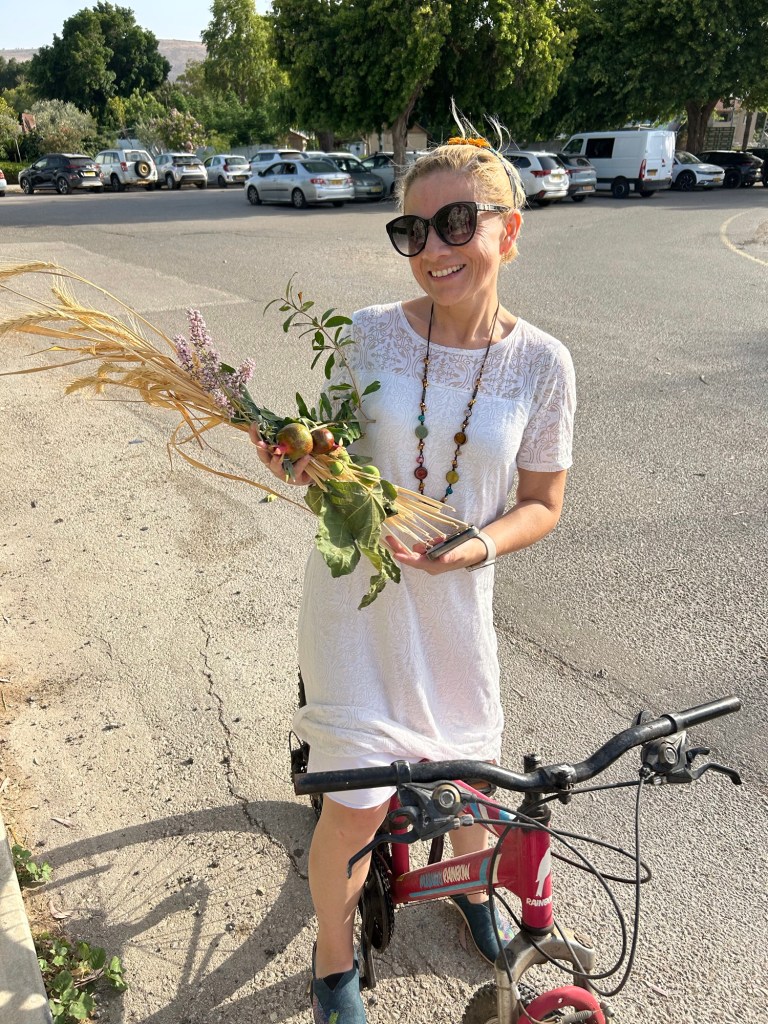
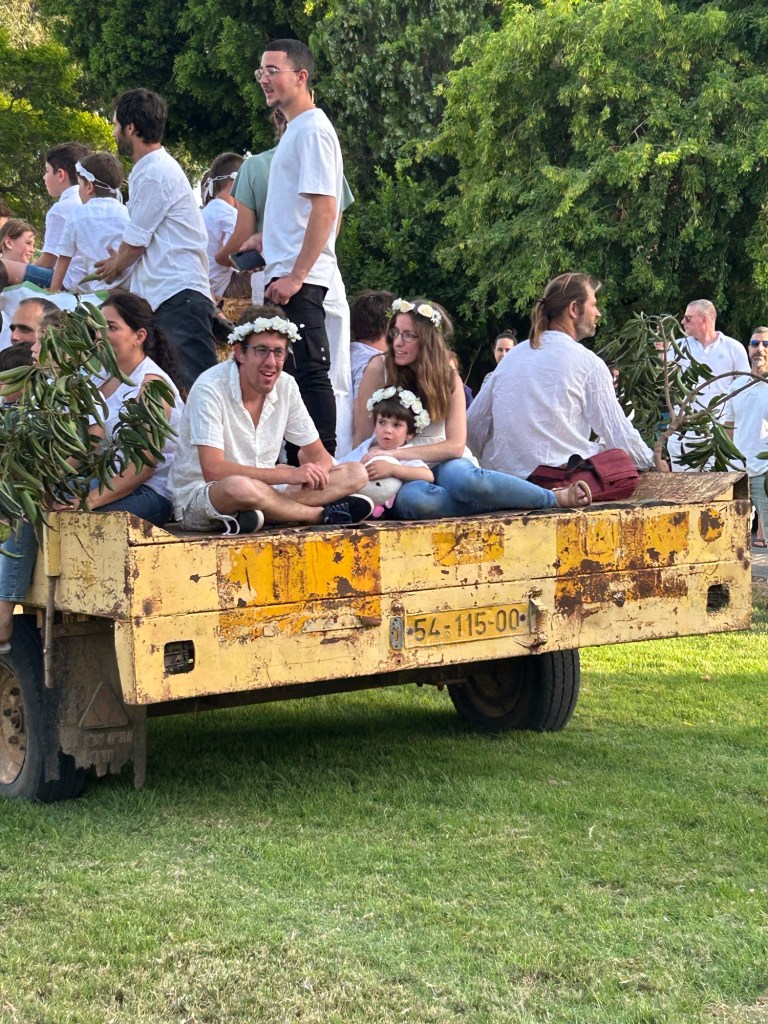
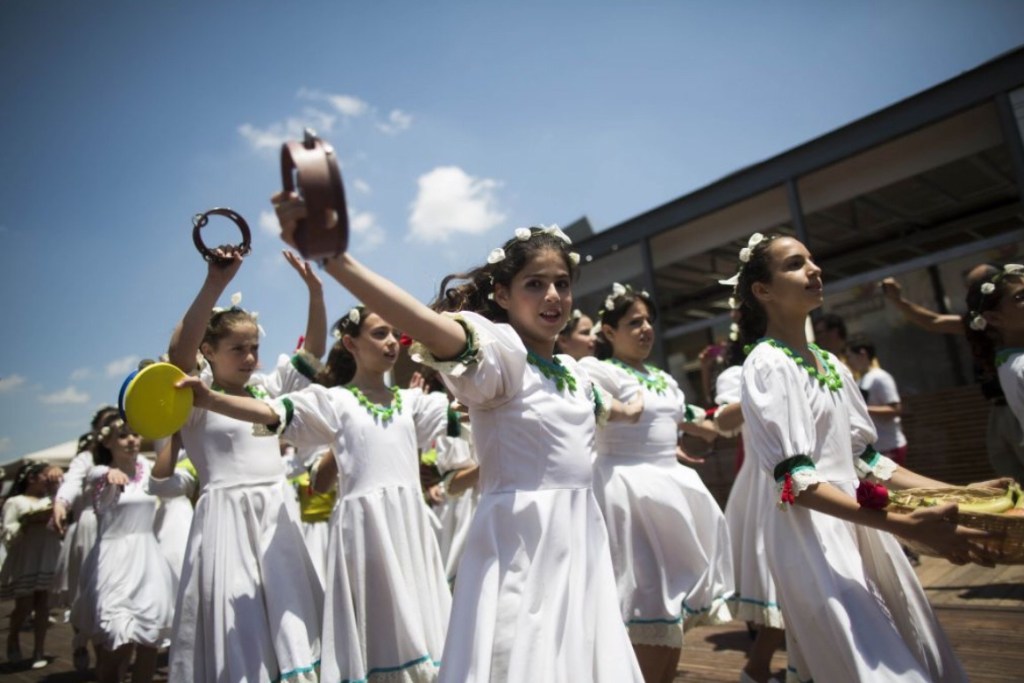
Evelyn greeted us at the entry gate. Her father-in-law knew we were coming and made me this gorgeous harvest bouquet of barley and wheat stalks, figs, pomegranates and lavender- all grown on the kibbutz. It was the most welcoming introduction. As is traditional, everyone wears white, and as it is a harvest festival, it is customary for people – young, old, male, female – to wear a lovely floral wreath on their head.
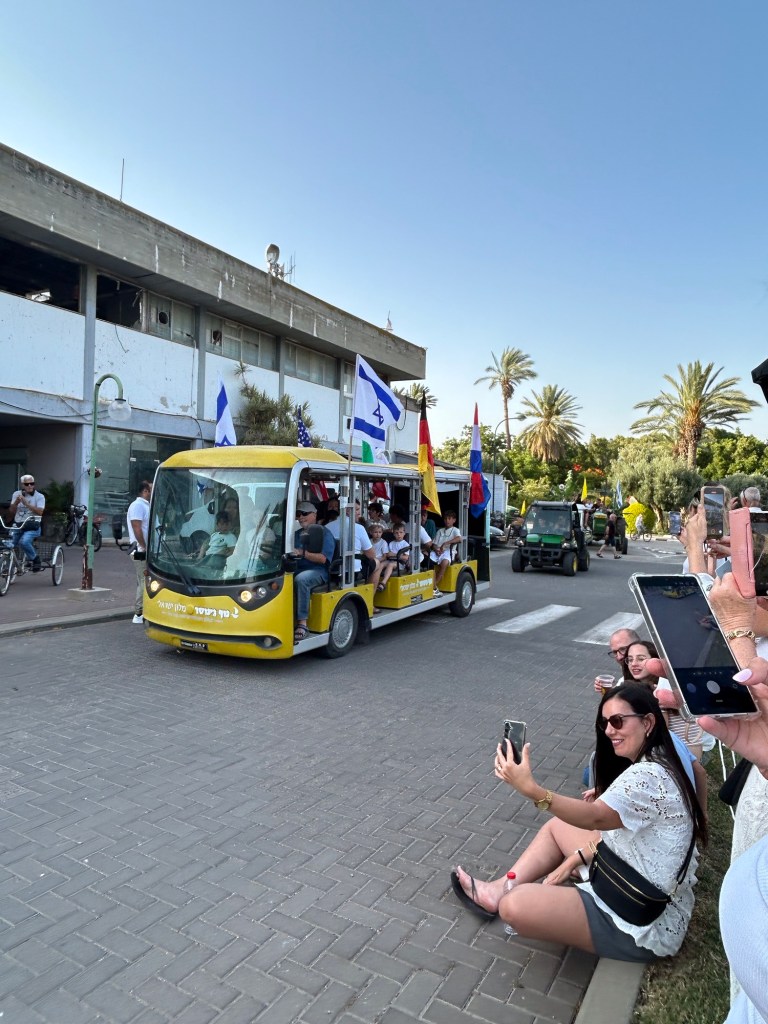
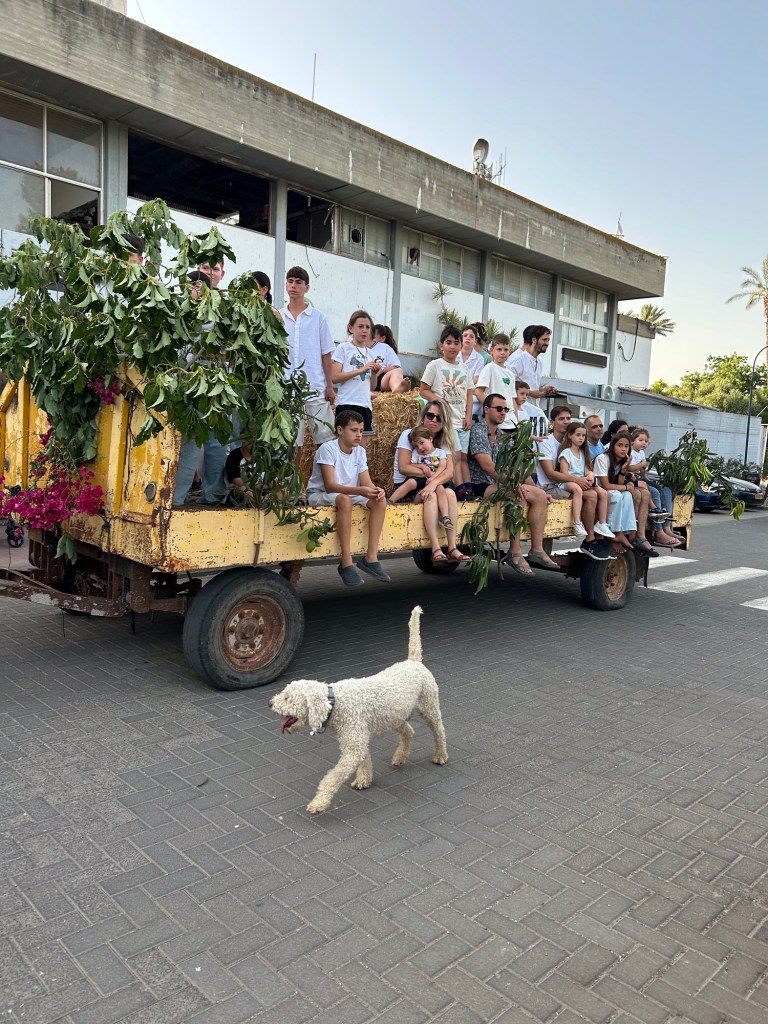
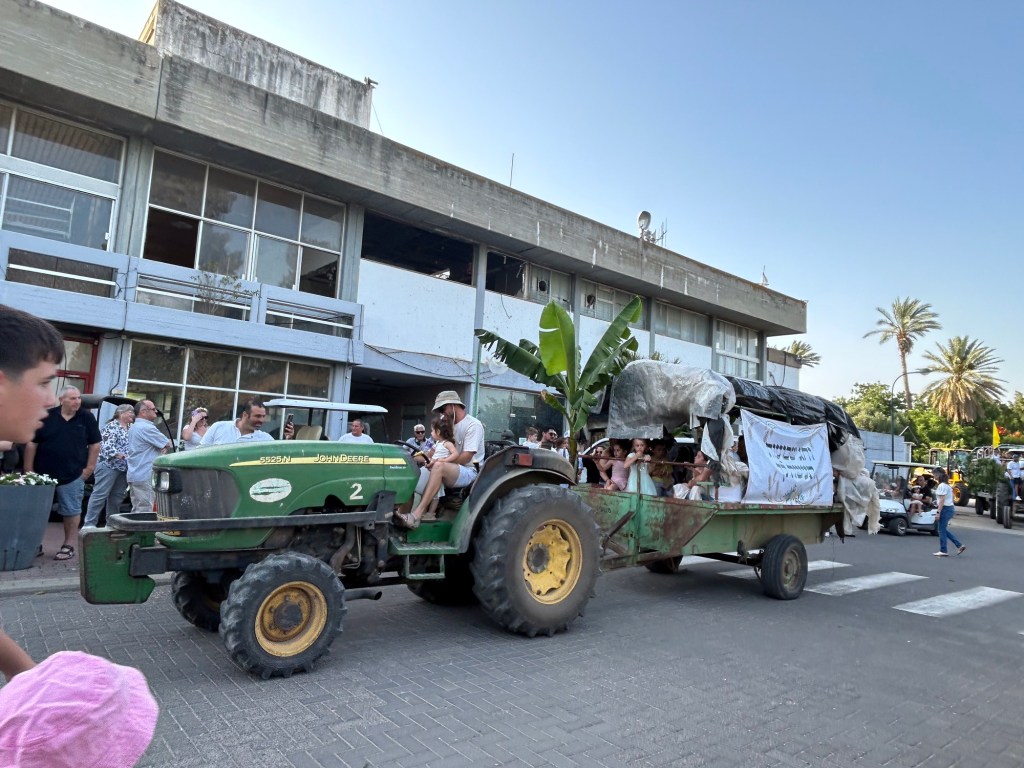
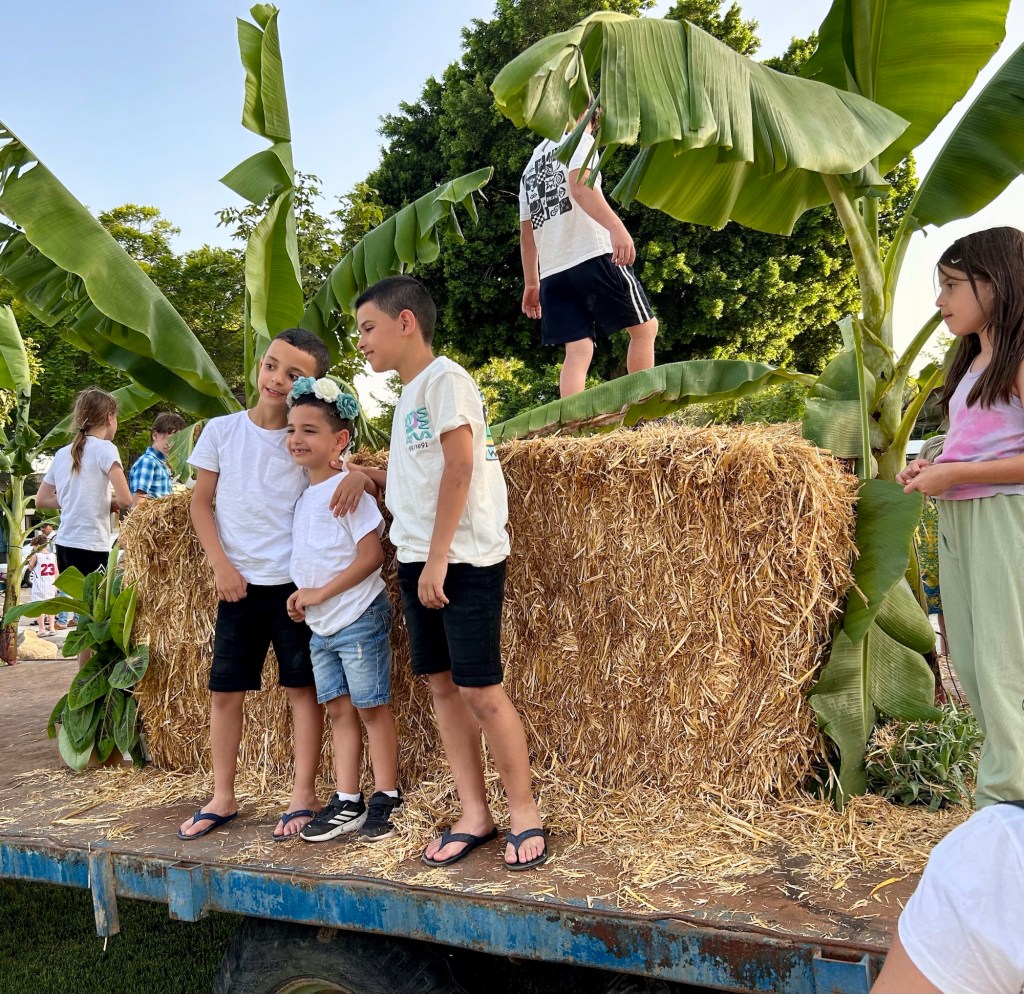
We arrived shortly before the festivities. Many of the kibbutz folk, mostly the older people, gathered on the main square to watch the tractor parade. Tractors pulling carts filled with hay bales and families.
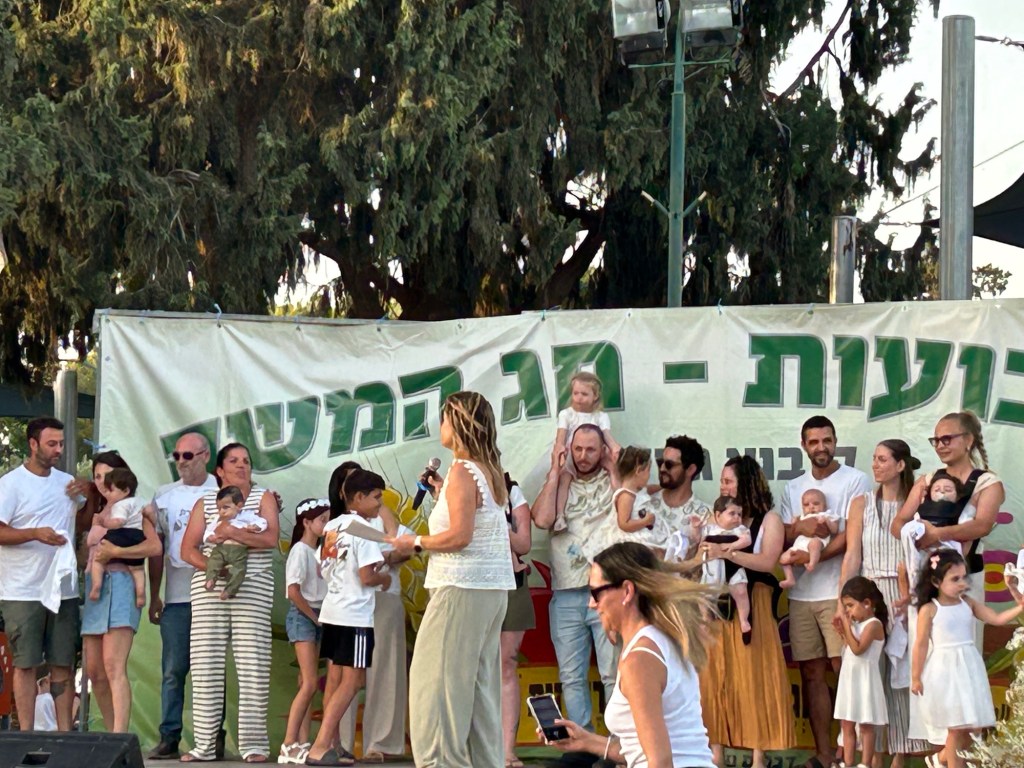
And the celebration began, first with the presentation of all the babies that were born on the kibbutz in the past year, 38 in all, a new record! So cute to see all the families. It is such a healthy thing to see a vibrant, happy, growing population. This was followed by a dance put on by some of the moms with babies on their front packs (or twins on front and back). It was adorable. The song, in Hebrew, was about how the mom can get no more sleep as the baby keeps her up all night and all day.
Notice the mom in the green shorts with twins!
The little children of three age groups all put on song and dance routines and little skits. The all the three year old boys were brought up for their first haircuts. It’s a very big, and very fun, deal here. There was a lot of remembrance of the war, those lost in battle, friends still in captivity. It was an incredibly hard year for all the kibbutzim. Many of the men between 18-50 have been doing military service. Pensioners took up the slack and planted and harvested all the crops.
Kibbutz Ginosar is a tremendously large and productive agricultural kibbutz. They own hundreds of acres along the Kinneret. The number of dunams (acreage) of each crop, and tonnage brought in was read aloud. I was stunned. Mangoes, bananas, pomegranates, wheat, barley, dates, apricots, peaches, avocados, almonds. Phenomenal.
I was even more surprised to see the teen involvement. They worked as ushers, MCs, and organizers. And several groups of teens put on choral and folk dance numbers. Did I mention wholesome yet???? This was followed by folk dancing, first by the women, the couples and finally, the plastic chairs were taken away and the entire field turned into one big folk dance fest as the sun began to set.
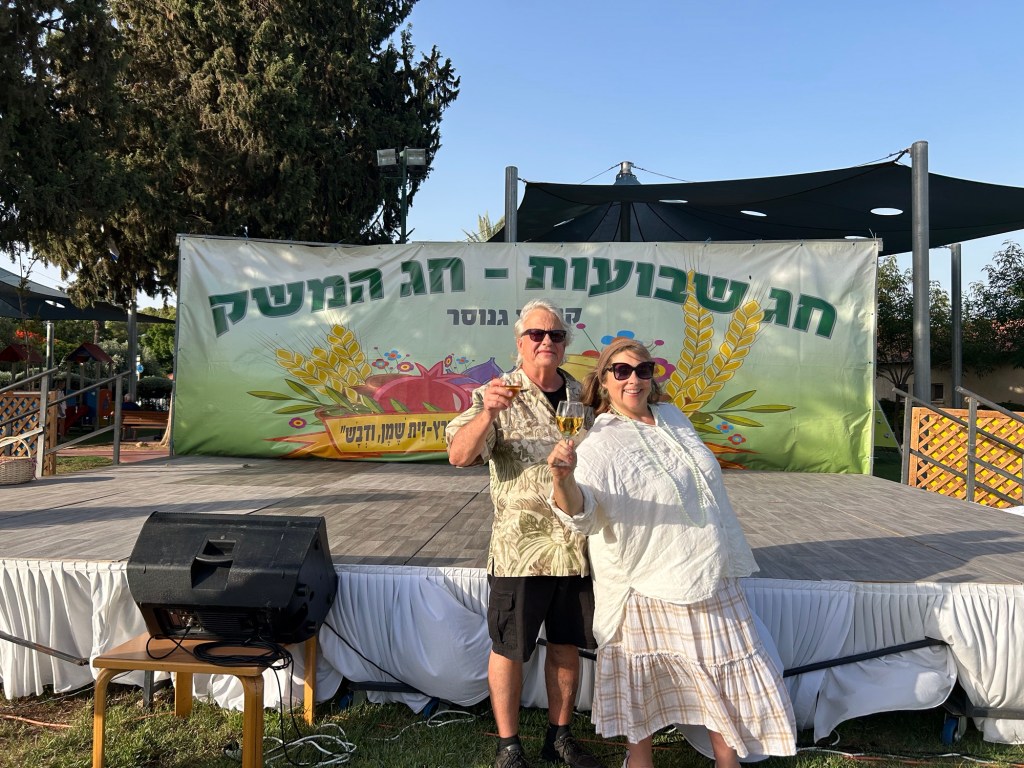
Rows and rows of tables and chairs had been set out for the communal kibbutz Shavuot dinner. Candles lit. Blessings set. There was a booth for Israeli wine and tables groaning under the weight of food. Quiches, salads of all kinds, vegetable dishes beyond belief. Hummus and techineh, and every kind of cheese and dairy one could imagine. It was super abundant and glorious! Folk dancing lasted until late in the evening. And there were small groups of instrumentalists. The wine flowed freely.
Evelyn, originally from Argentina, met her husband when he traveled to South America after his army service. She followed him back to Israel where they married. Yoav’s grandparents were some of the original residents of Ginosar, and her father-in-law was the one to find the famed sunken “Jesus boat,” a 2000 year old fishing boat. Evelyn is an ElAl flight attendant and Yoav is a farmer. They’ve lived at Ginosar for 19 years.
I tell you all this because Evelyn and her family took us in like we were one of the family. After living ‘in the city’ for ten years, I’d totally forgotten and missed that amazing aspect of Israeli life. Everyone is “mishpocha.” We met the brothers, the in-laws, the kids, and cousins. Young couples had driven up from Tel Aviv and central Israel to be with their family. And somehow there was room for all.
It was not extremely religious. In the morning some of the older folk went to the community synagogue. Children, with bathing suits on since 8am were eager to swim in the Kinneret. Others went sailing and jet skiing. The morning breakfast on the kibbutz dining room offered myriad dairy from cheese-filled bourekas and blintzes to fish. Fish is very typical for breakfast in Israel. There were fruit salads and vegetable salads over the top and freshly baked breads, homemade jams and freshly squeezed juices.
I must say, last year e spent Shavuot praying in Jerusalem. Most years, we spent at home very low key. Not particularly Israeli. This year, the Zionistic and patriotic spirit, albeit a bit subdued from what I was told (due to the fact we are still at war), was one of the most incredible experiences John and I have had here. Thank you, Evelyn!!! We had a blast!
If anyone were to tell me there was a holiday featuring cheesecake- and all dairy products, I’d swiftly sign up. Well, the Jewish holiday of Shavuot is not QUITE that, but it makes for a great excuse to go off one’s diet for a day.
Shavuot was the fairly forgotten Jewish holiday in the States, for the most part. It came right at the end of the school year with exams and graduations; summer vacations were just beginning; there was Memorial Day weekend; Mothers’ and Fathers’ Days; weddings and birthdays… and Shavuot for us was very minor indeed. My mother served blintzes and cheesecake, but that was about it for us.
Not so in Israel. For one thing, it is one of the three major pilgrimage holidays in the Torah (the first five books of Scripture). Everyone was commanded to go up to Jerusalem to the Temple where they would bring their offerings. It was a celebration of the first fruits or bikkurim. Today in Israel it is a complete holiday, day of rest, national day where all public transportation, government offices, clinics, schools, stores are closed. It is a true holiday.
After counting 49 days from Passover, the 50th day (the root of the Christian Pentecost) marked the anniversary of the giving of the 10 Commandments on Mt. Sinai. The Children of Israel had been liberated from slavery under Pharoah in Egypt and had just begun their desert wanderings. On Day 50, they had purified themselves and were gathered at the foot of Mt. Sinai. The entire mountain started quaking. There was thunder and lightning and wind and the people could hear the blast of heavenly shofar (trumpets). Fire came down out of the clouds, and in that dramatic movie cut, the finger of G-d wrote the commandments on two tablets for Moses to give the people. They were set to receive the Law.
O.K. All that is great but cheesecake???? In some of the more poetic passages of Scripture, the words of Torah (and the Bible) are often compared to milk. As food for growing infants, Words of Scripture nourish our souls. Also, Israel, the Promised Land, is known as the Land of Milk and Honey. Some Jewish people say we eat dairy because it was before the kosher laws came into existence and dairy is acceptable (this doesn’t really make sense to me, but whatever-). In any case, it’s a dairy fest.
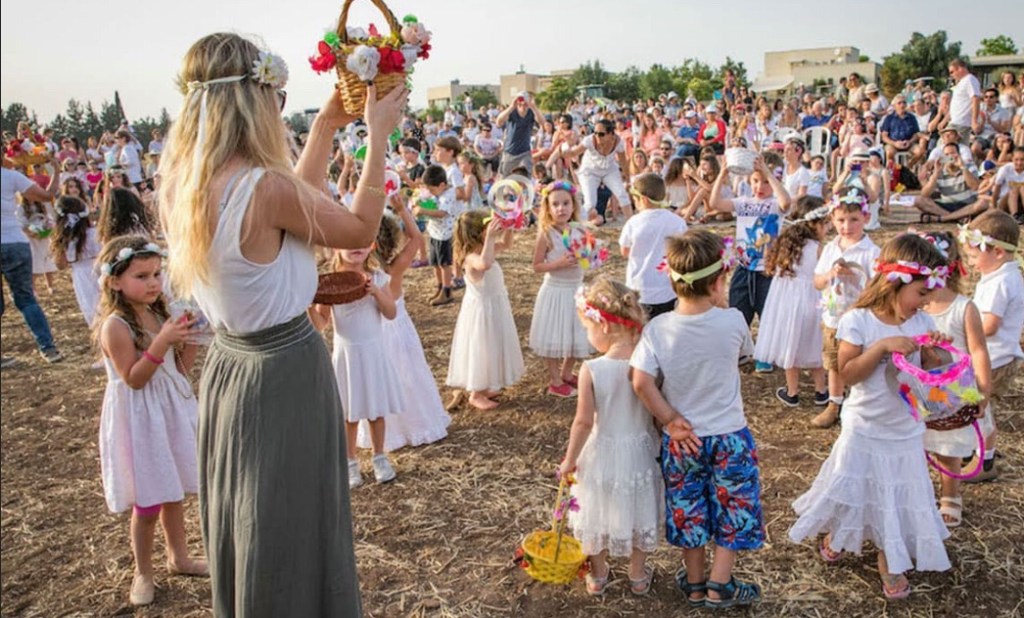
Also, Shavuot marks the first great summer produce and barley harvest. In the agricultural kibbutzim, the day is marked not only with the reading of the 10 Commandments, but with agricultural parades and county-fair like vibes. The produce is abundant. Big, beautiful and a wide variety of fruits and vegetables and grains are coming into market. Another family day, people dress in white and many wear floral wreaths on their heads. There is much singing and dancing and it is a time where the little three year old boys get their haircuts for the first time (upsherin). The schoolchildren put on skits and songs for their families. And there are communal picnics everywhere.
Shavuot festivities on the kibbutz
This year, I will start off the annual Shavuot (Feast of Weeks) recipe blogpost with a couple of my own. The first is a super easy, light and healthy Roasted Beet Salad. You can use crumples of feta or blue cheese for that creamy, slightly pungent burst of flavor. I use yellow and white beets (from my garden) as they have a marvelously sweet and nutty flavor, especially after roasting.
RoastedBeet Salad
Serves 4. Halavi/Dairy/Milkhig
Ingredients:
4 -6 medium yellow or white beets (can use red also), peeled and topped
2 TBSP olive oil
Sea salt and fresh cracked pepper
1/3 cup crumbled feta or blue cheese
1/4 cup candied pecans
1/4 cup pickled onions (recipe follows)
1/4 cup Brianna’s Blush Wine Vinaigrette (I bring back from US, but available from iHerb)
Preheat oven to 400*F/200*C. Cut peeled beets into quarters or bite sized wedges. Coat in oil. Sprinkle with salt and pepper (I add a sprig of rosemary and a sprig of sage). Wrap tightly in aluminum foil and roast for about 40 minutes or until tender. Remove from oven and let cool. When room temperature, place beets in serving dish and top with remaining ingredients. Serve cold as a side dish.
Pickled Onions
Easy to make. I always have these on hand to add to salads and sandwiches.
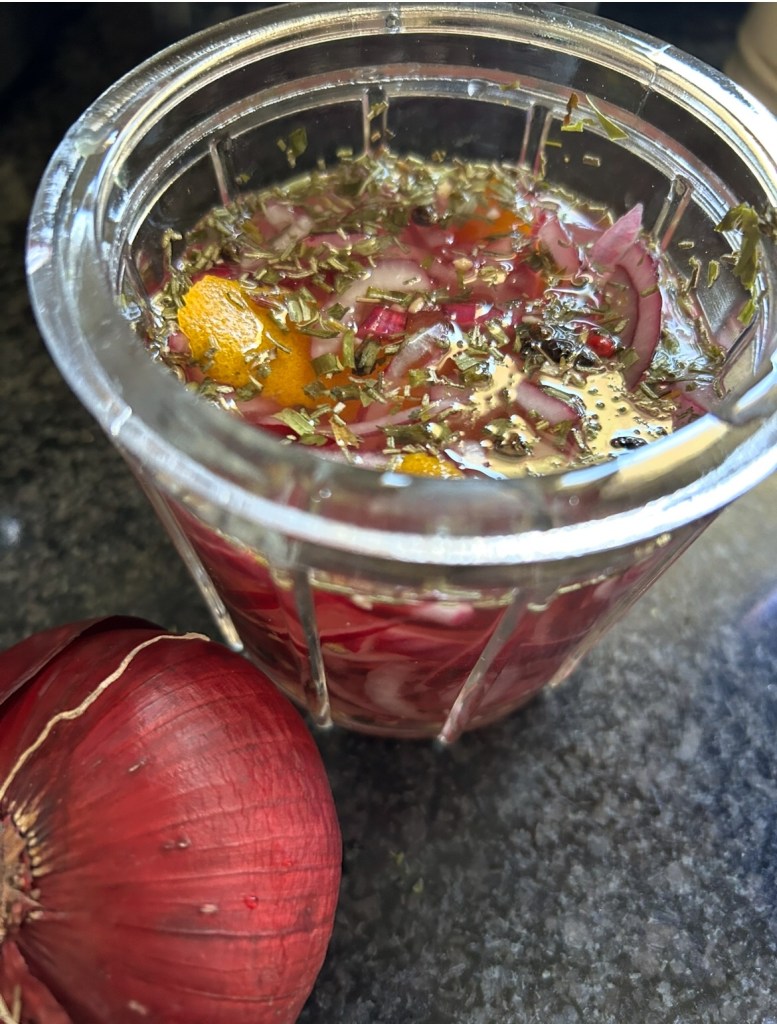
In a small covered jar, slice a red/purple onion quite thinly. Cover with white wine vinegar. Add either dry herbs or pickling spice (1 tsp). I prefer the pickling spice- Can also add a slice of orange or lemon rind to boost the flavor.
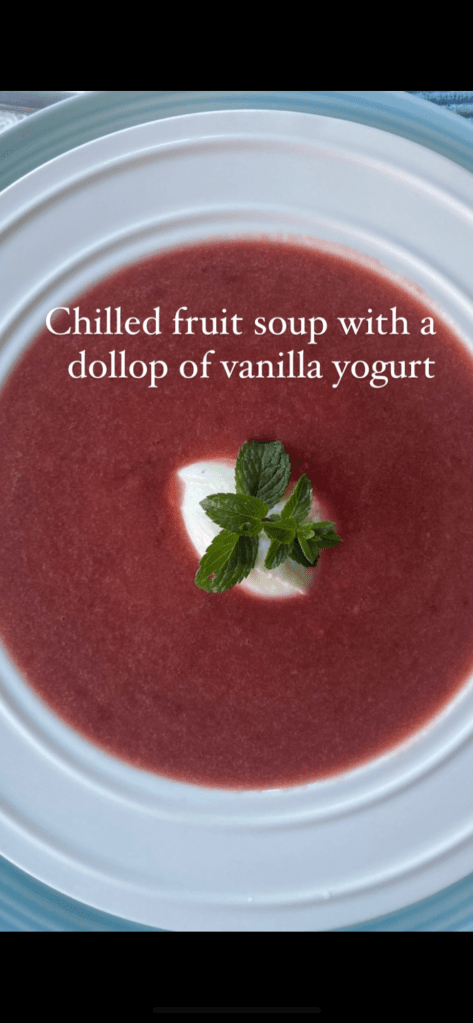
Because all of the stone fruits are just coming into season and the weather is getting warmer, I usually make a big pot of fruit soup which I chill and serve ice cold as an appetizer, especially for Shavuot and Shabbat. It’s refreshing, popping with sweet flavor and loaded with antioxidants.
Chilled Fruit Soup with Vanilla Yogurt
Serves 6-8. Vegan/vegetarian/parve or dairy
Ingredients:
1 cup fresh blueberries
1 cup fresh cherries, pitted
4 red plums, pitted and halved
4 peaches, pitted and quartered
1 cup fresh raspberries
1 1/2 cups freshly squeezed orange juice
1/2 cup (coconut)sugar, maple syrup, honey or agave syrup
1/2 cup fresh mint leaves.
3 cups water.
Optional 1/2 cup sparkling white wine
1 TBSP orange peel
Combine the orange juice, water and sweetener in a medium sized pot. Bring to a boil. Reduce heat and add the fruits. Let cook for 20 minutes on medium flame, but do not boil. When fruits have softened, taste and adjust for sweetness. You can add more sweetener if you like. Remove from heat and let cool, about 15 minutes. Add in the mint leaves. Using an immersion blender, purée the fruit mixture until it is all blended together and velvety smooth. Refrigerate for at least 2 hours. Serve cold with a large dollop of vanilla yogurt to mix in at table. Garnish with mint leaves and orange peel. I add about 1/2 cup sparkling sweet white wine just to juj it up even more. After all, it’s a celebration!
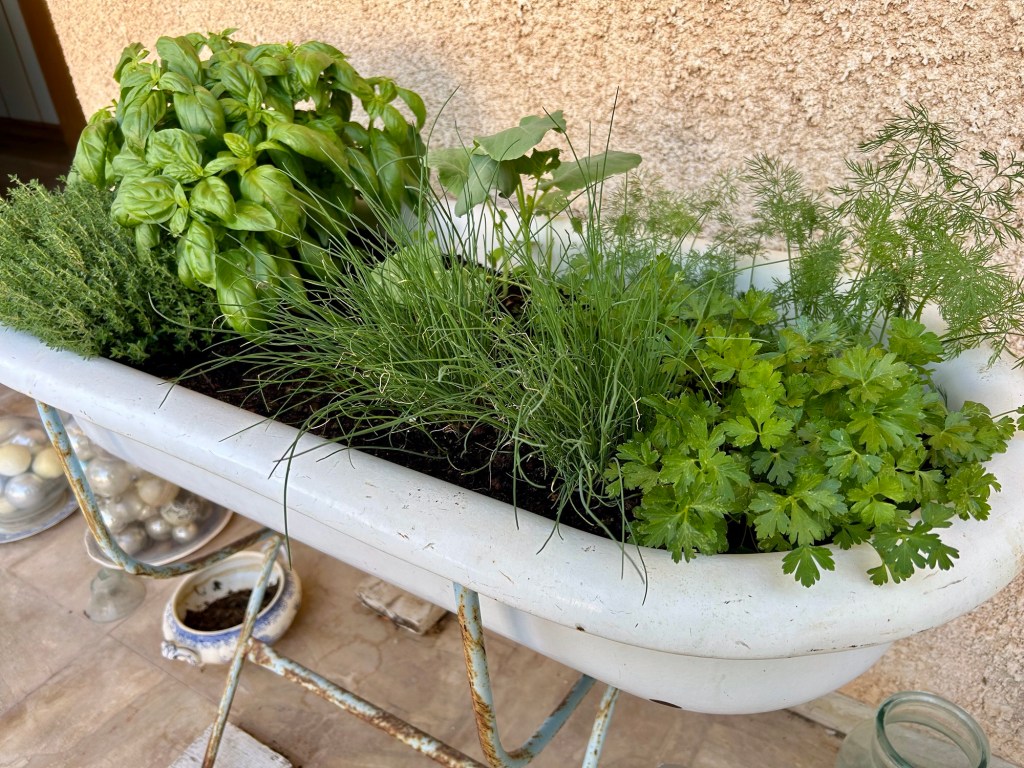
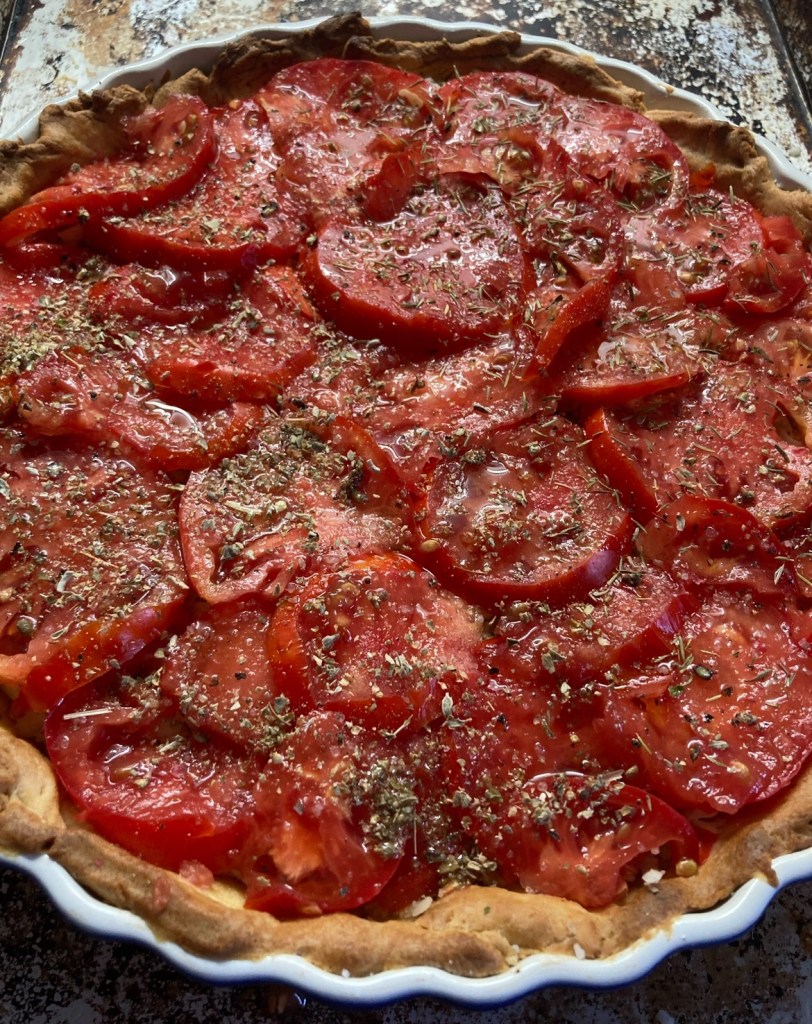
My rooftop garden is beginning to produce now. Large quantities of squash, Swiss chard, radishes, carrots, green beans and heirloom tomatoes. This year I’m growing 4 varieties of cherry tomatoes and 5 different heirloom tomatoes. The herbs in my baby bathtub are going bonkers. I’m ready to cook!
🍅 Tomato Ricotta Pie 🍅
Serves 4-8. Dairy/Vegetarian
Ingredients:
3-4 large beefsteak type meaty tomatoes
1 pre-made pie crust dough sheet
Olive oil
500 grams (2 cups ricotta cheese)
1 cup grated fresh Parmesan cheese
1 egg
4 large cloves garlic
2 TBSP dried oregano
Sea salt and freshly cracked pepper
2 TBSP balsamic vinegar
1/2 cup fresh basil leaves
Preheat oven to 350*F/170*C. Spray a large quiche dish with olive oil. Fit the pie crust sheet inside, press down, trim edges. prick the shell with fork tines. Place some dried beans inside as a weight. Bake until golden brown, about 12-15 minutes. Remove from oven and set aside to cool. In a medium bowl, combine cheeses, egg, salt, pepper, crushed garlic cloves, balsamic vinegar and dried oregano. Mix well. Add to cooled pie crust. Top the cheese layer with fresh basil leaves. Slice the tomatoes about 1/2 inch thick. Cover the cheese/basil layer with tomato slices in concentric circles. Sprinkle with dried oregano, salt and pepper. Bake in oven about 20-25 minutes until cheese is bubbly and tomatoes are juicy/soft. Remove from oven and let set for about 30 minutes. Can be served hot or cold.
The next recipe is a type of Israeli “cheesecake” which is way different than the typical American version. It’s from the family of Shlomo Mantzur. Shlomo in the late 1940s, was a survivor of the Iraqi equivalent of the Holocaust, the Farhud. He made his way to Israel. As a young man, he helped found Kibbutz Kissufim on the Gaza border. He was known by all on the kibbutz as grandpa and planned social activities for the community. As the kibbutz carpenter, he taught shop at the local elementary school. They say the smile never left his face. Children loved him and his open arms invited everyone right into his heart. He always had a pocketful of pistachios or halva to spoil the children with. Always there to lend a hand with his hammer or screwdriver, Shlomo was ready to fix anything. He loved watching the old American Western cowboy movies.
At 86, Shlomo was the oldest hostage taken by Hamas into Gaza. He was brutally killed and his body was held by the terrorist group for 509 days before being returned to Israel. His wife Mazal used to make this delicious old school crumb cheesecake. It was his favorite dessert-
Shlomo Mantzur’s Favorite Crumb Cheesecake
Ingredients for the dough:
7 oz (200 grams) soft butter. 1 cup
4.25 oz (120 grams) sugar – little over 1/2 cup
2 medium eggs
1/2 tsp ground cardamom
Grated peel of 1/2 lemon
1.75 oz (50 grams) ground almonds – 1/4 cup
For the cream:
500 grams (2 cups) sweet cream
1 package (80 grams) instant vanilla pudding
120 grams (little over 1/2 cup) sugar
500 grams ( 2 cups) sour cream
Grated peel of 1/2 lemon
Instructions:
Preheat the oven to 350*/170* on convection/turbo. In the medium bowl or stand mixer with paddle attachment, cream the butter and sugar. Add the egg and beat until integrated. Add the rest of the ingredients and mix until a uniform dough. Be careful not to overmix.
Spread a third of the dough on a small parchment paper lined sheet pan. Spread the remaining two-thirds uniformly and evenly in a parchment paper lined springform cake pan. Bake the sheet pan and cake pan for about 20 minutes until golden and fragrant. Remove from oven and cool completely.
In another bowl whip the sweet cream with the sugar and instant pudding mix until almost firm. Fold in the sour cream, cardamom and lemon zest until completely combined. Pour evenly over the baked cheesecake. Crumble the third that you baked separately. Sprinkle it over the cream and put in fridge for four hours or overnight. At hour before serving, out in the freezer. This makes the cheesecake easier to slice and hold together.
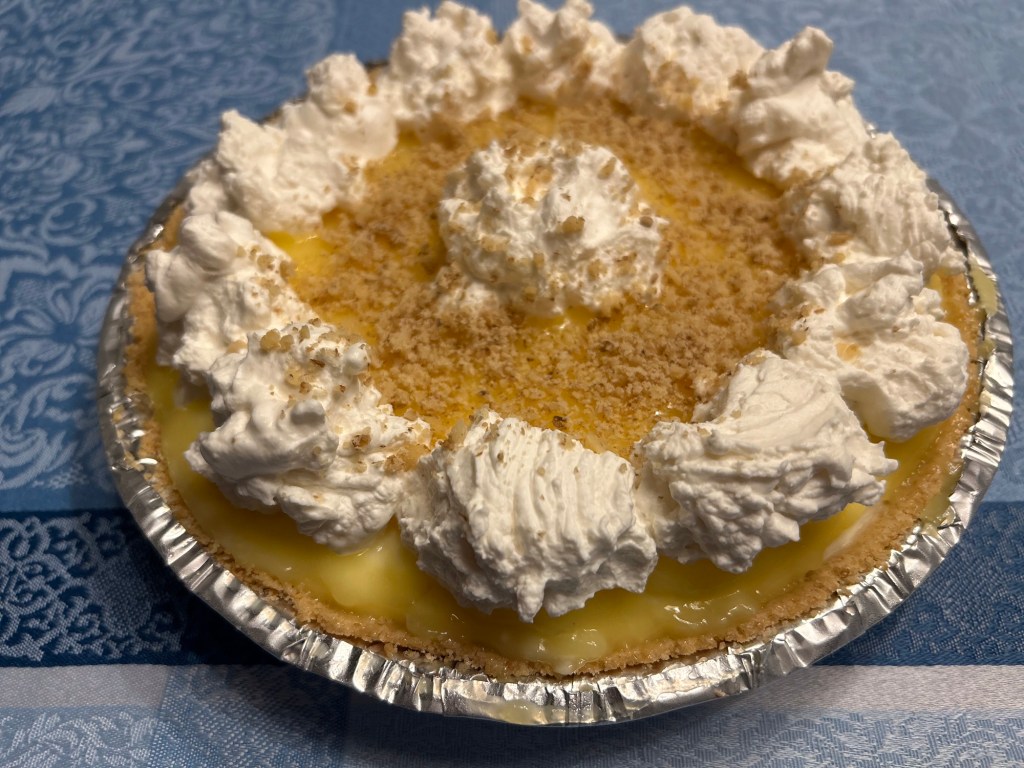
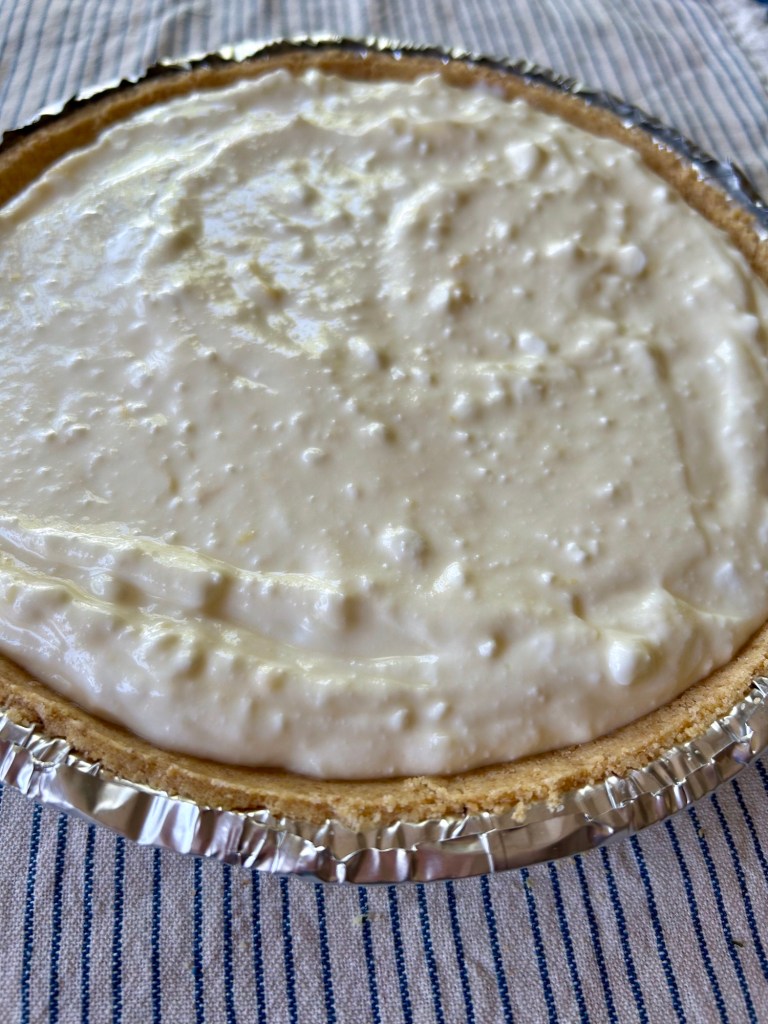
The next dessert is one that John loves. I don’t make it terribly often, but it’s great for Shavuot. He likes to mix lemon curd in with his cottage cheese in the morning which gave me great inspiration for this simple pie.
🍋 Lemony Cheesecake Pie 🍋
Ingredients:
1 pre-made graham cracker pie crust
2 cups cottage cheese
1 cup sour cream
2 cups lemon curd
1 cup whipping cream
1/2 cup toasted almonds, sliced
In a large bowl, gently fold together the cottage cheese, and lemon curd. Pour into pie crust. Leave about 1/4 inch at top. Smooth out. Place in freezer 1-2 hours.
Remove from freezer. Spread a thin layer of remaining lemon curd over top. In a medium bowl, whip the sweet cream until stiff peaks form. Spread over pie or spoon in dollops around edge. Scatter toasted almond pieces over the top before serving. Keep in fridge until ready to serve. Can refreeze for about a half hour prior to slicing for ease in cutting and removing to plates.
Environmental Terrorism: one or more unlawful or even hostile actions that harm or destroyenvironmental resources or deprive others of their use. It is different to [sic] environmental vandalism, which is a rather permitted but ethically disputed destruction of environment. – Wikipedia
Yesterday started out quietly enough with our morning coffee on the balcony. We had planned a subdued day with a short visit to the local cemetery to pay our respects at the graves of the fallen soldiers and victims of terror from our city. The national siren blared at exactly 11:00, just about the time the wind picked up.
With wind gusts reaching up to 80mph, and the temperatures climbing into the mid 90*F, combined with a very dry winter, the setting was perfect for acts of resistance against the occupation. You see, it was the beginning of Nakba Day, the day the Arabic speaking countries surrounding Israel lost the war they started in 1948. The Palestinian people were still mad. Bent on revenge combined with the desire to do as much damage as they could do the land. To disrupt. To frighten the “settlers” away. To kill Israelis, aka Jews.
By noon, the air was already dusty and sandy from the wind. Then the smoke started to pour in over the hills. I checked the news. A major breaking national crisis was unfolding as the hills around Jerusalem were engulfed in flames. Civilians, caught in the main highway between Jerusalem and Tel Aviv, were fleeing their vehicles on foot. Emergency crew from Hatzalah were going from to car to char to make sure everyone had evacuated.
Our friends, were visiting a soldier’s grave in BeitShemesh, the center of it all. I texted her and she sent a frightening photo-
It would take them over four hours to get through the traffic. My friend, Elli, in Modi’in was waiting for the call for her family to be evacuated. And the news started pouring in.
All public events for that evening and the next day, Israeli Independence Day, were cancelled. There are to be absolutely no barbecues, grilling or open fires throughout the country, Backup firefighters from Cypress, Greece, Croatia and Italy were coming in to help spray fire retardant.
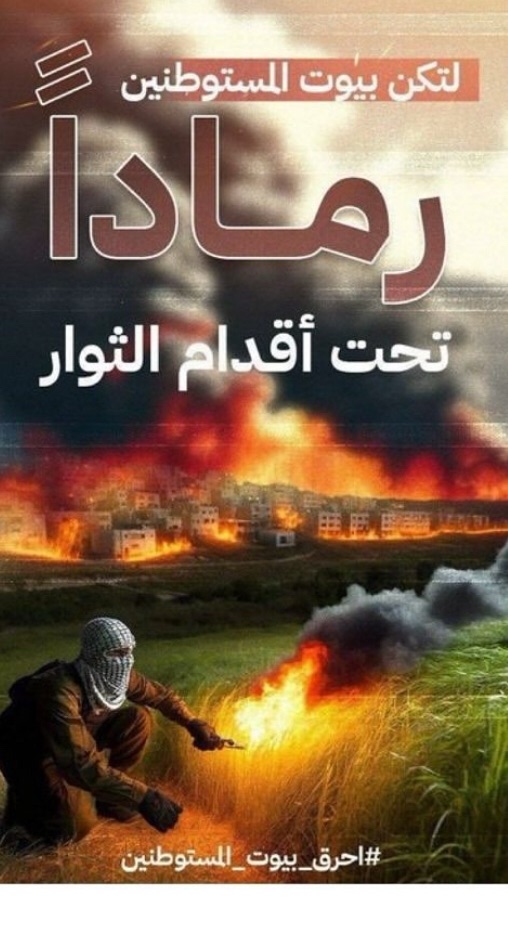
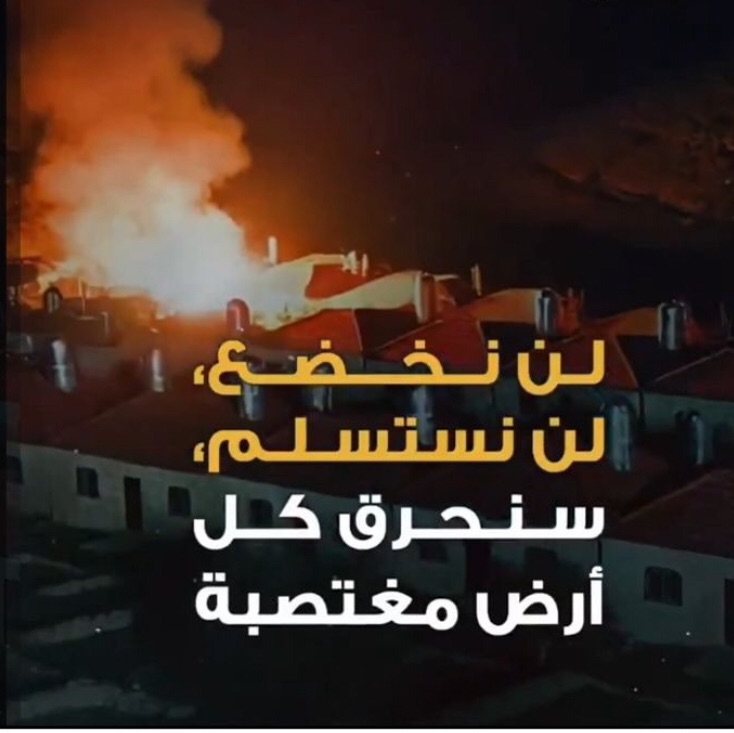
All across Arab channels, messages were going out for all people to go out and start more fires. They weren’t even bothering to hide it. Facebook, WhatsApp, Instagram, TikTok, Telegram. No shame. No cowardice. Here it is- and the Palestinians were celebrating it.
“Let the settlers homes be turned to ashes”Set fire to the forests and settlements”“Break the chains of the settlements with fire.”“we will not submit. We will not surrender. We will burn every usurped land.”“Let them know that every day is struggle and resistance.”Translated by breaking news from the Arabic
While we were trying to mourn our fallen heroes, they were setting our forests on fire. All over the country. As of my writing this, there have been 18 arrests. The massive wildfires spread by the strong wind through central Israel. Volunteers were asked to help go out and patrol their own areas for any suspected arsonists. It’s a national crisis, and to tell the truth, it might be a preview of what’s to come over a long, hot, dry summer.
The air quality index has listed the whole country as under a danger warning. People are instructed to stay indoors. The torch bearing ceremony, which included people who helped strengthen, defend and unite our country, has been canceled. There will be a televised previous rehearsal shown instead. More news comes in showing a map of all the fires burning.
I don’t know what the 2 orange men running means, but the rest is self-explanatory
I didn’t come up with this comparison, but it fits the narrative perfectly. Recall the story of wise King Solomon and the two mothers. The women were sharing the same bed with their two infants. In the morning one baby was dead. Each accused the other of murdering the infant and claimed the surviving baby was their own. What to do? King Solomon said to cut the baby in half, each mother taking half the child. The real mother relinquished and gave up her own baby to the accuser rather than seeing her precious child harmed/killed. These monsters (and yes, I am labeling them evil monsters) claim rightful ownership of the Land. What kind of person would destroy their own territory to spite the other?
In other news, yesterday in Renaana, a Reform synagogue held a public memorial service for both Israelis and Gazans/ Palestinians. Israelis were furious and protestors showed up. They tried to shut the service down, things grew ugly, the police were called in and people were injured. Israelis don’t take kindly to comparing our soldiers to Hamas terrorists. Meanwhile, also in Renaana, streets were renamed for the local fallen soldiers.
In southern Israel the high winds caused a massive, blinding sandstorm. Visibility was zero in the desert to Eilat. And at 11:13pm there was an emergency warning. A terrorist infiltrated the village of Giv’at Binyamin in Samaria. Everyone was ordered to enter a building and immediately lock all doors and shutter all windows. Go to a safe room or protected space. Sit on the floor below all window lines until further notice. The three terror suspects armed with knives and grenades were found, and after a gunfight with the IDF, neutralized and arrested.
Yesterday’s blogpost was entitled Beauty for Ashes. Today it’s mostly ashes. I’ll be happy to see the Beauty when it shows up.
…a year of comfort to all who mourn in Zion…to give unto them beauty for ashes, the oil of joy for mourning, the garment of praise for the spirit of heaviness; that they may be called trees of righteousness, the planting of the L-rd, that He might be glorified. -Isaiah 61:3
Nations are not formed in a day. They are formed oftentimes with toil, tears and the blood of those who would defend their land. And so it is with the State of Israel. From the late 1800s with the first waves of Aliyah until today, the blood of the returned Jewish people has been shed in her defense and in numerous terror attacks.
Once again this year, from sunset on 29 April until sunset on 30 April, Israel will commemorate Yom haZikkaron, the Day of Remembrance. It is the official day set aside to mourn all fallen soldiers and all victims of terror: Jewish, Christian, Messianic, Druze, Muslim, native born Israeli and foreign born. Once again this year, the day will be especially poignant and incredibly difficult as Israel is still embroiled in a war for her survival on several fronts – in Gaza with Hamas; in Lebanon with Hezbollah; with the Houthis in Yemen; the Syrian rebels on the slopes of Mt. Hermon; the Palestinian faction in Judaea and Samaria; and the head of the snake, Iran.
Shortly after the sun sets this evening, a two minute siren will sound throughout the nation. Memorial candles will have been lit in memory of the deceased. The radio stations will all be playing soft, sad music throughout the next 24 hours, and the television programming will commemorate the lives of all those who have died in the past year in service to their country or in acts of terror.
On the Day of Remembrance, schools and governmental offices are closed. Public transportation is free in order to allow all those who wish to visit the grave of a loved one the opportunity to do so. All flags hang at half mast. In the morning, special services are held at Mount Herzl in Jerusalem, the national armed forces cemetery, and at other Israeli cemeteries. Floral wreaths are laid at the graves of fallen soldiers. The Yizkor prayer (praises to G-d) is recited numerous times as well as the El Malei Rachamim (All-Merciful G-d) and the Mourner’s Kaddish as is customary during times of mourning.
Again, at 11:00 am tomorrow morning, another two minute siren will sound throughout the land. This is especially heartbreaking and moving to witness firsthand as the entire nation comes to a complete standstill. Drivers stop their cars and busses and pull to the side of the streets and highways. Everyone gets out and stands at attention, heads bowed out of respect for the fallen from the founding of Israel to today. People gather on balconies and come out of the shops for two seemingly interminable minutes. All is silent except for the blare of the siren.
I have never seen anything like this anywhere else. Each city holds a memorial service to honor their local deceased in war and in terror attacks. The synagogues and churches all hold their own memorial services. Bonds of unity are strengthened as Israelis mourn together collectively. John and I will make a visit to our local cemetery where many fallen soldiers (I believe 9 from this war alone) and victims of terror lie.
The entire day, a pall is cast over the nation. This is the price paid for freedom. This is the price paid for the right of return. This is the price paid for being a tiny country, incredibly outnumbered and surrounded by hostile nations who wish to see her eradicated, her people thrown into the sea. Not only have soldiers fallen, but there have been thousands of victims who have perished in senseless terror attacks. The message of the day is that Israel owes its existence to all those who sacrificed their lives for their country.
As of this writing, there are still 59 hostages held captive by Hamas deep within the terror tunnels of Gaza. IDF soldiers are still battling there, giving their lives, and being severely wounded. In TelAviv’s now-famous “Hostage Square” there will be displays set up in honor of the hostages as well as prayers and demonstrations. The Gaza Envelope kibbutzim, those on the border, will be holding special memorial services in honor of all those that were killed 7 October, 2023.
Wednesday evening, with the setting of the sun on Yom haZikkaron, the citizens of Israel are expected to make a sharp turnabout as Yom haAtzmaut (Yome ha-ahtz-mah-OOT) Independence Day, begins. It is an absolute emotional rollercoaster as the heaviness of mourning is supposed to shift to celebration in a moment.
As the sun goes down, the Israeli flag is raised on Mount Herzl. This is followed by an invitation-only ceremonial lighting of 12 torches which represent the 12 tribes of Israel. It is a great honor to be selected as a torch bearer. It is televised throughout the country and dignitaries from the government, military, religious life and cultural, educational and technological/business sectors are all in attendance as special guests. This year’s torch bearers include singer Zehava Ben; 2 IDF officers who have shown extreme bravery and heroism; released hostages Emily Damari and Eli Sharabi and American Ben Shapiro. The service includes military band and parades, singing of HaTikvah (the national anthem) and poetry readings. Simultaneously, there will be festive prayers, singing and dancing at the Western Wall in the Old City of Jerusalem.
This year marks Israel’s 76th Independence Day. Ashes of grief turn into charcoal flames from barbecue grills. As night descends, the festivities begin in city amphitheaters. Usually, big name musical stars travel from large city to large city putting on concerts until the wee hours of the morning. There used to be large fireworks displays, but they have since been banned out of respect for those suffering from PTSD.
Again, most schools and businesses are closed for the day. During 1 May this year, many people head to the beach. There are picnics and parties. Israeli flags fly proudly from every home and many car windows. There are military aircraft flyovers from North to South led by fighter jets and Israel’s version of AirForce One. In the past (not during wartime), IDF military and Air Force bases have been open with static displays of tanks, armoured vehicles, artillery and jets. Museums are free to all.
The Biblical Zoo in Jerusalem has become one of the country’s leading family attractions, thanks to the large collection of animals. 200 species of marine life are on exhibit at the Israel Aquarium, offering another free of cost day for families. And there will be guided tours in English, Hebrew, Russian and Arabic at the newly opened Israel National Library. On display will be rare manuscripts, maps, historical photo albums, newspapers and posters. Tours of the battlegrounds of Israel, especially at Ammunition Hill, are given every hour from 9:00 to 16:00. Capping off Jerusalem festivities will be a special drone and laser light spectacular telling the history of Israel, with a story of peace and a prayer for harmony.
TelAviv transforms into a non-stop party zone for Independence Day. Spontaneous concerts and DJs will be hosting pop-up events throughout TA and Jaffa. Local artists will hold street fairs and the city’s best chefs will be lining Teddy Beach with hundreds of gourmet food trucks. The gorgeous beaches are sure to be jam packed all day long. There will be dance and theatre performances at HaBima Theatre with special events for families and children. The Israel Philharmonic will also be performing at the Opera House.
Many kibbutzim and towns hold special parades with bands and decorated floats. The parade routes and highways are all adorned with flags. People dress in blue and white, the national colors. Whole streets are cordoned off with bouncy houses and water slides for the children. There are booths set up with craftsmen, agricultural displays, food and wine tasting and family activities. Children hit each other over the head with huge blue and white inflatable hammers, although the reason why this tradition started remains unknown. Other annual events held on Independence Day include the International Bible Contest. Much like the American Spelling Bee, schoolchildren participate in this incredibly difficult recall of Bible trivia.
Instituted in 1953, Yom haAtzmaut is the time when the prestigious Israel Prize ceremony takes place. Similar to the Nobel Prize, this awards notable persons from fields of medicine, exact sciences, literature and the arts, humanitarian achievements, Jewish studies, agriculture, law, technology and education. The nation’s highest honor will be bestowed upon 10-15 exceptional individuals.
Due to the current war, and the changeable security situation, the entire nation of Israel will be placed under extremely high alert this year. The Muslims refer to it as Nakba Day or Day of the Great Calamity (in 1948, little newborn Israel won the war against 5 attacking Arab armies in a matter of weeks). Last year, because of the volatile nature of the fighting and incoming missile attacks, most concerts and large outdoor celebrations were shortened or canceled altogether. This year, the concert line-ups were announced just this Sunday and it seems all is a “go.”
I’m sure this year’s celebrations will be quite muted due to the current situation. May peace reign throughout the nation. And one day soon may our moly be turned to dancing.
This is an unusual year here in Israel. For the first time in many years, Passover, the Roman Catholic, Orthodox, Coptic, and general Christian population celebrate concurrently their Holy Week. It is an exciting and special time to visit the Holy Land. This year, convents and hostels are filled with Christian pilgrims – many of them have traveled from Poland, the Philippines, Mexico and South Korea. Jewish people from the United States and Canada have come to celebrate Pesach with family living here. Still, the recent war has kept the multitudes away for the most part.
For the Jews, last Shabbat led right into the Pesach/Passover Seder. Families gathered together. Army units had their Passover Seders in dining halls and in the fields. Everyone celebrated the story of the liberation from Egypt under Pharaoh, the crossing of the Red Sea by Moses and the Children of Israel in Exodus, and ate the festive meal. During the seven days of Chag ha Matzot (the Matzah holiday) or Khol ha Moed, the intermediate days, Israelis head to to the hills and mountains hiking and to the shores of Lake Kinneret (Sea of Galilee) camping. For those that stay in the cities, museums are all free.
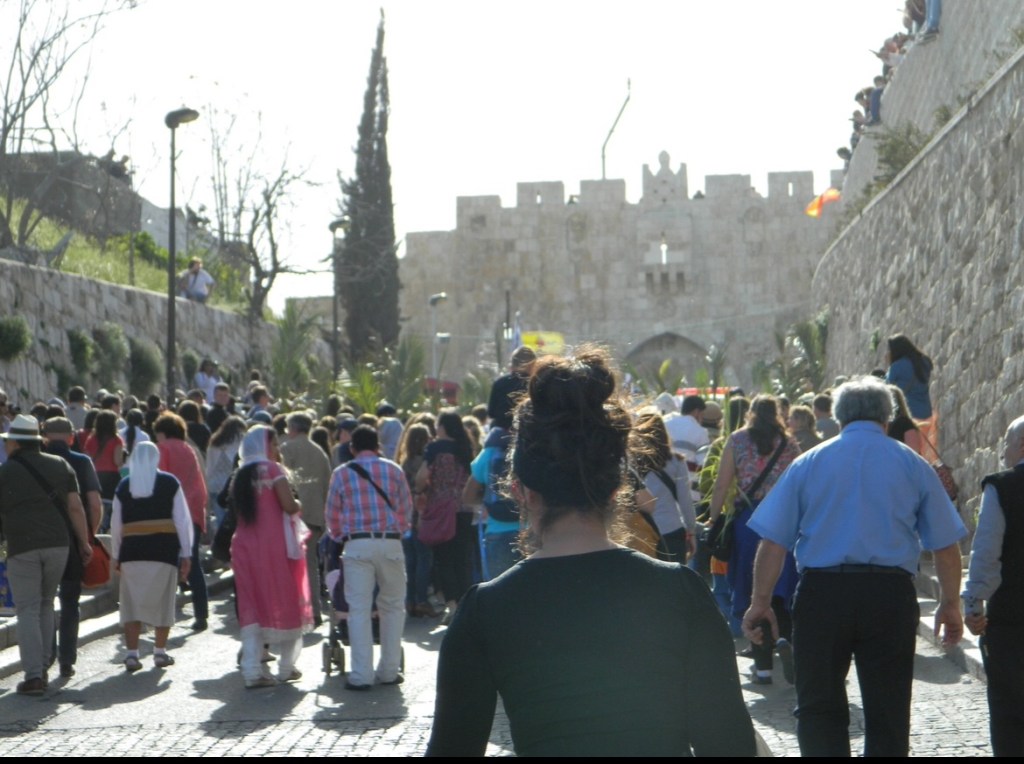
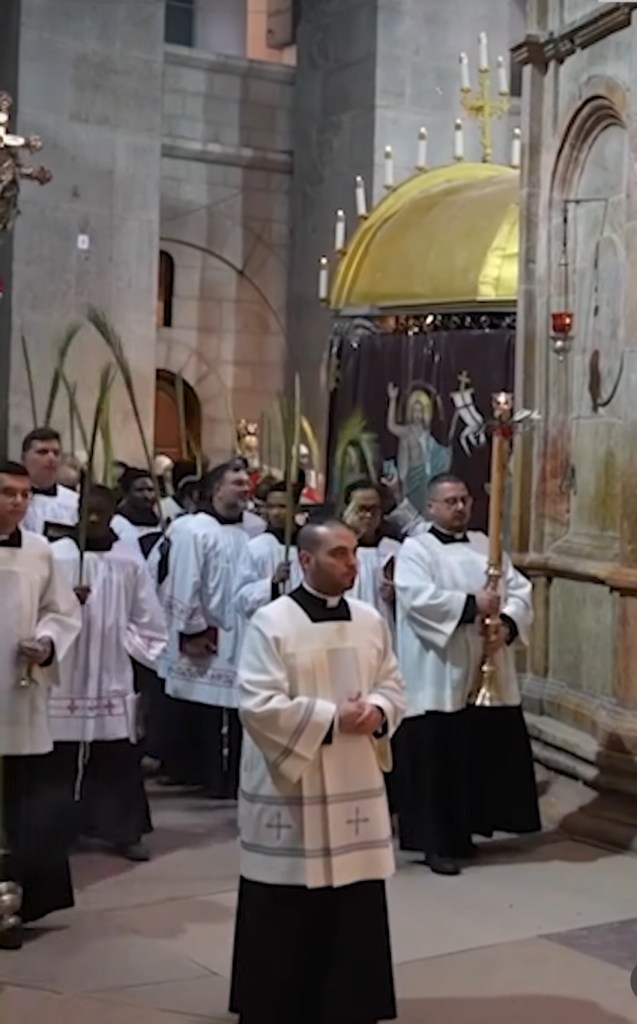
As the Seder feasts wound down in the wee hours of last Sunday morning, Holy Week started for the Christians. Thousands gathered with palms for the traditional Palm Sunday walk. Tens of thousands of pilgrims came from all over the world. The crowds were still not as large as in most years, but the festivities started at BethPage at the top of the Mount of Olives, Har Zeitim. The Latin Patriarch and the Franciscan Custos of the Holy Land blessed the palms and the participants in the walk. The Arab Israeli Scouts from Jerusalem, Nazareth and Ibillin led the procession.
Arab Israeli Scouts lead the procession with drums and bagpipes
The walk starts at the top of Mt. Olives and winds its way down through East Jerusalem. Spectacular views of the Temple Mount, Old City and all of Jerusalem are one of the high points of the walk which traces the path of Jesus from the starting point to its finish within the Holy City. The entire walk is about 3 miles. As in the Gospel accounts, people wave palm and olive branches and sing Hosannas and great Hallels. Security is tight with armed soldiers ready against any act of terror. Helicopters circle overhead for added protection for the walkers.
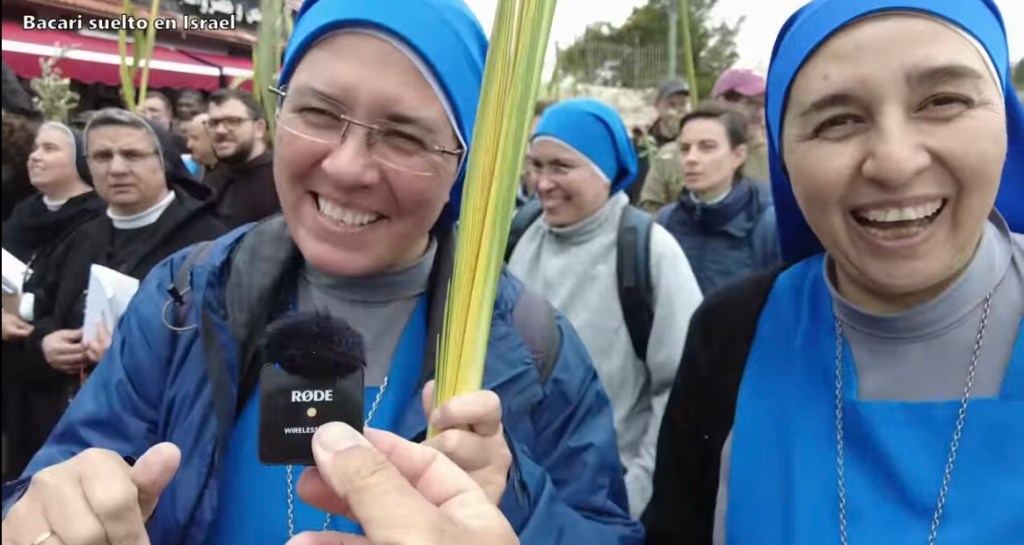
Mexican pilgrimsInternational throng with palmsThe Franciscans A group of nunsFr. Francesco Voltaggio with the NeocatechumensThe Hebrew CatholicsSweeping views of JerusalemKoinonia John the Baptist from ItalyA procession of Hebrew Speaking CatholicsThe pilgrims enter the Lion Gate into the Old City
And even Jesus showed up for photo ops…
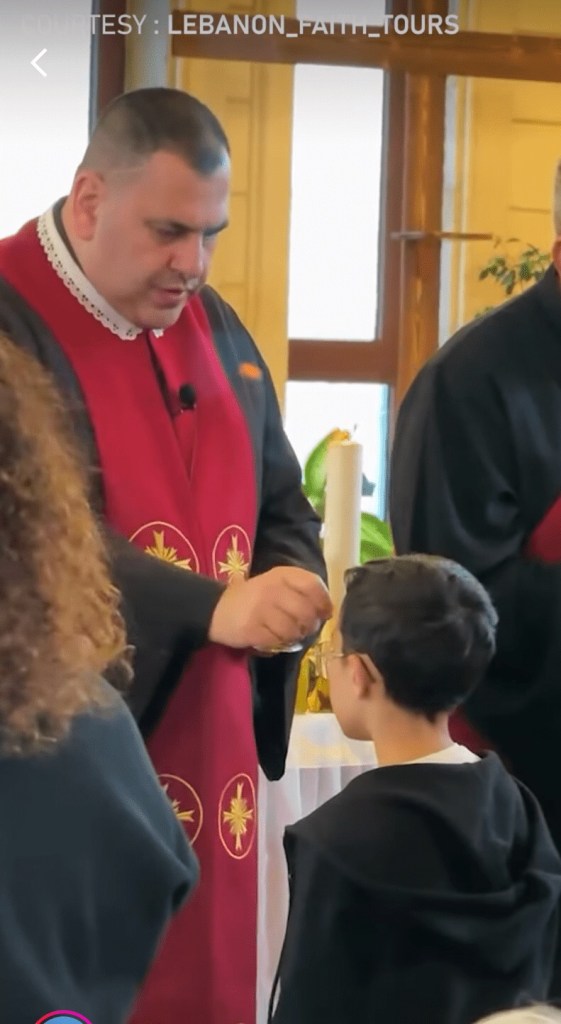
On Wednesday, Maronite Catholics, indigenous Arameans and Lebanese and Syrian Catholics living in the Holy Land, celebrated the blessing of the Holy Oils and the lighting of the Blessed Candles. Their congregations are mostly to be found throughout the North, where the majority of the Christian population is either Maronite of Orthodox Christian. Their population centers are Nazareth, Fassuta, Jish, Me’ilya, Tarshicha, Ibillin and Sh’faram.
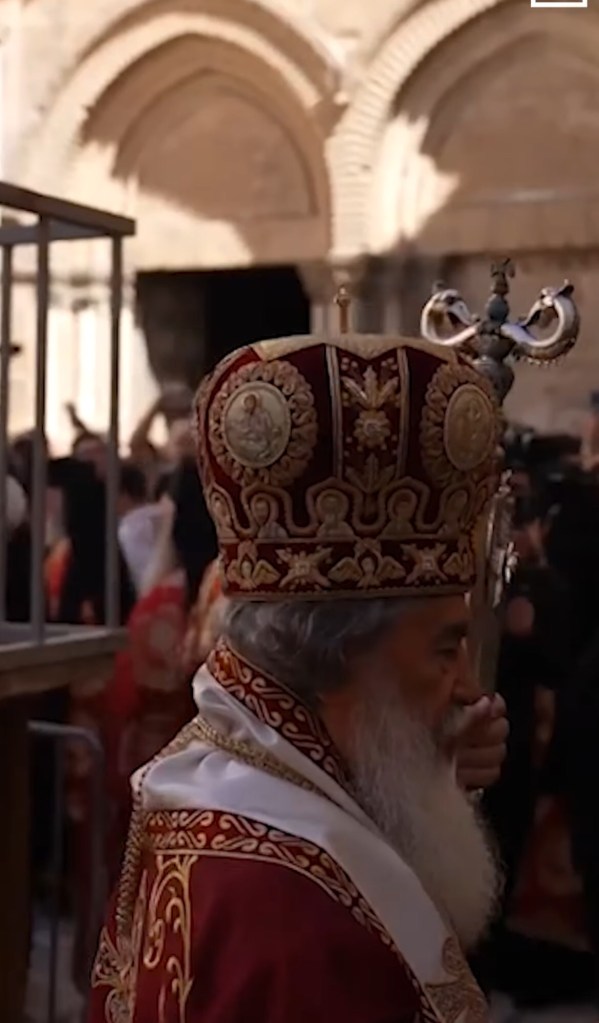
Yesterday, the Orthodox Christians (Greek, Russian, Eastern) and the Roman Catholics celebrated Holy Thursday, the beginning of the Triduum, or three-day holy period, concurrently. Eastern rite/Orthodox priests and patriarchs led the procession through their churches with the carrying of the cross for their congregation to venerate.
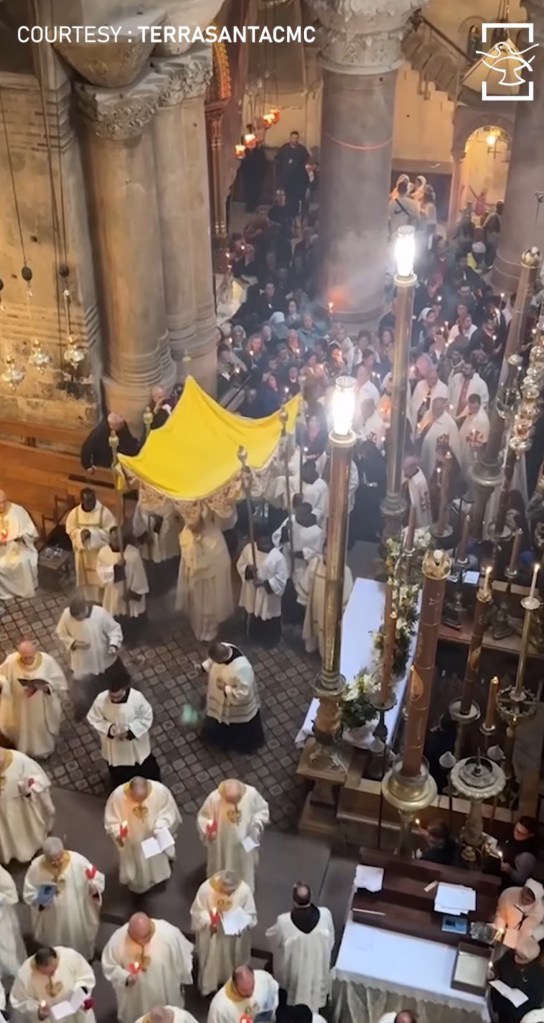
Cardinal Pierbatista Pizzaballa, the Latin Patriarch, commenced the Catholic liturgies at the Church of the Holy Sepulchre. There was a solemn procession from the place of the crucifixion to the stone where Jesus was wrapped and then throughout the church to the tomb where Jesus was interred. The faithful gathered to reverence, kiss and touch objects to the holy stone slab.
As soon as the Roman Catholic rite was finished, the church was cleared so the Orthodox worshippers could celebrate their liturgy. This is scheduled to happen throughout the weekend.
For the first time, in order to to accommodate all branches of the faith, the Roman Catholics will hold their Easter Vigil at the Holy Sepulchre very early in the morning – 06:30 am on Saturday morning. “Catholics must enter the New Gate between 05:30 and 06:00 am. After 06:00 am, the gate will be closed for entry to the Vigil Mass. Entry into the Basilica will be difficult due to extensive security apparatus in place on this day for the Orthodox Holy Fire ceremony. All those participating in the Latin Mass, will be obliged to leave the church after he Mass. No one will be permitted to remain, as the entire church will be cleared for the Orthodox worshippers.”
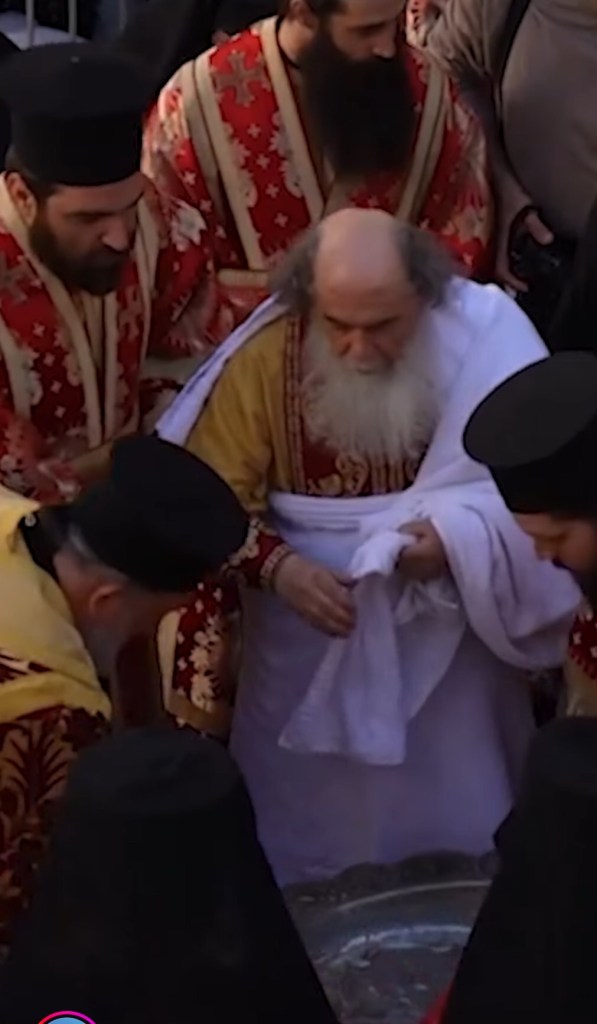
The Orthodox Holy Fire is the oldest recorded continual miracle. It has occurred in the Holy Sepulchre…the tomb where Jesus’ body laid… for 2000 years. The Orthodox priest enters the sepulchre at midnight with the Paschal candle and waits in darkness as the worshippers congregate throughout the basilica with their candles. A blue fire comes down and miraculously lights the candles. The flames burn cold for about 10 minutes afterward. This will be the eternal flame from the pascal candle that burns throughout the year in Jerusalem. You can view the entire spectacle onYouTube. It is quite fascinating!
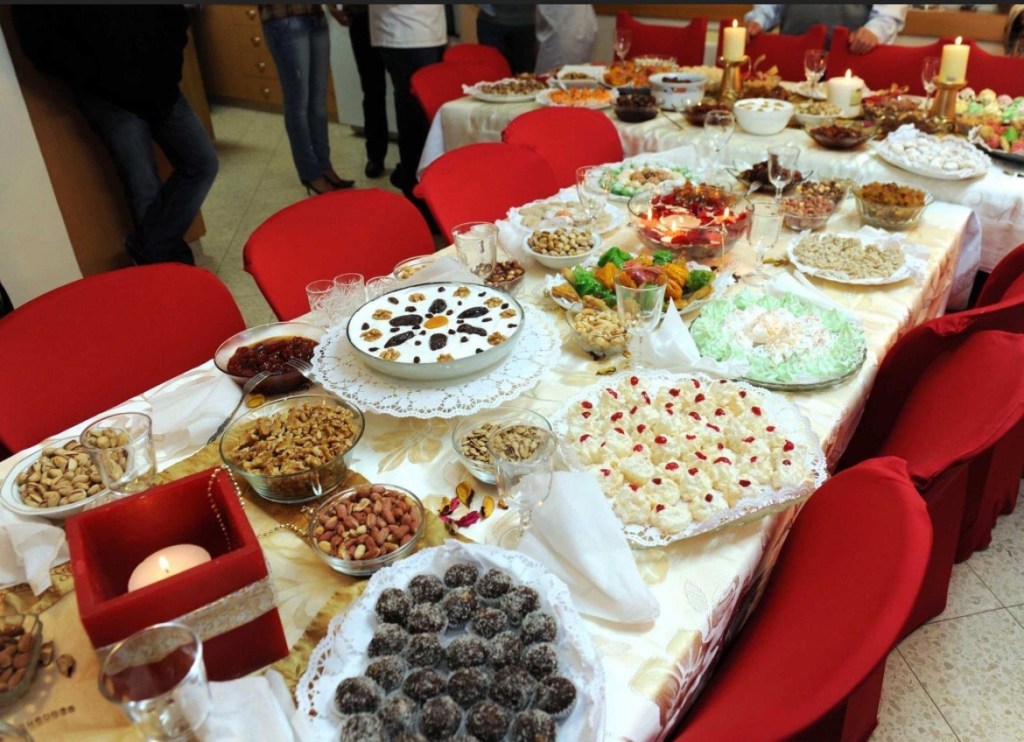
Passover ends this Shabbat for the Jewish people. Saturday night, as the Christians celebrate the start of Easter, Jews in Israel will be celebrating Maimouna. This party at the conclusion of Passover, comes from Morocco. But it has taken hold of the entire Jewish population here. It is a time of great merriment as pastries and tea and candies are piled high on golden trays. The revelers wear bright colors and lots of gold jewelry. There is music and dancing and fun to be had by all.
I wish all of my readers a meaningful, holy and happy feast. Next year I Jerusalem!!!!
These are the intermediate days of the (in Israel) 7 day Passover Holiday. All the children are off school. Families are taking vacations or going on field trips. Things are relatively quiet here. And I am spending the week at home, gardening, organizing and getting much needed rest. Despite grand plans of day trips and museum visits, I’m being a slug. Our houseguests from Vienna never arrived, and I’m taking advantage of all the extra time. Spring has officially arrived and the weather is glorious! All the trees are in full bloom.
So instead of getting into the war and all the intrigue about who knew what and when which has come forth in the past couple weeks, I choose to focus on the good.
The first story is the tale of a discovery and reunion.It is being seen as a small miracle from 7 October after over 18 months in Gaza. It was an emotional day yesterday when Rachel Danzig was reunited with her beloved Billy, a 3 1/2 year old King Charles Spaniel. Billy, was kidnapped from his home in Kibbutz Nir Oz into Gaza by Palestinian civilian terrorists. Rachel’s husband, Alex,76, was also kidnapped (subsequently murdered and still remains there). Many of Rachel’s family and close friends were slaughtered that day.
Last Thursday, a reservist, Aviad S., discovered Billy in Rafah, Gaza. He carried the dog back to his unit and took her into his care.. Billy even spent Passover with the soldiers before being brought safely back to Israel. Tuesday, a vet confirmed by microchip implanted in Billy that the dog belonged to Danzig and yesterday, the long-awaited reuinion took place. Billy leapt into Rachel’s arms, tail wagging and licking her. The family, still in mourning, described the moment as “a miracle from heaven.”
Since Billy’s captivity, the family had adopted another Kig Charles Spaniel, believing Billy would never return. Now both dogs will live together, a symbol of resilience and healing in the face of unimaginable tragedy. This story struck at the heartstrings of Israelis, still reeling after the events of 7 October, a small sliver of goodness and a reminder that miracles do happen.
Recently released hostage, Sasha Trouvanov was in the United States a couple weeks ago. He visited the White a house and spoke with President Trump. He also had the opportunity to speak with various organizations and at Jewish synagogues on the East Coast. At a Palm Beach Synagogue, he gave testimony yesterday of how he found G-d while in captivity.
Before October 7, I didn’t believe in G-d at all. . I was raised in a community they was atheist. g-d has no place in my life at all. During the time I was held in Gaza and the tough things I went through, step by step I got the place to think to reflect about my life, what I’ve been through, what I’ve done before 7 October, and the event itself and what I am doing now in this time in this place. I am in Gaza and I start reflecting on my life and thinking about what is life itself. Is G-d real or not. I came to understanding that the is G-d and it gave me a lot of strength. Believing. Being g able to pray. Finding strength from prayer. Being able to understand that well maybe I’m in tough moment right now. Maybe G-d put me in a place that is tough… it’s very sad. You are alone and feel very alone. Very vulnerable. It’s my choice what I’m d9g with it. I can be sad I can be depressed or I can find strength do things that will help me get out of this situation. To find happiness even if there is not a lot to be happy for. I chose the second choice. I choose G-d. It’s helped me a lot. It’s helped me when my life was in danger. It helped me going through hardships as well as physically and helped my soul a lot. I’m so grateful that I’ve been able to find this belief in G-d during this tough time.
Not only is Sasha back to safety with his now-fiancée, who was released in 2024, but he is studying the Scriptures with a rabbi and learning about Judaism. Because he is a Cohen, part of the priestly line, Sasha was invited to be one of the Cohenim to give the priestly blessing to the crowds gathered at the Western Wall this Passover.
Of the hostages taken from Israel into Gaza were the Americans, Keith Siegel and his wife, Aviva. Every weekend before that horrific day, the family would gather together for an American style pancake breakfast, made with love by Keith. It filled their home with joy and love, and the scent of maple syrup. On Simchat Torah, 2023, their Saturdays were shattered when their community was breached and they were abducted by the terrorists, their home destroyed. Aviva was released in December of ‘23, but Keith remained in the underground tunnels for 484 harrowing days. He was isolated, abused and starved before his release a little over 2 months ago.
Now that he’s back home and together with family, he’s joyfully sharing the family tradition with the public. In Sarona Market, Tel Aviv, he’s exuding hope, resilience and healing with his pop-up – Keith Siegel’s Pancake House. “In captivity, food was a rare commodity. I didn’t allow myself to think about pancakes,” stated Siegel. “ I was amazed when I came back and discovered that everyone. Israel was making them in my honor. It moved me deeply.” These days, lines to buy Siegel’s pancakes stretch around the block. It’s a message to the world. He asks the customers to remember the remaining 59 captives with every bite. All proceeds go to family recovery projects and for therapy for them and other victims. “This pancake house isn’t just about food. It’s about not giving up. It’s about remembering.”
Aviva and Keith Siegel and their daughter, Shir, at the Pancake House
We here in Israel have recently found out the heroism and bravery of IDF soldier, Eden Nimri, 22. Liri Albag, one of the female Israeli girl soldiers released two months ago met with the parents of Eden Nimri to share with them the details of their daughter’s valor during her last hours at the Battle of Nahal Oz Shelter. Despite 10 people murdered by the Hamas terrorists that day, and the 7 IDF soldiers being captured into Gaza, Eden kept firing at the terrorists. The Hamas terrorists tossed smoke grenades into the shelter where soldiers had taken cover. Her efforts allowed 14 to escape and then remained the last soldier armed in the shelter until she ran out of ammunition. Hamas then threw three more smoke bombs in which were tossed back out by Karina Ariev (also captured, just released) and Shiraz Yam Amar, who was killed. Eden then fought off several terrorists with her bare hands!!! until she, herself, was shot and killed. Altogether, Eden was responsible for saving the lives of 19 soldiers.
Before this war is over, I am sure we will be hearing the stories of our valiant young people and how they stared down terrorists bent on evil and destruction. Stories are just now coming out as people are in therapy sessions, willing to speak with news outlets about their ordeals and as more hostages are released.
The birth rate is up 14% since the war began. Couples are still getting engaged and married at an incredible pace. Grand engagement parties are being sponsored by IDF battalions as a soldier pops the question (always on blended knee) to his intended. The Jewish people are celebrating the true meaning of the holidays as never before. People are finding faith in G-d and I do believe that Israel is growing stronger and more solid in their faith. It is a healthy sign and gives hope that things will be better soon.
Have I told you yet how much I absolutely love this country? Its customs and traditions? Today is New Year’s Day! For 🌳 🌲🌴🌵🌳! Yes. TREES!!!! How cool is this? It’s the Hebrew month of Shvat – also amazing because who else has a month Shvaaaahht??? Even saying the word makes me laugh. And the 15th of the month, during the full moon, we celebrate nature. It’s the original Earth Day without all the political hype. And of course…. We eat and drink. But more about that later.
So to quote my friend, Arky Staiman, we have this holiday where we celebrate the blossoming of the trees. They are just beginning to sprout forth right now. Here in Israel. Now listen, for those Ashkenaz Jews in the US (hello, Chicago, NewYork, DC, St Louis and Seattle), in Canada (you out there freezing your tuchuses off inMontreal and Toronto), in France, Germany, England….this holiday makes little sense. For those in the extreme South (yes, you in Tasmania! In Argentina and Brazil, even in India) you are in the throes of summer. But here in Israel, the rains have come and everything is green and the buds are shooting forth from the ground and the bushes and trees. Judaism only makes sense here in Israel.
No where else does this make sense. The trees know it’s time to blossom their beautiful flowers and it’s all connected to one place, right here, in the Land of Israel, where Judaism is connected and the holidays are connected to the Land and Nature and the People. It’s the time when people go out and the earth is soft and fruit trees (and other trees) can be planted. The early settlers in the 1800s and early 1900s took this opportunity to restore the ecology and verdure of the land by planting forests and groves.
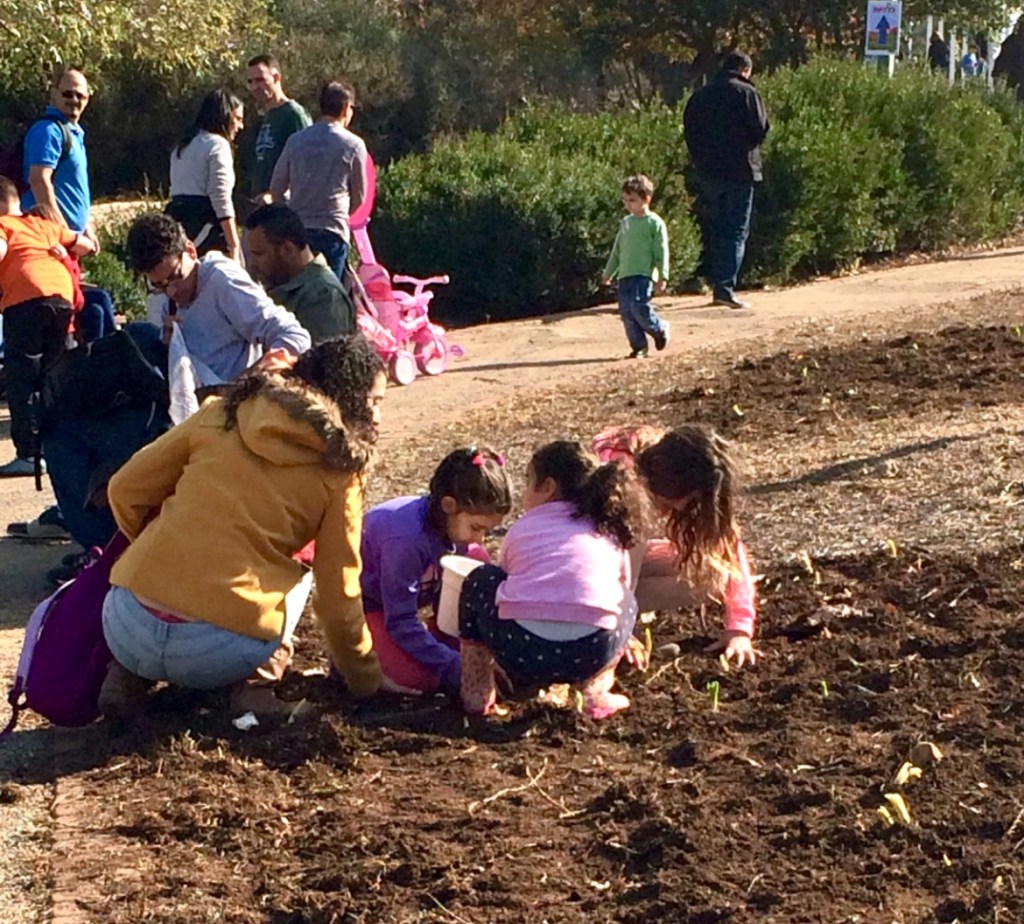
Groups of schoolchildren were out today planting bulbs and trees in the neighborhood park. Whole congregations go out together and plant – avocados are becoming increasingly popular. A friend lives on Kibbutz Ginosar (Gennesaret) where they are planting dunams/acres of bananas this week.
Did you know fruits can be really really Kosher? That Jewish trees in Israel are circumcised??? That’s another weird one. Let me explain. A fruit tree is planted about now…15 Shvat. It is cared for and grows. The first year comes and fruit pops out. Leave it alone! Do not touch the fruit! It is not ready yet. Why? Leviticus 19:23 states
When you enter the land and plant any tree for food, you shall regard its fruit as forbidden. Three years it shall be forbidden for you, not to be eaten.
In the fourth year of fruit bearing, the farmer would bring the fruit from those trees to the Holy Temple in Jerusalem as an offering…on Tu b’Shvat. Then the tree is circumcised, holy, set apart for eating, Kosher. Who knew? From year five onwards, the nuts, the fruits, the seeds are all good to go. Pretty wild, eh? Many farmers still abide by these Biblical laws today here in Israel – except they offer the fruits and nuts to the poor because there is no longer a Temple.
In the 1500s and 1600s, the Jewish mystics of the city of Tsfat (only 20 minutes from here) created a Tu b’Shvat Seder which has come into real popularity in Israel today. It was modeled after the Passover Seder, where different foods are eaten in a certain order, blessings said, and everything has a symbolic, deeply spiritual meaning. We have our own lovely Seder. Here’s what I do:
The table is set with a lovely bunch of fresh flowers I just picked from the neighborhood park. There is no requirement to light candles, but as this is a festive celebration I light the two candles and say the holiday blessing. We have four small glasses of wine set out – white wine, a light rosé, a darker rosé and a red. We take turns reading just like at Passover. I fill a large pitcher with rose scented or lavender scented water. There is a basin. Each person recites the prayer for handwashing and washes his hands individually.
The First Cup of Wine
This glass of white wine symbolizes winter. For a mystical twist this is the energy G-d used in creation to create the trees and flowering, seed bearing plants. We read Deuteronomy 8:7-10 and then lift our glass, say the blessing and drink the wine.
Barukh ata Adonai, Eloheinu Melekh ha-olam borei peri ha-gafen.
Blessed are you, Source of all life, Creator of the fruit of the vine.
Reader: For Adonai your God is bringing you into a good land. A land of brooks of water, of fountains and depths springing forth in valleys and hills, a land of wheat and barley and vines and fig trees and pomegranates, a land of olive trees and honey, a land wherein you shall eat without scarceness, you shall not lack anything in it; a land whose stones are iron and out of whose hills you may dig brass. And you shall eat and be satisfied, and bless God for the good land, which is being given unto you (Deuteronomy 8:7-10).
The First Fruits
Did you know a nut is also considered a fruit? At this point we eat a fruit that is hard and inedible on the outside but with a softer flesh on the inside, like coconut, pecans, walnuts, almonds. The hard shell is strong like our covering and protection by G-d when we walk in His ways. We become strong spiritually, but in the inside we are still tender and yielding. Today as a first course, I serve walnuts in the shell, almonds (indigenous to Israel. Aaron’s staff had budding almond flowers) and also some feta cheese.
Barukh ata Adonai, Eloheinu Melekh ha-olam, borei peri ha-etz.
Blessed are You, Source of all life, Creator of the fruit of the tree.
The Second Cup of Wine
The second glass of wine is a light pink rosé. It stands for springtime. It is also a mystical symbol of mercy (the white wine) mingled with a little bit of justice (the red grape juice or wine), two attributes of the Creator. We read Deuteronomy 28, the blessings and the curses for obedience and disobedience to G-d’s commandments. Then the blessing over the wine, and drink the second cup.
Reader: Blessed shall you be in the city, and blessed shall you be in the field. Blessed shall you be in the fruit of your body, and the fruit of your land, and the fruit of your cattle, and the young of your flock. Blessed shall you be in your basket and your kneading trough. Blessed shall you be when you come in and blessed shall you be when you go out (Deuteronomy 28:36).
Barukh ata Adonai, Eloheinu Melekh ha-olam, borei peri ha-gafen.
Blessed are You, Source of all life, Creator of the fruit of the vine.
The Second Fruit
The second fruit(s) we enjoy are soft on the outside with a seed or pit in the center. I use olives, as they are one of the seven Biblical species indigenous to the Land. They grow everywhere throughout the Galil. It has become a sign of home. You can also use any stone fruit like cherries, apricots, peaches. I also use dates, because they grow here around Lake Kinneret (Sea of Galilee) and in Hebrew, the date palm is Tamar. These fruits remind us of the spiritual and emotional strength within us.
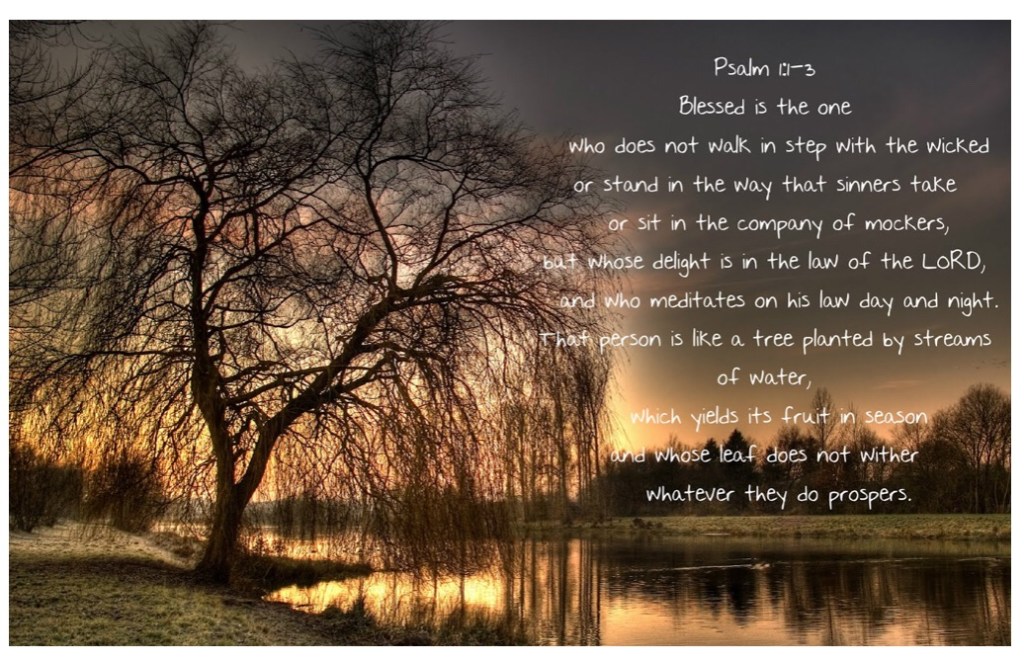
We read Psalm 1. We say the blessing over the fruit again. Now eat the olives or dates.
The Third Cup of Wine
The cup of late spring early summer. The wine is a deep pink rosé. It is more judgment than mercy. It is a season of growth and development. Life is always changing, but G-d remains the same.
The Third Fruit
This fruit symbolizes the first harvest. We eat fruits that can be eaten whole without peeling. What you see is what you get. It also stands for G-d’s omnipresence. Blueberries. Tomatoes. Apples and pears. Grapes. I use grapes as that is also one of the seven species. We read Genesis 1:29-31, say the blessing and consume the fruits.
28 And God blessed them, and God said unto them, Be fruitful, and multiply, and replenish the earth, and subdue it: and have dominion over the fish of the sea, and over the fowl of the air, and over every living thing that moveth upon the earth.
29 And God said, Behold, I have given you every herb bearing seed, which is upon the face of all the earth, and every tree, in the which is the fruit of a tree yielding seed; to you it shall be for meat.
30 And to every beast of the earth, and to every fowl of the air, and to every thing that creepeth upon the earth, wherein there is life, I have given every green herb for meat: and it was so.
31 And God saw every thing that he had made, and, behold, it was very good. And the evening and the morning were the sixth day.
The Fourth Cup of Wine
The last glass is red wine. We are judged for our actions. As the fall comes and winter sets in, it is time to plow under the soil. The land rests. We become introspective and make things right between ourselves as people and with G-d. This glass, all red, also stands for fire, burning, purging, but not consumed like the burning bush, or the fire of the Divine Spark within us. We read the story of the burning bush in Exodus 3, say the blessing and sip the wine.
The Fourth Fruit
The fourth fruit has a touch, protective skin on the outside, but sweet, soft flesh within like avocado, citrus fruits, mangos or bananas. It symbolizes the mysteries of the world and the hidden mysteries in Scripture. We are constantly seeking to uncover deep truths and are nourished by her fruits.
This is just a tiny bit of our Seder. We sing songs and eat lots of great vegetarian (and I serve dairy) foods between each part of the fun ceremony. There’s a lot of deep spirituality that goes with each part and, as a result, lots of discussion.
I know it’s a bit late for you this year, but here are some recipes that we will be enjoying.
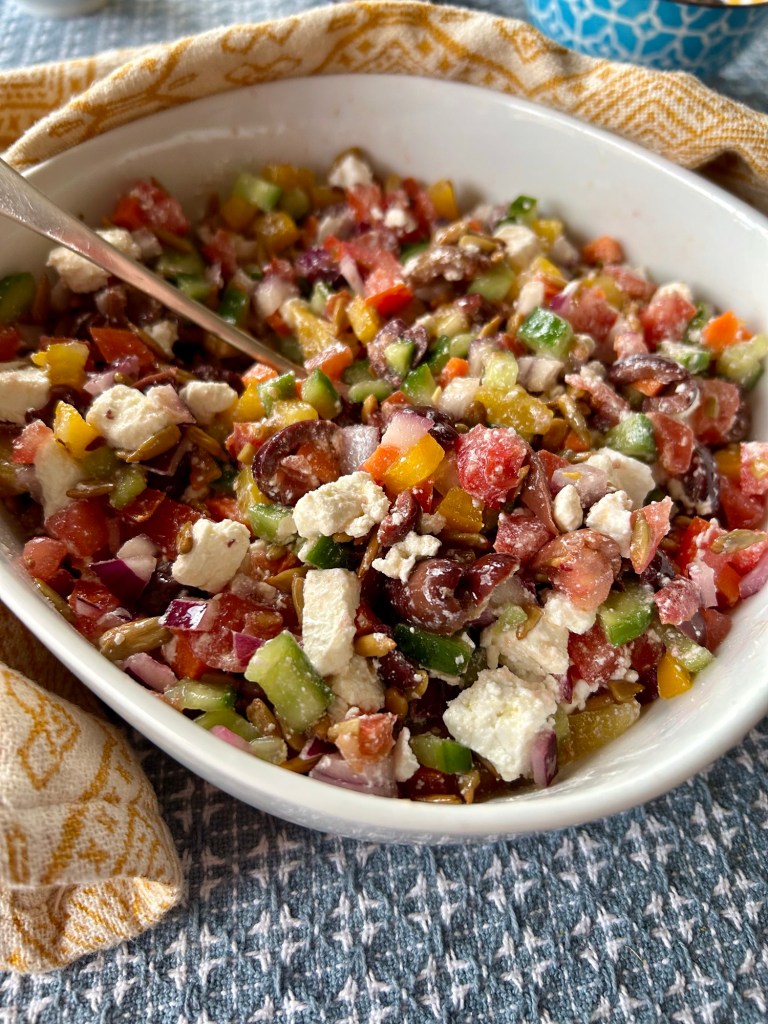
Tu b’Shvat Israeli Salad
Ingredients and Directions: Chop a variety of fresh vegetables into small diced chunks… Tomato, Cucumber, Yellow or Orange Bell Pepper, Red Onion, Carrot. Add crumbled Feta Cheese. Dress with juice from 1/2 fresh lemon and a drizzle of olive oil. Gently stir in roasted, salted sunflower seeds.
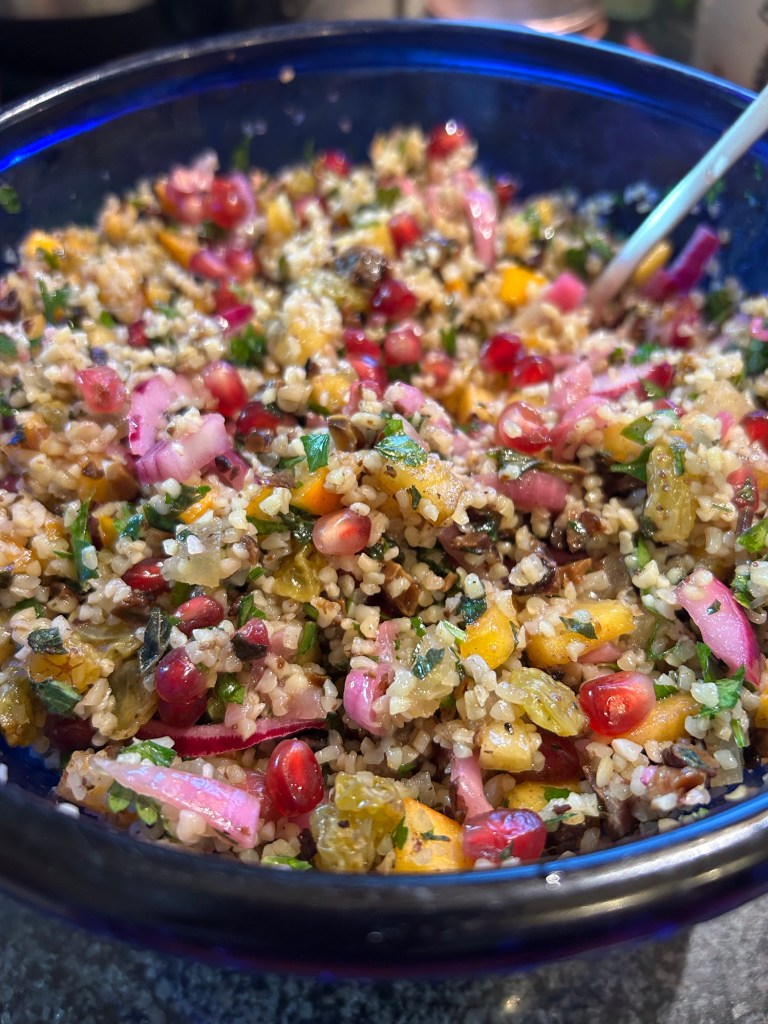
Tamar’s Sweet Israeli Tabbouleh
Serves 6-8 as a side dish 4 as a lunch entrée. Vegan. (Pareve)
Ingredients:
1 cup bulgur
1 1/2 cups boiling water
1/4 cup pickled red onion (onion pieces swimming in vinegar with pickling spice)
1/2 cup parsley, chopped very fine
1/4 cup fresh mint leaves, chopped very fine
1 cup toasted walnuts, chopped
1/2 cup pomegranate arils
2 persimmons, chopped into small cubes
1/4 cup yellow raisins
1/4 cup chopped dates
Dressing ingredients:
1/2 cup extra Virgin olive oil
Zested rind and juice of 1 large naval orange
2 TBSP apple cider vinegar
2 Tablespoons honey
2 Tablespoons pomegranate syrup/molasses or carob syrup, if available
2 tsp sumac
I tried to use all things indigenous to the land and/or part of the seven species in this cold salad. Wheat, dates grapes (raisins) pomegranates and honey for the Land of Milk &Honey. It’s so healthy, light and addictive! Very Israeli with a twist. I really do hope you make and enjoy this one!
In the meantime, plant some bulbs or a fruit tree. If you desire to bless Israel, go to https://shop.jnf.org>collections>plant-trees and plant a tree in the Land of Israel for only $18. You’ll get a gorgeous frame able certificate and can plant the tree in memory of someone who has passed away or honor someone having a special event like a birthday, anniversary, wedding or Bar/Bat Mitzvah.









































































 Israel Dreams