A Star Rising. Day 584. 8 May, 2025

Starting off with accentuating the positive. I’ve lived in Israel for a decade now. Hard to believe how fast it’s gone by. There are LOTS of things we can criticize and find fault with, but today I’d like to start off by accentuating the positive. Things I’ve come to love or find really amusing.

I love flying on ElAl with a bunch of Israelis. Seriously. Besides good food (they feed you like a Jewish momma and you’ll never leave the flight hungry), at the end of the flight, just as the plane touches down, everyone breaks into thunderous applause. It’s a tradition and a way of saying thank you to the pilot and crew. Also a way of being thankful for a safe trip. It’s amazing!!!

Now, the pre-flight fun – or any time Israelis are asked to queue up. They have absolutely no concept of how to form a line. Our last flight we passed the counters and check ins for Singapore, Netherlands, American, Italy…. All super straight, super organized, well-formed lines. Israel?

Inability to form straight lines

And don’t get us started about the lines at the grocery store or the inability to have personal space when you use the Cespomat (ATM). It’s totally hysterical.

I love eating seasonally. In America, we always had everything produce wise all season long. I could find peaches in November and grapes in January. Brussels sprouts and gourds could be bought all year long. Oooo, I have a hankering for blueberries. No problem. Here, I’ve come to savor strawberry season from Chanukah to Passover. And then the stone fruits. After what seemed like forever, they finally come out early summer….peaches, nectarines, cherries. Then,they are gone until next summer. In the winter, I look forward to the delicious Jaffa oranges, and the CaraCara and blood oranges, which are available for about a month. Limes can be found late, late summer. So I buy 40 to freeze for use throughout the year. But in general, I’ve learned to miss the transience of some things, while I anticipate the coming of others.

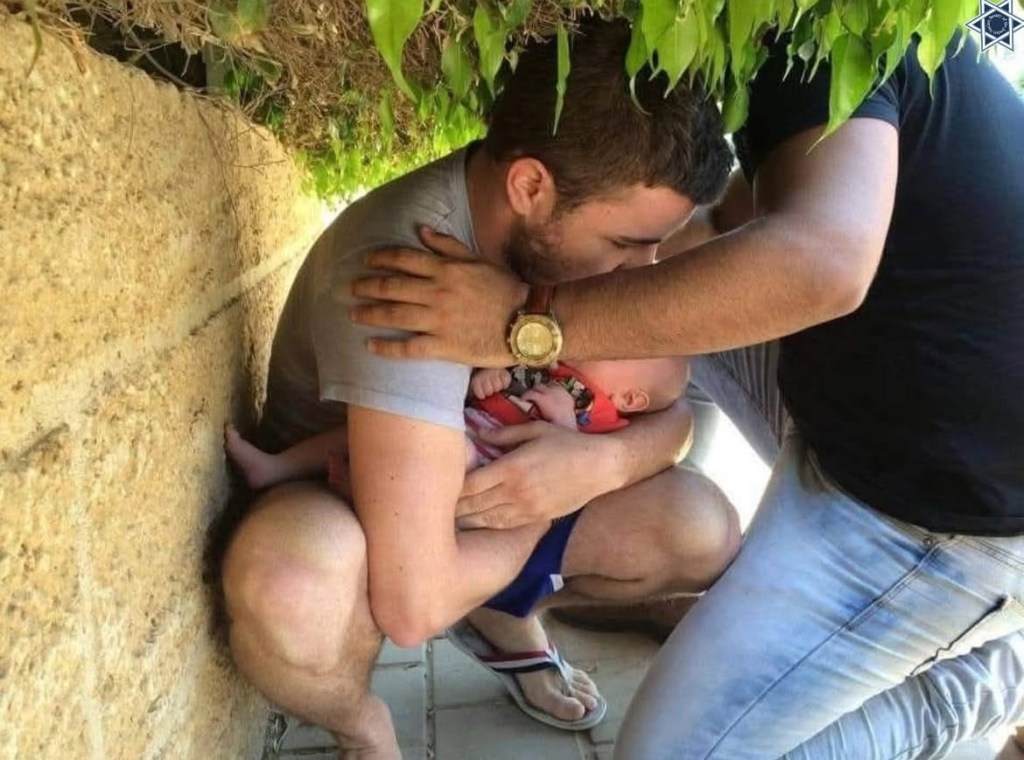
I love that, for the most part, we are all one big family here. Sure, we disagree about everything, but when someone is in need, there is always a stranger or five who step in to help. Great examples of this happened just this week. For the first… on Sunday morning there was a red alert signal throughout central Israel. When the siren goes off, you pull over and take cover the best you can. A young father jumped out of the car, unstrapped his 5 week old baby and rushed to the side of the road seeking shelter beside a wall. A stranger crouched in front of him, wrapping his arms around both the father and child, shielding them with his own body from any falling shrapnel. We look out for each other.
Yesterday, a friend down in the center of Israel called. Her husband had just been called back to reserve duty in Gaza. He left Or behind with a three year old and a 4 month old. Tomer, the husband, is the kind of guy who fills his wife’s gas tank, brings her coffee every morning, takes care of much business so she can care for her children and run her own small business (Or has an Etsy shop). Or’s neighbor knew how overwhelmed she was with a teething baby and absent husband, so she made her a week’s worth of hot meals. Just because. We take care of each other.

I really find it amusing at how superstitious many Israelis are. G-d forbid you should say anything negative about yourself or your family – you wouldn’t want to tempt trouble. My husband often expresses in public how stupid he is (joking), and it flips these people out. You never say anything bad about yourself. And if there’s talk of impending danger be it health or wealth or other, then khas v’halillah, don’t tempt the evil eye, tfu, tfu, tfu. So I cracked up last week when John spit through his fingers and said tfu, tfu, tfu. He’s really becoming one of them.

I love how connected most Israelis are to nature. Planting trees, Going for hikes. Concerned about sustainability in a good way. How every Jewish neighborhood is mandated to have a park within walking distance.

And how family oriented people are. It is not at all uncommon for couples to marry early and have a large family of 4 or more children. There are little kids running everywhere. It’s really healthy to see. Or how the families come together every weekend for Friday night dinners. And just Fridays in general when the busyness of the week slows down. The DJs on the radio play much more relaxed and mellow music and the noise of the city dissolves away. To wake up every Saturday morning to birds chirping. No leaf blowers. No garbage trucks. No motorcycles or blaring music. Just quiet. I love it. “And what did you do all Shabbat?” “I just rested. Betten gahv.” I love this idiom!!!! It translates ‘stomach back,’ but just means to be a slug. Flip over from one side to the other. Just resting from stomach to back. I did nothing. Betten gahv.

I love making an appointment at the clinic and being seen by a doctor in less than 15 minutes. No waiting in a treatment room for hours. The doctor is right there. You go into the room and sit down and your appointment starts. When I go to my regular doctor in California, I make my appointment months ahead of time, sit in the waiting room for a good hour, and then the treatment room for at least another hour. It’s maddening. It would never be stood for here.

Last week, we discovered a small family of mice who had taken up residence in our larder (downstairs pantry). John went to the hardware store to buy some mousetraps, only to find out that they don’t sell the kind that kill or harm the animals here in Israel. The country is so darned humane and has such a respect for life that the only traps available are catch and release cages. So….John set the bait in the cages and within four days had caught all the mice and released them into far away olive groves. So much for a country bent on ‘genocide-‘

When I lived in the United States I had never heard of Eurovision. It’s a very big deal in Europe and Eurasia. An international pop music contest that has taken place for almost 60 years, it has launched careers of Abba and Celine Dion. Israel has been a participant since its inception.

I got in on the craze for the first time last year with the song “Hurricane” (fantastic) sung by Eden Golan. It was a highly contested entry because the original song, “October Rain” was deemed too controversial. The organizers had complaints that the original song was too political, so it was slightly modified. Eden Golan participated in the contest under heavy protection. She had received numerous death threats and had to be escorted by bodyguards wherever she went. Her song was booed when done live, but the performance (song, voice, set, dancers) was so wonderful, she got fourth place (out of 36 entries). It was the number one song in Israel all last year.

https://youtu.be/lJYn09tuPw4?si=CpOmftp-aE2AKKO5

This year, the story gets even better. Yuval Raphael attended the Nova Music Festival with her friends that fated October morning in 2023. When the shelling started and the Hamas terrorists invaded the Israeli border communities, Yuval took shelter in one of the concrete bunkers on the side of the road. Normal capacity is about 20 people, but over 50 young concert goers crowded into the bomb shelter. Yuval was texting her parents through the whole ordeal.

The terrorists came around and started sending volleys of bullets from their machine guns right into the shelters, killing and wounding several kids. One Gazan threw a grenade into the shelter. It was tossed back by a young IDF soldier inside. Then another. He threw the grenade out. Seven times. Over and over. The brave soldier kept catching and throwing the grenade outside where it exploded. Then on the eight time, the grenade exploders inside the shelter killing scores. Yuval and her friend were at the back. Dead bodies piled on top of them.

Her father told her “Play dead. Don’t move. Don’t make a noise.” Hamas kept coming back, shooting into the shelter. It was a living nightmare that lasted for over 8 hours. Finally her father, defying all roadblocks and odds came to rescue her. She survived the Nova massacre, albeit wounded. Now she’s facing hate at Eurovision. Over 70 past Eurovision stars as well as present entries are calling for Miss Raphael to be banned because of her ethnicity/nationality. (Her family has Kurdish, Iraqi, Persian and French roots).

Yuval never sang professionally, but decided to enter into Israel’s version of The Voice, The Next Star, last January. It was part of her healing process. Her performance was so shattering, that she not only won that competition, but was immediately chosen to be Israel’s representative for Eurovision. “I’m coming to Eurovision to sing for all the angels who can’t be here. I survived, I have to make the most out of my life to honor them.” Have we talked of Israeli resilience before???? This is Yuval giving her story and her song on The Next Star. It’s a MUST WATCH AND SHARE! Get your tissues out. Seriously. You’ll cry- (close caption translations…)

https://youtu.be/OUeejYiU8LA?si=K8LJMyVN7NBSBZXj

Is she not poised, beautiful, amazing, brave?? You can see more, full interviews with her testimony on YouTube. Fluent in Hebrew, English and French (her family lived in Switzerland and now she returns to Switzerland for the competition). Such a talent! Such a person to represent our country. This is the music video that was made for her entry into Eurovision.

https://youtu.be/Q3BELu4z6-U?si=8ElYEXRj0S-H4xIw

The semifinal round is coming up this weekend. Yuval has already had to face threats and is heavily guarded. Wherever she is escorted in Switzerland, this 24 year old has had to face massive anti-Israel/pro-Gaza protests and demonstrations. With the backlash against Israel in the world, it’s pretty much a surety that she will not win. Still- we shall see how it shakes out.

You can follow (and vote for your favorite contestant) the Eurovision contest live. It’s being live-streamed across the internet. Most of the groups and performers are pretty sleezy to say the least. It’s known for its wackiness for the most part. I shall report back on how Yuval Raphael placed.

A Happier Story: A Canvas of Hope and Love. 3 February, 2025

Late last summer, the war front in Israel moved up here to the North. Hizbulla began firing missiles at us every day, multiple times a day (and night). Each salvo contained anywhere from 20-60 missiles. When the red alert siren sounded, we had only a few seconds to find shelter. Thank goodness we had the Iron Dome Missile Defense System which intercepted most of the rockets. But then there was the vey real danger of falling shrapnel.

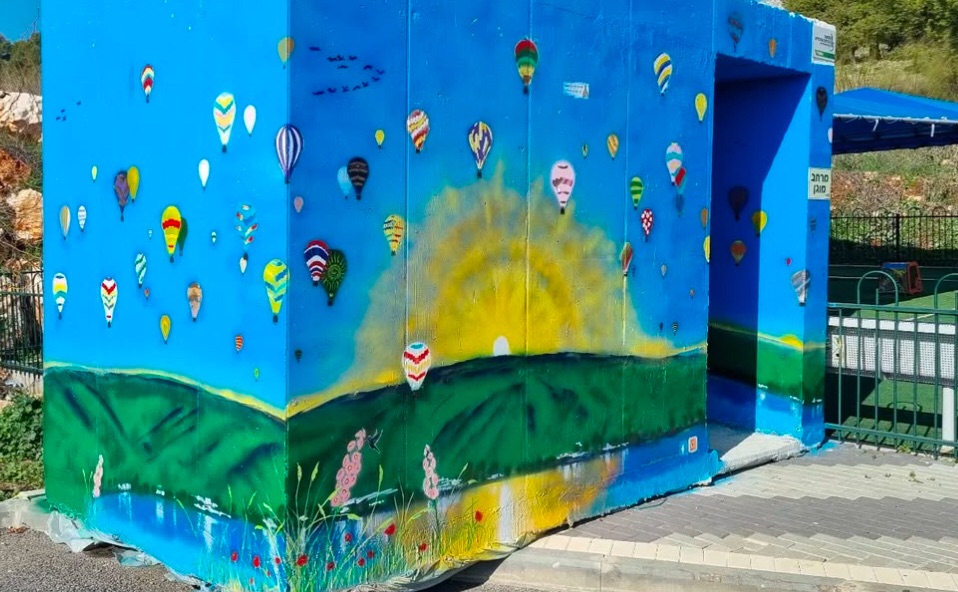
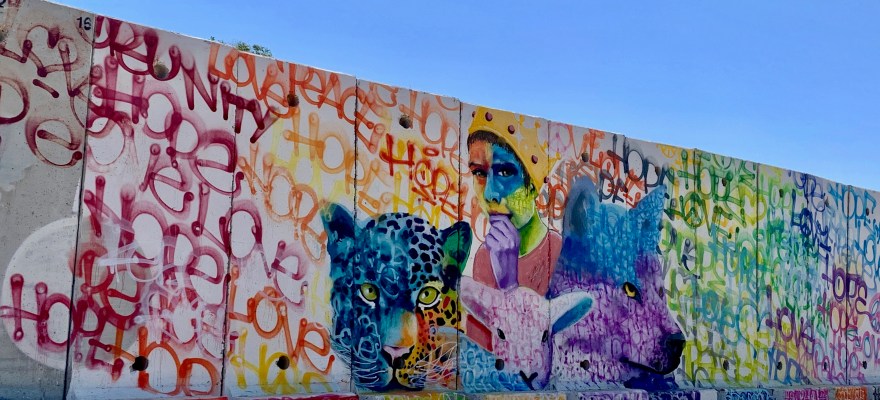
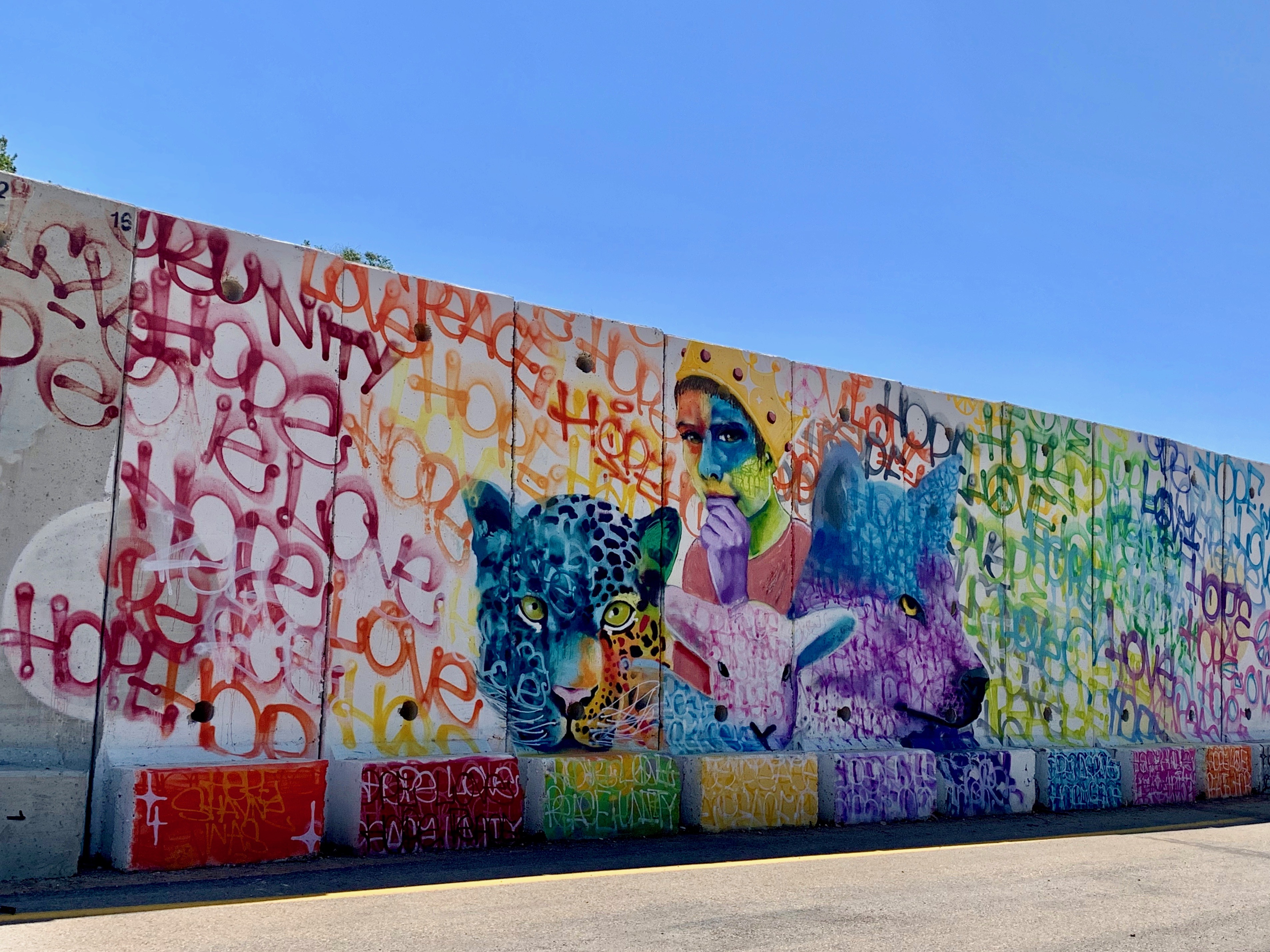
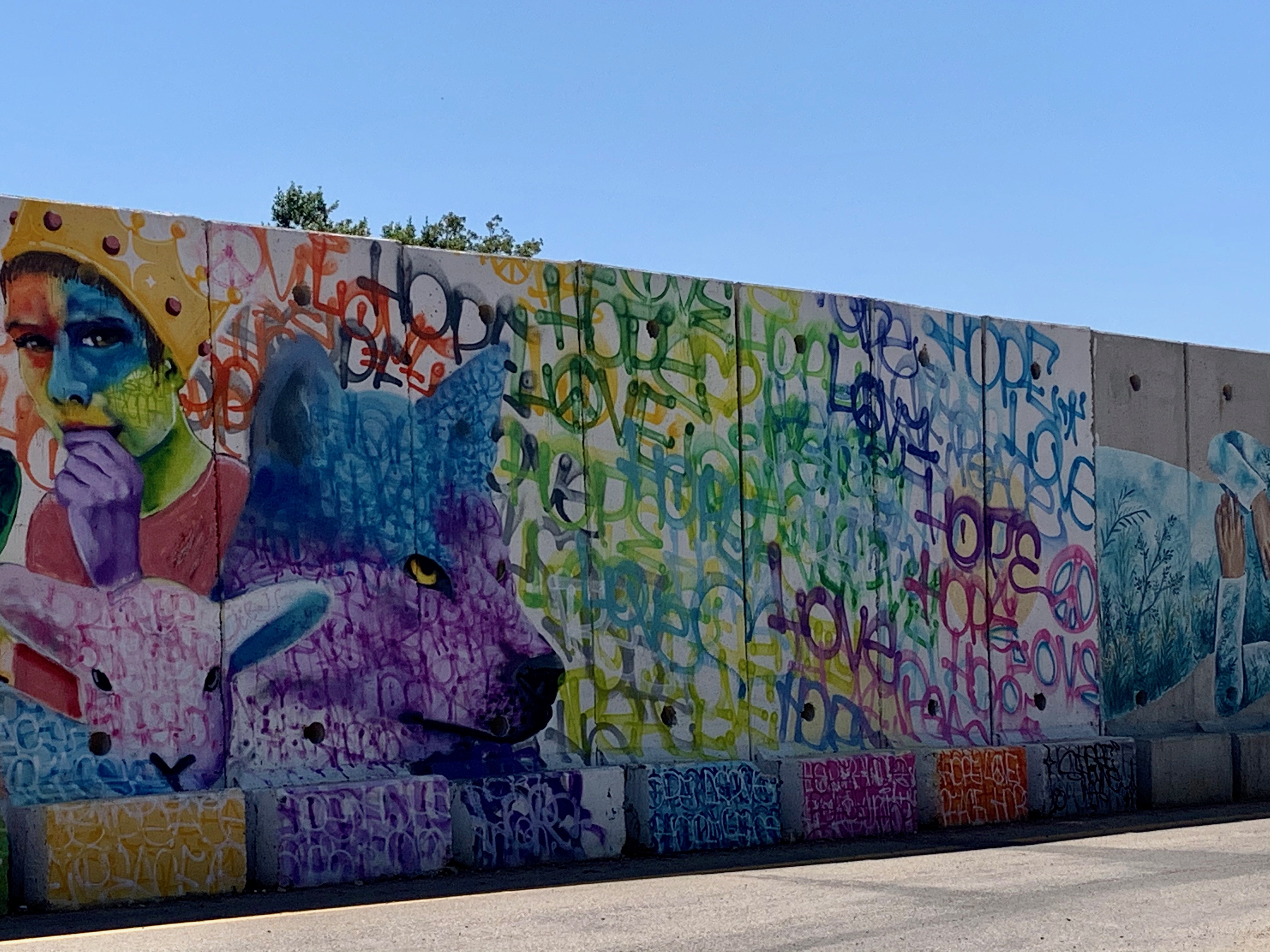
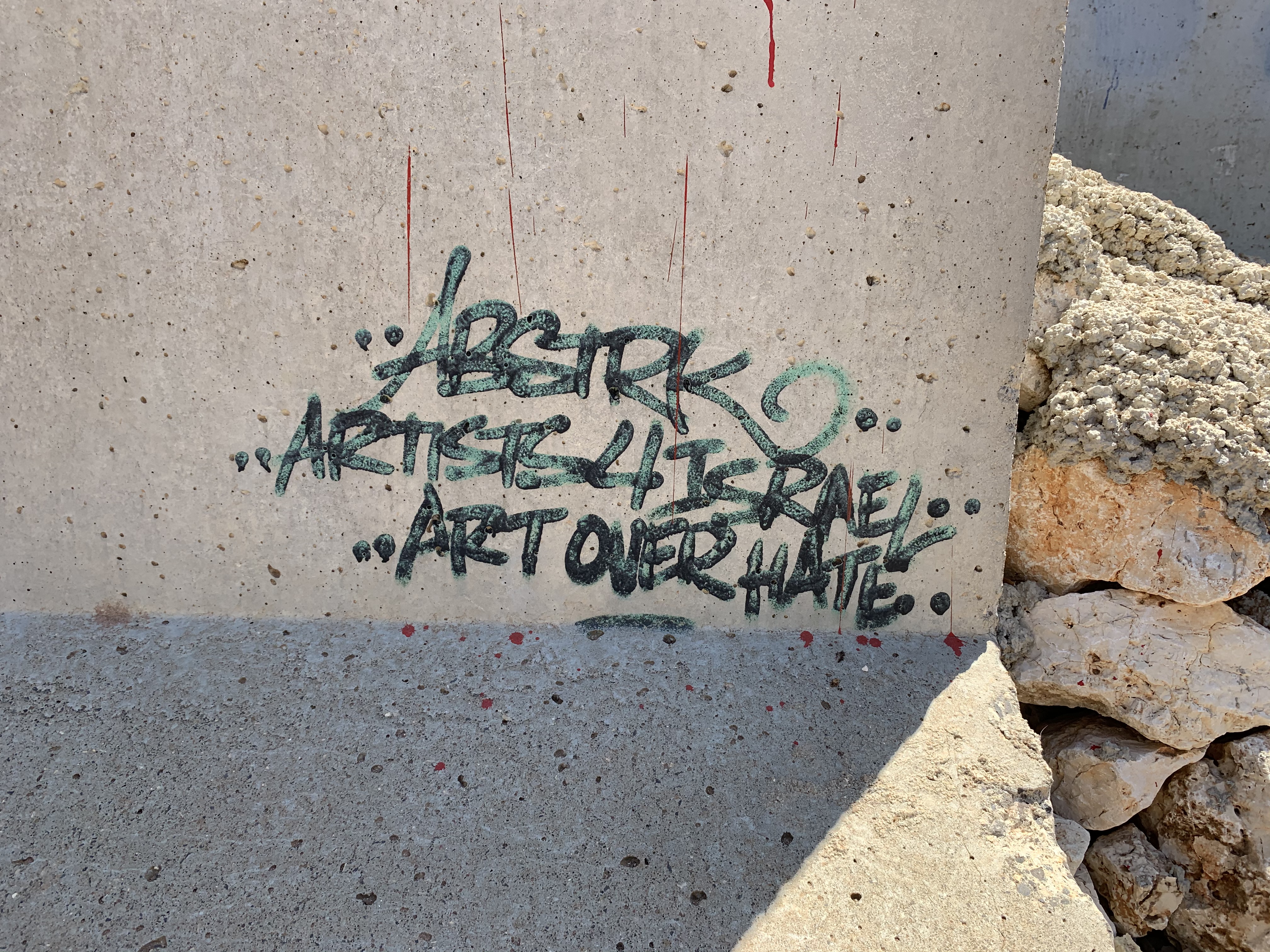
Soon after, concrete bunkers – small shelters called magenit, or little shields – started popping up on highly trafficked street corners. They were placed in parks, near schools, kindergartens, shopping center parking lots. Hideously ugly, they did the job. But they also proved to be the perfect blank canvases. Enter Australian artist, Justin Andrew Hook.

John and I had the good fortune of spending a day with Justin last month, hearing his story and getting to know this amazing human being. Justin, whose, stepfather is Jewish and mother who is Christian, worked for a while in the luxury hospitality industry in Sydney, even serving members of the government and foreign dignitaries. Everything changed for him during COVID, when his jobs ended. This led to some intense soul searching.

“G-d placed certain gifts inside me that needed to be honored. Art was my currency that actually became my identity. When I started to acknowledge and use that, things began to shift for me,” explained Justin. He began to show his paintings at exhibitions and galleries, and then became a curator and manager of an art gallery in the heavily traveled Bondi Junction suburb of Sydney. Opening nights attracted many different kinds of people from all over the world.

Because many Israelis travel the globe after their army service, Justin soon made many new Israeli friends. He began to bump into Israelis everywhere, and a desire to visit the Holy Land grew within his spirit. He now comes every year. “I absolutely love Israel! The culture is so attractive, fast-paced and super inclusive. The people are warm and inviting: the lifestyle and food is amazing! It’s like you become instant family with everyone here! Despite all the severity here, Israelis know how to live life, prioritizing G-d, family and friends. They live life to the max and know how to get the most out of life.”

Totally extroverted and exuberant, Justin has met a wide spectrum of people in Israel from Orthodox Jews to seculars; from Arabs to Druze; Christians and Messianics. His experiences are different each trip. In 2022, he was commissioned to paint a huge mural on a prominent wall in the village of Mesilat Zion outside Jerusalem. A short documentary was made and put on YouTube which opened up many more opportunities for him.

https://youtu.be/FzhMbIL-5fc?si=S9keT8WNhSNGQrKQ

During his 2023 trip, Justin happened to be celebrating Sukkot in a village outside Haifa when the 7 October Hamas invasion into Israel took place. Thousands of rockets were falling on Tel Aviv and the center of the country. The Australian government put a notice out to all travelers that they must return home immediately. There was no choice and a military airlift was scheduled to depart. Justin was in no way fearful. He even wanted to stay and help anywhere he was needed, but the government was insistent that he leave.

In the months that Justin was home in the Land Down Under, it seemed that everything had truly turned upside down. The narrative of the situation in Israel as told by the media was nothing but half-truths and outright lies. This deliberate anti Israel propaganda resulted in the growth of the pro-Palestinian movement, marching and chanting and vandalizing the larger cities of Australia. The media was playing upon the good Will of innocent, well-meaning people – stories of genocide and IDF atrocities against the people of Gaza was a complete deception. Immediately, Justin knew he had to become a voice for truth and for the people of Israel. He was well connected to the Land and the People and knew firsthand the reality of the situation on the ground.

At the very last minute, this past September, he knew in his spirit that it was time for his return. Justin booked round trip tickets for a 2 1/2 week stay during the Feast of Sukkot. He was led to travel the country, bringing a message of hope and support to his friends. When he arrived at Tiberias on the shores of the Kinneret (Sea of Galilee), the doors opened wide for him to put his artistic talents to work.

Despite continual bombing by missiles from Hizbulla in Lebanon and suicide drones, those ugly cement shelters were calling out to him. Justin reached out to an Israeli friend, who immediately and miraculously received instant approval from the mayor of Tiberias to decorate the blank boxes. Not only that, but Justin’s Jewish friends who run NGOs throughout the Galilee would help support the project. There was just one hitch: it had to be done now or never.

A new dilemma arose: Justin was scheduled to fly back to Australia in less than a week. There was no way he could attempt to complete such a project in so little time! Justin walked along the Kinneret, praying and seeking G-d’s direction. Everything was happening so quickly, but if this was part of the Divine Plan, all the little details would come together. In Israel, there is a saying: “There are no coincidences. It is all by HaShem (G-d).” And so it was, that at the very last minute, Justin’s non-refundable plane ticket was changed and paid for by his very own travel agent who also had a deep love for the people of Israel. Both of them knew that Justin had been handed a once-in-a-lifetime opportunity.

“I also set up a last minute page (on his social media) showcasing this opportunity. It included a Go Fund Me link so people could help contribute to my living expenses. My visa was good for three months. Amazingly, after posting a few videos, generous people from all over the globe caught on to the vision and funded my ability to stay in Israel.” The various cities paid for all of his art supplies and he was able to focus on the project and complete the first season of shelters. The. L-rd provides and guides.

“It was during this time I learned spontaneity. I just rode the wave and flowed with the Spirit. I knew G-d wanted me to be a bridge builder with love and the desire to help these people in need.” For the next three weeks , Justin painted his first shelter, right in the center of downtown Tiberias, an extremely important Orthodox city, one of the four holy cities of Israel.

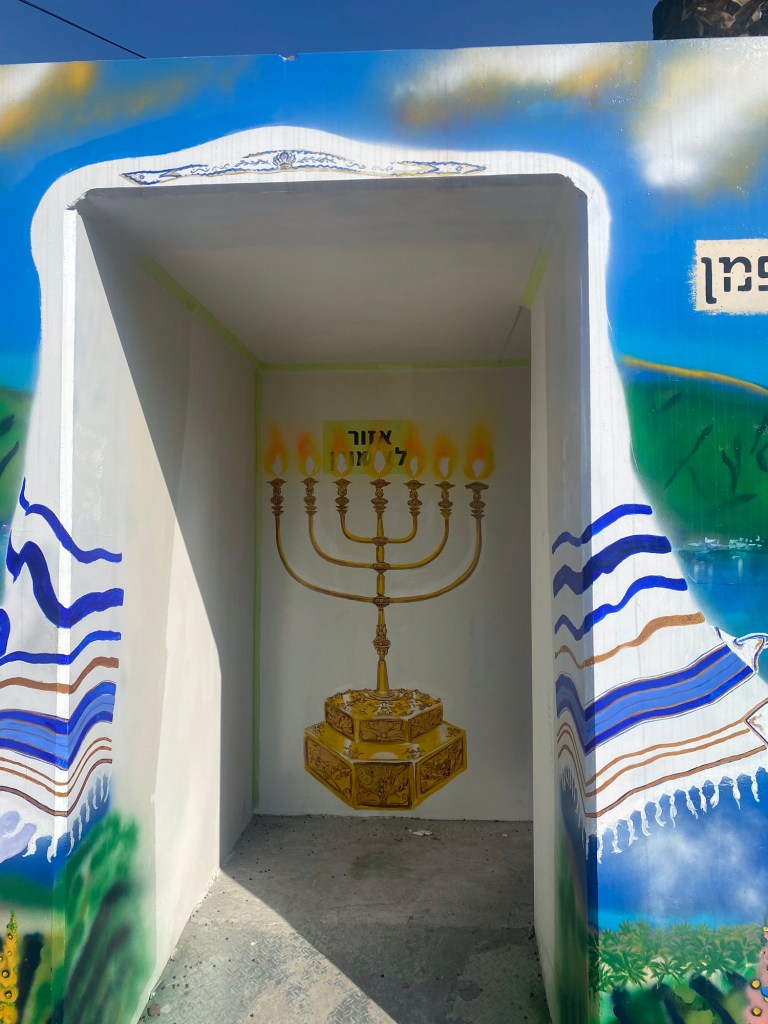
On the outer walls of the bomb shelter he painted the most gorgeous mural of the Sea of Galilee in the full bloom of springtime. The painting wraps around the entire magenit. The mountains of the Golan and lower Galil region encircle it. Butterflies ands birds symbolize new life. The red poppies are a remembrance of the hostages still in captivity. Working with a medium of spray paint, Justin captured the fishing boats on the sea and the migrating birds overhead. The morning sun over the mountains depicts the verse from Malachi 4:2. “The sun of righteousness will arise with healing in his wings.” It was truly a project of healing.

But this was not all. Missiles flying overhead and the thunderous booms as Iron Dome intercepts the incoming rockets can be terrifying for many people. Little children, especially are easily traumatized by having to run for cover. Through Justin’s gift, fear, trauma and ashes could be transformed into beauty and hope.

Justin was inspired to paint a large tallit, prayer shawl wrapped over the entrance to the shelter. It was a sign of G-do’s abiding presence. People were beginning to take notice as he painted. Rabbis stopped to admire his work. Justin painted a verse from Psalm 16:1, a Psalm of David, in Hebrew: Preserve me, O G-d. You are my shelter.”

Stepping inside, instead of being greeted by cold, gray walls, Justin painted the seven-branched menorah that stands in the Old City of Jerusalem, its flames almost alive, glowing brightly. It was truly an inspired vision and a way to share the message of hope and G-do’s love and mercy to His people. It is the national symbol of Israel and has become his signature inside each bomb shelter. “The menorah is a sign of the victory of the Jews over their enemies. It is an eternal symbol that proclaims ‘I am with you always,” explained Justin.

The chief Chabad rabbi of Tiberias sent a video of the finished shelter to the chief Chabad rabbi of Sydney. It was shared with the public on the last night of Chanukah, giving a loving message of perseverance to the Jewish people of Australia. The video soon spread throughout Jewish congregations worldwide:

https://youtu.be/l71sEL_uaao?si=dX9_T2QayrnynL9P

After this first shelter project, 50 more quickly became available throughout the Galilee, in Tiberias and he Holy City of Tsfat. Justin has received a commission to decorate magenit at playgrounds, skate parks, bus stops and schools. Thus far, six have been completed.

Returning to Jerusalem, Justin bumped into wildly popular social media influencer and Jewish/Israel activist, Zack Sage Fox at the Kotel (Westen Wall). He was visiting from the States.The two did an interview on the spot and Justin’s fame spread like wildfire. I met up with Justin a couple days thereafter. He is totally a bridge between Australia and Israel, the Christian Zionists and the Israeli people.

Justin had to leave as his visa was up, but is praying that the Australian and Israeli governments will grant him a long term visa which will enable him to see the new art project to its completion. “We are all called to be light wherever we go,” he told us over coffee. “We embody His living Torah; we are to do good works and serve others in love, to bring joy and hope to those we meet. We are each given specific gifts and talents that make up our unique identity. If everyone used the gifts given us, for the betterment of the world, this would be a better place.”

He can be found on Instagram @justin_andrew_hook. On Facebook and at http://www.justinandrewhook.com

To support his work, you can go to SUPPORT A PROJECT. justinandrewhook.com/s-projects-basic

War Stories. Day 289.

A Jewel Among Women

I have had the incredible honor to meet quite a few truly amazing people living here in Israel since we first made Aliyah in 2015. This country is made up of so many dedicated, resilient and caring individuals. Every time I interview somebody, the first words out of their mouth is an apology for not being able to do enough to help. For just being a small cog in a larger machine. And to thank me (who really am not doing much but raising awareness) for my contribution. Honestly, I have never ever experienced anything like this. John and I were struck by this willingness to share, to be hospitable, and to reach beyond one’s comfort zone the first time we visited this land in 2011.

This is my last in a series of people making a difference to help out during the war. After finding out some of our own donations were not being used as justly to help people directly (skimming off the top or huge salaries to the organizers/CEO), I went on a quest to find truly honest people giving of their time and effort and even pursestrings to help those most needed. To those of you who asked where they can donate, these are three that we fully endorse…

A Ray of Light

In Hebrew, “or” means light. And here in Israel parents take their baby names more than seriously. This feature article is the third in a series of feature articles about people making a difference. Meet Or Avni-Aharoni.

For some unknown reason – perhaps just to cut the seriousness of the constant flow of bad news- I decided to scroll Etsy a few weeks ago. Not intending to buy anything, I came across this online shop that sold Judaica. A lovely bracelet caught my eye and nearly brought me to tears. Those words!!!! It spoke to my heart, was just what I needed to remind me – the people of Israel live – עם ישראל חי and I had to have it. And so the story begins.

I know there are many ways to spend your money. I know there are many stores out there, both brick and mortar and online. And I know there are many ways to support Israel: small business owners, soldiers, wives of soldiers. But this is a story set apart.

Or Aharoni kept in touch with me from ten minutes after my order was placed. At first the rose gold metal for my bracelet was unavailable, but Or fulfilled and then expedited my handcrafted order, which I was shocked to receive within ten days. It came so beautifully packaged. A blue wax seal said “The people of Israel live” in Hebrew. But there here was another smaller box with a seal.

There must be a mistake, because I had only bought the bracelet. The bracelet was even nicer than I expected. But inside the small box, was a little gold necklace with a tiny charm….absolutely perfect for gifting my granddaughter. But this is not supposed to be a buyer’s testimony. Still, I was shocked to receive a note (Or speaks and writes perfect English) thanking me for my purchase, explaining how this sale actually helps the people of Israel (story follows below).

John and I had an upcoming engagement party and I wanted to get a meaningful gift for the couple. I already knew that Or’s shop, Jewselry, had housewares, clothes and gifts that were unique and well-priced. I called her up and we talked on the phone for quite a while.Things clicked between us immediately. And I knew instantly that I had to share her story with you, because Or truly is a ray of light in this dark world.

Or is a young wife of a firefighter and reservist. She is a mother to three little children. A graphic designer and maker of jewelry as well as a small business owner, she has a heart of gold. She started out designing and selling her products a little over a year ago on various platforms and had instant positive response, and then 7 October rocked everything and everyone in this country.

“ All I wanted to do was to take something horrifying and turn it into good,” she shared with me.

Or grew up in a very secular Israeli family. Her grandparents made Aliyah in 1948 from Romania. Everything changed for Or in 2015, when she met her bashert, the one that was “meant tobe.” David and his family were fairly religious Jews. A large modern Orthodox Jewish family, they took delight in celebrating the Shabbat with big meals and holiday get-togethers. It was so beautiful, but very different from Or’s upbringing.

After she and David married, Or, too, wanted to host these wonderful family Shabbat gatherings, but she didn’t have any of the accoutrements, nor did she feel she knew the proper blessings. Even living in Israel, this was all so unfamiliar to her. Or searched for, but couldn’t find anything she liked that would start off a person new to G-d, new to religion and new to observance. She saw a need and decided to remedy her problem. As an artist, Or designed and made little cards, magnets and signs for the home with Shabbat candle blessings, grace over meals, prayers and home blessings. They were not only functional, but pretty.

Her friends saw them, and they, too wanted Jewish related products for their homes. And thus, Jewselry was born. It was the beginning of a journey. Jewselry is more than just a store for buying Judaica and Israeli merchandise – it’s a celebration of joy. It’s a way Or, inspired by a love for traditions and beauty, brings life to all her contemporary creations. It’s a celebration of the vibrancy of Israel and her people. It’s about passion.

Or decided upon the name Jewselry as a play on words. The Children of Israel in the Bible are called Am s’gulah. They are each individual jewels in the eyes of G-d. Each different, but with its own beauty, light and potential. Each has the opportunity to be a great gift. name, so are Or’s products.

The Inside-Out

Life was going more than wonderful for the Aharoni family. Then 7 October came and the world turned inside out. David was away on duty and the missiles were flying regularly from Gaza into central Israel. Or could not sleep. She was continually having to wake up her children in the middle of the night or grab them during the day to get them all to the bomb shelter. The business became her sanity. All too soon things got worse on so many different levels as she found herself on the front lines of confronting Israel hatred and pro-Palestinian attempts to hurt Jewselry.

Whether Etsy or Amazon, Israeli products were being taken down, scratched from the internet. Amidst a frenzy of antisemitism, there were complaints that the Israeli flag, the map of Israel, the word “Zionist” were threatening and hateful. On Israeli Independence Day, sixty plus products were pulled from Or’s Etsy shop because they contained the Hebrew words “Am Yisrael Chai” or “the people of Israel live.” Someone had made the claim that they owned the rights to those words, the anthem of the Jewish people for generations.

Fighting Hatred With Love

Or would not be swayed. With Israeli chutzpah she decided to fight hatred with love. After petitioning to have her products returned to her site, she came up with two incredible ways to help others directly affected by the war. She saw all of her neighbors making meals for soldiers, gathering up equipment. Visiting the wounded in hospitals. But how could she help? Or saw this as her chance to do her small part to rectify this complicated situation here in Israel.

At the beginning, the economy was hit as so many reservists had to leave behind their small businesses. Being called up for duty meant they had no way to attend to their online presence. Israeli artists could no longer create, much less advertise, sell or ship their products. Her idea started with a friend from Sderot who made mezzuzot (the boxes you attach to the doorposts in your home. They contain a parchment with Deuteronomy 6:4-9). She got his permission to upload his products onto her site at no charge. She has since begun selling for more and more Israeli vendors, picking up their products in Tel Aviv and packing and shipping them both locally and abroad, with ALL proceeds going to the soldiers. Or says, “This way I save their livelihoods as they concentrate on saving us.” At Jewselry, she provides an online platform for Israeli soldiers who are business owners to sell their products worldwide.

This extreme act of kindness was not enough. She wanted to do more, but how? Her own sales had been impacted, so not only did she reduce her prices, so more people could support Israel by buying Israeli products, she had another idea. For every hand designed, gold-filled or 925 necklace bought, she would gift one to the mother or wife of a soldier. She has a list of women to whom she can donate on behalf of the buyer. The recipient can choose her own necklace from several options. Each beautifully boxed necklace comes with a personalized thank you note to the buyer telling them that

“Thanks to you for donating a necklace to ‘Daniella’ the wife of ‘Avi’ who is currently serving as a tank driver in Battalion 279 in Gaza.”

Also, the recipient gets a beautifully personalized letter with her gift.

“This necklace is a gift from …. in …..who is thinking of you and appreciates your sacrifice for the people of Israel. Together we will win.”

It’s a moving experience for all involved. Not only that, but Or donates a portion of her revenue to a family of a hostage still in captivity by the Hamas terrorists.

Your support counts too

By supporting Or, everyone wins. Businesses are helped in their fight to stay open. Reservists are helped to support their families. Wives and mothers of soldiers are appreciated for their sacrifice. Hostage families are remembered. And you get a high quality, unique product. Plus, you can especially show your support of Israel by wearing a cute t-shirt or beautiful piece of jewelry that is sure to get compliments. You don’t have to be Jewish. And the products are really inexpensive without compromising quality.

Jewselry has a presence on Etsy, Amazon and on Or’s own website, www.jewselry.com. It is also on Instagram @jewselry_world where Or offers specials, giveaways and shares recipes and insights on Scripture. Currently, there are great sales going on, so it’s fairly easy to show your support for Israel. The store gets 5 star ratings and rave reviews from the customers.

It’s the little things done by ordinary people with great love that will turn the darkness into light. Or says, “ I’m not just doing this for myself, but for Ha Shem (G-d) and for my children. They need to see the acts of kindness and to believe in the good. It’s for their future that I do this. And I hope they will have a beautiful future.” What an example!

Sliding into the Weekend

First, I want to thank you, my dear readers. You are the best!! I collected several heartfelt notes and letters both in my messages and direct email for our neighbors, the Aviv family. They lost their son, a beautiful peaceful windsurfer, who fell while on reserve duty in Gaza. I took them in a lovely ribbon-tied envelope last week. Emmi, Ido’s mom, was overwhelmed to tears. Both Emmi and Mark were absolutely shocked to know that people across the globe stand with them and support Israel. Every single Israeli I’m talking with feels so alone now. We all cried and I hugged both Emmi and Dasha (Ido’s fiancée- the wedding was supposed to be next month). We held each other close for a long while. I’ll be taking them another meal next Thursday, so your letters of comfort and encouragement are still wanted.

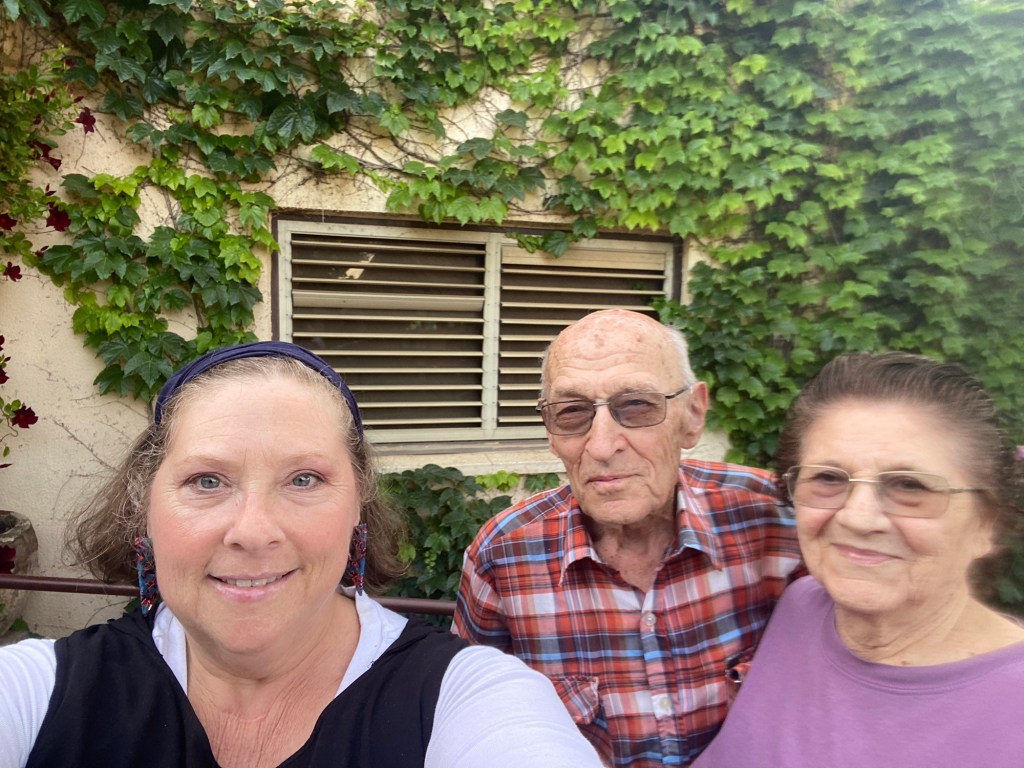
Speaking of neighbors: it’s time you met a few of my neighbors. Aryeh and Leah are 94 and 92 years old. They were born here and their passports and documents from pre-1948 label them as Palestinians. They were born under British mandated Palestine and their families have been here since the 1800s. They have been married 73 years. Every evening, Aryeh and Leah go on a long neighborhood walk, which is how we first met them.

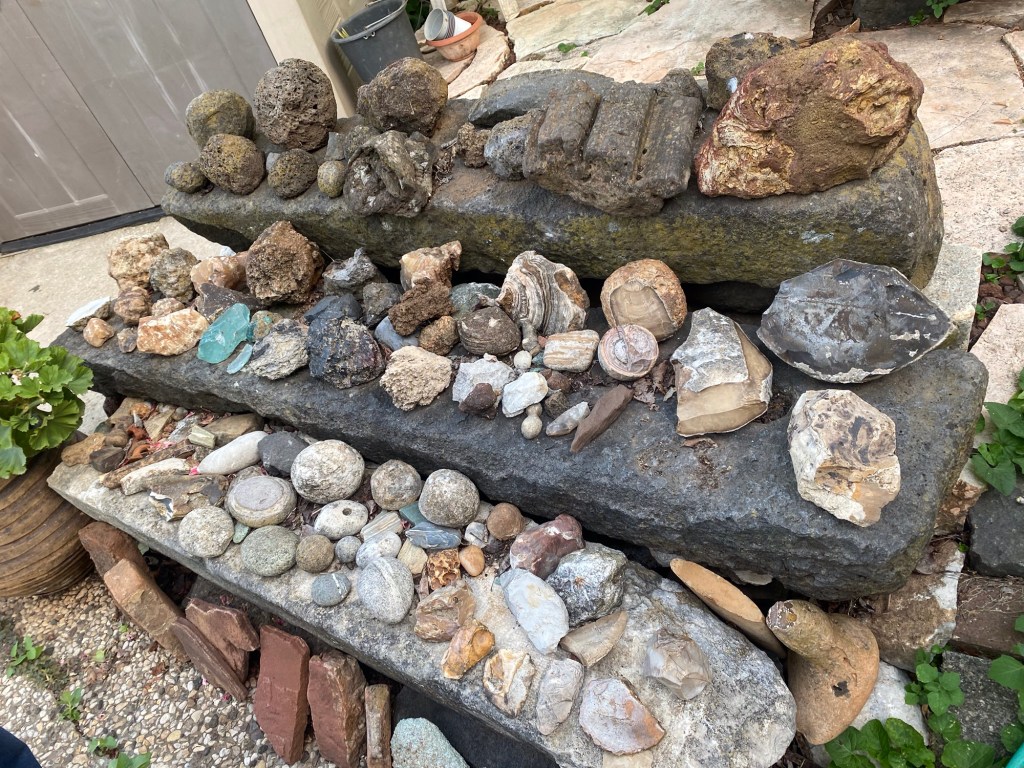
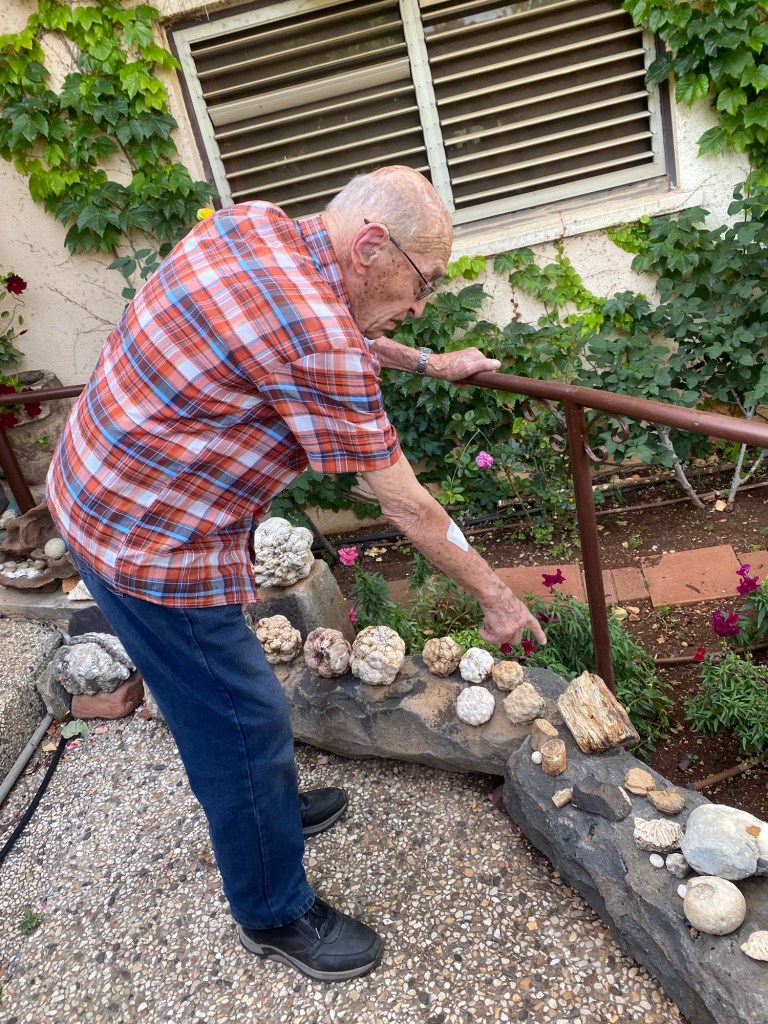
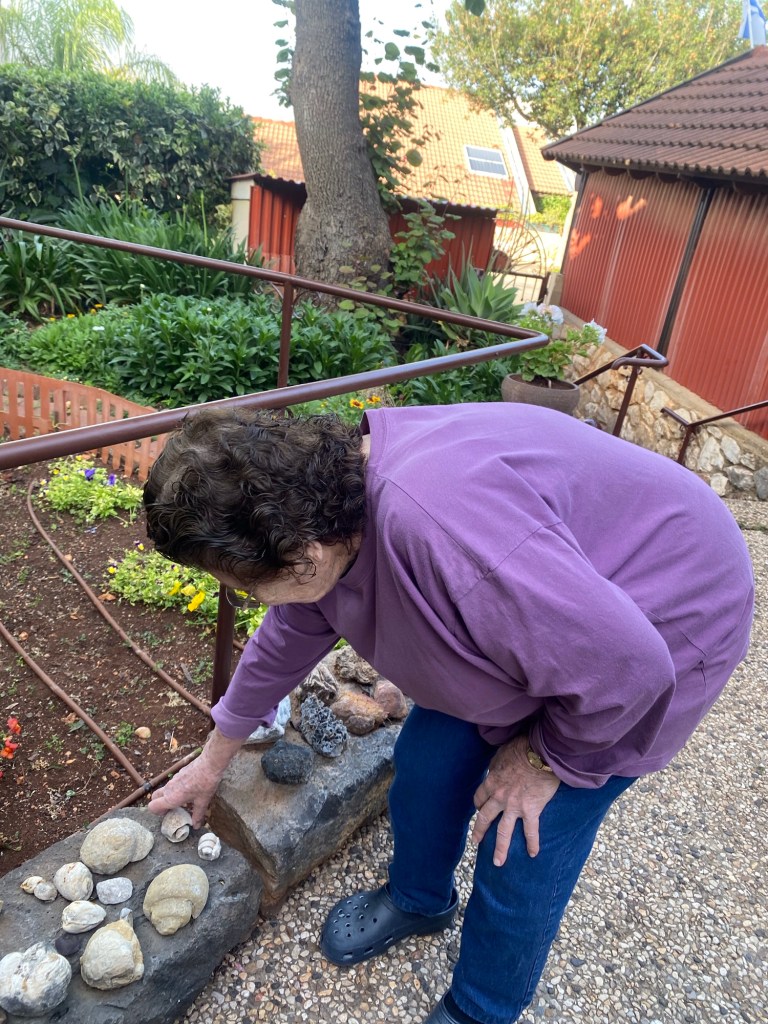
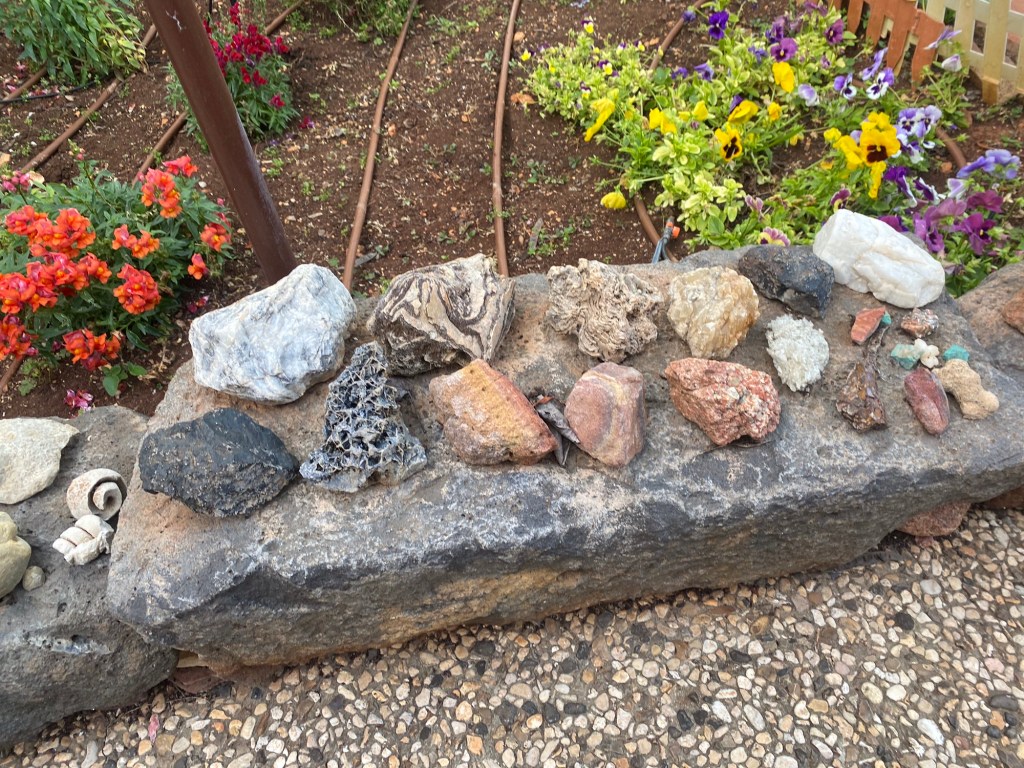
Leah loved my hollyhocks, so I gave her some seeds. She gave me a gorgeous red amaryllis. I shared my baby Italian and Native American tomato plants with her. Turns out Aryeh was an engineer just like my husband and he worked for years at Raphael, which is very much like Teledyne where John worked. Leah was a school teacher for decades. They are still avid hikers, and have traveled the world with their children and grandchildren. And…… they, too, are “collectors of found objects.”

It’s been a hobby/obsession of mine to pick things up from our travels and walks: flowers to press, shells from the beach, coral (leading to my arrest here the first year), pinecones, fossils and rocks. My kids used to make fun of me. John has gotten used to it and has become a pretty good “picker” himself. So, last week when we visited our neighbors, we were amazed. Geodes, rocks, fossils – each from a special place with a unique history and a story.

This past weekend was the Jewish holiday of Lag b’Omer, a celebration of the Light of Creation, holy Light, the Light of the World through the Scriptures, which is sometimes compared to fire. It also commemorates the life of Rabbi Shimon bar Yochai (Rashbi) and the miracles associated with him. Lag b’Omer is always a huge holiday here in Israel. Whether religious or secular, it’s a fun family festival where huge bonfires are lit. Kids sing and dance around the bonfires and families roast potatoes and eggs and meat wrapped in foil in the hot coals. The ultra religious make a pilgrimage to Mt. Meron, Rashbi’s tomb. This year, because of the war, everything was cancelled. No bonfires. No large gatherings. Especially Meron, which is a closed military area. It’s quite depressing.

Wednesday, John and I decided to drive up to Tsfat, about 30 minutes away. Nestled at the top of a mountain, it’s one of my favorite cities. This is the usually-busy tourist season. We would be having guests and taking them there this time of year. Big Bar Mitzvah and wedding parties would, in normal circumstances, be processing with musical fanfare down the already bustling cobblestones alleyways. Tsfat – sometimes transliterated Safed or Tzfat or Zefat, dates from Biblical times and is one of Israel’s four Holy Cities.

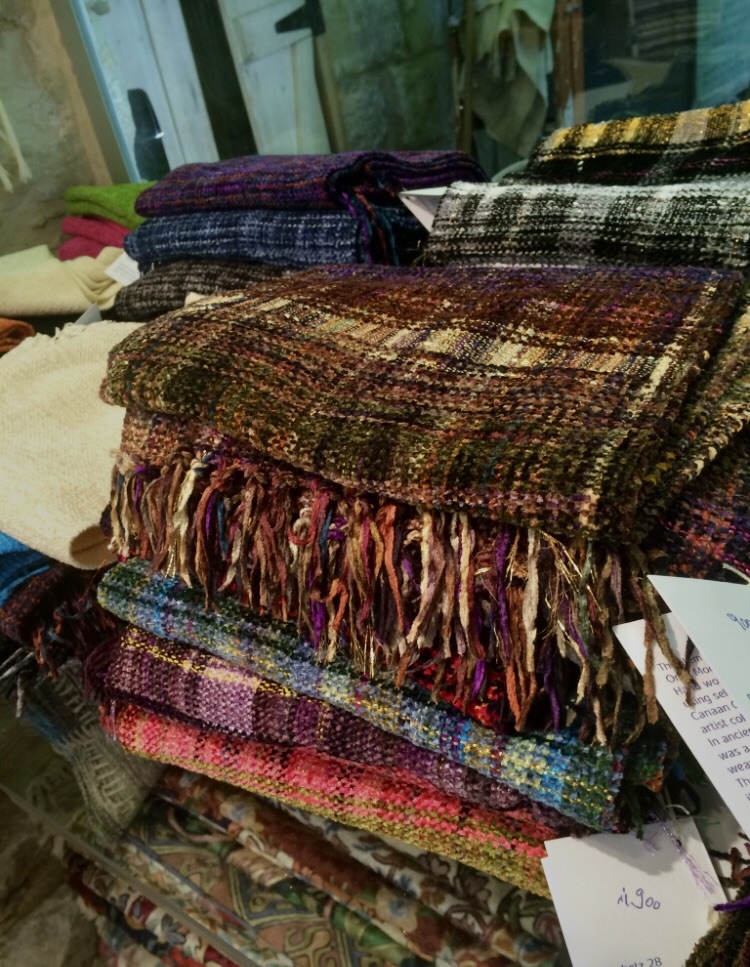
Tsfat was the home of the mystics and kabbalists. Today there are still many ultra Orthodox, but also there the hipsters, the hippies and the artists. Galleries line the streets of the Old City displaying high quality professional artwork like weaving, sculpture, painting, incredible jewelry and various crafts. They are known for their pieces of Judaica. And it’s a great place to shop for presents. We had an engagement party coming up and two weddings, and an anniversary.

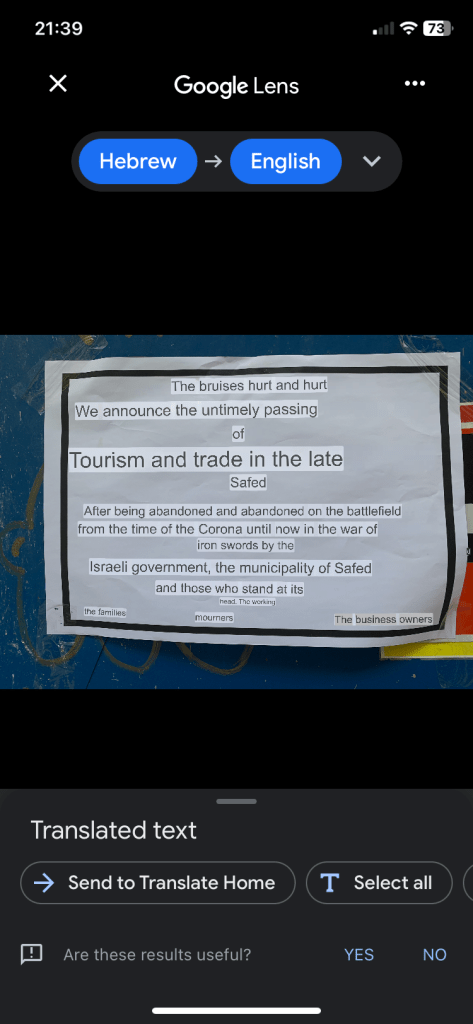
The drive up, although always gorgeous scenery-wise, was somber. Much of the area is so close to the border, people are not traveling there. We get drones and missile attacks from Lebanon several times a day. The city was a ghost town. No tourists. Empty streets. Most shops are closed. In Israel, when a person dies, a black and white notice goes up informing the public of who died, where the funeral and where/when house of mourning will be held. This time in Tsfat, posters were plastered throughout the city. Death notices. A sad but also clever way of saying the city and its businesses had died.

Luckily, the candle shop was open. Safed Candles are amazing handmade, all-beeswax candles…for Shabbat, Havdalah, Chanukah and every day use. Plus this business, open for over 50 years, has lots of other beautiful Judaica. And now, because there is no business, everything was on sale. To fulfill a request from my oldest daughter I bought 6 pairs of long golden beeswax tapers for only about $15. She’ll be delighted. Plus I scored a few other colorful handmade gifts. One other gallery was open. We felt so sorry for the shop owner who had four small kids and no income for nearly eight months. So we bought a few items: Roman glass earrings for my daughters, an engagement gift and anniversary gift.

all-beeswax candles…for Shabbat, Havdalah, Chanukah and every day use. Plus this business, open for over 50 years, has lots of other beautiful Judaica. And now, because there is no business, everything was on sale. To fulfill a request from my oldest daughter I bought 6 pairs of long golden beeswax tapers for only about $15. She’ll be delighted. Plus I scored a few other colorful handmade gifts. One other gallery was open. We felt so sorry for the shop owner who had four small kids and no income for nearly eight months. So we bought a few items: Roman glass earrings for my daughters, an engagement gift and anniversary gift.

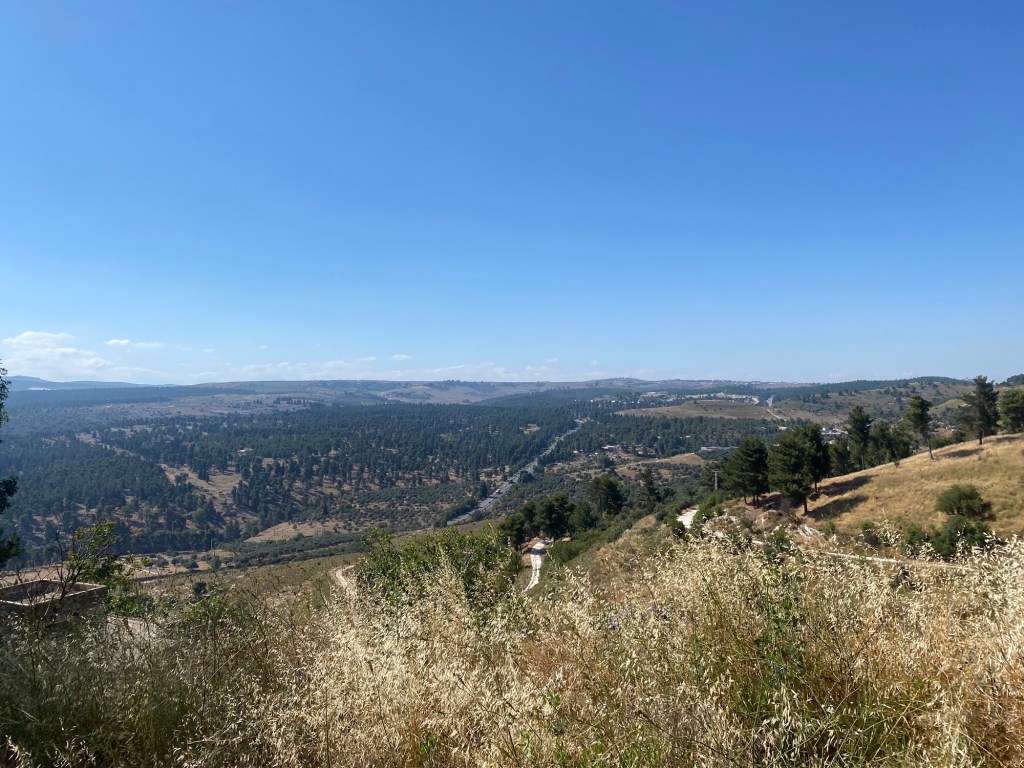
We stopped to admire the views from Tsfat. Mount Meron, which has been shelled daily (it’s a high point, literally, and a military intelligence installation. The day was so clear, there was no trouble at all seeing directly over the mountains into Lebanon – now all Hizbulla. Thankfully, there was no action, but John couldn’t leave quickly enough.

The highlight of our week happened last night. We were invited to an irusim, an engagement party. John had coached Pri’el in baseball as a kid and now he’s marrying his sweetheart, Bat’El. The cutest couple! But I’d never been to this type of party. The bride is from a Mizrachi Jewish family (Mid Eastern) and they have their own traditions. I was expecting a short, informal religious ritual where a rabbi blesses the newly engaged couple, basically a formal betrothal. I was totally wrong. No ceremony. No religious service.

Once again, most of the women were dressed fairly elegantly. Nope, not me. I kinda stuck out like an American sore thumb… and John in a short sleeve Hawaiian shirt. What were we thinking? We’ve been to funerals and weddings where people wore jeans, but the Mizrachi are different. Or rather we were- the men wore jackets, the women nice dresses. The young friends of Pri’El…. very casual, several in army uniforms.

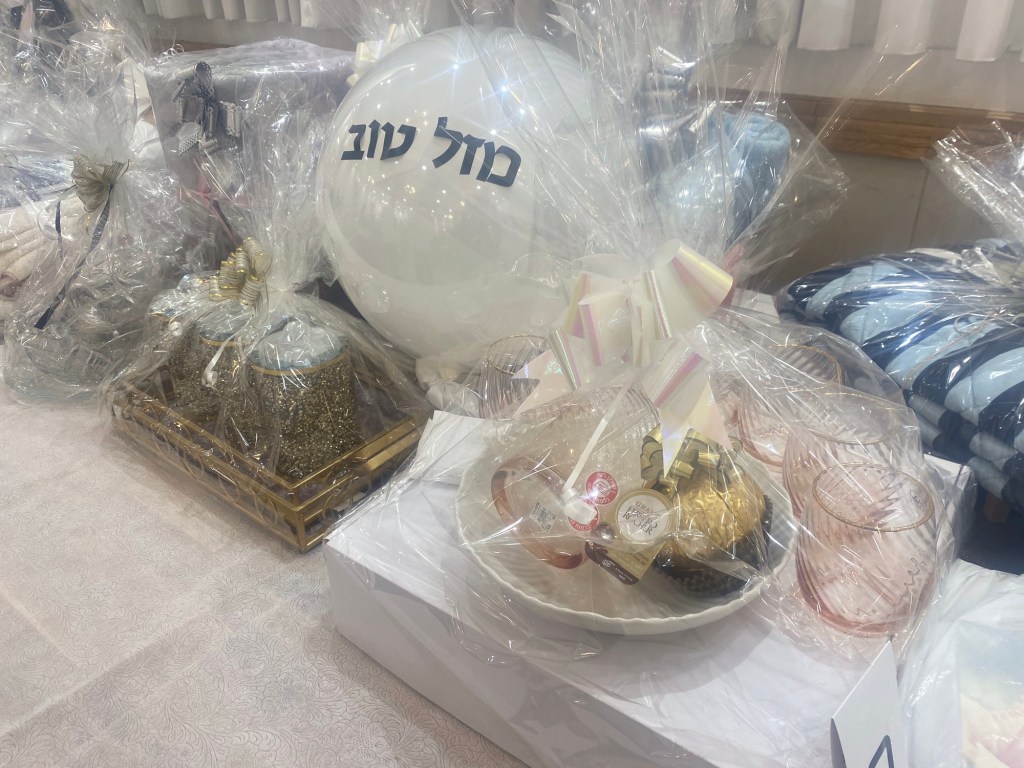
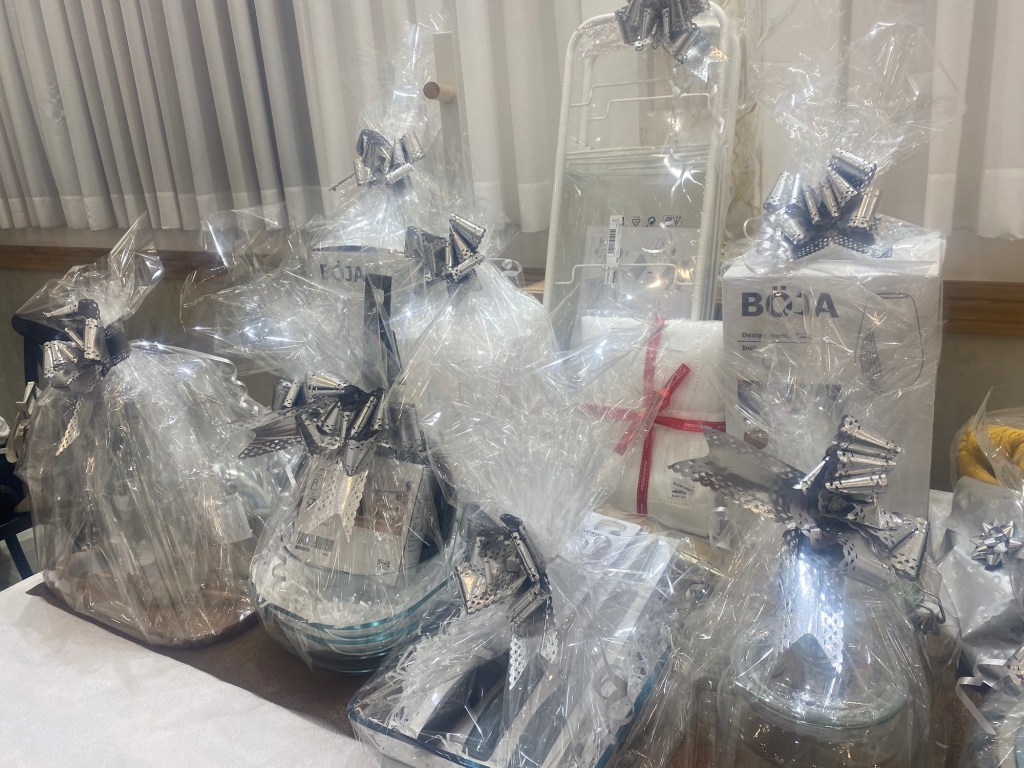
The bride’s dowry and a gift table was set up for everyone to see. Gifts from the bride’s parents. All beautiful housewares – in white and black and gold. All wrapped beautifully in cellophane with silver or black ribbon. And my rainbow colored gift bag from America that said congratulations with the colorful tissue paper tucked inside. Totally out of place.

The music! Live DJ, drummers, guys singing these melodiously Arabic sounding Hebrew songs. The bride and groom-to-be wore all white. And the food! Hors-doeuvres, salads of the Middle Eastern variety (Baba ganoush, dolma, tabbouleh, humous, lox, pickled fish, cabbage salads, lentil salad….). Then the first course- skewered salmon grilled over a fire. Wow. Then the large platters of meat – kabobs, sausages, brisket, steak pieces). So the party was at 7:30. And I had made dinner and we ate beforehand. Oooopps!

And of course, the dancing. The guys all dancing separately from the girls in circles. The joy. Spontaneous eruptions in different places. And then the young couple and friends sneaking out into the courtyard for a dance together…but never touching. All so pure, and innocent, beautiful and joyful.

After all the food and dance, the father of the bride-to-be presented his future son-in-law with a magnificent gold watch. Rolex??? Then our good friends, the parents of the groom presented Bat’El with gold earrings, a necklace, bracelet and ankle bracelet. It is a tradition in the Mizrachi culture to give gifts of gold.

Then came the next high point. The engaged couple paraded through the room like prince and princess with families behind. Then the bride’s mom and the Kallah instructor (the bride has a special female escort and instructor of the laws of family purity…well save that one for another time) handed a crystal bowl filled with chocolate pudding??? and two candles to Bat’El. They each lit a candle. They then took the bowl of pudding???? with the lite candles and proceeded to wave it in circles over the heads of the engaged couple. So weird. While the chazzan chanted and the people clapped along. PriEl’s friends were dancing on the chairs – it was very very cool.

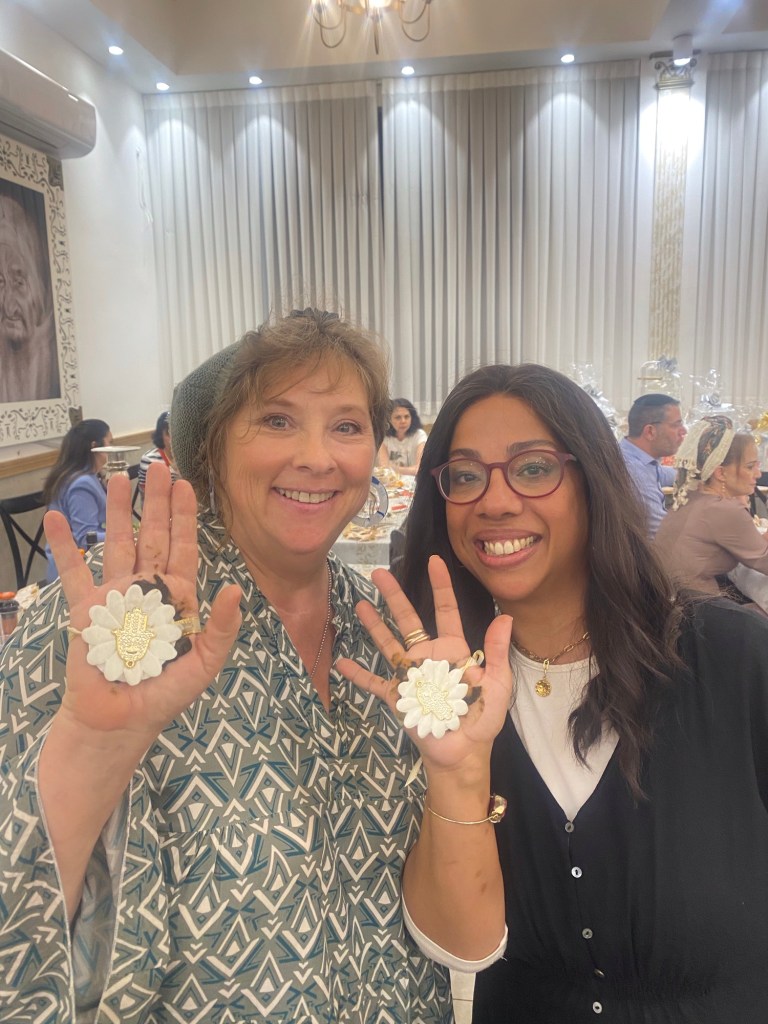
O.K. So I found out it wasn’t pudding. Or mud. Or a bowl of poo. It was Hannah. And now the ceremony begins as the bride’s mother and grandmother henna’d the palms of the engaged couple. And put a cool seal on to, tying it behind the hand. And next all the women line up to get their hands henna’d too.

By this time, it was getting on to midnight, and the desserts and rest of the festivities were going strong. We were beyond exhausted so John and I took our leave. It was quite the cultural experience- and a lot of fun. But now, preparations for Shabbat begin in earnest, so…more news next week.

Please, if you haven’t already done so, I ask you to write little notes of comfort for and solidarity with the grieving Aviv family. I will present them next Thursday. I can’t tell you how much a little note means to these people. To know they are not alone. Just put them in the comments section. And have a peaceful, relaxing weekend.

Taking the World by Storm

So for today’s post I could write about the constant intrusions and rockets from Hizbulla…. or the way the IDF set up over 450,000 tents and shelters with cots, cookstoves ( no, the innocent Gazans are not reporting to wood and trash fires to cook), water and medical attention. 8 hospitals have been fully staffed with doctors and medical personnel not associated with Hamas. They are for the Gazan civilians in need. There is also a special women’s center set up for maternity and OB/GYN needs. The staff is all women-

I could write about how Israel was not even included in the last round of hostages talks: the one where Hamas accepted a deal. Only they had changed it so radically and by then it was too late as every effort had been made to negotiate. Or how the IDF withdrew troops down to two battalions and put any attempts to enter Rafah on the Egyptian border and clear it of Hamas.

I was going to write about how the IDF did start to invade Rafah on Sunday night with surgical precision; how Hamas responded with rocket barrages into Israel; how in the morning, Hamas rockets landed on the Kerem Shalom Border Crossing. How 5 Israeli soldiers inspecting humanitarian aid shipments were killed, 4 injured, 3 trucks, and over a ton of food marked for entry into Gaza destroyed.

But no. Today I’m writing about a phenomenon that has swept all of Europe…and Israel. When I went to England, everyone was talking about (and my son-in-law’s sister’s husband was a respected commentator) who would win. Here, in Israel it’s reached a fever pitch. And no. It’s not Football/soccer.

It’s Eurovision!!!! Usually, we are not sucked in, but this year. Both my husband and I have been listening to all the entries and the pundits’ and social media influencers’ reviews of the 39 contestants. We listened to all of the first half of the entries Tuesday night. Tonight are the performances of the last 20.

I know Americans have The Voice and American Idol. But this is waaaay bigger. And this year there is major controversy. You see Israel (always a major contender and who has won four times, I believe), was not allowed to join at first because of the Israel-Gaza War. There were protests, petitions and threats to keep Israel out of the competition, but the Eurovision Committee decided at last to let Israel in.

The song to be entered was reviewed by the committee and rejected as being too political and too controversial in the midst of a humanitarian crisis in Gaza. It was titled October Rain. The song was reworked and resubmitted under the name Hurricane, with female vocalist Eden Golan singing. 20 year old Eden has recently immigrated to Israel from Russia, where she had won several vocal competitions. This is her big international debut.

I really was marginally interested until I heard the commentators from other countries’ reactions. Everyone was blown away and moved to absolute tears. Two anti-Israel people completely changed their bias and said they now understand where Israelis are coming from because of 7 October.

“We can bring everything we’re feeling and everything the country is going through in these three minutes,” stated Golan. It is a powerful song of loss and redemption, of strength in tough times. Compared with all the other entries, Eden Golan’s range, her emotion, her dramatic pauses put her in a league way above everyone else. Listen:

https://youtu.be/lJYn09tuPw4?si=pp6vaaUUWpS-NIYU

I’m so deeply moved by this song. We will definitely be watching tonight, hoping the politics are placed aside and that Israel comes across strongly enough to make it to the finals Saturday night. There are a couple countries that give stiff competition, but we shall see how the live performances go. Of course, we will be rooting for Eden Golan!

Living History: Sassoon Codex 1053

For one week only, the ANU Museum in Tel Aviv is displaying living history. A book, written over 1,100 years ago; passed on for generations; lost and now resurfaced. A mystery as to its exact author. No one knows exactly where it was written. This codex (a codex is handwritten on parchment, before the advent of printing on paper or vellum) is one of the world’s great historical treasures. It is the oldest, most complete Hebrew Bible to date, a bridge between the fragments of the Dead Sea scrolls dating from the First Century BC and other Hebrew writings dating to the Middle Ages. This Bible, known as Sassoon Codex 1053 predates the handwritten Medieval illuminated manuscripts by over a century. And it is coming up for auction at Sotheby’s in May. The codex is expected to break all records and sell for upwards of $50 million. The history behind this magnificent book is a story in itself.

Some time in the late 9th century, probably in Tiberias, a small city on the Western shore of the Galilee, an unknown sofer (scribe) copied the entire Jewish Bible over a period of years by hand on sheepskin parchment. It was most likely transcribed at the time of the great rabbis who wrote the Biblical commentaries of the Talmud. Much of the oral tradition was beginning to be codified in writing during this period. The Sassoon Codex Tanach contains all 24 books of the Torah, the Prophets and the Writings. Christians uphold these books as the Old Testament. Muslims believe the Torah and Psalms were divinely inspired. So this manuscript marks a foundation to Western civilization. The writing is a little bit messy in places in some of the vowels and spelling. But the writing style of the Hebrew only adds to the mystique of this 792 page manuscript.

Historically, Torah and Haftarah scrolls were written completely without vowels or punctuation: all of the pronunciations and chants were passed on exclusively through oral tradition. The Codex Sassoon was written in the Masoretic text. In the early Middle Ages, mostly in Tiberias, the great sages of old, rabbis and scribes known as Masoretes created a body of notes that standardized the Hebrew text of the Scriptures. Vowels were added along with punctuation marks and trope or chant marks, called nickadot (jots and tiddles). The root of the Hebrew word ‘masor’ means to transmit. These notes were added to ensure correct transmission of the traditional oral text and to eliminate any possible human error in copying the Scriptures. The Masora, all the nickadot, are of utmost importance as they instruct the reader exactly how a word is pronounced, thus ensuring the correct meaning. The punctuation ensures the correct grammar, and cantillation marks indicate how the text is chanted, also ensuring correct punctuation (when to pause at the end of a phrase; specific words requiring emphasis; where to stop at the end of a sentence or paragraph). 

The earliest Hebrew manuscripts found are the Dead Sea Scrolls dating to the First Century BC. They are very incomplete, missing entire books of Scripture. Most of the scrolls are fragments that needed to be pieced together. After a silence of almost 900 years, the Sassoon Codex is a bridge to the ‘modern’ era. It has been carbon dated to the late 800s AD. There are notes of ownership written at the back of the text and a deed of sale written in Aramaic Hebrew was discovered in the middle of the Bible. From this, as well as carbon dating, historians can site its provenance. What is known is that the manuscript traveled throughout the Middle East. Most likely written in the Galilee, Israel, only the wealthiest could have afforded its commission. Eventually it made its way to Damascus, Syria, where the codex was owned by a Khalef ben Avraham. It was sold to Yitzhak ben Yehezki’el Al Attar who, in turn, bequeathed it to his sons, Yezki’el and Maimon ben Attar. Along the way, a leather cover was added and the manuscript was bound in a book. In the 13th century the manuscript found its place in the great synagogue in Makisin (present-day Markada),Syria. Before the synagogue was destroyed by Mongol hordes in the 14th century, the codex was given to a Muslim man named Salama ibn Abi al-Fahkr, for safekeeping, with the promise to return it after the house of worship was rebuilt.The synagogue was never rebuilt. History of the book remained silent for the next several centuries. It was as if the book had completely vanished!

600 years later the leather-bound book resurfaced in Iraq. In 1929, the manuscript was sold to David Suleiman Sassoon (1880-1942), son of a wealthy Iraqi international merchant. Sassoon was born in Bombay, but moved with his mother to London after his father died. Educated in London, and inheriting his father’s business and wealth, his greatest mission in life was to find and collect Judaica and historical Hebrew texts, much of which he bought in Baghdad, Israel, and Persia. Eventually, he would hold the world’s most impressive private collection. Each item received a number, catalogued in the order in which they were added to the collection. One of these included Sassoon Codex 1053, named for its sequential number. It was bought for £350 in 1929 in Baghdad. This copy of the Old Testament is older than the earliest Hebrew Bible now come to light, the Leningrad Codex, written in the 10th century. Sassoon 1053 was possibly written at the same time as the famous Aleppo Codex, but the latter is very incomplete, missing almost 200 pages. Scholars have been aware of the existence of Sassoon’s holding and importance since the 1960s. 
David Sassoon passed his extensive collection on to his children. In order to pay his estate’s British tax obligations, many of the tomes were sent to auction or were sold privately between the 1970s and the 1990s. Today most remain in private collections, universities and libraries. His son, Rabbi Solomon David Sassoon, sold Codex 1053 to the British Rail Pension Fund, who, in turn, put it up for auction at Sotheby’s in 1989. The precious manuscript was bought by a dealer for £2,035,000, who turned around and sold it to a Swiss investor, Jacob (Jacqui) Eli Safra, heir to the Lebanese-Swiss Safra banking family. Codex Sassoon 1053 then became known as Safra JUD002. Safra had the original leather cover completely rebound to keep the integrity of the parchment pages intact.

Mr. Safra allowed Biblical scholar, Prof. Yosef Ofer of Bar Ilan University to study the codex at his home in Geneva as guards stood outside the room. The leather-bound manuscript measures 12” X 14” and is 6” thick, weighing 25.5 pounds. The script on each page is divided into three columns. The Scriptures start with Genesis 9:26, as the first few pages of the folio are missing. To decipher the Masora requires a considerable amount of knowledge for full understanding of all the notes, which Professor Dr.Ofer has. Only a select few people have been able to study the notes found in the margins of texts from the Medieval period. This particular manuscript is incredible! The Hebrew writing is clear and dark, although a bit sloppy in places, without vowels or trope marks. The latter, the nickadot, have been added in a lighter pen at the bottom and top of the Hebrew letters. Notes on grammar, punctuation and inflection are written between the margins and at the top and bottom of the pages are more extensive handwritten notations. 

Tickets were free, so the minute I heard about this, I made my reservation. The museum is dedicated to telling the story of Jewish history through archaeological findings, art, writings, artifacts and oral tradition. The Bible on display is encased in a large glass vitrine, and spotlighted so the writing is crisp and clear. Much larger than I originally expected, it is truly amazing that I was able to read these pages. The letters are crisp and clear, but lacking the beautiful ornamentation or ‘crowns’ found at the top of certain letters. The text is quite plain, different from a Torah scroll. Although the edges of the parchment seemed worn and discolored, it was as if this was written recently. Absolutely incredible that something this old could be so well preserved! The margin notes were indecipherable to me, and the notes penned at the top and bottom of each page were tiny and without vowels..

Sharon Mintz, Senior Judaica Specialist at Sotheby’s states that this evolutionary history of the written Tanach “radiates power.” It is one of the most significant books as it documents the foundations of Western society and history. Before Codex Sassoon 1053 is auctioned in New York on 16 May, 2023, it will be on display for one week only in March and April in London, Tel Aviv, Dallas and Los Angeles. 

City of Peace: The Pearl of the Galilee

We visited Israel for the first time in 2011, when I was still a homeschooling mom. Because we used a modified Classical curriculum, my children and I immersed ourselves in history, literature, art, philosophy, ancient languages (Hebrew and Latin), and culture. Israel, a land steeped in Biblical, Hellenistic, Jewish, Roman, early Christian, Byzantine, Muslim and Crusader history was a place where my young son and I could actually walk out much of what we had learned in books. For us, it was truly exiting, and I knew we had to somehow be a part of this fantastic place. We first stumbled upon Tzippori in 2011, and wound up moving to a town just 20 minutes to the north. Last winter, my husband, John, and I decided to visit once again. Come with us to one of the most phenomenal archaeological discoveries in the 20th century (right in our back yard!!).

Perched like a bird on top of a high hill in the middle of the Lower Galilee is the city of Tzippori (which means bird in Hebrew). It was first built by Hellenistic (Greek) Jews around 125 BCE, and was chosen for its prime location on the main trade route between Egypt and Damascus, the Via Maris. It was also on the route from Akko on the Mediterranean to the Sea of Galilee. On several occasions, the city was attacked by marauding bands, and finally Herod Antipas, the great builder, undertook its reconstruction in 37 BCE. He employed many different tradesmen from stonemasons to carpenters and the top artisans of the day to create what the historian Josephus would call “the pearl of the Galilee.” As it is only 3.5 miles (a 45 minute walk) from Nazareth, it is more than probable that Joseph the carpenter and foster-father of Jesus was employed here, as was Jesus himself.

Lower Tzippori, a sprawling city adjacent to modern-day Nazareth, in background

By 4 BCE, the Romans were fully entrenched in the Holy Land. Many times they were fought off by zealots, but Tzippori was different. The newly remodeled city was full of Roman sympathizers, often times at odds with the local Galileans. Because Sephoris (as it was called by the Romans) was a “City of Peace,” it was spared destruction from Vespasian and Titus like most of the other towns and cities that were razed by the Legion between 66 and 73 AD. In fact, at one time, Vespasian had over 7500 troops quartered here. For its time, Tzippori was a very wealthy city as evidenced by the many magnificent buildings and especially the mosaics…some of the best in the world! Craftsmen were not only locals, but employed from Egypt, Greece, Rome, experts in the latest styles of carving, fresco painting and tile work. Let’s visit, shall we?

The archeological ruins in the lower part of the city included a colonnaded cardo, the Roman term for the large main thoroughfare. On either side of the cardo, merchants’ shops stood. From the excavation, we get a wonderful picture of daily life in the first century. Glass bottles with remnants of exotic perfumes were discovered; ceramics and stoneware vessels containing grains and pulses; exquisitely crafted jewelry (a gold earring with gemstones, bracelets, an olive leaf head wreath of gold) have been uncovered in situ. Historians note that farming in the rich Jezreel Valley soil and shepherding was done outside the city walls. Fish were brought in fresh from the Mediterranean and Sea of Galilee. In the center of the city were government buildings, a synagogue, and a bank or treasury. Most citizens in this mixed Jewish and Roman city worked for the government under Herod Antipas. There were scribes, tax collectors, judges, lawyers and merchants.

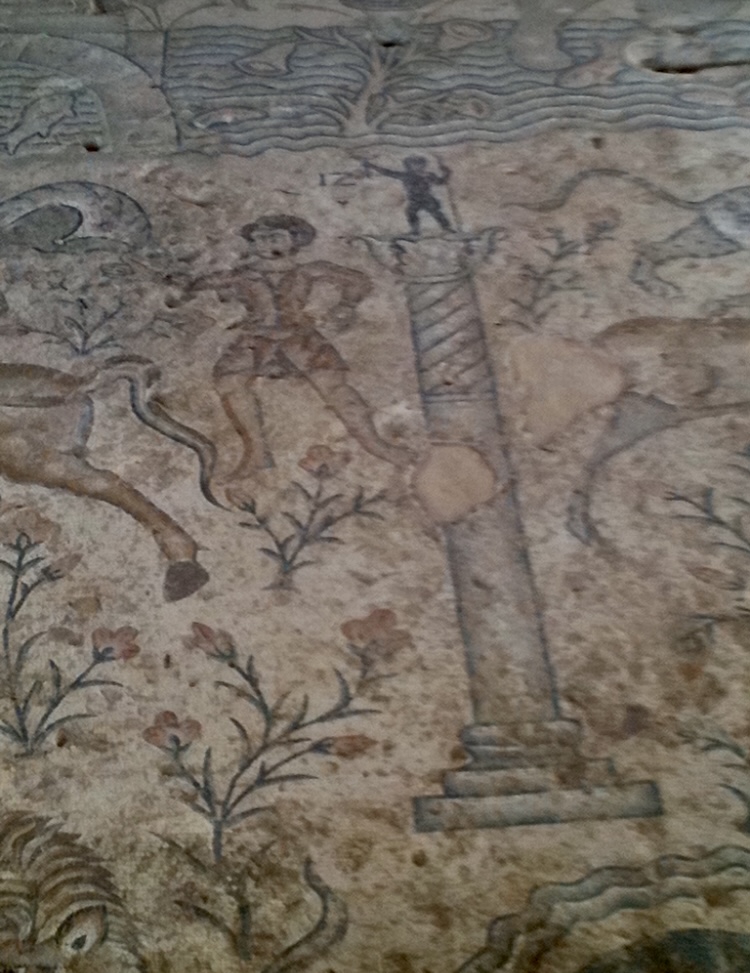
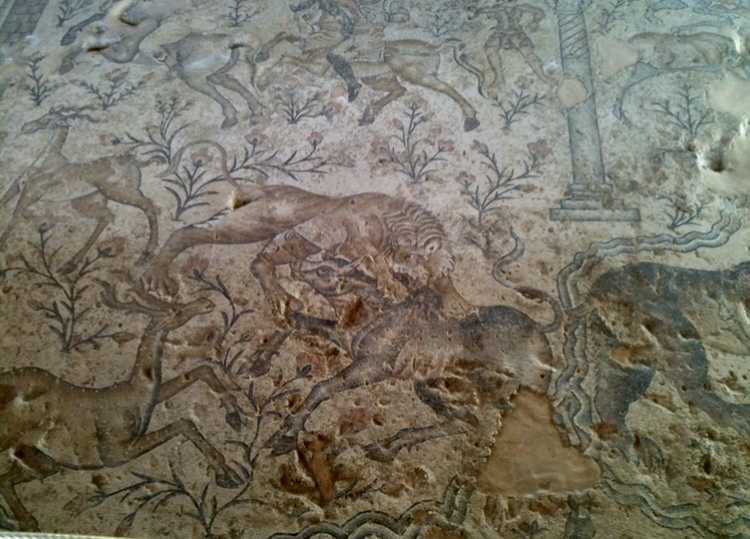
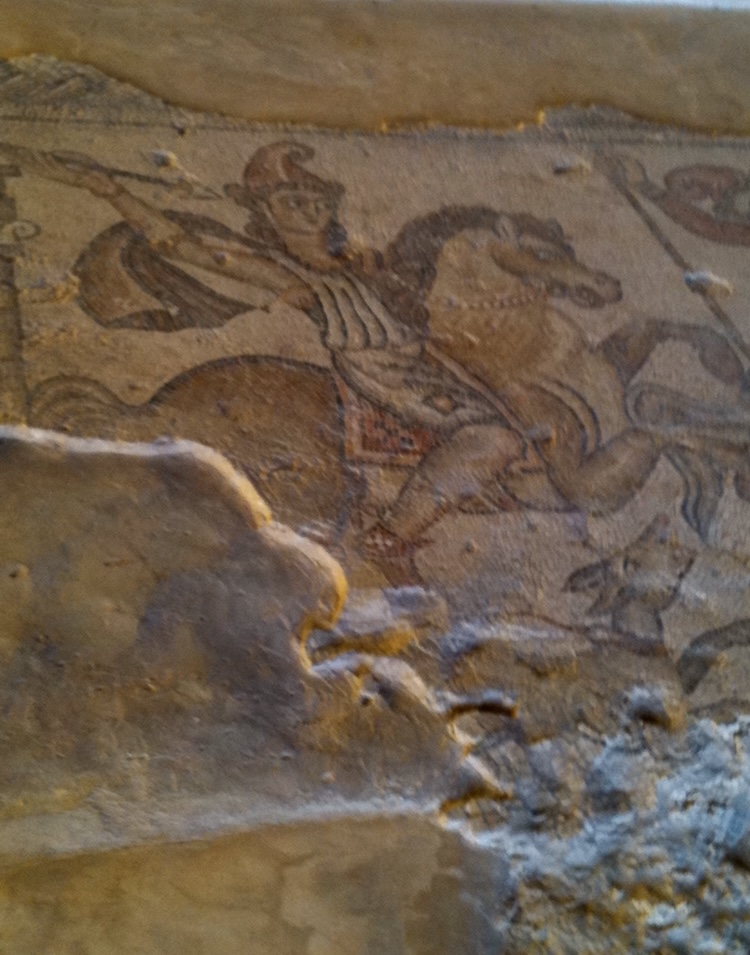
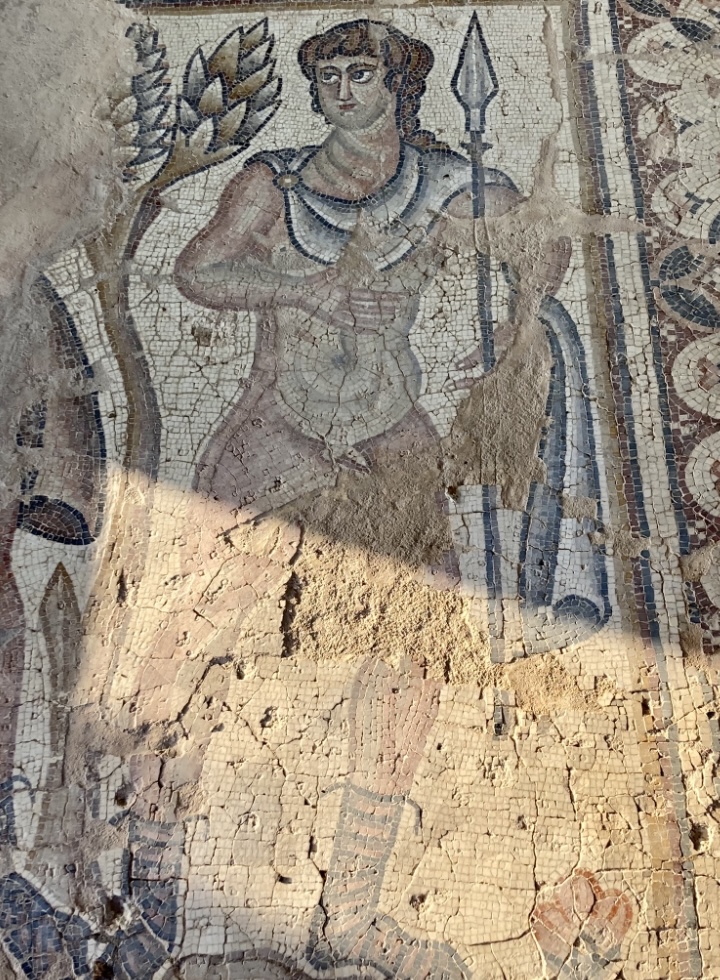
A large villa was unearthed in 1987. The many rooms contained floors of magnificent mosaics. It is called “The Nile House” because the floor in the main hall has a large mosaic depicting the celebration of the Nile River, with a number of separate scenes of different events. In one corner, the river flows from the mouth of an animal on whose back sits a Nile god. In another a reclining female holds a basket of fruit. There are papyrus and lilies in the stream, and the center figure is a picture of a man on a column with a rod called a Nilometer, which measured the height of the river. Surrounding are mosaics showing wild animals in hunting mode. In the room adjacent, the mosaic floor depicts Amazons hunting. The Amazons were a mythical race of female warriors originating from the Caucasus, they settled in Cappodocia (Turkey) and mated with the neighboring Gargarensians, keeping only the girls that were born. The word Amazon comes from the Greek ‘a’ meaning without and ‘mazos “ meaning breast. Legend has it that these women cut off their right breast in order to be better archers…. Anyway, you can see the Greek (Hellenistic) as well as the Egyptian influences in this ancient metropolis (The Greeks invaded Israel in about 150 BCE influencing many Jewish people in Israel to adopt their culture. Centuries before, the Jews were scattered throughout the ancient world in the First Diaspora, hence Hellenized Jews).

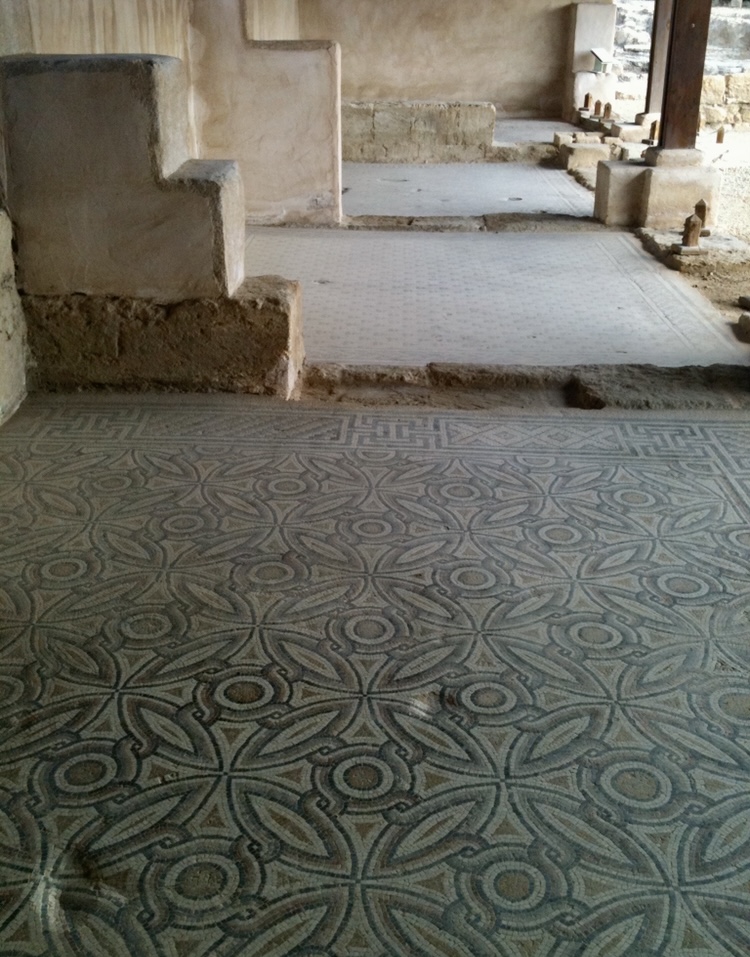
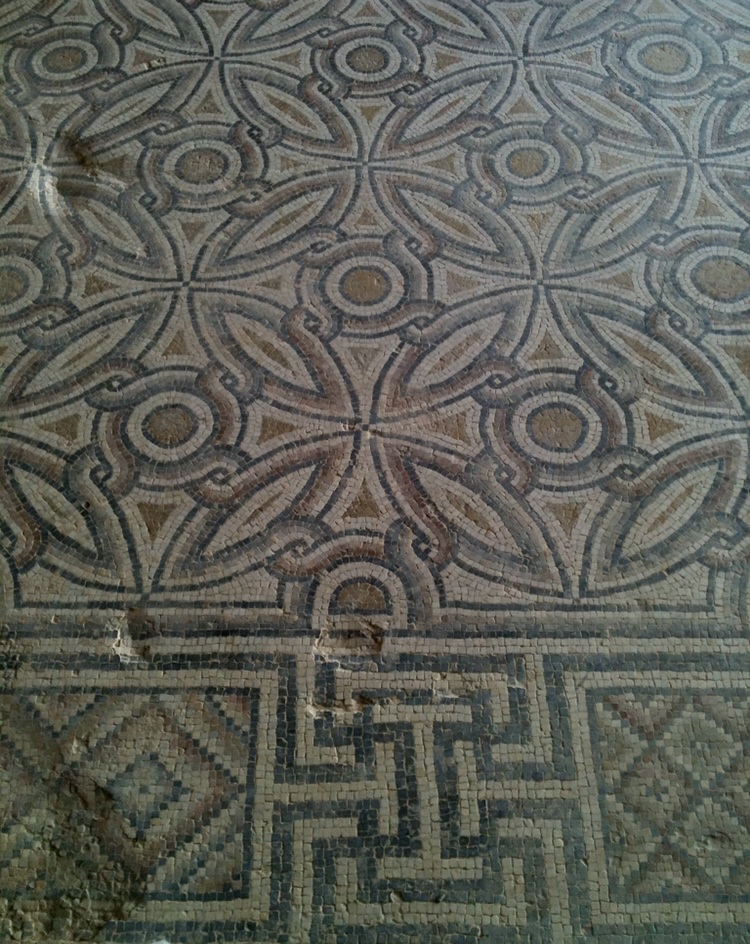
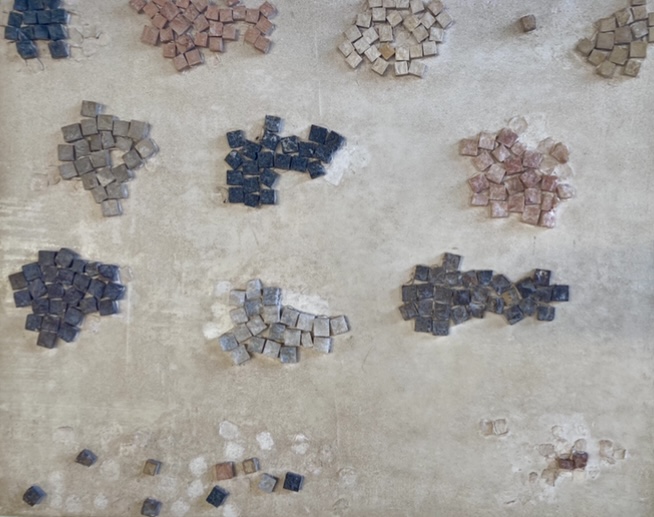
One of my favorite places is the tile merchant’s/ mosaic artist’s showroom. Just as we would go to a carpet warehouse or flooring store today, people in the first century could visit the tile showroom and see samples of floor designs. It’s absolutely great!! The ‘warehouse’ had sample designs in little cubicles, offering a variety of geometric shapes, borders, floral and figurative designs. Plus a sample board to choose the colors and sizes of the tesserae!! I don’t think you can find this anywhere else in the world!

Close up of tesserae samples… 68 varying shades in all

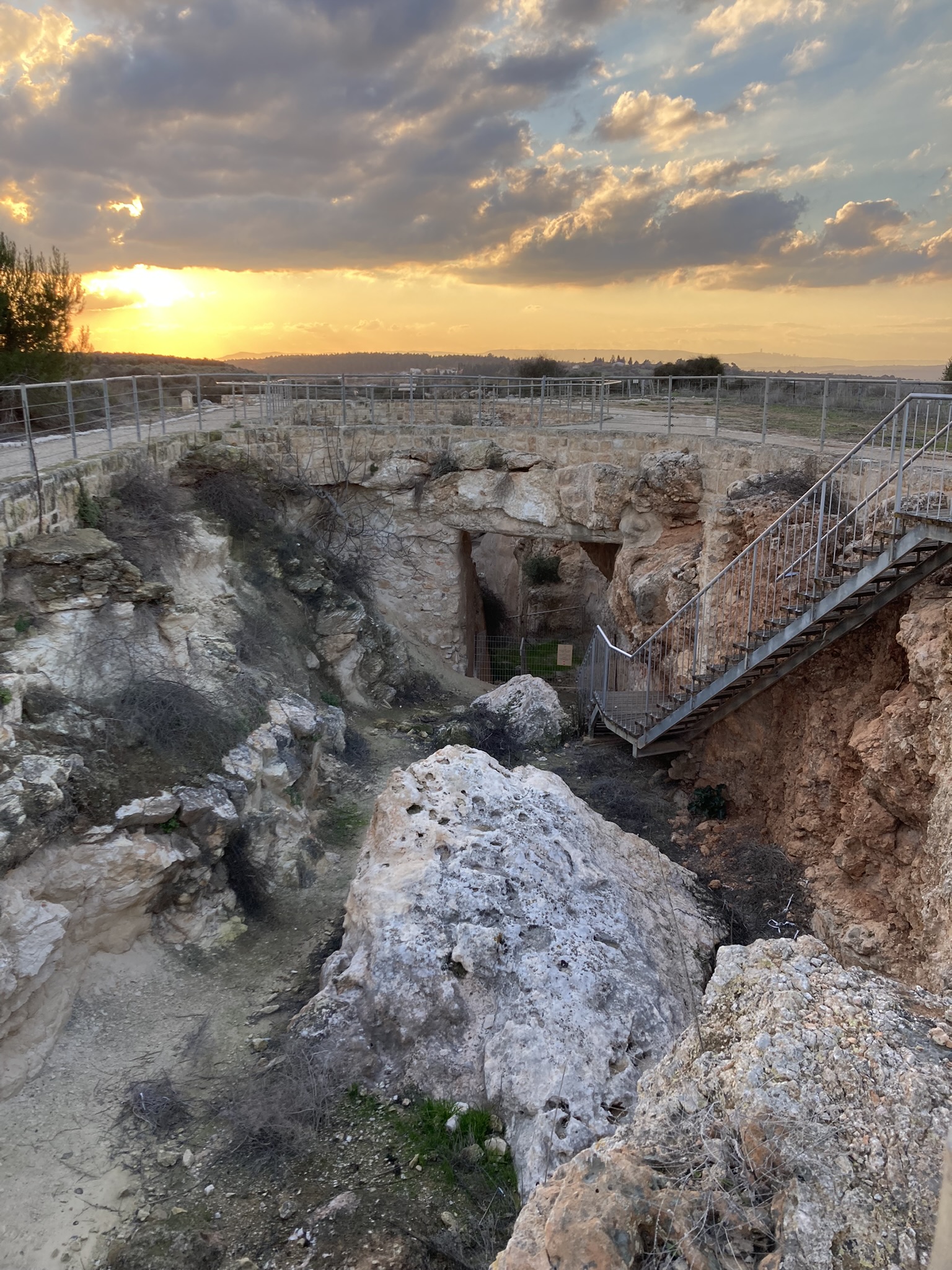
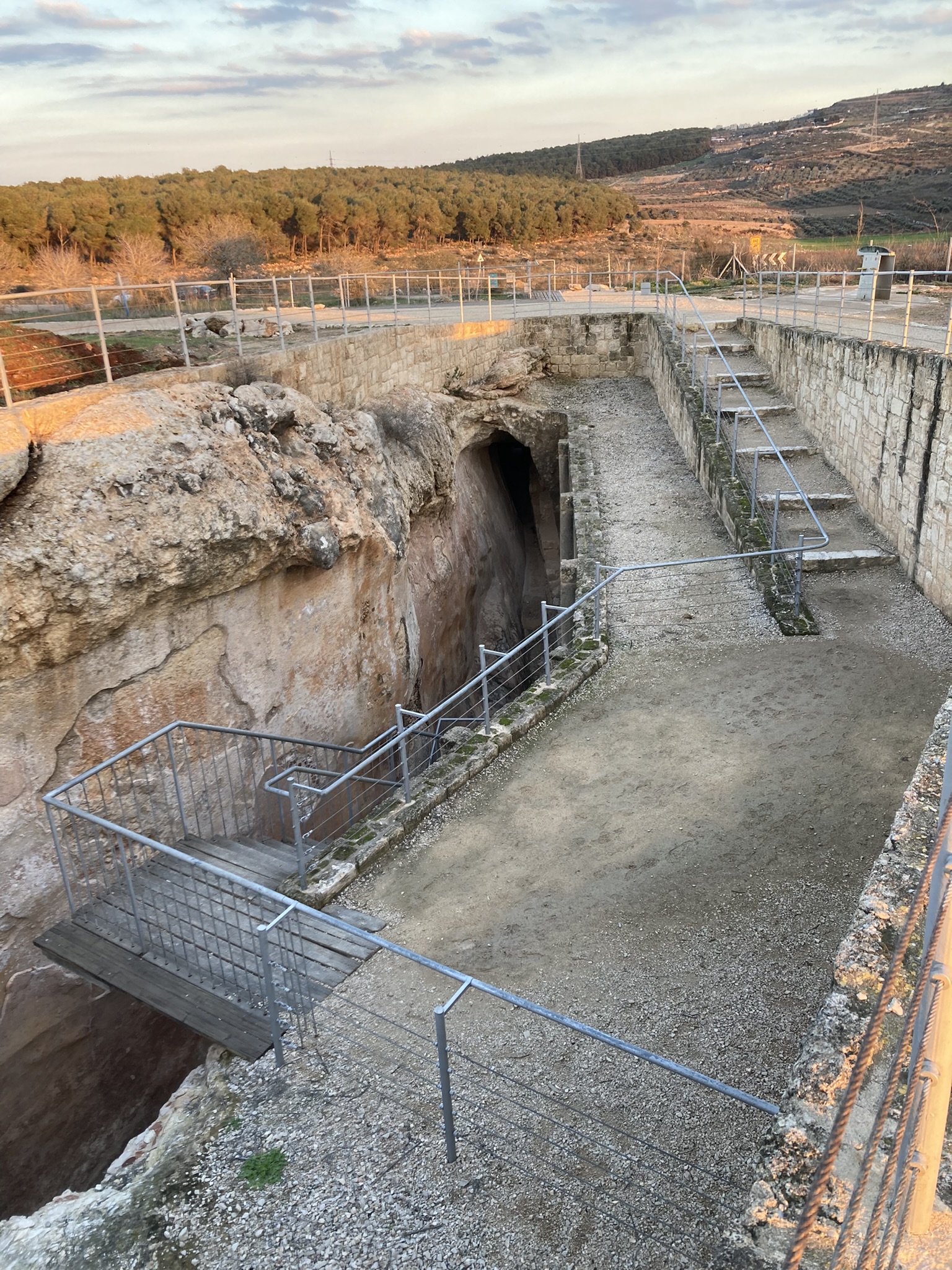
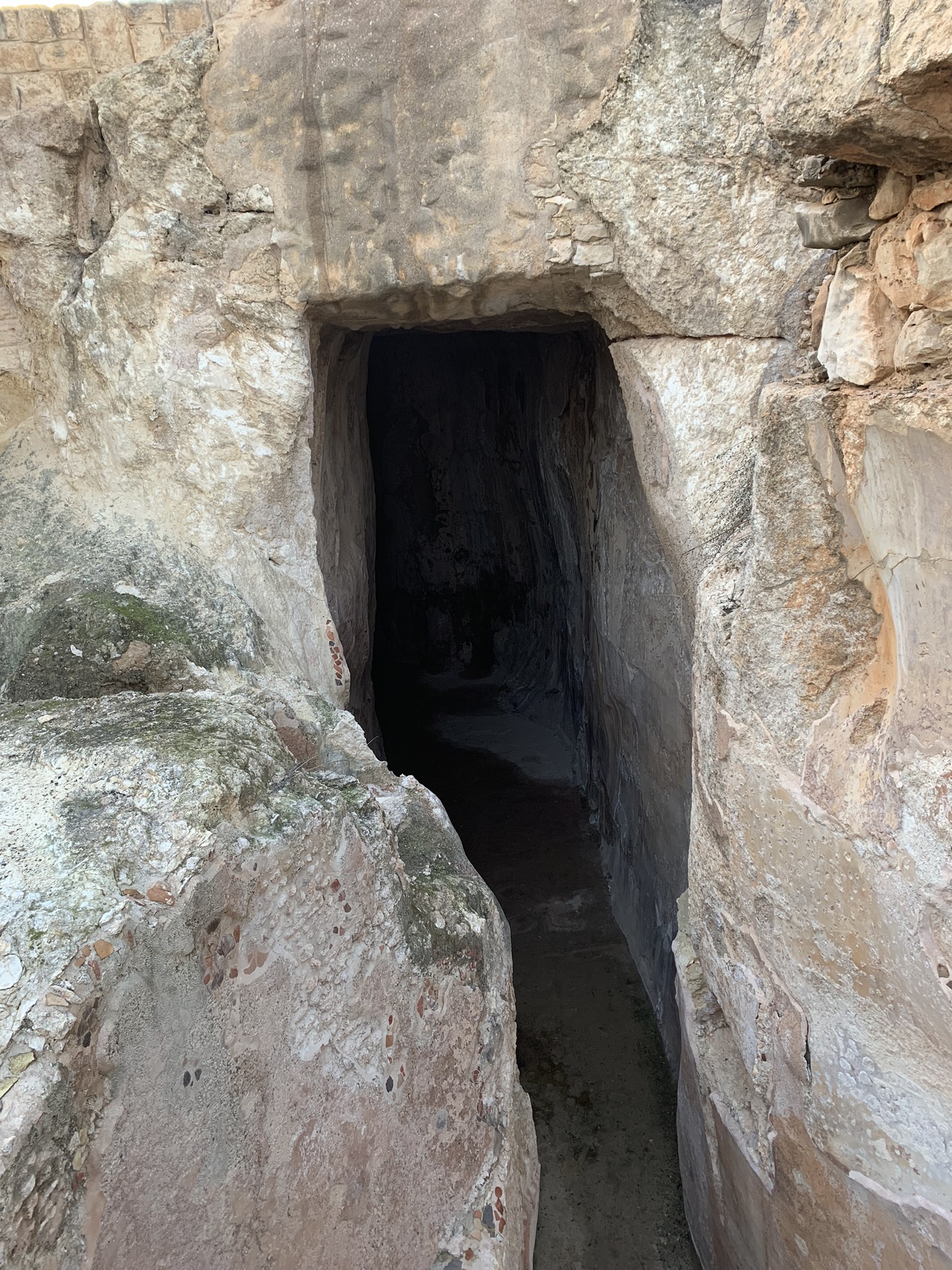
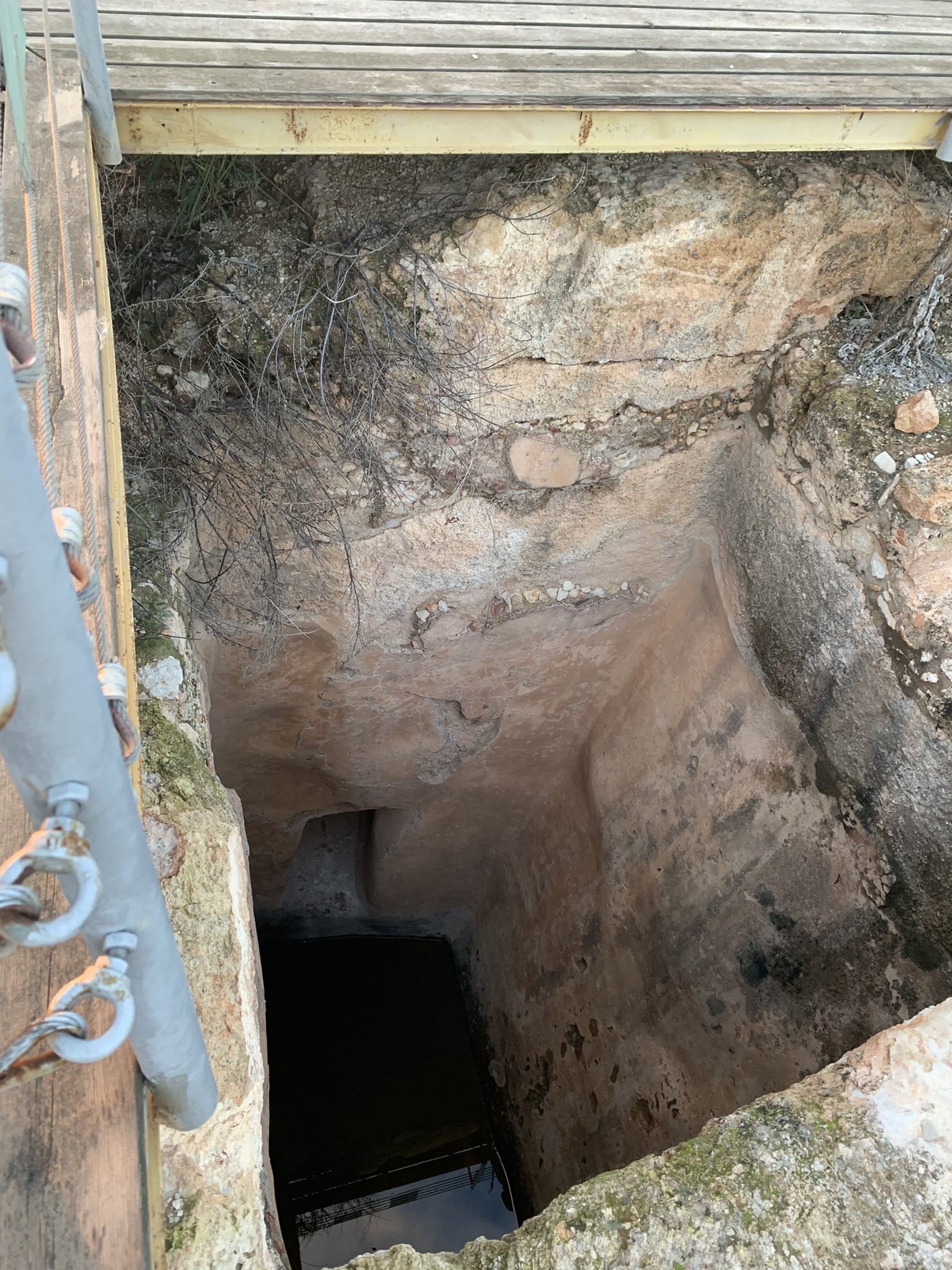
For those of you who are interested in feats of engineering, one of the first considerations when building a city is water. How does a team of engineers get water to a city without digging wells? Israel is situated in a desert/sub-Saharan zone. It only rains in the winter: the rest of the year is bone dry. Especially in ancient times, cities were built atop hills and mountains for obvious defensive reasons. So getting water uphill was quite the engineering problem. In the Nazareth mountains nearby flowed underground springs. These springs were channeled in six separate aqueducts which converged outside Tzippori into an enormous hand-hewn cistern or reservoir. This huge underground storage chamber is 260 meters long and 12 meters deep with a volume of 4300 cubic meters. It was in use from the first through the seventh centuries. From the reservoir, the water then ran into a sedimentation chamber, and filtered into another reservoir or holding tank. Enormous amounts of water then exited via a large lead pipe with a filtering sluice at one end. It is truly a marvel to see this sophisticated system! From the reservoir the fresh water was carried by aqueduct into Tzippori. The tremendous build up of water pressure from the reservoir to the small viaducts propelled the water uphill. The remarkable engineering feat actually carried running water through the town and into each house, providing fresh water for drinking, cooking, washing, sanitation, and the ritual Jewish purification baths called mikvaot as well as to the Roman bathhouse in the lower city.


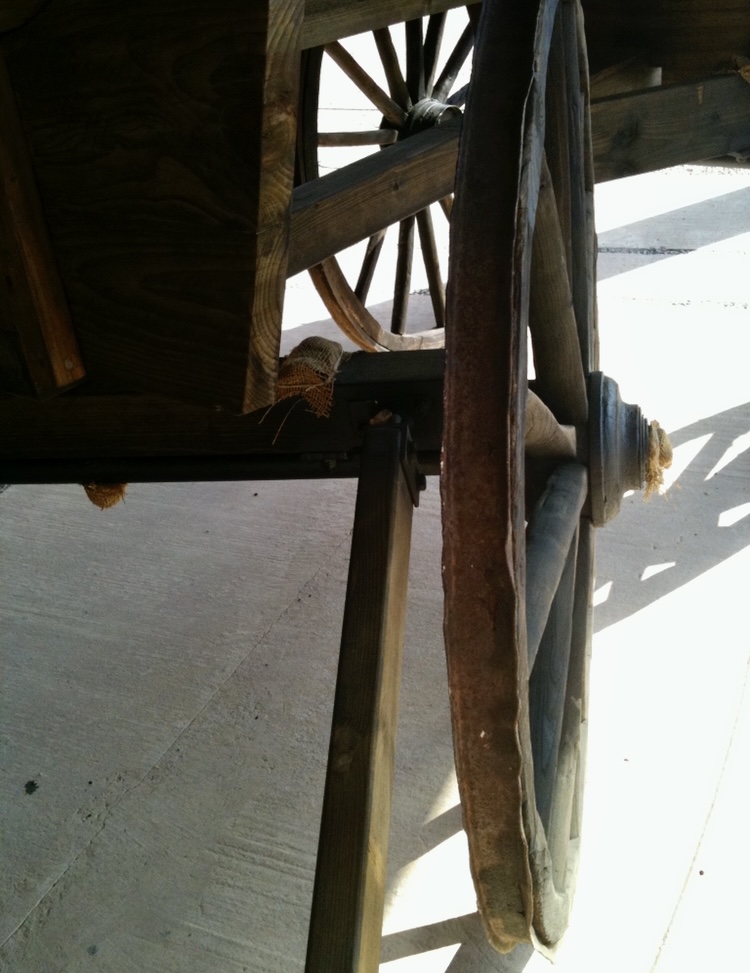
There are just so many interesting things to see here. Let’s head back to the cardo: we were smitten with the actual tracks made by the heavy wagon wheels on the stone streets. A representation of an ancient cart built upon wheels and axels found there is on display. Seeing this really brings the place to life as we could envision a bustling city teaming with life and wagons laden with building materials.

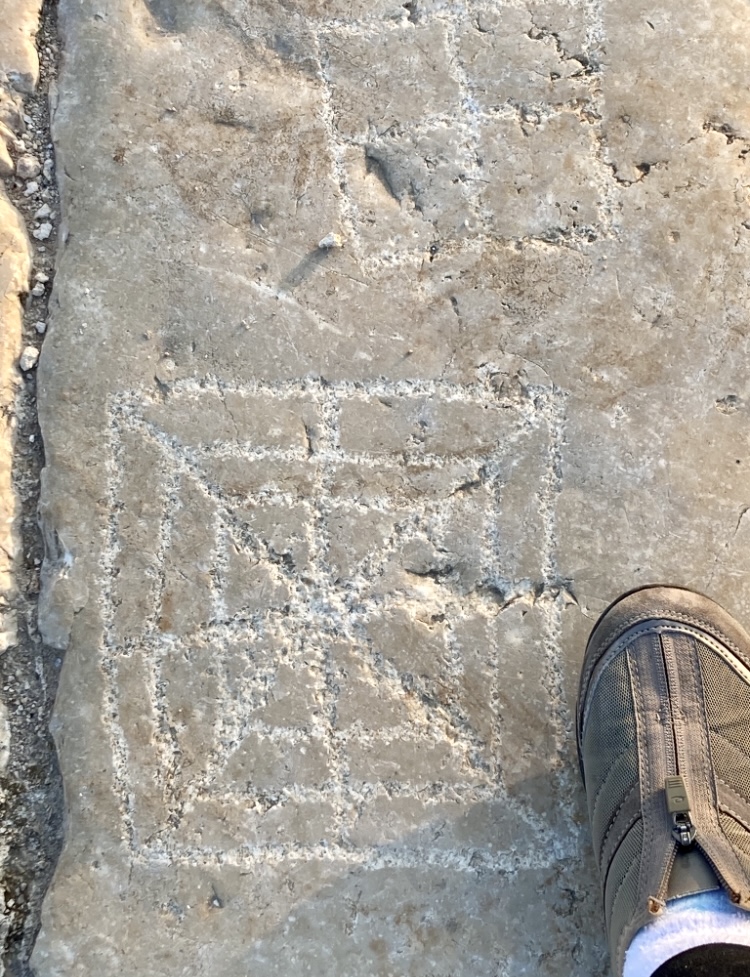
Back in 2011, Max and I got most excited over our tremendous ‘discovery.’ As soon as we saw this graffiti etched into the paving stones on the wide city street, we knew exactly what they were. We had read about this in our Rome studies, so to see it up close for reals: WOW!!! Before I explain, I’ll let you look at the photos and you can try to guess what they were-

So what are all these odd markings? They are street games. During times of boredom, children, merchants, and soldiers alike used to throw knucklebones. Small bones or cubiyot, like dice would be rolled into a designated area etched into the street and points would be racked up. For the adults (and street punks?) it was a game of great skill and often involved placing bets. Sometimes, as in the photo uppermost right, the grids would be stacked in a line and the game resembled cribbage or backgammon as the player would move their pieces from grid to grid. Is this super cool or what???

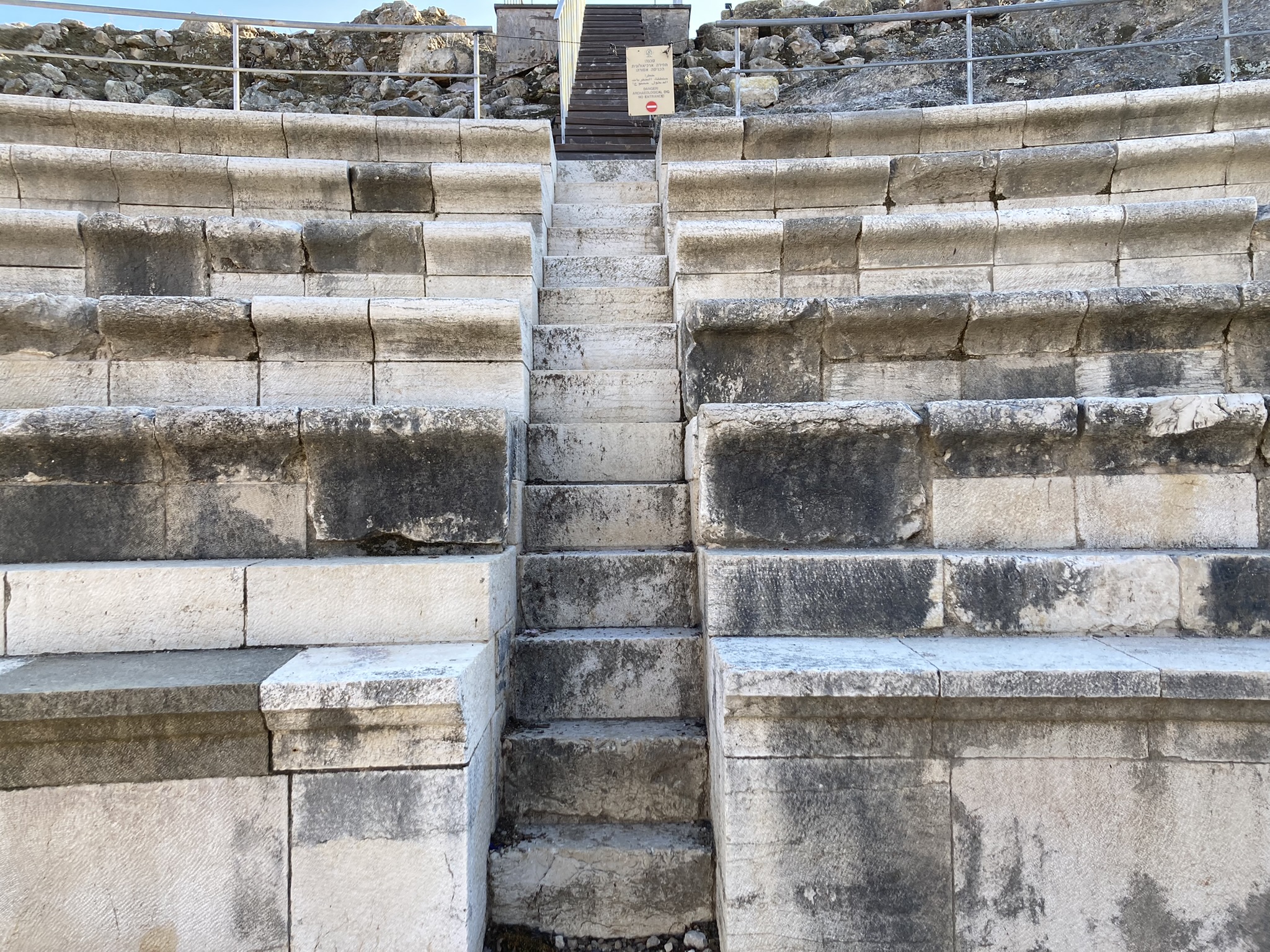
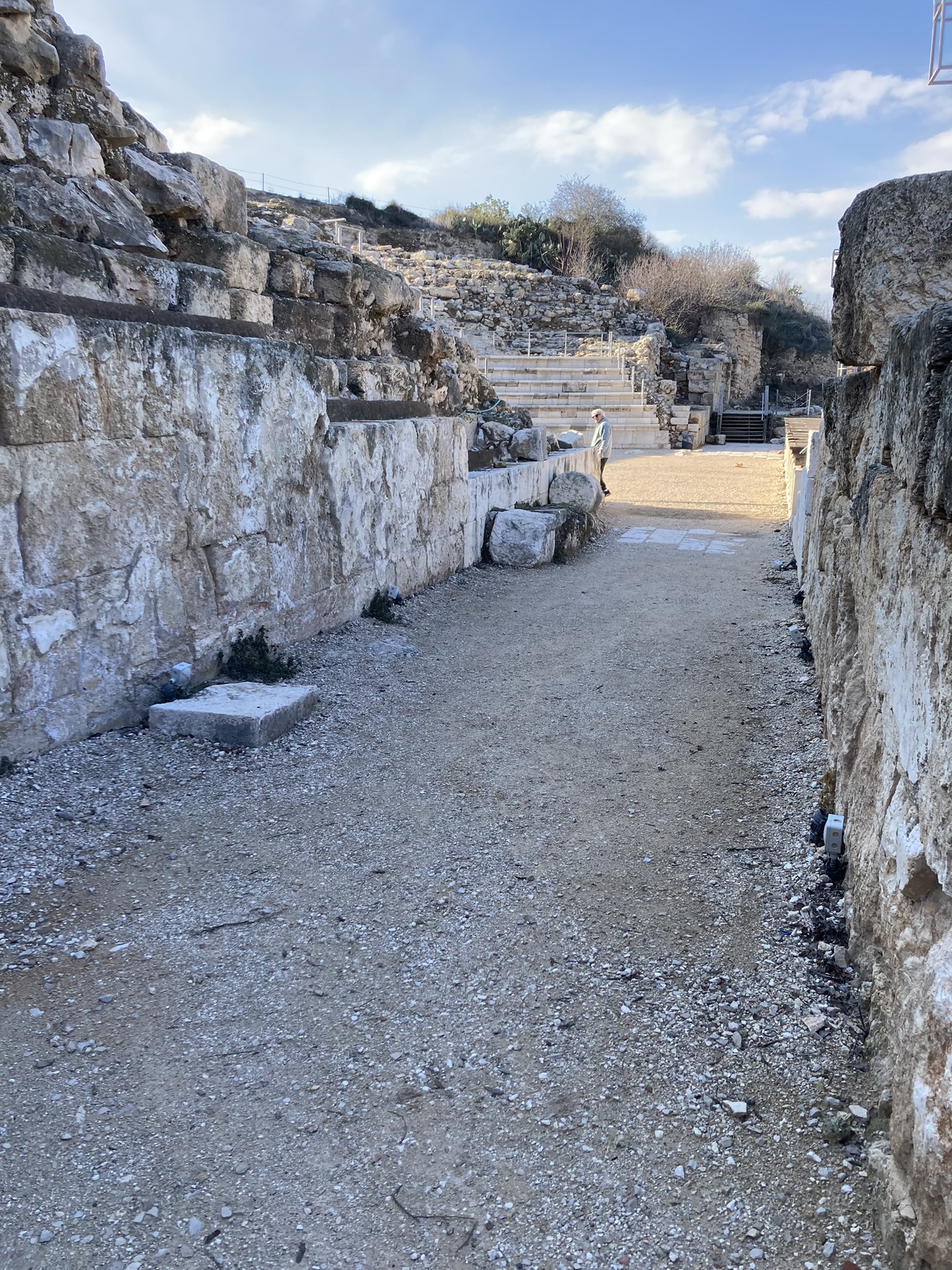
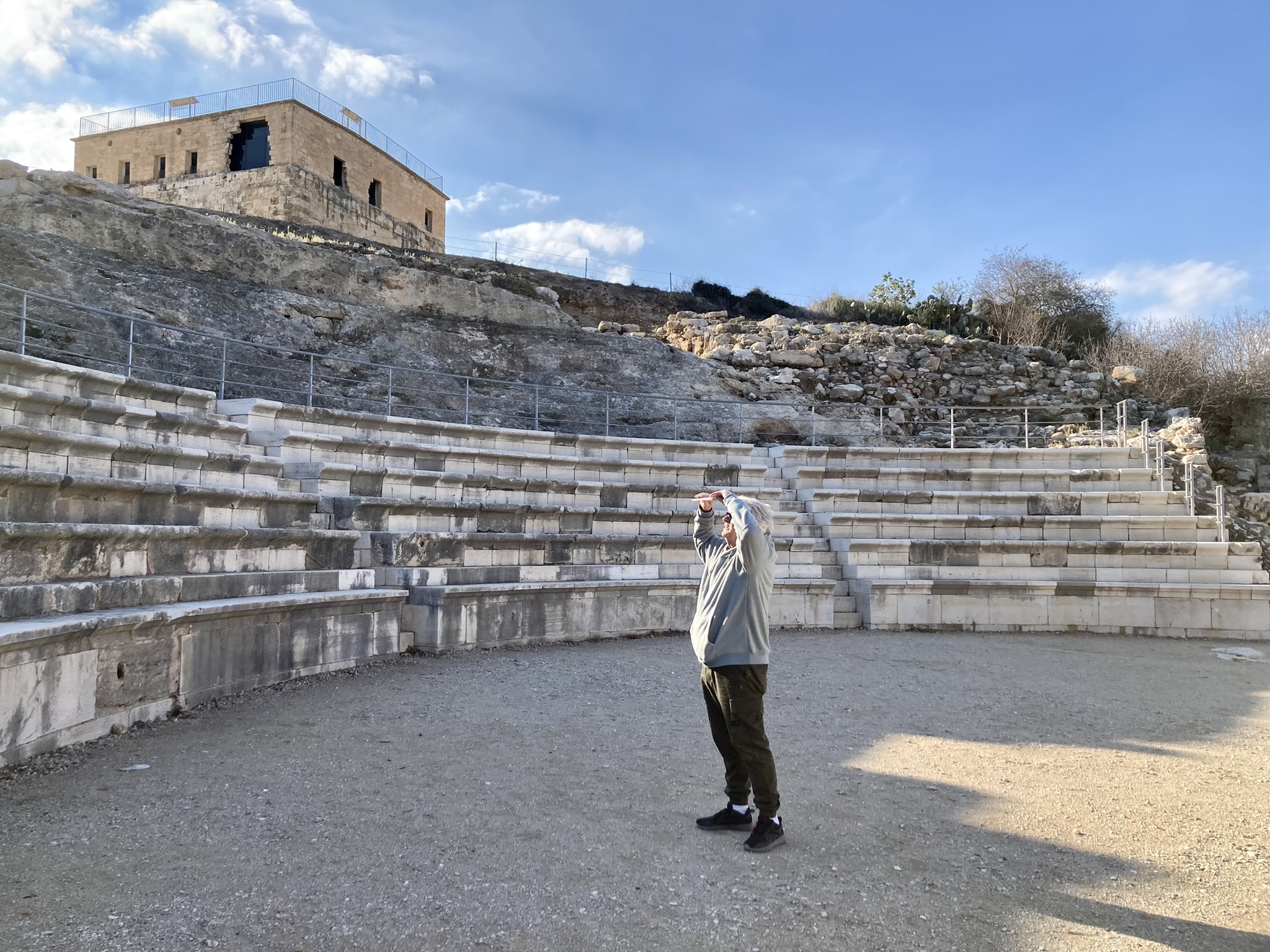
Now we make our way up the mountain to the upper part of Tzippori. Again, we can see the influence of Rome. Every metropolis needs entertainment, and as one would expect, there is a nice sized amphitheater carved into the north side of the mountain. It was built in the late first or second century AD and had seating for 4000. On ground level in front was the orchestra (the place for the chorus during the Greek period, reserved for honored guests during Roman times. The elevated stage or scena was made of marble and wood. Behind would be large scaffolding for the backdrops with costuming below and balconies for soliloquies above. At this particular site, metal scaffolding has been added so one can get a general idea of the design. Rows of seating were hewn out of the bedrock and covered with marble slabs. Most have been raided and repurposed for building by other civilizations, a very common occurrence. The bottom rows remain intact.

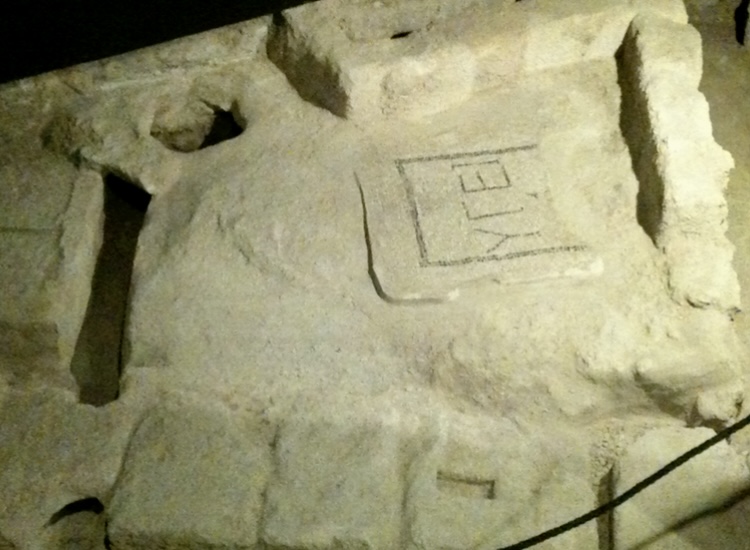
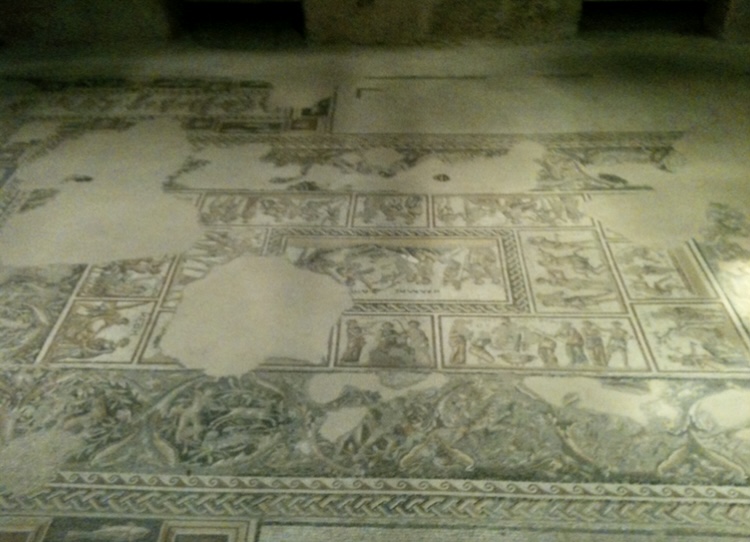
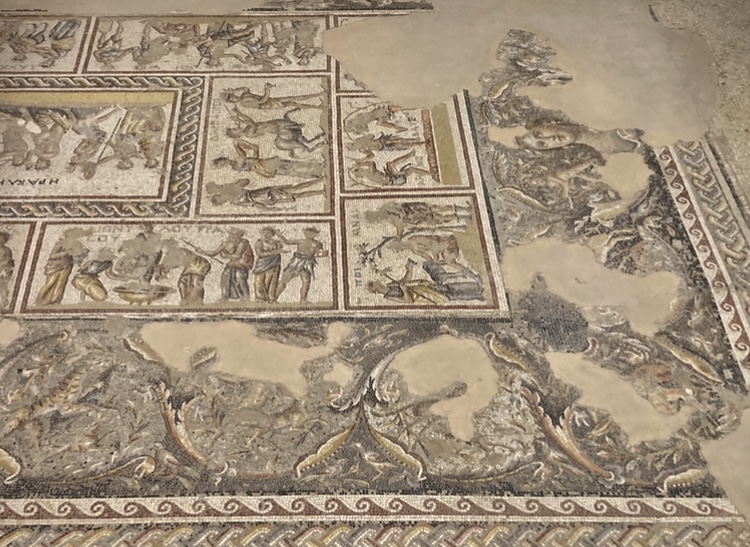
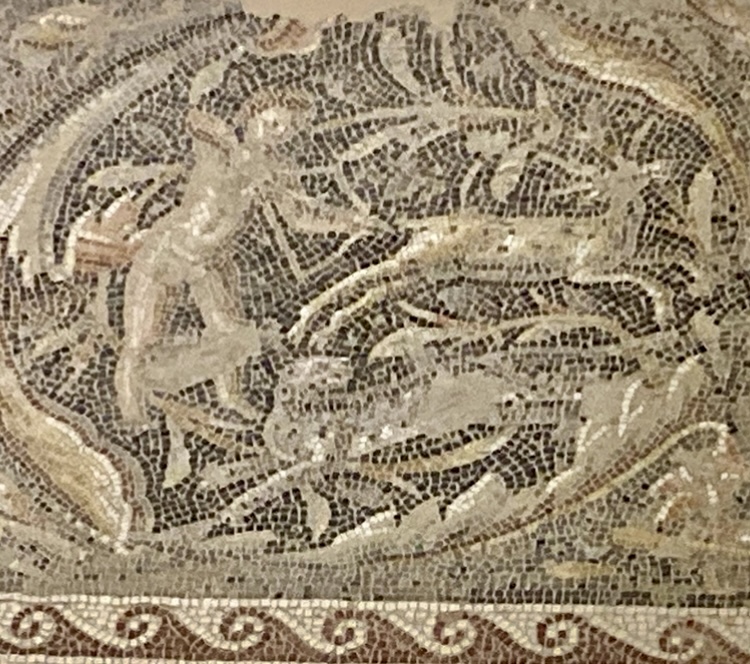
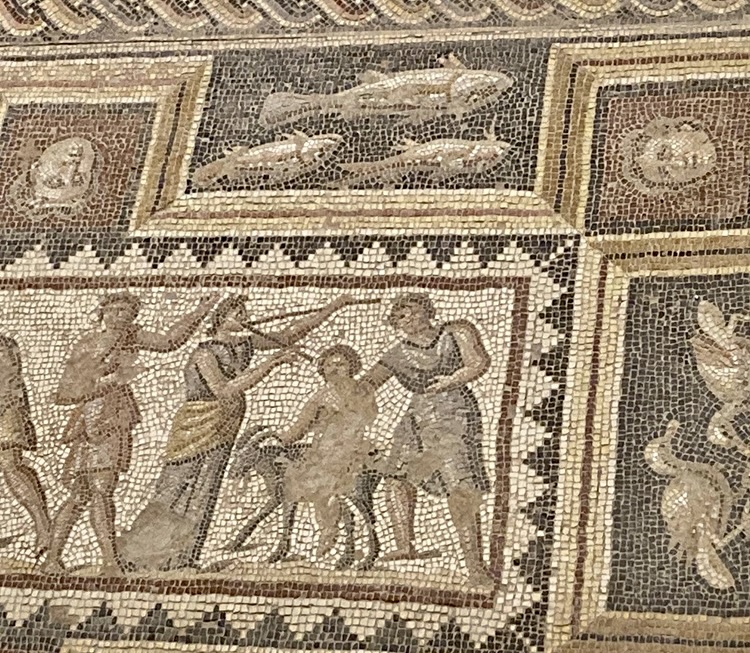
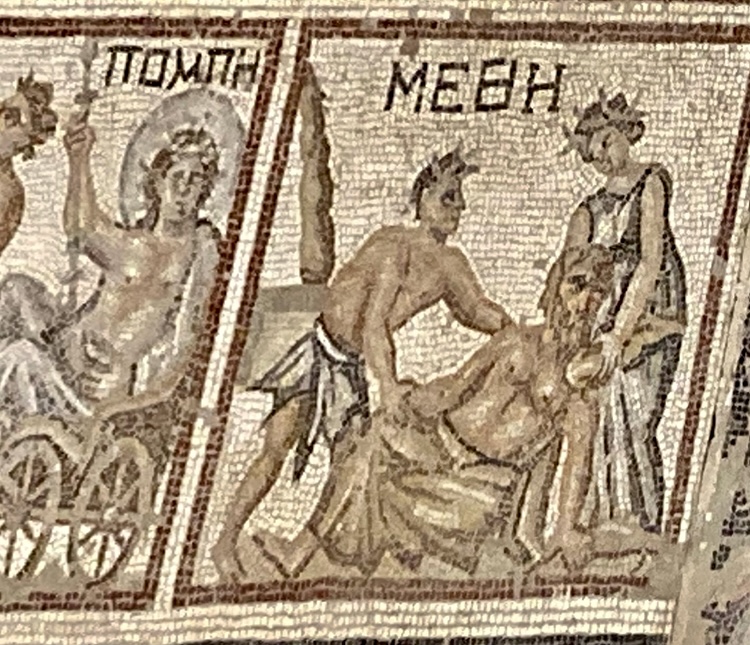
The remains of a spectacular Roman residence built at the beginning of the third century AD were found towards the mountain’s plateau. This villa, along with most of the other structures in Tzippori, was destroyed in the great earthquake of 363 AD. The villa would have had most spectacular views, and because of its proximity to the theatre, indicates a high status of the owner. It has now been enclosed to preserve what is left including Israel’s finest mosaic, the Mona Lisa of the Middle East. The mansion was built according to a popular Roman floor plan. The main room of the sprawling villa was the triclinium, or dining room walled on three sides open to spectacular views and a colonnaded portico facing the Mount Carmel Ridge of Haifa. Cubiculum, or bedrooms, were located off the main hall. Also, just off the dining room, was an indoor bathroom (picture below) with running water below the latrine hole. The walls of the villa were once covered in beautiful frescoes as evidenced by the remains of paint on the existing walls. Many of the rooms had mosaic floors with colorful patterns, the most ornate in the dining salon contains scenes from the life of Dionysus, god of wine. The mosaic is comprised of 1.5 million stones in 23 colors.

Now for a bit of interesting history. The Romans finally decided to subjugate these living in Israel. Why after so many years? The Jews paid taxes at the Holy Temple in Jerusalem. The taxes exacted by the Romans were exorbitant and bleeding them dry (hence the “render unto Caesar…” speech). Many refused or just could not pay, which oftentimes led to enslavement. The Romans worked seven days a week except for State/religious festivals. The Jewish people insisted on keeping the Sabbath: every Saturday was a day of complete rest in which no work at all was done. When in the early 30s-70 AD, this new cult of Jewish believers in Yeshua (Jesus) as their promised Messiah started springing up, not only was Shabbat kept, but now Sunday was held by these nascent Christians as the Lord’s Day. The Romans were losing a day’s labor from the Jews and two days labor from the Messianics. It was going too far! Plus bands of Jewish zealots were springing up trying to shake off their hoke of bondage to Rome.

In 66-68 AD, the Roman legions led by Vespasian and his son, Titus, landed on the shores of Akko in Israel. They spent the next two years routing out all the Jewish people living in the towns and countryside of the Galilee region. It was during this time the Jewish general Mattityahu Ben Joseph was captured (later becoming Josephus Flavius, the historian to Rome). Many Jews were expelled. Many were taken as slaves. Many killed. Many traveled south towards Jerusalem. By 70 AD, the Romans captured their prize jewel, the eternal capital of the Jewish people: the city of Jerusalem. The walls were breached after a long siege and after a bloodbath, the Roman army seized the city and razed the holy Temple (see Arch of Titus in Rome). This marked the beginning of the great diaspora in which most of the Jewish people were either taken into captivity or were dispersed throughout the world.
Jerusalem, the Holy City since King David, had always been the spiritual or religious center for the Jewish people. It was where the Sanhedrin (the main body of the court of law) assembled. Home to the great priests, rabbis and Torah scholars of the day. it was a major center of learning in the ancient world. Many of these great sages of old (khazal) escaped Jerusalem and went south to Yavne (south of modern day Tel Aviv) or north toward Tzippori. For the first part of the new millennium, the Oral Law or Mishnah (companion to the Torah), which had been handed down from generation to generation, was codified, much of it in Tzippori. Great sages of Judaism, Yehuda haNasi and Rebbe Eliezer lived in this city arguing, discussing and writing the heart of the Talmud. The remains of a large synagogue from the first century are here, but the structure was mostly destroyed in the great earthquake.

Early Christianity/Catholicism also had their own Oral Traditions that had been handed down from generation to generation (Dormition and Assumption of Mary; home of the Holy Family; sites of miracles). One of these traditions states that Mary’s parents (grandparents of Jesus), Joaquin and Anna, were originally from the city of Tzippori. During the times of the Crusaders, a large church and monastery were erected at the site of their purported home. It was called Deir Anna or the Monastery of St Anna.

There is a Crusader fortress at the very top of the mountain. It was destroyed by the Mamaluks under Baybars, then rebuilt in the 18th century by Daher Al Omar, the Bedouin ruler of the Galilee. During this time period, Tzippori, called Sephoris by the Romans, was now renamed Safouriyeh thus Arabizing the Hebrew.

Last, are the ruins of a large synagogue from the second century. It was a center of activity for the sprawling city, and reflected not only its Jewish heritage and connection (commemoration of) the destroyed Second Temple, but also has Greek, Roman and Eastern influence as seen in the mosaics. There is a large central medallion of the zodiac with both Hebrew and Greek writing. Side panels depict the accoutrements of the Temple worship: shofarim (trumpets), menorah (lamp stand), incense table, showbread table, bulls for sacrifice, jars of olive oil, baskets of fruit containing the seven species of plants native to Israel. At the other end of the synagogue floor are mosaic representations of the Biblical story of Abraham: Abraham feeding the angels, Abraham and Sarah, and Father Abraham’s ascent up Mt Moriah with his son, Isaac on the donkey. A side band in Hebrew reads that the floor was “donated with generous funds by ….. in memory of their son, …. “ So it keeps the tradition of a memorial plaque. The geometric design is more Eastern than Western. Even though the synagogue is now a museum, pre-arranged weddings and Bar Mitzvahs can take place on the site. When we were there, a group was gathering for a Bar Mitzvah. A portable ark with Torah was being wheeled onto the main floor and a bima was being set up. It’s another example of living connection to the past.

Israel’s Got Talent

When we moved from the greater Los Angeles area to Israel, we really felt we’d be giving up a lot. We were pretty spoiled, because LA/Hollywood is supported by “The [Entertainment] Industry” and so many of our friends and neighbors were connected in some way… stunt men, costume designers, editors, composers, musicians. We had so many musical genres represented from pop to hip hop and rap to Broadway, jazz and the best in classical with the Los Angeles Opera, Los Angeles Philharmonic, LA Master Chorale and smaller opera companies, choruses, and conservatories. We were never at a loss for entertainment from rock concerts to childrens’ choirs and loved our summers at the Hollywood Bowl and season tickets to the opera.

I really didn’t know what to expect culturally when we first moved, but I was told that each large city had its own first-rate music conservatory. This was important, as our son was a trumpet player, and I wanted to afford him the opportunity to continue his lessons and have performance venues as well. In addition, throughout the year different cities and kibbutzim host all types of concerts and festivals featuring both local Israeli talent as well as talent brought in from abroad.

Music speaks to the soul and as such, is so important across cultures. We’ve had the chance to experience firsthand the local flavor of the Arabic music and have visited some of their music schools. We’ve enjoyed Yemenite bazooki concerts and French café style entertainment. The Ethiopians have brought with them their own heritage in liturgy and contemporary music and the immigrants from the former Soviet bloc countries are known for their early training in the classical arts. We’ve found Arab Christian bagpipe bands in Nazareth, a hold-over from when Scottish missionaries came to the Holy Land in the 1800s. And we even have a good friend who is the promoter of heavy metal concerts coming to Israel.

Each year, our local music conservatory hosts a fundraising concert with all the proceeds going back into community programs. At first, we were reticent to go, but now look forward to this event as the range of musical talent is representative of the diverse fabric of our society. There is a beautiful women’s chorus made up of religious Jewish, Arab Christian and Druze and secular young ledies. They sing liturgical, folk and classical chorale pieces.

There are several sopranos, who sing the standard art song repertoire in Italian, French, German and even Arabic:

Our mid-sized city has so much talent, including a young woman cellist who has won several international competitions and will go on to study music after her army service; Russian siblings, ages 11 and 13, pianists who both perform solo and duets; a flutist from Canada and a Ukrainian balalaika player who has been performing professionally since he was six and now serves in the IDF, but made the time to play at this concert.

Karmi’el is one of several cities that prides itself on its Children’s Village. There are 200 children from grades 1-12 who live on the spacious and well-manicured campus. Some are orphans, but many come from broken, abusive or disfunctional families. Separated into 16 “mishpachtim” or family groups, they live in large, specially designed homes with sponsor parents and their families. All the kids attend the public schools, but return to the village for afternoon activities, clubs, music and dance lessons, therapy and sports. In this well-rounded program, the older children help with volunteer service projects within the city. Their success rate in academic excellence, reintegration into society, military service, sports and entertainment is unparalleled. One of the young men recently won Israel’s version of The Voice, Junior. Each year, they put on an amazing show for the community at our local theatre arts complex.

Just before the first wave of lockdowns due to the pandemic, John and I went to a hands-on drumming workshop in Nazareth. It was tremendous fun learning about the darbouka, made of wood or aluminum and covered with leather from donkey, goat, camel or skin, each having a different sound. Demonstrations even included a fish-skin covered tambourine, a bandir, based on the ancient models. The last clip in this series was an ancient Aramaic song from the book of the prophet Jonah: the prayer he made from the belly of the fish. The melody itself is centuries old.

During the summer, neighboring Tsfat hosts a three day Klezmer music festival. At Kfar Blum, a kibbutz in the Upper Galilee, there is a weeklong classical music festival. The kibbutz operates a first class hotel and the venues, for both indoor and outdoor concerts are said to be quite pleasant. The festival features vocal and instrumental music with world class guest artists from throughout the world. Jerusalem hosts an international oud festival (an ancient stringed instrument), and the Red Sea resort city of Eilat is famous for its international jazz festival.

In years past, in the Galilee, there was the twice annual Jacob’s Ladder Festival with the best in bluegrass, Celtic, and blues. Most festivals here are very family friendly with activities and workshops for even the youngest. In the early summer, on the shores of the Sea of Galilee at Ein GeV kibbutz, there is an choral music festival of mostly Hebrew and European choirs. It also includes a competition.

Speaking of competitions, Israel has been placing first in the Eurovision Competition, a huge international “Who’s Got Talent?” show broadcast throughout Europe. Israel hosted last year in Tel Aviv. The Abu Ghosh Music Festival (just south of Jerusalem) is home to a classical vocal competition in the Spring. Vocalists come from all over the globe. Performances are held in ancient churches and cultural arts centers in the area. Master classes are open to the public.

We had tickets to the Liturgical Festival, but because it was during the pandemic, the events were all livestreamed.

There’s something here for everyone. If you’re into indie, the InDNegev Festival each October is the place to be. The event has grown each year since 2007, and now includes art exhibitions, poetry readings, movies, and huge parties lasting all night. As with several of these types of festivals, camping is strongly encouraged. Every winter, there is also a Grateful Dead festival with live music cover bands as well as dance tents and hippie art shows. If raves are your thing, then there’s the Minus 424 (meters below sea level) Dead Sea Rave. Electronica, lots of DJs and laser light shows have festival goers dancing from sunset to sunrise with the red desert mountains as part of the surreal backdrop. And not to be outdone by America’s Burning Man Festival, there is the infamous Midburn Festival in the Negev Desert each October. A combination Woodstock, Coachella and Burning Man, the participants themselves are the ones who create the performances. They set up an entire weeklong installation in the desert. It has become so popular, that you need to know someone who is part of the event in order to get a ticket.

Israel is truly a crossroad of the world. Because of its proximity to Africa, and due to the influence of our Ethiopian, Eritrean, Nigerian and Ugandan immigrants and visa holders, there are several AfroBeat, AfroJazz, heritage and Reggae concerts throughout the year. Every city has multiple entertainment venues, and most events are free to the public, like the Nuite Francaise which even included a wine and cheese bar and ballroom dancers!


And of course, we have our own mega stars singing pop, hip hop, and indie folk. All during the summer, our Israeli entertainment icons perform concerts in amphitheaters all over the country, many are free, sponsored by the municipality.

(Warning: the next two video clips include bright, flashing lights-)

The very popular Hatikvah 6
Static & BenEl, a high energy boy band, is extremely popular here

Saving our favorite Israeli performer for last: John & I first heard the music of Idan Raichel in Los Angeles in 2010. We saw him at different locations in California and we haven’t missed one of his concerts here (which always sell out in hours). Idan first started performing (accordion) at age 12. He’d play for the dancers at the Karmi’el Dance Festival every year. Last year he, most deservedly, received an honorary PhD in philosophy from BarIlan University and has been named Israel’s Poet Laureate. His music is not only beautiful, but the words! About the beauty of life, of love and friendship, of peace and unity. Many international recording stars have teamed up with Raichel to form the world-beat Idan Raichel Project. It truly is peace through music. So I leave you with this- Enjoy!

Solo performance at the Elmaa Arts Center, Zichron Yaakov

A Micronation Within Israel & Parties on the Beach

As I always say, Israel is the most random country. There are adventures and interesting spots in the most unsuspecting of places. It’s another reason we enjoy living here: we never know what we’ll find next. I had heard rumors of Achzivland when I was in high school from friends’ older siblings who’d returned from Israel. Then the stories popped up again when we were volunteering with the army. There were tales of rock concerts, hippies, free love on the beach, artists, celebs and draft-dodging wanderers in the 1960s-1970s.

Achzivland is actually its own independent country, the smallest in the world, on the shores of the Mediterranean just 3 miles south of the Lebanese border. The story begins with Persian-born Eli Avivi who immigrated with his family to Israel when he was a baby during the Palestinian Mandate, a time when the British ruled the nascent Jewish state. Always in love with the sea, Eli, who was in his early 20s, was a smuggler. He was involved with the underground navy, pre-IDF: really just a few old fishing boats, a couple freight barges and a decommissioned cruise ship. The British had imposed strict quotas on the number of immigrants after World War II and the numbers were quite low, so Eli would take a small fishing trawler from British Palestine to Cyprus and other European locations to pick up Jewish refugees from the Holocaust and smuggle them at night across the Mediterranean back to their ancestral homeland. After the British withdrew in 1948 and the newly approved (by UN majority vote) nation of Israel fought off the invasion of Arab nations in the War of Independence, Eli Avivi left Israel for colder climates. He worked on fishing boats in the North Sea, in Iceland and Norway for two years. Then he sailed to Africa. But Israel was always calling him back.

Eli returned to Israel in 1952, settling down at an old abandoned Arab fishing village on the Mediterranean Sea once known as Al-Zeb. The few stone buildings were run down, but there was a certain charm to the compound. To Eli, it was Paradise. Beautifully frescoed plaster walls and magnificent mosaic and tiled floors in each room added to the mystique. Rumor had it that the large house was owned by a wealthy Bedouin sheik and his many wives and concubines. The fishing was excellent, there was a natural-spring well, and it was close to Akko. It was quiet and remote, perfect for a solitary life. The beach-combing and scuba diving were favorite pass-times as well as scouting out the surrounding unplowed fields. Eli picked up all sorts of artifacts and antiquities, his massive collection constantly growing to include pottery, sculptures, ancient Iron Age tools and farm implements, Ottoman and Crusader weapons, glass and coins. Avivi studied the history of his ’new’ home and discovered it went back to Biblical times. It was home to the tribe of Asher and was also inhabited by the ancient Phoenicians who used to trade nearby. What more could a handsome young man want in this Garden of Eden? He was soon joined by the beautiful fashion model, Rina, who became his wife.

Technically, Eli and Rina were squatters on this 3 1/2 acre piece of prime real estate. The Israeli government repeatedly tried to take the property back, even showing up with bulldozers. After nearly two decades of battles and their refusing to leave, Eli and Rina ripped up their Israeli passports and declared their independence. They held a large press conference and became overnight celebrities in Israel. ”I fought for this country. I loved Israel. But I have no time for the government. I just want to be allowed to live on my own little piece of land, in my own place, in my own way,” he said in a television interview. As an act of protest, Avivi created the State of Achzivland in 1971 with himself as its President for Life. He established a bicameral House of Parliament consisting of Eli and Rina. The new micronation had its own flag, with a mermaid and his house as an emblem. He wrote up a constitution (“The President is democratically elected by his own vote.”), a national anthem and passports.

For all of this Eli Aviv was arrested by the Israeli police and border patrol. He was thrown into jail, but released ten days later when the judge ruled the charge ”Creation of an Independent Country Without Permission” did not exist. Still, he was hounded by the government until he brought a countersuit. The high court ruled he could have a 99-year lease.

Eli and Rina were no pushovers. A group of six Arab PLO assassins tried to infiltrate Israel from nearby Lebanon to commit acts of terrorism in the winter of 1971. The Palestinian terrorists landed their raft on the beach of Achziv on a foggy March morning. The Avivis had seen them approach from their living room window. One wetsuit-clad terrorist met up with a fully-armed Rina as he snuck into the house. Not expecting a loaded rifle and Karl Gustav pointed at his head, he dropped his gun and a bag of grenades and pita breads. Two were wrestled on the beach by Eli and disarmed. The Avivis tied up their captives and fixed a pot of hot tea as they waited for the authorities. The paratroopers, police, Golani brigade – the whole army showed up. The other infiltrators escaped inland and were later caught by the IDF. At this point, the Avivis were national folk heroes.

In the early 1970s, just as today, the world was in upheaval. It was a time of great unrest. The war in Vietnam was raging. The hippie movement was growing. Students were protesting in Europe. The Mideast was in constant turmoil. And the beach at Achzivland was just gaining notoriety. Jewish kids, whose parents sent them after high school to work on a kibbutz would end up there. European hikers and university students found out about this great, laid-back camping area and hostel right on the beach where the only rule was non-violence. They would help out around the property in return for a place to stay and a meal. Nude bathing? No problem. Free love? It was not unheard of. Drugs? While not encouraged, it was not discouraged either. The water was pumped from the well. The bathrooms were rudimentary latrines. The house had no electricity. The young people helped Eli as he constructed his makeshift second story to the house. They helped build additional guesthouses. It was a work in progress. At the time, it was an out of the way local, yet through word of mouth, Achziv attracted artists and bohemians, poets and musicians.

Israeli musicians and rock bands played free, all-night summer concerts on the beach. Soon artists and celebs from around the world were guests there. Young couples came asking Eli to perform marriage ceremonies for them on the beach. He happily complied. In the summer of 1972, the Avivis planned a large Woodstock type music festival. Young people came from Israel, Europe, America, Canada and Australia. From that summer on people from the likes of Bridget Bardot to David Bowie, Leonard Cohen and Bar Rafaeli would drop in. The main house grew in size but not to any code. More bungalows were erected. Electricity and plumbing were eventually installed.

We first visited Achzivland almost three years ago to the day. It was exactly one year to the day that Eli Avivi passed away. Rina was there with several of their old friends remembering times past. Long gone ere the concerts and parties. The main house, now a museum open to the public, was in terrible disrepair. Still, it was not hard to envision groups of revelrers dancing around a fire or hanging around the salon. A few people come by to swim at the beach. But the sun-worshipping youth have now been replaced by large Arab men, their fully-covered wives sitting on the sand. We went again last year and met Ofer, helping out around the property before his army service. His parents were regulars at the beach compound years ago. He remembered the tail end of Achzivland’s glorious past.

Our good friend, Norman (now of blessed memory) had also told us of the place in its heyday. He had come to Israel the summer of 1974 to work on a nearby kibbutz. After his stint there had ended, he met a gorgeous blonde from Sweden. It was an August romance, the tale of the girl that got away. The guests and rock stars that were there. Swimming in the Mediterranean on a moonlit night. Barbecues on the beach. His ”Lagatha” returned to Sweden, he stayed in Israel… and so it goes.

We return infrequently to that idyllic beach. The large lot next door is now a national park/ lifeguarded beach where families come to picnic and swim. The strains of music have been replaced by the sounds of children. It’s a completely different vibe. At Achziv, Rina still rents out cabins called tzimmers, mostly to the locals. They are quite rudimentary, but fitting for the beach. Old timers occasionally spend a summer weekend there, chatting with Rina and recounting tales of the past. If you visit, make sure to bring your passport and have it stamped with the seal of this interesting micronation.

Art Over Hate

IMG_6452

We had heard about the graffiti wall on the Northern border of Israel with Lebanon, but had been unable to located it in day trips past. So it was with great anticipation when we drove up there with Israeli friends a few weeks ago. The world seems to have exploded in bouts of rage and rioting and baseless hatred and division over the past few weeks. This wall is most definitely a ray of hope.

Despite the fact that the Hezbollah terror group is strongly entrenched directly on the other side, with hundred of thousands of missiles (thank you, Iran!!!) pointed at us, we actually felt quite safe traveling up to Moshav Shetula. The moshav (small community – this one of about 250 people) was founded shortly after the 1967 War by a group of brave individuals forming the front lines of defense. As one man told us, “Someone has to do it. And we are here to live fruitful, quiet lives.” In fact the Hebrew word ‘shetula’ means planted firmly with roots going deep. It is a beautiful place, perched atop the mountains with spectacular views. The families earn their living mostly through farming and raising chickens, both for the eggs and the meat. Many of the residents are Kurdish Jews, who managed to escape before things got really bad. For them, just the ability to live in freedom in the land of Israel is an honor and a blessing.

In 2017, after several breaches in the security fence, and the finding of Hezbollah terror tunnels that were dug underground into Israel for the purposes of kidnapping and killing Israeli citizens, a reinforced cement wall was built along the border. Soon after, artists – Israeli graffiti artists; school children; non-profit organizations and artists from around the world were invited to decorate it. The theme: Art Over Hate/Love Conquers All. It is an amazingly beautiful sight!!! Full of bright colors, love and hope.

IMG_6453IMG_6457IMG_6459

The above paintings are entitled  “Planting the Tree of Life: Shetula” and “Come Together Right Now Over Love.” The vibrant colors express a vision of hope and peace for Jews and Arabs, looking towards a brighter future when all people can live in harmony. We are not there yet, but perhaps one day soon….

IMG_6466IMG_6467IMG_6460

The next grouping is an homage to the people of the moshav who raise chickens. Whimsicality reigns with these three pieces of art. Honest work to feed the country’s people – noble indeed. May they enjoy many peaceful years up there raising the chickens!

IMG_6454

I absolutely love this one. It’s a painting of Montfort Castle, just a few miles to the south. For a story on the mystery of this Crusader ruin, read my last blog post. The olives grow all over the Upper Galilee, and are one of the crops the people of Moshav Shetula grow. The olive branches are symbols of holiness (the holy oil used to light the menorah and to anoint priests and kings in Biblical times) and of peace. The blue in the background is a special color used here on roofs, gates, doors, and the tombs of holy saints. It has its roots in thousands of years of superstition and is thought to ward off demons from entering.

IMG_6456IMG_6479IMG_6478IMG_6489

In the next grouping, the top painting was done by the children of the moshav. Grapes (grown in the little village), olives, and a heart shaped swimming pool to cool off on those sweltering summer days. A child’s vision of a good world. The bird in the next photo is a Bee-eater, indigenous to the area and quite necessary for pollinating the fruit trees and flowers. He’s bitten his apple into the shape of a heart (Love and Beauty Conquer All). In the next illustration, a dove of peace flies an olive branch to a young girl. And the last in this set is a whimsical depiction of colorful elephants. Check out the baby, holding a lit candle to be a light in the darkness. These illustrations are all about happiness. There is no negativity, no hate here. It’s simply wonderful!!!

Of course, there are the typical graffiti tags and pictures. What would a graffiti wall be without those??? The portraits of the two men were done by Solomon Souza, who is most widely known for his painted murals at the Mechane Yehuda Market in Jerusalem  – as well as several album cover designs.

IMG_6461IMG_6462IMG_6464IMG_6494

Something every soldiers looks forward to – there is actually a phone app counting down the days – is that momentous day they get to cut their choger, (pronounced khō-GAIR) which is their active military duty ID card. And here is a piece of art celebrating that:

IMG_6483

Of course, being in the Holy Land, there is the Bible Verse from Isaiah 2:4 and Micah 4:3 “They shall beat their swords into plowshares, and their spears into pruning hooks; nation shall not lift up sword against nation, neither shall they learn war any more.” This is an English translation from a youth group, B’nei Akiva. I think their English skills need a little help, but the sentiment is there.

IMG_6501IMG_6498

My favorite remains the explosive colors and message of hope and love below:

IMG_6452IMG_6450

O.K. I lied. It’s the blue owl. He’s called the Mona Lisa Owl, because his eyes follow you as you walk along the road. But if you look carefully at his pupils, you can see the reflection of the local mountains, opposite him.

IMG_6509

So, there are a few other things I’d like to point out before we leave the art wall. Every few meters there was an indentation of sorts in the wall which looked out over the real electrified border fence. Several military bases are stationed within a mile of each other guarding the border. Our friend, Gabi, was able to explain just what we were looking at. There are cameras all over the place. Every square inch is under IDF observation 24/7. An extra security fence was in the process of being built around the moshav, a necessity and fact of life as to increased threat. IDF patrol vehicles and UNFIL jeeps (United Nations Interim Forces in Lebanon) also passed us frequently. Exactly what good they do is hotly debated. And a gentleman who had just picked the most delicious nectarines from the local orchard stopped to give us handfuls on his way to market. That’s typical Israel.

What type of people would build homes, places to raise young children in a place like this? What does the community look like? The homes were all very nice and well-manicured with flowers and an abundance of green everywhere. There was a synagogue, community sports facilities, little general store and post office, swimming pool, amphitheater, basketball courts – typical of every single moshav I’ve visited throughout Israel. Every block had the instant emergency warning system and underground bomb shelter, may they never have to be used. Adjacent to some houses were farms, groves and gardens, with lots and lots of chicken coops on the Southern outskirts of the village. There is also a restaurant on the moshav serving authentic (Kosher) Kurdish dishes….

IMG_6531

As we were leaving, we were stopped at the front gate by the police, border patrol, and civilian guard from the area. There had been a “security breach.” The main exit road was blocked to deal with it. We still felt safe as there were other cars stopped and no-one was panicked in the least. We were told to turn our cars around and leave through the back gates. No biggie. Later we were to find out that three Sudanese men attempted to sneak into Israel and had been apprehended.

We pray for the peace and safety of this land and for art to rule over hate.

IMG_6486