
Have I told you yet how much I absolutely love this country? Its customs and traditions? Today is New Year’s Day! For 🌳 🌲🌴🌵🌳! Yes. TREES!!!! How cool is this? It’s the Hebrew month of Shvat – also amazing because who else has a month Shvaaaahht??? Even saying the word makes me laugh. And the 15th of the month, during the full moon, we celebrate nature. It’s the original Earth Day without all the political hype. And of course…. We eat and drink. But more about that later.
So to quote my friend, Arky Staiman, we have this holiday where we celebrate the blossoming of the trees. They are just beginning to sprout forth right now. Here in Israel. Now listen, for those Ashkenaz Jews in the US (hello, Chicago, NewYork, DC, St Louis and Seattle), in Canada (you out there freezing your tuchuses off inMontreal and Toronto), in France, Germany, England….this holiday makes little sense. For those in the extreme South (yes, you in Tasmania! In Argentina and Brazil, even in India) you are in the throes of summer. But here in Israel, the rains have come and everything is green and the buds are shooting forth from the ground and the bushes and trees. Judaism only makes sense here in Israel.


No where else does this make sense. The trees know it’s time to blossom their beautiful flowers and it’s all connected to one place, right here, in the Land of Israel, where Judaism is connected and the holidays are connected to the Land and Nature and the People. It’s the time when people go out and the earth is soft and fruit trees (and other trees) can be planted. The early settlers in the 1800s and early 1900s took this opportunity to restore the ecology and verdure of the land by planting forests and groves.
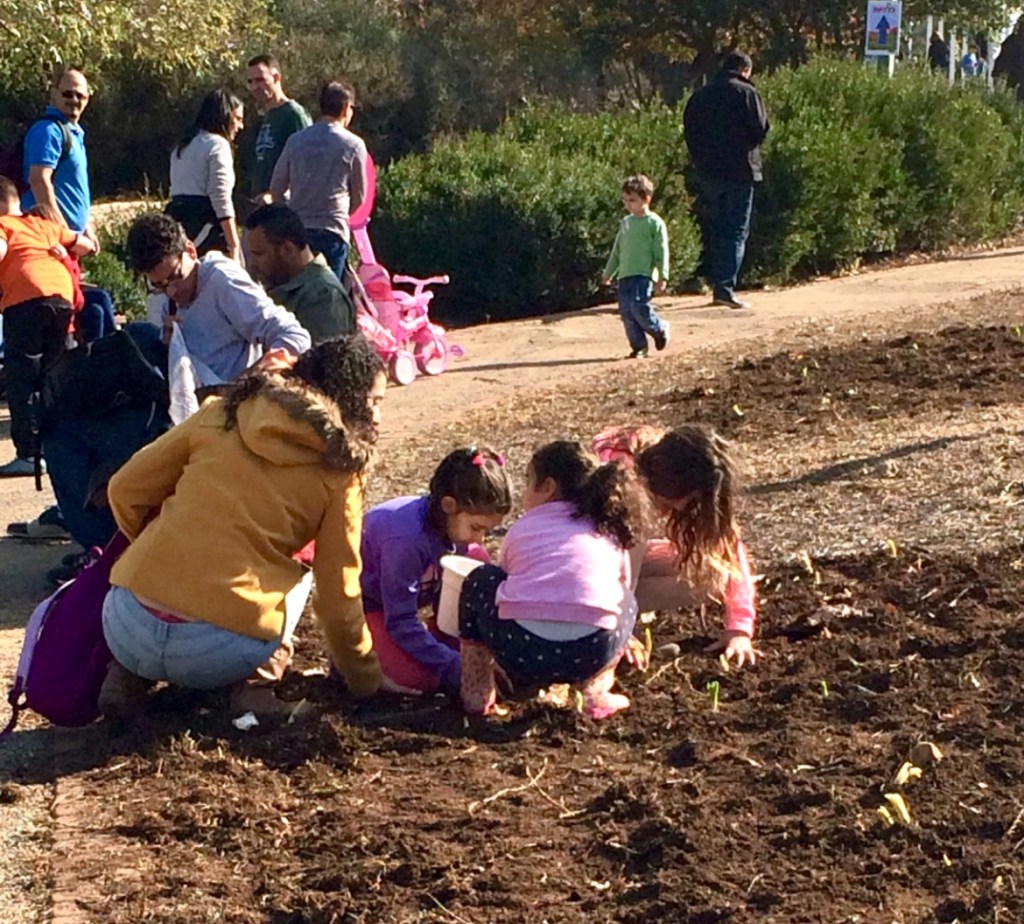
Groups of schoolchildren were out today planting bulbs and trees in the neighborhood park. Whole congregations go out together and plant – avocados are becoming increasingly popular. A friend lives on Kibbutz Ginosar (Gennesaret) where they are planting dunams/acres of bananas this week.

Did you know fruits can be really really Kosher? That Jewish trees in Israel are circumcised??? That’s another weird one. Let me explain. A fruit tree is planted about now…15 Shvat. It is cared for and grows. The first year comes and fruit pops out. Leave it alone! Do not touch the fruit! It is not ready yet. Why? Leviticus 19:23 states
וְכִי־תָבֹ֣אוּ אֶל־הָאָ֗רֶץ וּנְטַעְתֶּם֙ כׇּל־עֵ֣ץ מַאֲכָ֔ל וַעֲרַלְתֶּ֥ם עׇרְלָת֖וֹ אֶת־פִּרְי֑וֹ שָׁלֹ֣שׁ שָׁנִ֗ים יִהְיֶ֥ה לָכֶ֛ם עֲרֵלִ֖ים לֹ֥א יֵאָכֵֽל׃
When you enter the land and plant any tree for food, you shall regard its fruit as forbidden. Three years it shall be forbidden for you, not to be eaten.
In the fourth year of fruit bearing, the farmer would bring the fruit from those trees to the Holy Temple in Jerusalem as an offering…on Tu b’Shvat. Then the tree is circumcised, holy, set apart for eating, Kosher. Who knew? From year five onwards, the nuts, the fruits, the seeds are all good to go. Pretty wild, eh? Many farmers still abide by these Biblical laws today here in Israel – except they offer the fruits and nuts to the poor because there is no longer a Temple.
In the 1500s and 1600s, the Jewish mystics of the city of Tsfat (only 20 minutes from here) created a Tu b’Shvat Seder which has come into real popularity in Israel today. It was modeled after the Passover Seder, where different foods are eaten in a certain order, blessings said, and everything has a symbolic, deeply spiritual meaning. We have our own lovely Seder. Here’s what I do:
The table is set with a lovely bunch of fresh flowers I just picked from the neighborhood park. There is no requirement to light candles, but as this is a festive celebration I light the two candles and say the holiday blessing. We have four small glasses of wine set out – white wine, a light rosé, a darker rosé and a red. We take turns reading just like at Passover. I fill a large pitcher with rose scented or lavender scented water. There is a basin. Each person recites the prayer for handwashing and washes his hands individually.
The First Cup of Wine
This glass of white wine symbolizes winter. For a mystical twist this is the energy G-d used in creation to create the trees and flowering, seed bearing plants. We read Deuteronomy 8:7-10 and then lift our glass, say the blessing and drink the wine.
Barukh ata Adonai, Eloheinu Melekh ha-olam borei peri ha-gafen.
Blessed are you, Source of all life, Creator of the fruit of the vine.
Reader: For Adonai your God is bringing you into a good land. A land of brooks of water, of fountains and depths springing forth in valleys and hills, a land of wheat and barley and vines and fig trees and pomegranates, a land of olive trees and honey, a land wherein you shall eat without scarceness, you shall not lack anything in it; a land whose stones are iron and out of whose hills you may dig brass. And you shall eat and be satisfied, and bless God for the good land, which is being given unto you (Deuteronomy 8:7-10).
The First Fruits
Did you know a nut is also considered a fruit? At this point we eat a fruit that is hard and inedible on the outside but with a softer flesh on the inside, like coconut, pecans, walnuts, almonds. The hard shell is strong like our covering and protection by G-d when we walk in His ways. We become strong spiritually, but in the inside we are still tender and yielding. Today as a first course, I serve walnuts in the shell, almonds (indigenous to Israel. Aaron’s staff had budding almond flowers) and also some feta cheese.
Barukh ata Adonai, Eloheinu Melekh ha-olam, borei peri ha-etz.
Blessed are You, Source of all life, Creator of the fruit of the tree.
The Second Cup of Wine
The second glass of wine is a light pink rosé. It stands for springtime. It is also a mystical symbol of mercy (the white wine) mingled with a little bit of justice (the red grape juice or wine), two attributes of the Creator. We read Deuteronomy 28, the blessings and the curses for obedience and disobedience to G-d’s commandments. Then the blessing over the wine, and drink the second cup.
Reader: Blessed shall you be in the city, and blessed shall you be in the field. Blessed shall you be in the fruit of your body, and the fruit of your land, and the fruit of your cattle, and the young of your flock. Blessed shall you be in your basket and your kneading trough. Blessed shall you be when you come in and blessed shall you be when you go out (Deuteronomy 28:36).
Barukh ata Adonai, Eloheinu Melekh ha-olam, borei peri ha-gafen.
Blessed are You, Source of all life, Creator of the fruit of the vine.
The Second Fruit
The second fruit(s) we enjoy are soft on the outside with a seed or pit in the center. I use olives, as they are one of the seven Biblical species indigenous to the Land. They grow everywhere throughout the Galil. It has become a sign of home. You can also use any stone fruit like cherries, apricots, peaches. I also use dates, because they grow here around Lake Kinneret (Sea of Galilee) and in Hebrew, the date palm is Tamar. These fruits remind us of the spiritual and emotional strength within us.
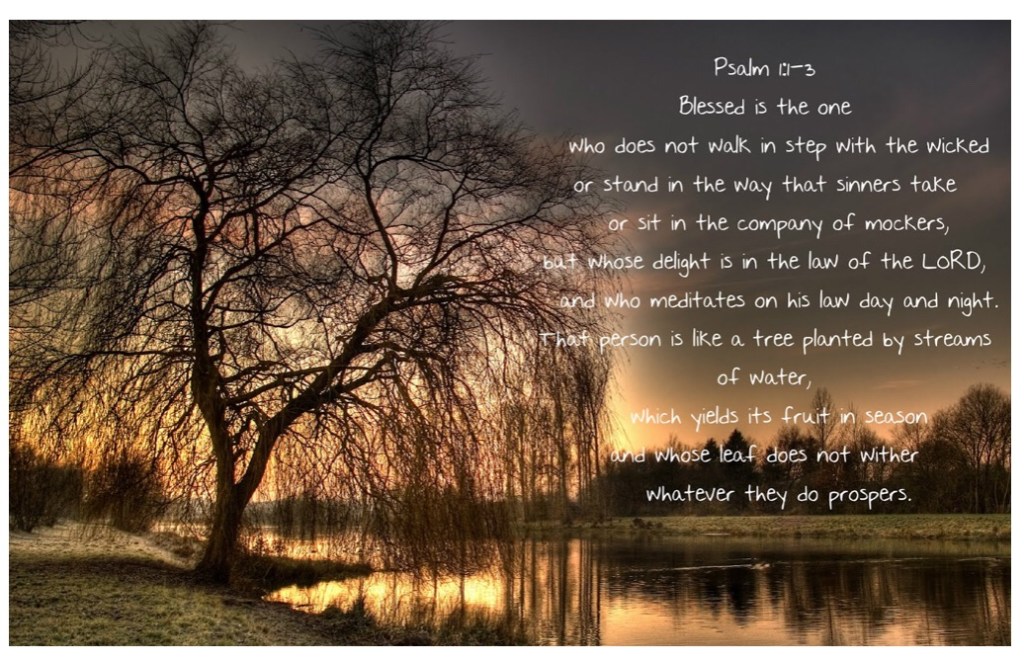
We read Psalm 1. We say the blessing over the fruit again. Now eat the olives or dates.
The Third Cup of Wine
The cup of late spring early summer. The wine is a deep pink rosé. It is more judgment than mercy. It is a season of growth and development. Life is always changing, but G-d remains the same.
The Third Fruit
This fruit symbolizes the first harvest. We eat fruits that can be eaten whole without peeling. What you see is what you get. It also stands for G-d’s omnipresence. Blueberries. Tomatoes. Apples and pears. Grapes. I use grapes as that is also one of the seven species. We read Genesis 1:29-31, say the blessing and consume the fruits.
28 And God blessed them, and God said unto them, Be fruitful, and multiply, and replenish the earth, and subdue it: and have dominion over the fish of the sea, and over the fowl of the air, and over every living thing that moveth upon the earth.
29 And God said, Behold, I have given you every herb bearing seed, which is upon the face of all the earth, and every tree, in the which is the fruit of a tree yielding seed; to you it shall be for meat.
30 And to every beast of the earth, and to every fowl of the air, and to every thing that creepeth upon the earth, wherein there is life, I have given every green herb for meat: and it was so.
31 And God saw every thing that he had made, and, behold, it was very good. And the evening and the morning were the sixth day.
The Fourth Cup of Wine
The last glass is red wine. We are judged for our actions. As the fall comes and winter sets in, it is time to plow under the soil. The land rests. We become introspective and make things right between ourselves as people and with G-d. This glass, all red, also stands for fire, burning, purging, but not consumed like the burning bush, or the fire of the Divine Spark within us. We read the story of the burning bush in Exodus 3, say the blessing and sip the wine.
The Fourth Fruit
The fourth fruit has a touch, protective skin on the outside, but sweet, soft flesh within like avocado, citrus fruits, mangos or bananas. It symbolizes the mysteries of the world and the hidden mysteries in Scripture. We are constantly seeking to uncover deep truths and are nourished by her fruits.
This is just a tiny bit of our Seder. We sing songs and eat lots of great vegetarian (and I serve dairy) foods between each part of the fun ceremony. There’s a lot of deep spirituality that goes with each part and, as a result, lots of discussion.
I know it’s a bit late for you this year, but here are some recipes that we will be enjoying.
Tu b’Shvat Israeli Salad
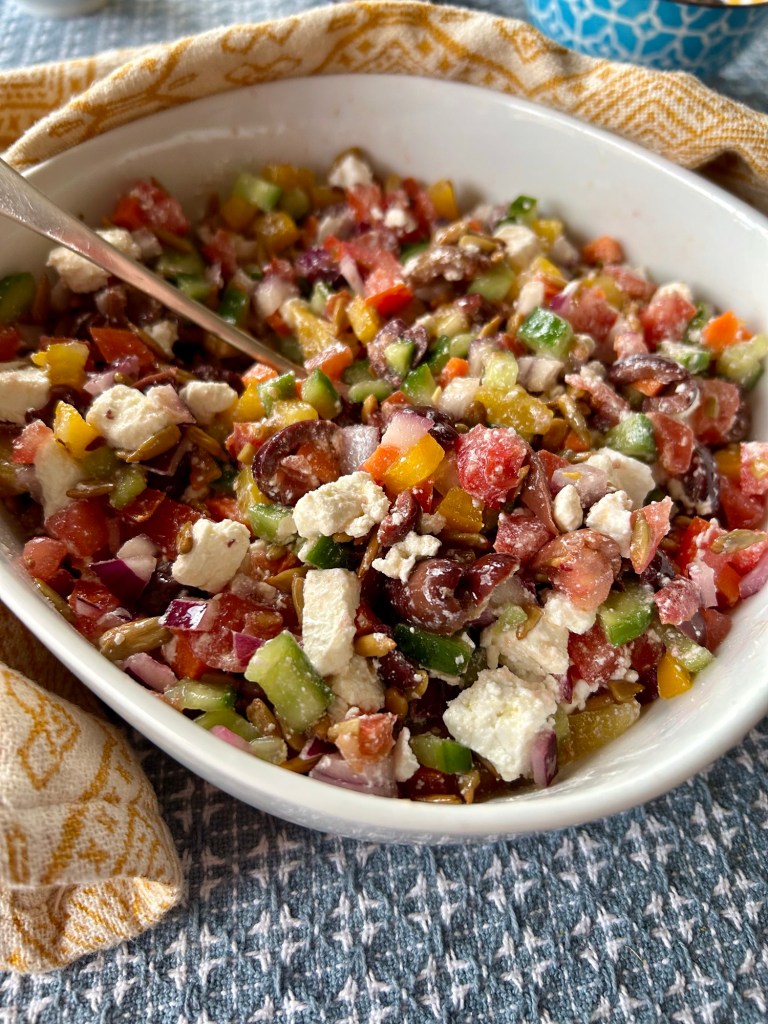
Ingredients and Directions: Chop a variety of fresh vegetables into small diced chunks… Tomato, Cucumber, Yellow or Orange Bell Pepper, Red Onion, Carrot. Add crumbled Feta Cheese. Dress with juice from 1/2 fresh lemon and a drizzle of olive oil. Gently stir in roasted, salted sunflower seeds.
Tamar’s Sweet Israeli Tabbouleh
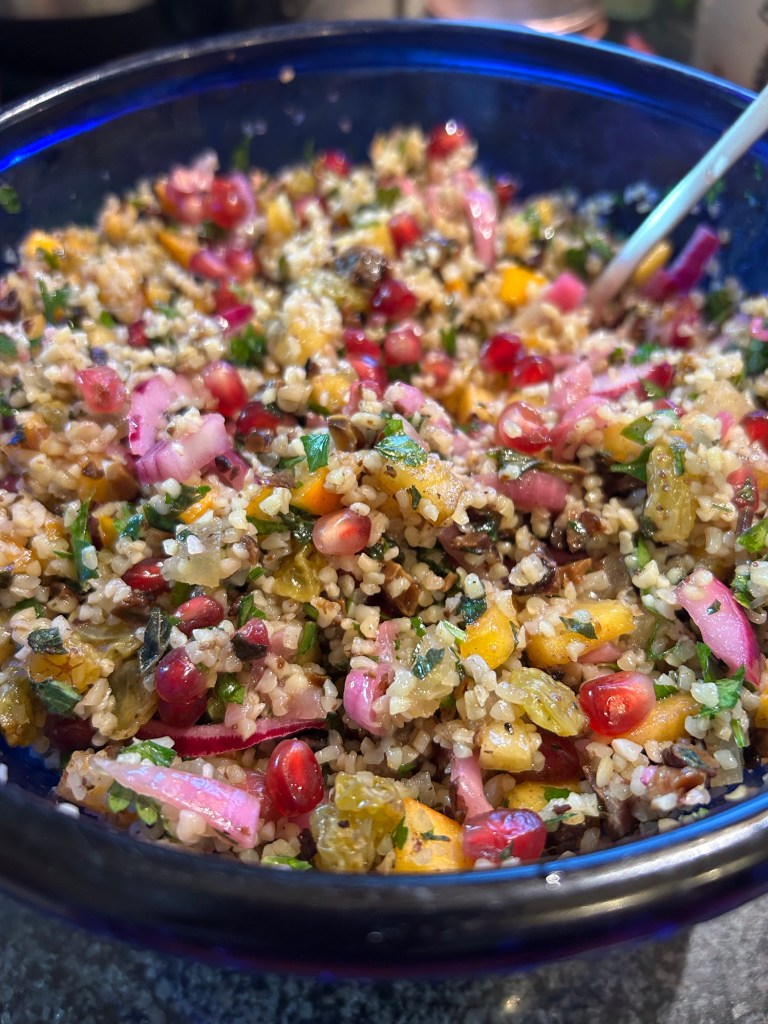
Serves 6-8 as a side dish 4 as a lunch entrée. Vegan. (Pareve)
Ingredients:
- 1 cup bulgur
- 1 1/2 cups boiling water
- 1/4 cup pickled red onion (onion pieces swimming in vinegar with pickling spice)
- 1/2 cup parsley, chopped very fine
- 1/4 cup fresh mint leaves, chopped very fine
- 1 cup toasted walnuts, chopped
- 1/2 cup pomegranate arils
- 2 persimmons, chopped into small cubes
- 1/4 cup yellow raisins
- 1/4 cup chopped dates
Dressing ingredients:
- 1/2 cup extra Virgin olive oil
- Zested rind and juice of 1 large naval orange
- 2 TBSP apple cider vinegar
- 2 Tablespoons honey
- 2 Tablespoons pomegranate syrup/molasses or carob syrup, if available
- 2 tsp sumac
I tried to use all things indigenous to the land and/or part of the seven species in this cold salad. Wheat, dates grapes (raisins) pomegranates and honey for the Land of Milk &Honey. It’s so healthy, light and addictive! Very Israeli with a twist. I really do hope you make and enjoy this one!
In the meantime, plant some bulbs or a fruit tree. If you desire to bless Israel, go to https://shop.jnf.org>collections>plant-trees and plant a tree in the Land of Israel for only $18. You’ll get a gorgeous frame able certificate and can plant the tree in memory of someone who has passed away or honor someone having a special event like a birthday, anniversary, wedding or Bar/Bat Mitzvah.
 Israel Dreams