Love and War Stories. 9 November, 2023

The last couple days have been quite heavy. So today I thought I’d share this wonderful and uplifting story with you. It’s one of those ‘Only in Israel’ things and another reason I love this country so much. Enjoy!!!!

Proposals, weddings, births! Israel becomes more hopeful and Jewish ‘davka’ during wartime

Despite the tragic events of Oct. 7, Israelis deliberately choose to celebrate life

Tuvia Pollack | Published: November 7, 2023 

Share:
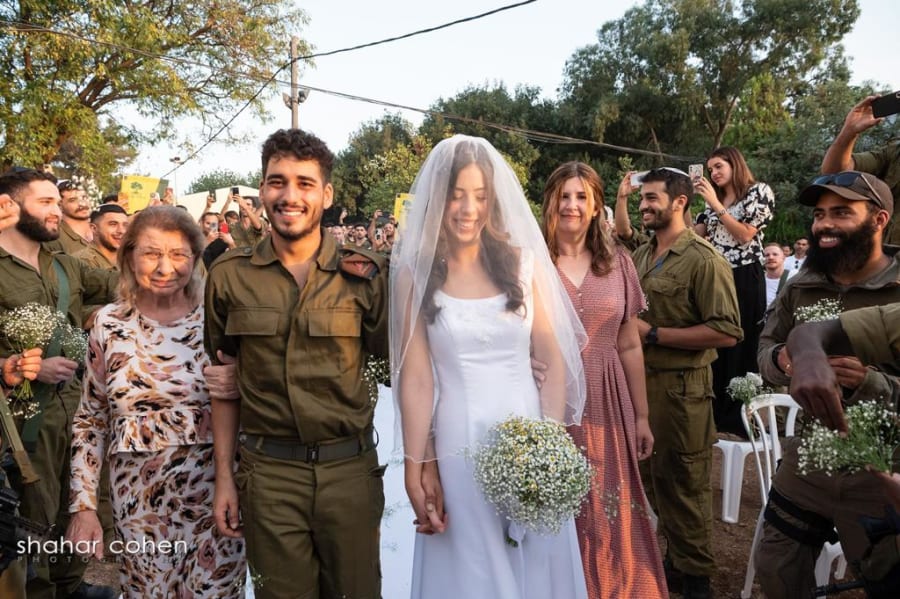
Benny Maidan and Naomi Theodor walking down the aisle (Photo: Shahar Cohen)
As the war today marks one full month of hostilities, Israel is experiencing an unprecedented surge of births, marriage proposals and weddings, despite the war looming over its society. Why is that? We can sum it up in one Aramaic word – davka. Originally meaning “precision” in Hebrew, we use this word to express something that is done in spite of, or specifically because of.

Hamas wants less Jews in Israel? We will davkacreate new families and make more babies.

Benny Maidan, 25, and Naomi Theodor, 20, had planned to get married in April or May of 2024, and this past September they were looking for a venue within their budget but were unable to find anything. And then the war broke out, Benny was called up to his reserve troop in the Golani Brigade, close to the Lebanese border.

“As the war started, we felt this urge that something wasn’t finished. We caught ourselves wishing we were already married, or that we had married earlier,” Naomi told ALL ISRAEL NEWS during a recent interview. “And then we heard news of couples getting married in their army bases, and thought it might be an option.”

Naomi is referring to something being seen in Israeli news media more and more: A couple whose wedding ceremony was canceled due to the war, and decided to get married on their military base instead.Wedding of Benny Maidan and Naomi Theodor (Photo: Shahar Cohen) 

Already on Oct 17, just ten days after the war started, former Israeli Prime Minister Naftali Bennett shared on social media a photo of the couple Tamar and Adir, getting married in their uniforms and posted:

“Lately I find myself more and more urging young couples who have gone out for a long time to get married and have kids. I think I have already set up 4-5 weddings for injured people, or bereaved family members. Our victory against our enemies will not just be through the hell we will unleash on them in the battlefield, but also by starting new lives of the Jewish people here in the Land of Israel. With optimism, with building a new generation, with faith, and with growth from the horrible pain,” Bennett wrote.

“Here in the photo are Tamar and Adir, getting married in Kibbutz Urim in the south. You don’t need a fancy venue, a catering, or a band. Not even a wedding dress. You can get married in uniform, with a military rabbi, an army bottle of wine, and some chicken and rice from the military kitchen. There’s no people like the People of Israel – ‘In thy blood live.’”, which is a reference to Ezekiel 16:6.

Similarly, the Times of Israel reported on Oct. 28 about numerous weddings, davka, during this time. In some cases, it was a wedding ceremony that was scaled down but still took place on its planned date. In other cases, such as Benny and Naomi’s celebration, the wedding date was shifted to an earlier date than what was originally planned for because of the war. In some cases, the scaling down means that not all family and friends are able to attend. In other cases, the number of guests actually increases, as Israelis are volunteering in droves to be a part of the celebration and bring joy to the bride and groom.

These weddings frequently go viral on social media in a nation that is starving for good news and glimpses of hope.

Benny’s military comrades volunteered to arrange his wedding, Naomi told ALL ISRAEL NEWS. She was told that all she needed to do was to find a dress, arrange for the rings and show up.

“In my mind, I thought we would get married and they’ll hold a piece of bedsheet over our heads [for the chuppah], get married and go home. But then I saw how everyone was really giving their all into this and was happy to be part of it.”Wedding of Benny Maidan and Naomi Theodor (Photo: Shahar Cohen) 

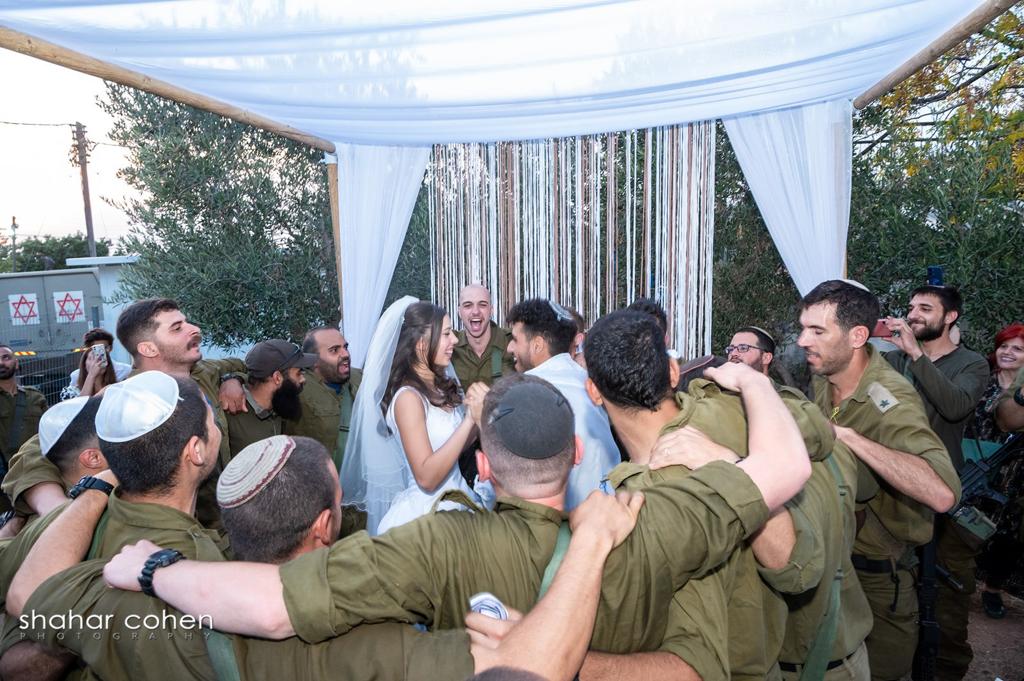
Naomi describes how the comrades arranged a professional chuppah, catering, a photographer, flowers, wedding cake, makeup and hair – everything for free.

The guys of the Golani Brigade met every evening to plan the wedding, with each one pitching to help via their connections and who would be available and wiling to volunteer their time and effort.

Naomi said the guys didn’t even let Benny in on all the plans.

“I was still concerned about the safety,” Naomi said, in reference to the frequent missile attacks being launched by the Hezbollah terror organization against military bases near the northern border.

Benny told her, “If something happens, we’ll go into a bomb shelter, and then hopefully come back and finish the wedding, and that we can’t let ourselves be overwhelmed by ‘what if’-scenarios.”

Another issue that could have potentially held things up was the legal procedure with the Israeli rabbinate, which can take up to at least three months in some cases.

With less than two weeks to plan the wedding, Naomi said, that issue was also resolved, as military rabbis at the army base were able to pull some strings for them.

“Two days before the wedding I was told, ‘The wedding is in two days, on October 26th.’ My family arranged a decorated car for me, I wore my dress and we went up north, and I had no idea what would happen,” Naomi said.  Except for the soldiers at the base, the only invited guests were the couple’s closest family members – their mothers and siblings.

Benny and Naomi are both fatherless, as Benny’s father was a Holocaust survivor who passed away from old age and Naomi’s father died from COVID two years ago at only 54 years old.

The couple first met each other while Naomi and her family were mourning her father’s death. The wedding would take place just a few days before the second anniversary of her father’s death, on what is referred to in Yiddish as the second Yahrzeit.

This is also something unique for Jews in Israel, to go from bereavement to joy overnight. This is reflected in the way we celebrate memorial day of our fallen soldiers – a holiday that is observed one day before we celebrate the Jewish state’s freedom and establishment – Independence Day – and is a deeply-rooted part of the Jewish experience.

“When I arrived, I was overwhelmed because everyone was wearing green, and they were all excited about me, shouting  ‘The bride has arrived!’ and you could really see the joy in their eyes,” Naomi continued.

“They took me to a room they had prepared for me, and this guy said, ‘Let’s do your hair.’ And then a lady came and did my makeup, and then there’s music, they’re getting flowers ready, and then I go outside and I see this huge really professional chuppah.”

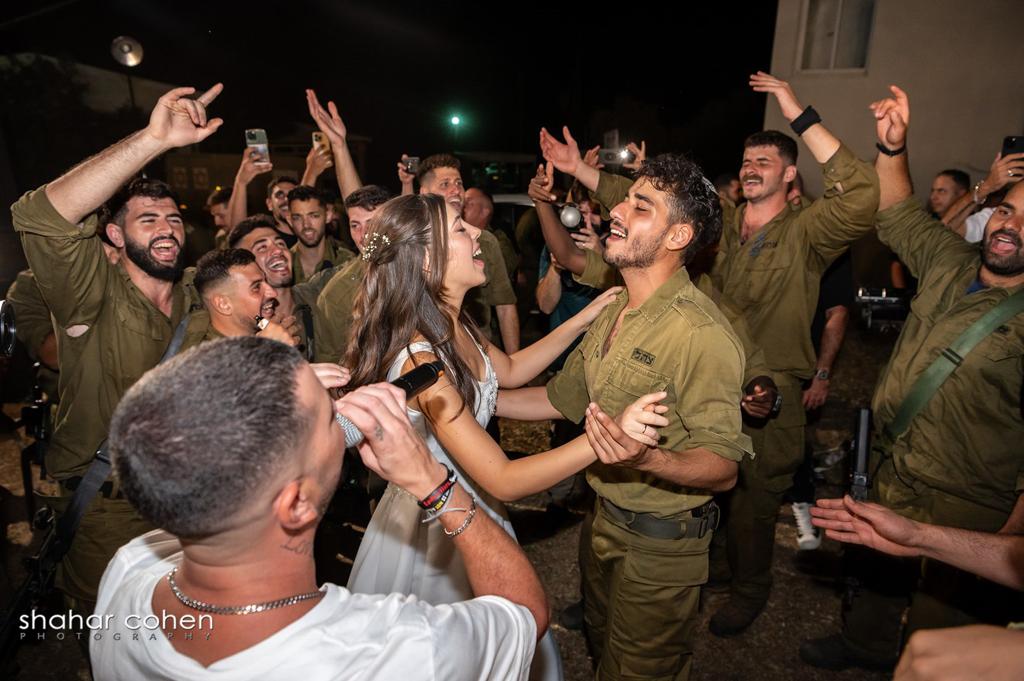
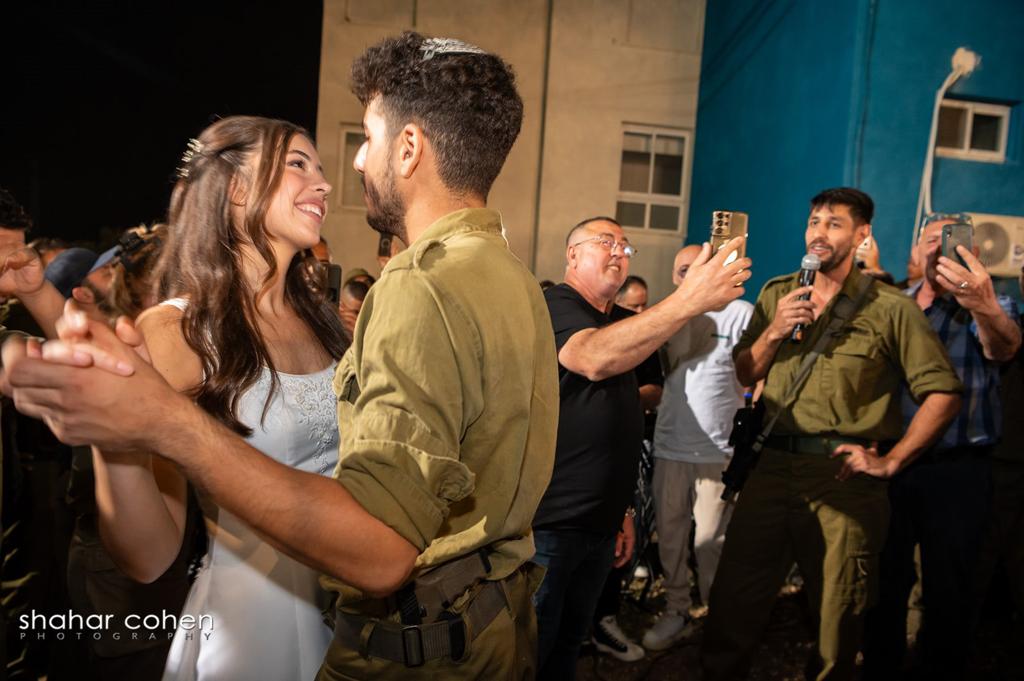
“Someone came up and said, ‘Hi, I’m the videographer,’ and someone else says he’s the photographer. I had no idea I was going to have a videographer at my wedding. They took us around the place and took pictures of us. Then we had the ceremony under the chuppah, which was very emotional. And then the famous singer Shay Tzabari shows up and sings, and then we go dancing,” Naomi shared.

“The food was amazing.: Steaks, chicken pullets… I was in shock that they made this whole thing and everyone were so happy for us. And then we go dancing again, and the famous singer Idan Amedi, whose music I love, showed up and sang especially for us. It was so amazing and beautiful. A 40-year-old high-ranking officer was crying his eyes out during the ceremony.”Idan Amedi singing at Benny Maidan and Naomi Theodor’s wedding (Photo: Shahar Cohen) 

The phenomenon of Israeli celebrities appearing for free at military weddings has become more  common in recent days, with many reportedly surprising the bride and groom by appearing and performing at weddings.

During one portion of Benny and Naomi’s wedding ceremony, loud gunfire could be heard as the Israel Defense Forces was shooting at Hezbollah target.

After the ceremony was finished, the couple was sent to a cabin for their wedding night – also for free.

“Everyone gave from their goodness from their heart. The providers of the services for the wedding came from all over the country, from Ashkelon, Tel-Aviv, drove all the way and volunteered their time just to make us happy.”

Naomi shared that the lady in charge of making the chuppah told her that her husband had been at the nature festival that was brutally attacked by Hamas terrorists on Oct. 7. Her husband saw his friends being shot in front of his eyes, which was very traumatic.

Regarding the wedding chuppah, “She told me that she did this because what we’re doing gives hope again,” Naomi shared. “I really saw the heart people have to help in times of need.”

“We often forget that,” she added, “but in times of need, Israelis are really good. We’re all here for one another.”

This togetherness and solidarity within Israeli society – and the Jewish community at large – is what Hamas terrorists did not take into account on the day they invaded and massacred Israeli soldiers and civilians.

Hamas saw Israel’s protests and debates over judicial overhauls and corruption scandals, and thought the Jewish state would remain divisive under fire.

But they were wrong. This war against Hamas in Gaza has made Israeli society more united than ever, and more connected to its Jewish identity.

“I also think about all these families being broken apart, and we have the privilege of stand on the same land and start a new family and a new home in Israel,” Naomi said during the interview.

“The venue, the amount of flowers, the exact right dress, nothing of that really matters. What matters is to start a new family in Israel at a time like this. We both love this country and felt this is an important statement. I had friends wondering why getting married during a war, when something could happen to him, and I answered – that’s exactly why! If something does happen to him, I want to be by his side,” she said.Benny Maidan and Naomi Theodor at their wedding (Photo: Shahar Cohen) 

This hope, with weddings, marriage proposals, births, etc.; some 300,000 Israelis living abroad who returned home to serve in military reserves to protect and defend the State of Israel; and even the wave of new immigration we expect as Jews begin to feel more unsafe in the diaspora – all of these things make the Israel even more significant for Jewish society than ever.

And such anticipation and hope for the future is happening davka at such a time as this.

“But the more they afflicted them, the more they multiplied and the more they spread.” – Exodus 1:12

War Stories: A Spiritual Battle 8 November, 2023

This is a difficult post to write. If I haven’t estranged readers up until now, this one will possibly do so.

As a point of reference, I am a Torah observant Jew married to an observant Catholic. Since I’ve known John, we’ve had more than a few heartfelt dialogues over the past 44 years. I have written books and articles on theology under an assumed name and have led Bible studies for decades on the Tanach (Old Testament) and the Hebrew roots of the New Testament. I have studied the mystical (Jewish) Tanya and the Talmud as well as the history of the Church and the early Church fathers, especially in their thoughts and relations to Judaism. Judaic studies is more than just a hobby for me.

The current Israel-Gaza War is real and physical. It’s nasty. I pray as few casualties as absolutely possible. The war is a battle between good and evil, a culture of life versus a culture of death. You can see it in the brutality of the October 7 massacre and you can see it and hear it in the voices of the mobs and pro-Palestine protests worldwide.

Not only is it a real, physical war, but it is also a spiritual war. Israel is a country founded on the three Abrahamic religions: Judaism, Christianity and Islam. We live in the land where the great Bible stories have taken place – for us, we’re not far from the battlefield of Hazor where Joshua fought many battles; Mt Tavor where Deborah sat in judgement and where Jesus was transfigured. We have visited the burial cave of Hannah and her seven sons. The gate in Dan, a pre-Canaanite city recently discovered, where Abraham negotiated with the four kings for his nephew,Lot is a short drive away. The prophet Habakkuk is buried right down the road from us. Elijah and the prophets of Baal took place on Carmel Ridge which I see from my balcony. And of course, the Galilee holds Nazareth and all of the sites where Jesus lived and taught and did miracles. It is truly a Holy Land.

The people of Israel are spiritually tied to this Land in a way like no other. The Jews live out the Bible mitzvot (the laws and edicts) in their daily lives. The Aramaeans see themselves as among the first followers of Jesus. And the Christians see themselves as “living stones.” And sometimes we all don’t get along – we bump elbows on occasion. There are definite religious tensions here at times.

At present, there is a genuine spiritual revival going on here throughout the Jewish community. Soldiers are requesting tsitsit (fringes for the corners of their undershirts), kippot/yarmulkes and t’fillin (phylactery boxes). They are spontaneously singing and dancing and blowing the shofar in the fields. To answer a statement written to me a few days ago- no. That doesn’t make one holy or guarantee one’s salvation or deliverance, but it’s definitely a Biblical commandment (Numbers 15:37-41) for a Jewish male that is now being observed. People everywhere are holding Bible and Torah studies and are forming prayer groups. Everyone is lifting voices and minds to G-d. The usual atmosphere now feels charged with a tangible holiness.

Even the radio disc jockeys of Israel know how to set an atmosphere. Instead of the usual pop music, you turn on the radio and hear Psalms and Scripture set to hauntingly beautiful music. It makes me want to cry. Voices are being lifted up heavenward in true, heartfelt repentance and prayer. I’ve never experienced anything like it in a synagogue, a church or at a tent revival (we used to have them regularly in our small Southern town. Every summer. The clapping. The tambourines. The singing. The shouting). This is something very different.

As stated here yesterday, the Jews are not a perfect people by any means!! Far from it! But neither are we a bloodthirsty people. We all pray for world peace. The examples given to me regarding the story in Genesis about vengeance of Jacob’s sons after their sister who was kidnapped and raped; the battles Joshua fought in the Promised Land and the battles of Saul and David (with tremendous casualties on BOTH sides); and how this is not the Christian solution to paganism and violence is not pertinent at this time. That Jesus preached a message of peace and love for one’s enemies by several readers might be true, but you are not living here at this time. John and I have had this discussion repeatedly and we are convinced he spoke on a personal, not a national level. Yet, still, we are a nation/people who value life and the dignity of each person as made in G-d’s image.

We are in a fight for the existence of the Jewish nation, and conversely, Western society. Look at a map. Ours is not a friendly neighborhood. Not only Gaza and Hamas but Hizbulla in Lebanon and the Houthis of Yemen as well as the Syrians, all backed by Iran are breathing heavily down our necks. Where else do we have to go but to G-d? We are not seeking revenge but the IDF is attempting to surgically extract and eradicate Hamas while trying to rescue 243 hostages and spare the lives of innocents. While engaged in booby trapped urban combat, the most dangerous there is. If you’ve heard the chant, from the Jordan River to the Mediterranean Sea Palestine will be free of Jews. Then they will focus on the Christians and the West. One can stand up now or face silencing and eradication later.

In response to the other person who wrote: “Jesus taught us to love and pray for our enemies and to turn the other cheek. We are to give up our tunic if our persecutor takes our cloak and to “walk the extra mile.”

Firstly, in Leviticus 19:18 it is commanded for us to love our neighbor as ourselves. It was my Bat Mitzvah portion. I see it often on bumpers and car windshields here. We take this seriously, especially now. The help and cooperation between different groups of people is unbelievable. Religious and non-religious are acting as one in unity. We are doing what we can to support one another and have always tried to uphold the mandate “to be a light unto the nations.”

Israel, although a tiny country land-wise and population-wise has led the world on many fronts. Israelis working together, Jew, Christian and Muslim, have given the nations a great many medical and technological advancements. Some include the endoscopic camera, flexible stent (I have one now), Israeli pressure bandage, paramedics on motorcycles who get to the patient before an ambulance. We have developed agricultural technologies that save the soil and the water (hydroponics, drip irrigation, bee and hive propagation, natural pest prevention). Israel has given the world drugs for Parkinson’s, Altzheimers, Diabetes, MS, cancer. For those who use a cell phone or computer, we have given the world Firewall protection, WAZE navigation systems, stand alone instant messaging and first flash disc storage. How about Soda Stream and Roomba? Both Israeli innovations. The Israeli system that developed a cube no larger than a dorm fridge which extracts oxygen from the air to somehow produce fresh, potable water has been given to communities in drought stricken Africa as well parts of South America. We provided Gaza with water pipes and they, in turn, have dug them up to produce missiles.

The Israeli search and rescue teams are among the first in the world to provide emergency and medical assistance to those most in need throughout the world. They have set up full spectrum field hospitals in Nepal and Mexico after their earthquakes; in Haiti in Ukraine to name a few. That, in practicality, like the Good Samaritan, is showing love, not just to the Jewish people, but to all humanity.

Our hospitals treat not only Jews, but Muslims, Palestinians. The head of Hamas, Yahya Sinwar, was treated and cured in an Israeli hospital for a brain tumor. He is now planning the mass-destruction of Israel. If that is not loving one’s enemy and showing no preference, I don’t know what is.

During the Syrian Civil War, Operation Good Neighbor provided innocent civilians with unmarked humanitarian aid in the form of water, flour, beans, baby formula, diapers and other necessities. Civilians wounded by their own clashing armies and children with heart problems, cancers and cleft lip and palate were airlifted to Israeli hospitals for treatment at no cost to them. My son was part of this relief effort.

One day, perhaps you will be able to visit the Holy Land and actually see firsthand the wonders of this Start-Up Nation.

Secondly, to address the Matthew Scripture. If someone asks you to walk a mile, go two. For historical reference, in the time of Jesus, Israel was ruled by Rome. There was an impressarial service that a Roman could impose upon any Jewish person, usually the weakest. The Jew would be expected to carry the weapons/baggage of the soldier for a Roman mile. This load could be up to 50-60 pounds. The roads were dirt, gravel or cobblestones. It was arduous business. Oftentimes, the elderly, feeble, pregnant would cave under the load. To go an extra mile would mean almost certain death. It’s sadly ironic that Jesus himself walked the Roman mile on his way to Calvary.

If a person takes your cloak, and you give him your tunic, your under robe, it would render you in a state of immodesty. In Jewish law, the covering of the body, especially the private parts, is holy. To bare the body in the sight of someone to whom one is not married is deeply humiliating and even sinful to an observant Jew.

When a person strikes you on the cheek, he uses the inside of his palm. It hurts, but is a fair fight, so to speak. When you turn your cheek, it forces the striker to smack you backhandedly. Definitely not fair, and if wearing a ring, can actually do more damage that a front handed smack.

All three examples are a way of standing up to your opponent in a defensive, yet provoking way. If the attacker accepts the challenge, if he causes more damage, the onus is on him. It makes the attacker look weak, in turn shaming him, therefore the underdog in essence wins. Seen in this light, none of the three examples is “walking in love towards one’s adversary.” It’s actually a defensive stance.

To say that “the Children of Abraham lost their status and blessing as the Chosen People of G-d because they did not accept Jesus as their Messiah… the Church has inherited their blessing and they will be forever a cursed people” is very dangerous. To write that the Church is the New Israel is not Scriptural. It not only foments baseless hatred and antisemitism to a dangerous level, it is downright wrong. This theology has a name. It is called Replacement Theology or Supercessionism which has been responsible for many a pogrom and ethnic cleansing. Romans 11:29 in the New Testament states that “the gifts and calling of G-d are irrevocable.(for he does not withdraw what He has given , nor does He change His mind about those to whom He gives His grace or to whom He sends His call). When G-d makes a covenant, by its very definition it is eternal. Does G-d not love all His children, Jew or Christian, slave or free? Has G-d only one blessing??? Yes. We are ALL sinners who fall short, but surely the G-d we share is by far bigger and more merciful than we frail humans, made in His image are.

For a bit of Church history: the early Christian movement started as a Jewish sect based on Jewish scriptures. Jesus and his entire family were practicing religious Jews. His disciples and first followers were all Jewish. He was from the tribe of Judah, born in Bethlehem near Jerusalem. He had a Brit Milah, circumcision rite, putting him under the Abrahamic covenant. He had a Bar Mitzvah (teaching in the Temple), celebrated the feasts (Chanukah, John 7; Pesach; Sukkot). He lived in the Galilee, Israel. He taught and expounded on the Law and the prophets. He kept Kosher. He made mikveh (ritual immersion) under John the Baptist.

At its inception, this group of mostly Jewish believers in Jesus as Messiah formed a dominant faction, centered under the leadership of the apostles Peter and James in Jerusalem. As Believers took the message of their messiah out to the world, the make up of the congregation shifted. The Jews were now in the minority and the Gentiles were becoming more numerous.

50 A.D. was an auspicious time in the history of the Early Church, as a split between the Jewish Believers and the Gentile Believers was an imminent threat. The Judaean Believers, together with Paul and Barnabus who had returned to Israel from a successful missions trip were gathered in what would be known as the First Jerusalem Council.

Until this time, the Early Church was thoroughly Jewish in both members and in practice. The dilemma arose: uncircumcised Gentiles would be welcome into the Body of Believers, but was circumcision needed at all? Were Kashrut, the Shabbat and Festivals to be kept? What about the other 613 laws? What would socialization and worship look like? How were they to create unity between the two such visibly and spiritually diverse groups?

Paul and Barnabas had been establishing congregations of mixed Believers in Lydia, Phrygia, and Galatia. The movement started in the synagogues and moved outwards to the pagan lands. Until that time, any Gentile person who wished to become Jewish had to be thoroughly educated in the laws of Moses and take on the yoke of Judaism. Some of the Jewish Believers were converting the Gentiles to Judaism before they were allowed to be discipled and undergo ritual immersion into the Body of Messiah. Faced with these exact problems, Paul wrote the Letter to the Galatians. He penned his epistle on his way to the Council in Jerusalem.

After much discussion at that Jerusalem Council, Peter, the apostolic head at that time, gave his well-reasoned speech, recorded in Acts 15. The Holy Spirit had also been poured out on the Gentiles who had eagerly accepted the Gospel, as confirmed by Paul and Barnabas. G-d had made no distinction between the Jews and the Nations when granting salvation. Even James, head of the Jerusalem congregation, agreed, citing Scriptural references. Thus it was decided, much for the sake of unity, that these new Believers would not need to be burdened with accepting the Mosaic Law, but would keep four basic laws: refraining from eating foods sacrificed to idols; from any meat that had been strangled; the prohibition against consuming blood; and the adherence to sexual morality. It was resolved at the Jerusalem Council that non-Jews do not need to convert to Judaism, but that they should not follow their old idolatrous practices of worshipping their pantheon of gods. They would be brought into monotheistic worship, salvation through Jesus and the promise of resurrection to eternal life. Implicit was the idea that the Jewish faction could maintain their Jewish customs. Thus, a rupture within the Body of Believers was narrowly averted.

Skip ahead two centuries: the growth of the Nations/Gentiles within the Church quickly overtook the number of Jewish Believers. Although the original intent was to have one unified Body, Jewish and Gentile Believers together, the new majority began to call for the Jews to abandon their adherence to their Jewish identities. Assimilation into the Church became the expected sign of unity as the Gentile contingent grew more dominant. This would eventually lead to Replacement Theology/Supercessionism, the concept of the Church replacing Israel as the covenant people of G-d, receiving the promises and blessings of Messiah in their stead. It eventually led to a mass-persecution of the Jewish brethren as well as the non-believing Jews. In essence, what started as a Jewish movement was swallowed up by a ‘Gentile’ Church. This was nowhere to be found in actual dogma, but became widely accepted (false) theology preached and practiced by the Early Church.

I am in no way putting down my Christian brethren, nor am I criticizing the Catholics. I am just trying to explain the origins and the dangers of this line of thought. With Christian Zionism and with the Catholic encyclical of Nostra Aetate and Lumen Gentium, I had thought the Jewish people and the Christian people were coming together again, not exactly eye to eye, but as brothers nonetheless, the fig tree and the vine intertwined producing fruit together.

So if we are bothers and sisters in Spirit, please see that this, too, is a spiritual battle to sow division. Where there is division and disunity, the enemy can enter in. Israel was physically attacked at a time when she seemed at her weakest. The government was broken, factions were fighting and demonstrating. Reservists threatened to not show up for duty. There was widespread vilification each of the other side.

When Christians label Jewish people as killers of their Messiah, it only exacerbates mistrust and ill will. Throughout history, this has only led to ghettoization and persecution. There is already enough hatred in the world. Don’t let the enemy win, spiritually or physically. We must stand up to evil together.

Glory to G-d in the highest and peace to all people of good will.