"When G-d will return the captivity of Zion, we will be like dreamers. Then our mouths will be filled with laughter and our tongues with glad song." Psalm 126
I’ve spent the morning talking to friends, calming nerves, reassuring. Civilians here are visibly nervous. We check up on one another. I’ve found safe housing for people living in the Tel Aviv area. We know there is a great army encamped about us. Our loved ones are assembled at the fronts to repel them. We know that through misinformation and propaganda, the world turns against us. We hold life….all life precious. We are created in the image of G-d with a certain dignity. The loss of any innocent life anywhere pains us greatly.
The people of Israel are completely united. We have Jews, Christians, Bedouins and Druze fighting side by side to defend our Land. We have faith in G-d. There are several interesting things I’d like to bring to mind: the Gaza massacre in Israel occurred on 7 October. I feel this was no coincidence and hear me out. It was a Shabbat, a holy Shabbat, also Simchat Torah. On this holy day, the end of our fall feasts, we celebrate the Torah, the gift of the Five Books of Moses given to us at Sinai. We finish the last chapter of Moses and roll the scrolls back to the very beginning and start reading Genesis 1:1. It is supposed to be a time of great rejoicing. For the Catholics, October 7 was the Feast of Our Lady of Victory and Our Lady of the Rosary. It, too, is a holy day for Catholics. For those who know history, October 7, 1571, was another auspicious day. It. Was the Battle of Lepanto. The radical Islamic forces had waged jihad, holy war, on the West. They had infiltrated into Spain, Portugal, France and other points in Europe. Lepanto was a decisive battle in which the forces of all Christendom overcame the Islamic jihadists. It marked the day of their defeat. They have never forgotten this.
In Judaism, this Shabbat, we are reading Noah. As I stated in a post a few days earlier, the story begins : “in those days violence and lawlessness covered the earth.” In Hebrew, in Aramaic and early Arabic, this word is Hamas. (Despite what they say now, that it is just an acronym for another group of words). It stands. Hamas means violence, lawlessness. They are a people’s not ruled by a law, morals or ethics. But the story is Noah. He is righteous in the eyes of the L-rd. He is obedient to do what G-d commands. He makes his Ark of wood. He covers it inside and outside with a red, sticky pitch which will keep it afloat. Tradition says it took 120 years (no Home Depot nearby, folks). During that time, he tried to warn people as they mocked him. Noah equipped his Ark with food to last for a long time, with animals, with his family. And when the time came, the Ark closed and G-d did what he had to do to wash away the Hamas. Noah, Mrs. Noah and family came out to a rainbow.
During the Passover, the Children of Israel, under the bonds of slavery in Egypt, sacrificed a lamb. One lamb for a family. They painted the blood on their doorposts on their lintels. It must have been one hell of a night as the angel of death passed over. But in the morning, they emerged to freedom. We stay in the Ark. We stay under the blood on our doorposts. Every Shabbat we commemorate this at the Kiddush, e blessing over the wine.
We are nervous. Our bodies are doing weird things. But we are strong people this morning. The army, the whole army, is singing the Psalms and the praises of HaShem. We are prepared as much as we can possibly be. All we civilians have to do is close the little doors of our arks and wait.
We pray for an easy time. We pray for as few casualties as possible. We pray there is no escalation. We pray for no interference from foreign governments and militaries. We’ve got this one. G-d is in total control. He is in charge. We pray He goes before us. We are strong and courageous people. It’s been a long time, thousands of years, since we have truly been in a position to defend ourselves, but now we can. The IDF is the strongest army in the world. And the Spirit runs strong this morning as I get feed from different bases.
I am getting ready for Shabbat. Making challah. Preparing food. Showering. Putting on my good clothes to greet the Sabbath Bride. May it be peaceful, angels of peace, surround us. May it be quiet. May it be holy. I leave you with three songs:
you can look this one up on YouTube. “Kol ha’olam kulo. Gesher tsar meod:”
The whole world is a very narrow bridge. The main thing is not to be afraid, not to be afraid at all. -Rebbe Nachman
Roll into dark. Roll into night. Night becomes day. Day turns to night. And so it goes. Day follows night and joy comes int the morning. One day nations shall turn their swords into plows and there will be no more war.
And of course, my mind completely blanks on the third. But we are praying Psalm 83. Psalm 91, Psalm 121. We’ve got this one…. Todah l’haShem.
Ah yes! Of course. The beautiful prayer/song we sing every night:
Help us, Adonai, to lie down in Peace, and awaken us again, our Sovereign, to life. Spread over us your shelter of peace; guide us with your good counsel. Save us because of your mercy. Shield us from our enemies, pestilence, starvation, sword and sorrow. Remove all the evil forces that surround us. Shelter us in the shadow of Your wings, O G-d, who watches over us and delivers us, our gracious and merciful Ruler. Guard our coming and our going. Grant us life and peace, now and always. Spread over us the shelter of Your peace. Praised are You, Adonai, who spreads His shelter of peace over us, over all His people, Israel, and over Jerusalem.
Craig Taubman does my favorite version of this song. It can be found on all streaming platforms. Craig Taubman “Hashkivenu”. A beautiful, peaceful lullaby.
חזק ואןמץ!!! עם ישראל חי!!!! (Kha ZAHK’ v’ oh METZ) Strength and courage! (Ahm Yisrael khai!) The people of Israel live.
This past weekend, the citizens of Israel celebrated the last of the Spring holidays. Besides Holocaust Memorial Day, Remembrance of Fallen Soldiers and Victims of Terror Day, Independence Day, and Jerusalem Day, there were the religious festivals. For the Jews there was Pesach with its grand Seder meals; the campfires of Lag b’Omer; the counting of the Omer from Passover to Shavuot and Shavuot, the Feast of Weeks and Spring harvest. The Christians celebrated Holy Week culminating with Easter Sunday, Ascension Sunday and Pentecost. And we all celebrated in our individual villages and cities without too many clashes. Despite what one hears and reads, most Israelis, regardless of their differences, really do want to live quiet, peaceful lives of coexistence.
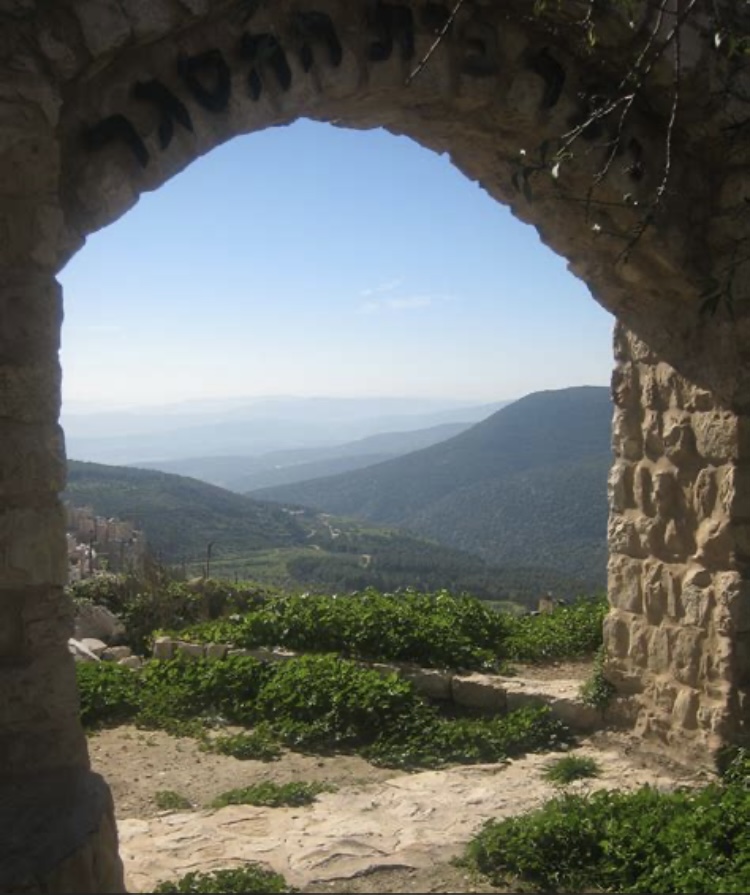
The Galilee region of Israel is made up of rolling hills, not quite big enough to be called mountains, but beautiful nonetheless. The word Galilee comes from the Hebrew gal, or wave and the landscape is, in fact like the swelling of waves on the ocean. The Galil is indeed a holy land to both Jews and Christians. Much of the combined history interweaves and overlaps in this small strip of land. The Northern Kingdom of Israel; battlefields of Joshua; tombs and burial caves of prophets, martyrs (Channah and her seven sons) and great rabbis; the meeting place and codification of the Mishna; the home of the Blessed Virgin Mary, the Holy Family, the Disciples of Yeshua; Mary of Magdala; the place where Yeshua taught, healed and preached; the mountain where He was transfigured; the place where Mattityahu Ben Yosef/Josephus Flavius was governor and general. It is all here….and more!
On a small ridge, the next hill over from Nazareth, is Tsippori, also known as Sephoris. (I wrote an entire blog on this magnificent site 29 August, 2022) Perched at the top, the ‘Pearl of the Galilee,’ was an ancient First Century city. It was an exceptional place of co-existence, and the capital of the Galil during the Roman occupation. Tsippori was one of the few cities in the Galilee that was not razed by the Romans during their March to Jerusalem in 68 CE. It was a Jewish city, with mikvaot(Jewish ritual baths for purity), synagogues and Jewish homes. But it was also a Roman city, complete with amphitheater, Roman style villas, and a Roman street plan. Built during the last decades BCE, and the first decades CE, Tsippori is about a 45 minute walk from Nazareth. It is also a long morning’s walk to the Sea of Galilee, so it is most likely that Joseph the carpenter (mason) and Jesus were laborers here building the city. After the destruction of the Temple in Jerusalem, 70 CE, many members of the Jewish Sanhedrin and great sages of the Talmud made the Tsippori area their home. Today, the ruins of this large ancient city are preserved under the auspices of the Israeli National Parks. We have visited many times.
I had heard that there was an old church and monastery somewhere on the mountain, uninhabited, in disrepair, long abandoned. John and I had stumbled upon it once, not knowing its amazing history. It just seemed like an old, uninhabited place… and there are so many of those around. We ‘discover’ places in remote areas but have no idea what they are or the significance they held.
A new family of Olim (immigrants) recently moved to our neighborhood. They are an intermarried couple from Argentina. Daniel is a Conservative Jewish man and his wife, Rosa, is a practicing Catholic. In the short time they have lived here, Rosa has gotten to know all the priests and Catholic holy sites in the Galilee. Many of the priests here speak Spanish, so that has been extremely helpful to her. Last week, Rosa told me of a special discovery she made and she wanted to share it with me. She knows we are into history and that I have a blog, so this could be a potential story. It was quite the adventure!
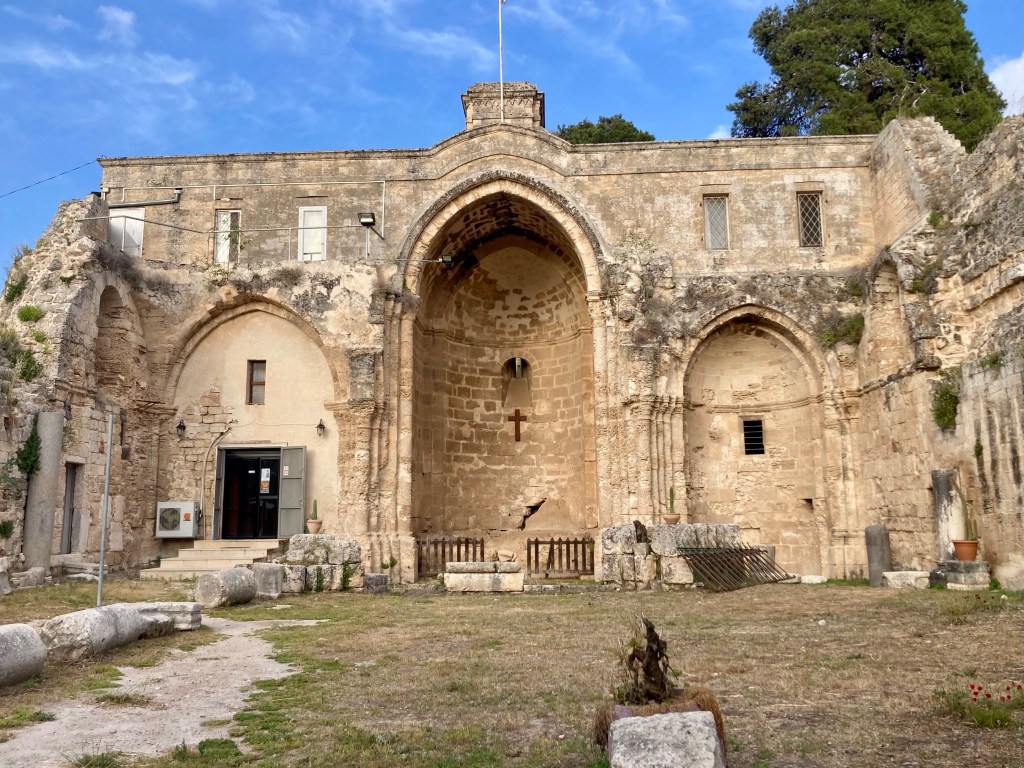
On the back side of the mountain ridge of Tsippori, on a small road that wound through a tiny Jewish village just outside the W fact that St. Joseph was from Nazareth and the Holy Family lived just a short walk away gave this place credence. The basilica was built on the foundation of the home of St. Anne, and was the largest church in that entire vicinity during that time. The dimensions of the church were unusually large, as typical Byzantine churches in the Galilee were quite small, so it must have held a special significance for the early Christians living there. It is exactly proportional in size and orientation to the grand Church of St. Anne in Jerusalem, also built in the 4th century, but intact and still in use today. At the basilica in Tsippori, the roof has long since collapsed, as well as the columns. The mosaic floor is barely visible. It is now mostly grass. Most of the church is now ‘outdoors.’ Behind the altar of the three-arched apse is the foundation of St Anne & St Joachim’s home. As the story goes, it was possibly the birthplace of Mary before they moved to Nazareth.
During the early-mid 1100s, the Crusaders took over St. Anne’s and rebuilt the surrounding walls. The Crusaders held the Holy Family and the Virgin Mary in very high esteem, so they would have revered Mary’s parents as well. They made additions to the Church with vaulted ceilings and more columns on the side apses. A monastery was added to the back, the monastery of Anna. Because this Crusader church was so close to the ‘Horns of Hattin,’ the great battlefield and final conquest of Saladin over the Christians in 1187, this was most likely where the knights would have celebrated their final Mass together. The large Crusader army met their defeat only three miles to the northeast. The church, and all else in the Levantine fell under control of the Ottomans.
The grand church eventually fell to ruins over the centuries. Then in the mid 1800s, the Franciscans, under the Custos of the Holy Land, bought the property (from Arab Bedouins) along with many other sites in Israel, and the remains of St. Anne Church came under their guardianship. Some minor repairs were done to the property in 1859, and a memorial plaque installed, but it was largely left uninhabited except for a few nuns who lived in the monastery for several years in the early 1900s. In 1973, the property was closed due to its dilapidated state and lack of resources. There were so many other holy sites in the Galilee that needed attention. When the new Custos, Pierbatista Pizzaballa (now Latin Patriarchate of the Holy Land), was put in charge of all the properties in 2006, he gave what was left of St. Anne to a newly formed order from Argentina. It was the Order of the Institute of the Word Incarnate (IVE), which “draws its spirituality on the Incarnation and the Consecration to the Blessed Virgin Mary.” It was through this Argentinian tie that Rosa found Fr. Jason and the basilica ruins.
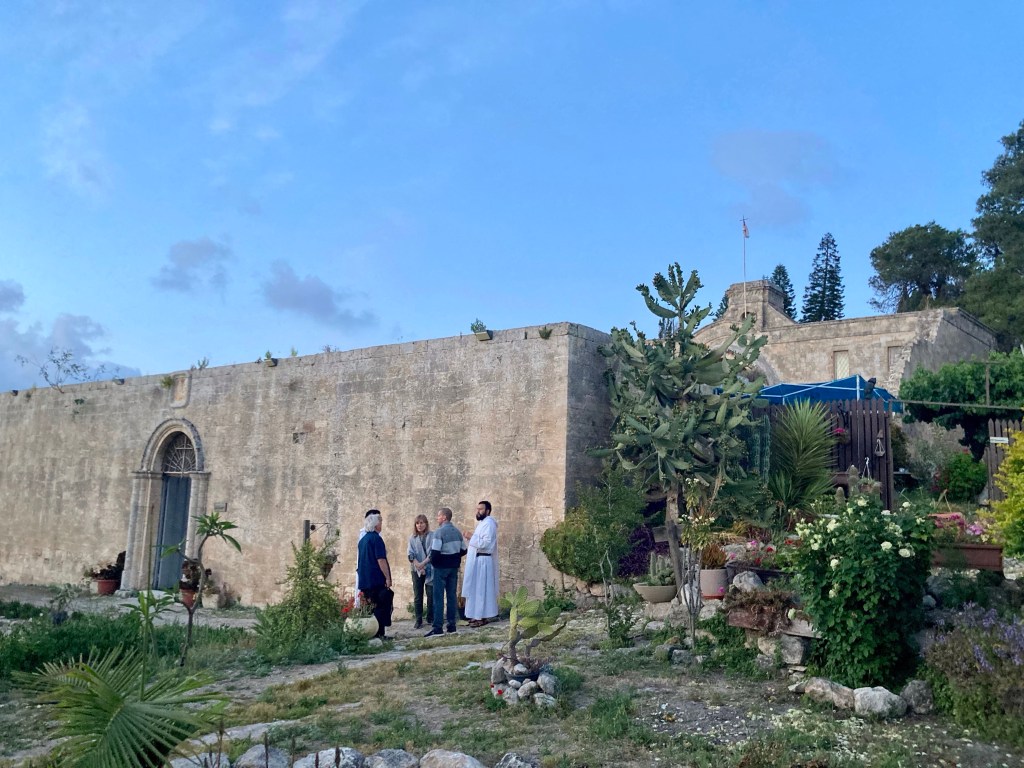
Outside the wallsA welcome from Fr JasonThe old basilica… reconstructed chapel at left apseThe foundations of the home of St Anne &Joaquin behind the altar gateByzantine sandstone. Crusader additions are the darker stonesOuter courtyard was one a huge church interior
Rosa had pre-arranged for me to do an interview, and we were warmly welcomed by Fr. Jason. Speaking in broken English and Hebrew with some Spanish thrown in and Rosa translating, Fr Jason told us of the priests’ personal history living in Israel at St. Anne. When the Institute of the Word Incarnate was granted custody of the property in 2006, the two priests and a seminarian who had traveled to Israel from Argentina found it in complete and utter disrepair. It was absolutely overgrown with weeds and downed tree limbs. The church was crumbling. Part of the old monastery in back of the church was in shambles. One large house in the back was now a Muslim orphanage.
The first stage of their mission was literally to rescue the church, to save it from total decay and to preserve what was left. That took the three men labored nonstop over ten years. The second stage was to prepare it for the arrival of pilgrims: to put in public bathrooms; to create places of quiet meditation with wayside shrines; to study the Hebrew language to communicate with the locals and to educate local tour guides about the place. They have just begun to advertise on social media that this holy site is again open and active. Today St. Anne is a working Latin Rite Catholic church. Masses are at 5pm in Spanish every Saturday. There is Eucharistic Adoration followed by a Rosary in Spanish every Thursday from 4-7 pm. A celebration is being planned for the feast of Sts. Anne & Joaquin on July 26. This last stage complete, it is now an official pilgrimage site.
Since the first days the priests arrived, they have worked hard to partially restore the property, clearing the basilica of old fallen stones; moving fallen columns, weeding and clearing the olive grove adjacent and making gardens. They put in electricity and water and built a little indoor chapel and rectory adjacent to the apse. The indoor chapel has been completely restored. It is tiny, holding only 20 people maximum, but it is beautiful inside. Bounded by high sandstone block walls with a vaulted ceiling reminiscent of the Crusader era, I immediately felt drawn back in time. The scent of incense hung heavy in the air, and the chapel was lit by the pink rays of the setting sun and candlelight. A large golden monstrance was placed front and center on the altar, and Diego, a young seminarian, knelt in silent worship. The most intriguing mosaic plaque, found in situ, hangs on one wall of the chapel and bears a Hebrew inscription. A remnant from the Byzantine era, it is only a fragment and missing tesserae. It was most likely a dedication plaque or a funerary marker from a burial site nearby.
During good weather, Masses are held outdoors in what was once the grand basilica. The old stone door which used to be the entrance to the basilica is now the outdoor altar. It is a most dramatic backdrop and scene for Church services. The priests are hopeful that they can garner enough interest to hold Classical music concerts here summer evenings. Until then people are encouraged to visit, to take in the holy silence, to stroll through the garden and olive grove and to attend Adoration.
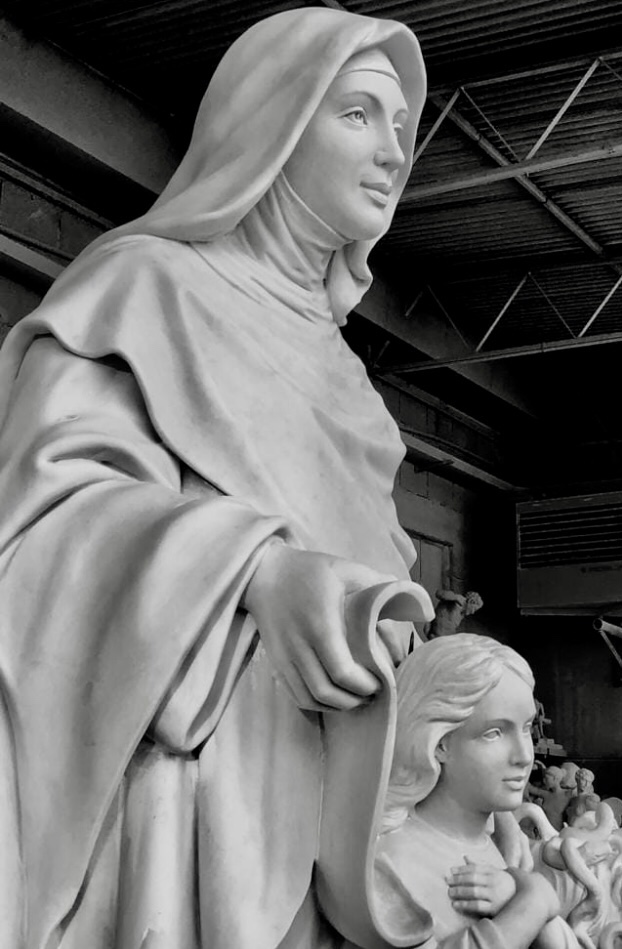
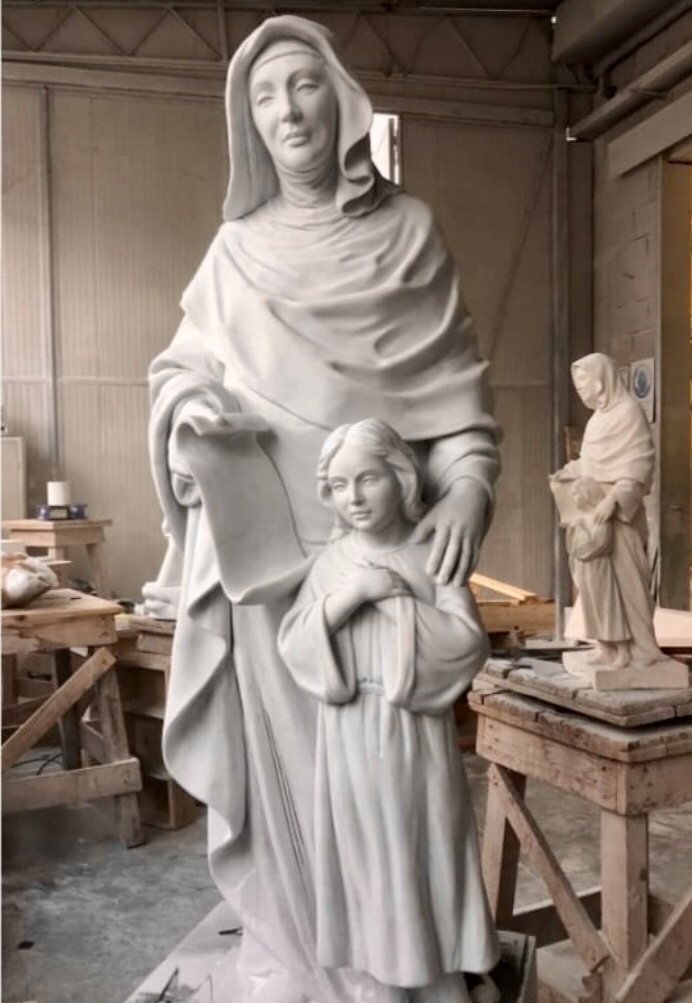
Recently, the priests received a gift from a gentleman in Italy of a beautiful Carrera marble statue of St. Anne & the young girl, Mary. It was delivered to the church last week and left in its crate near the outer wall. Funds are currently being raised to pay for a base for the statue and for a contractor to crane it into the church and to install it. These are photos Fr Jason sent of the life size statue when it was still in Italy:
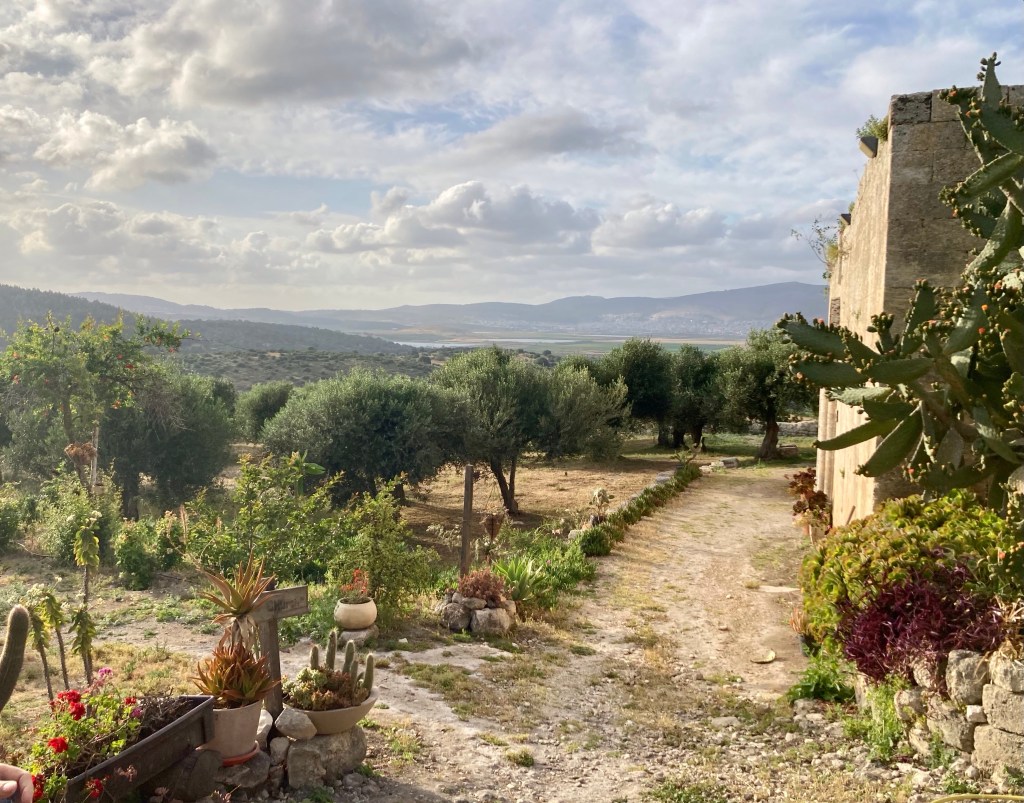
We walked with Fr. Jason and Br. Diego through the newly tended olive grove. They wanted us to look out at the majestic view of the Netofa Valley. Not 100 meters down the hill I spotted it: the blue dome of a building. Living in Israel, I have learned that this can only mean one thing: the tomb of a tzaddik, a great prophet, rabbi or holy person. Orthodox Jews go to the burial sites of the holy tzaddikim to light candles (yarzeit candles) and to pray. It is believed that the prayers made in the vicinity of a holy one and in the merit of that tzaddik, gives the prayers ‘wings,’ so to speak. I inquired from Fr Jason as to who that was, and was told, “It is the tomb of Yehuda haNassi.” I knew this could not be correct because one of the greatest rabbis of all time, Judah the Prince (Yehuda haNassi) was buried not far from there, in Beit Shearim. Yehuda haNassi lived in the 2nd century, CE, A grandson of the teacher, Gamaliel. Yehuda haNassi was also a great teacher and became head of the Sanhedrin (the Jewish Council of 70 elders) when it fled from Jerusalem to the Galilee after the Roman destruction of the Temple. Not only was he sought after for his wise judgements in legal matters within the remaining Jewish community in Israel, but he was also revered as an important sage in Rome. haNassi was most famous for editing and codifying (putting into writing) the Mishna, the books of Oral Law, the traditions and history of the Jewish people that had been handed down throughout the generations verbatim since the time of Moses. Besides the Tanach, (Jewish Scripture), the Oral Law is perhaps the most holy. Yehuda haNassi died in Sephoris in 217 CE. This was definitely not he.
So who was it in the mausoleum below? It had to be someone important from the looks of things. The tomb belonged to Yehuda haNassi’s grandson, Yehuda Nessia, an important man in his own right. He was the last head of the Sanhedrin, the last ‘Prince’ of a long line of rabbis.
After visiting St. Anne’s, we made a little visit to the tomb below before it grew too dark
The grandson, Yehuda was nothing like his grandfather in scholarship or behavior. The great Resh Lakish befriended him and over a period of years tried to inspire Yehuda. There is written history of a dialogue between Yehuda Nessia and Origen at Caesaria (if only I could have been there at that time to overhear!!!) Nessia is known for two religious ordinances: reforming divorce law and allowing the use of liturgical oil prepared by Christians to the Jewish specifications. He did, however, hold firm, and would not allow the use of bread prepared by Christians to be used by Jewish people in any way.
So here we found ourselves at yet another place of coexistence in the Holy Land. A ancient city, Sephoris, shared by Jews and Romans and by Jews and Christians. A Byzantine church next to the final resting place of the last rabbi in a long line of Sanhedrin. Their lives definitely mixed in the Galilee. A few friendships were formed. Heated discussions were a part of life here at times. There seemed to be a “live and let live” policy as long as laws, religious or political, were respected and not violated, the land could be shared. It is that way today in this region. A place Jews, Christians, Arabs and people from all nations call home.









 Israel Dreams